Vetting Hedge Fund Managers: Checking for Conflicts

A clean P&L says little about whether a quant manager’s incentives align with investors’ interests. Vetting a hedge fund manager can uncover conflicts that headline disclosures may not reveal by comparing statements with fund documents, ownership, compensation and professional history. This process can identify inconsistencies and material relationships, although no review can prove that every conflict has been disclosed.
That scrutiny matters because an investment decision involves more than market risk. Liquidity terms, valuation practices, leverage and how fees respond to gains and losses all shape what an investor is accepting. The point of manager vetting is to connect these details to the allocation decision.
A professional review brings these strands together before capital is committed. It examines conflicts, risk disclosures and background information in light of fiduciary responsibilities. The aim is to clarify where incentives may diverge, what remains difficult to assess and which issues merit attention before an allocation is approved.
Key Takeaways
- Compare a firm’s disclosures with its ownership and compensation arrangements to understand what may influence trading decisions.
- Consider a team’s employment history and technical background alongside the strategy it runs and the markets it trades.
- Understand how the firm’s risk limits relate to your strategy’s exposures and its ability to tolerate losses or delayed liquidity.
- Examine how the fund values hard-to-sell positions and manages operational risks before joining.
- Manager searches and SMA structures can show how a role’s mandate and account setup differ across firms.
Fraud, regulatory issues, conflicts of interest, and operational red flags
A systematic fund’s stated strategy can look sound on paper while its disclosures, controls and operating evidence tell a different story. I focus on the gaps that could affect reported performance, risk or the way the strategy is run.
Strategy and Operational Controls
Operational due diligence tests whether a hedge fund’s controls and practices support its stated strategy. A quant strategy can still be undermined by conflicts, weak oversight or unreliable operations.
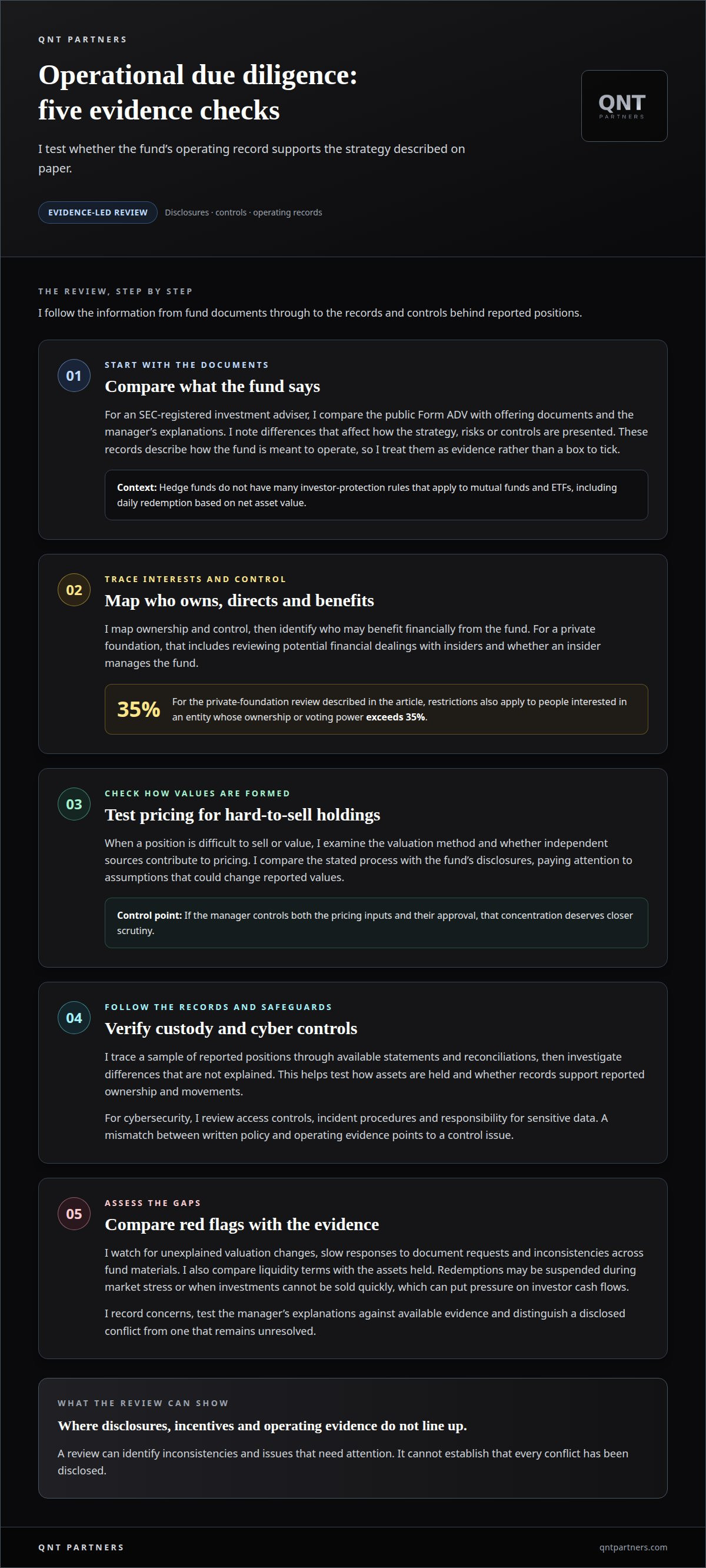
For an SEC-registered investment adviser, I compare its public Form ADV with offering documents and the manager’s explanations. Hedge funds are not subject to many investor-protection rules that apply to mutual funds and ETFs, including daily redemption based on net asset value and rules addressing conflicts, pricing fairness, disclosure and leverage limits. That makes the documents important evidence of how the fund is meant to operate, rather than a box-checking exercise.
I also map who owns, controls and benefits from the fund. For a private foundation, reviewers examine potential financial transactions with insiders and whether an insider manages the fund. Restrictions also apply to people with an interest in an entity whose ownership or voting power exceeds 35%. A relationship that looks remote on an organisation chart may still need closer analysis.
Valuation, Custody, and Cybersecurity Controls
These controls matter when reported portfolio values inform subscriptions, redemptions or investment decisions. For a systematic fund, I want the valuation and records process to be clear enough to test against the manager’s disclosures.
When holdings are difficult to sell or value, I examine the valuation method and whether independent sources contribute to pricing. I compare the stated process with the fund’s disclosures, focusing on assumptions that could affect reported values. If the manager controls both the inputs and approval, that concentration warrants scrutiny.
Custody review examines how assets are held and how records substantiate ownership and movements. I trace a sample of reported positions through available statements and reconciliations, then investigate unexplained differences. Cybersecurity review examines access controls, incident procedures and responsibility for protecting sensitive data. A gap between written policies and operating evidence is a specific control issue, not just a documentation problem.
Operational Red Flags
Operational red flags are inconsistencies or control gaps that weaken confidence in a manager’s disclosures. They can affect reporting, liquidity or the fund’s ability to operate as described.
I look for unexplained changes in valuation methods, delayed responses to document requests and conflicts between fund materials. I also compare liquidity terms with the underlying assets. Hedge funds may suspend redemptions during market distress or when investments cannot be liquidated quickly, creating cash-flow pressure for investors that rely on periodic distributions.
Fraud prohibitions and fiduciary duties apply to hedge fund managers. I record concerns, test explanations against available evidence and distinguish a disclosed conflict from an unresolved one. The key is whether the evidence supports the manager’s account of how the fund is controlled and run.
Role scope and team build-outs
A senior title tells me little about who owned the risk. When I assess a quant or HFT role, I want to know what the person built, which decisions they controlled and how their work reached live P&L. That distinction matters in a pod shop, where a researcher may support a PM, and in a prop shop, where researchers and traders can share responsibility for a book.
Role scope comes down to decision rights and production ownership. A “portfolio manager” title does not establish authority over capital allocation, drawdown limits or hiring. I look at whether the person set risk, owned a strategy’s live performance or contributed research under another PM. For an engineering hire, I want to understand whether they owned exchange connectivity, co-location or tick-to-trade latency work, rather than simply maintaining a wider platform.
Team build-outs reveal how a firm expects the work to happen. A new systematic team might need a PM with a track record, researchers who can take signals into production and engineers responsible for execution. Those are different mandates, even if the hires sit on the same desk. A researcher who built signals may be central to the strategy, but that alone does not establish responsibility for capital allocation or drawdown decisions.
- Map each role to its decision rights, production responsibilities and reporting line.
- Clarify whether the team is building a new book, supporting an existing PM or extending shared infrastructure.
- Check how the proposed remit fits the firm’s setup, including its risk ownership and execution stack.
Compensation structure can help clarify the remit. A P&L split, equity partnership or SMA arrangement carries different implications for risk ownership and how a team is funded. I would pin down what the split applies to, who pays for infrastructure and whether the person has authority over the capital allocated to the strategy. A headline percentage without those terms tells you little about the actual role.
For a spinout or new desk, the build plan matters as much as the initial hire. I want to know which capabilities must be in place before trading starts, and which can be added later. A team dependent on one engineer for exchange connectivity has a different execution risk from one with established shared infrastructure. The same goes for hiring constraints: garden leave and non-competes can affect when a PM or researcher can join and whether the proposed launch sequence is workable.
Fiduciary duties of care and prudence
A hedge fund manager’s fiduciary duty runs to the fund they manage. The endowment’s decision-makers have separate obligations to act with care and prudence. A review should distinguish these relationships before assessing whether the investment serves the institution’s purposes. The fund documents and mandate help define the manager’s responsibilities, while the endowment’s own investment record shows how its decision was reached.
For private foundations, prudence means assessing a proposed investment in context, not treating projected returns as a standalone case. Reviewers examine expected return alongside price-level risks and portfolio diversification. They also assess whether the hedge fund could jeopardise the foundation’s purposes. A strategy with attractive return potential may still be unsuitable if its drawdowns or liquidity terms conflict with the foundation’s obligations.
Document the reasoning behind the allocation. A clear record sets out the investment objective, the expected role in the portfolio and the risks considered. It should explain how the strategy complements existing holdings, rather than merely repeat the manager’s return target. If the allocation changes after a drawdown, record the new analysis and the evidence behind the decision.
Income requirements need explicit treatment. Private foundations may need to maintain a 5% annual spending rate, so reviewers assess how the investment fits expected distributions and available liquid assets. Hedge funds may limit redemptions or suspend them in certain circumstances. That creates a practical question for the foundation: can it meet planned payments without relying on a redemption that may be delayed?
Prudence also means examining how the manager’s mandate operates under stress. Reviewers compare the stated strategy with its risk limits, liquidity profile and potential effects on the endowment’s broader portfolio. For example, an investment concentrated in hard-to-sell positions may increase pressure on other assets when distributions fall due. The assessment should record that interaction, not just the hedge fund’s standalone risk.
Finally, keep oversight responsibilities distinct. The manager is accountable to the fund under its governing documents, while the endowment’s decision-makers remain responsible for their own investment judgement. A review can support that judgement by linking each material risk to the institution’s objectives and obligations. The resulting decision record should explain why the allocation was prudent when approved and what developments would warrant reassessment.
Where does a systematic fund’s research process become an execution risk?
I look closely at the hand-off from research to live trading. A strategy can be coherent on paper, but the people, systems and decisions behind it determine whether implementation follows the intended investment logic.
For a systematic fund, that means tracing how research becomes a live signal and how the signal affects portfolio construction. I want to understand model development, the rationale for material changes and how the team assesses performance after deployment. A strategy description alone cannot show whether live implementation matches the research.
The response to changing evidence matters too. Who can challenge an investment thesis? How are material strategy adjustments recorded, and does post-trade analysis inform later decisions? A change to a signal’s inputs should have a documented rationale that can be compared with subsequent portfolio behaviour.
- Trace research assumptions through model changes into portfolio decisions.
- Assess how investment decisions are challenged and documented.
- Examine whether capacity assumptions fit the strategy’s intended deployment.
Capacity deserves particular attention when a strategy depends on less liquid instruments or a narrow set of opportunities. Additional capital can change execution choices or reduce the opportunity set. The issue is whether the investment process remains consistent at the proposed scale, not simply whether the manager can accept an allocation.
Team dependence is a separate operating risk. I look at where strategy knowledge resides, how research findings are shared across the investment team and what happens if a key decision-maker leaves. For a fund built around a founder’s intuition, limited documentation can make continuity harder to assess than in a process with shared research and explicit decision records.
These details show where a strategy depends on individual judgement, model assumptions or capacity constraints. For a quant team, they also point to the roles and processes that need to hold together as the strategy develops. A clear record of research decisions and post-trade outcomes makes it easier to see whether the live process still reflects the original investment logic.
How do valuation, custody, and cybersecurity controls affect a systematic fund?
Valuation, custody and cybersecurity matter when they change the numbers a trading team acts on or the information investors see. I look at how an operational event could affect reported positions, investment exposure or the ability to respond quickly.
For valuation, the review follows material changes through to investor reporting and trading decisions. It checks who can approve an adjustment, how the change is explained and whether figures are used consistently across reports. A revised mark, for example, may change reported portfolio concentration or a manager’s performance. The important point is how the change flows through the process, not only how the valuation was calculated.
Custody assessment traces the link between fund ownership records and the information available to the trading team and investors. It identifies the legal entity holding the investment, the account structure and the reporting path from the fund to the investor. That makes clear where questions about an asset or transaction should go, and whether the records support the decisions people need to make.
- Trace how material valuation changes feed into investor reporting and trading decisions.
- Map the ownership and reporting chain for the fund’s investment.
- Assess how technology changes could affect portfolio data or trading decisions.
For cybersecurity, I focus on the integrity of the live investment process. The review examines how changes to models, market data inputs or trading logic are governed, recorded and reviewed. In a systematic fund, an undocumented change to a production signal could alter portfolio behaviour without showing up as a conventional security incident. The key check is whether the manager can detect and investigate differences between approved research and live implementation.
The assessment also considers whether the fund can explain a technology incident’s operational impact to investors. It looks at how information about affected systems, portfolio data or trading activity is assembled, and whether escalation routes connect technical staff with investment decision-makers. That link lets the team assess potential effects on the strategy rather than treating an incident as an isolated IT issue.
These controls shape the quality and timeliness of information available to investors and the trading team. They matter most when records or strategy behaviour change, because an unclear valuation, custody trail or incident response can obscure the source and scale of an exposure. Each finding should connect to a specific effect on portfolio information or trading decisions.
QNT Partners: Manager Search & SMA Sourcing
QNT Partners’ Manager Search & SMA Sourcing helps institutional investors identify managers and account structures aligned with a defined mandate. It is a natural next step when an endowment has clarified its objectives but needs to identify suitable investment talent or assess an SMA route.
The search starts with the investment problem, not a generic manager profile. An endowment may be seeking a systematic strategy, a particular market exposure or a manager experienced in running capital within a specific mandate. We translate that requirement into a focused search, sourcing managers whose experience and strategy are relevant to the brief.
An SMA can offer a different account structure from investing through a pooled fund. The mandate, portfolio parameters and reporting arrangements need to fit the endowment’s investment process. Our SMA and SVA partnerships insight explores how these structures can shape a manager relationship. The right structure depends on the investor’s requirements and the strategy being considered.
Manager search is particularly relevant when an investment committee is exploring a new allocation, replacing a mandate or considering a strategy that requires specialist expertise. A clear brief defines the role, investment approach and constraints. Useful inputs include the strategy sought, its intended role in the portfolio and any requirements for an SMA structure. These details give the search a practical frame.
Search and sourcing are distinct from the endowment’s investment approval process. A manager’s fit with the mandate does not by itself establish that the fund’s controls, disclosures or terms meet the institution’s requirements. The due diligence discussed above remains important to the committee’s decision. Search identifies relevant managers; the endowment then evaluates the investment against its own governance and portfolio needs.
We also recruit across Trading & Research, Technology & Engineering, and AI & ML. These capabilities are relevant when a manager’s strategy depends on specialised research or technical execution. For an endowment assessing a systematic manager, understanding the team’s research and engineering needs can sharpen the search brief without confusing recruitment with investment due diligence.
Frequently Asked Questions
Can manager vetting reveal conflicts of interest at a quant fund?
It can expose inconsistencies, but it cannot prove that every relationship has been disclosed. Manager vetting at a quant fund means comparing what the firm says about decision-making with the roles and incentives of the people running strategies. I pay particular attention to how PM autonomy, P&L attribution and capital allocation fit together. The useful outcome is a clearer view of where incentives might diverge, what evidence supports that concern, and what remains uncertain.
How does a quant firm’s structure affect the way its teams operate?
A pod shop, a prop shop and a multi-manager platform can offer very different working environments, even when the strategies sound similar. The structure shapes how capital is allocated, who owns risk decisions and how a team’s P&L is measured. In a pod, a PM may have a defined risk limit and a P&L split; at a prop shop, the economics may sit within a broader partnership. The details matter more than the label when assessing how a role will work in practice.
What should quant researchers understand about a strategy’s return drivers?
A strategy’s track record says little on its own about how it produces returns. The important question is whether the team can connect its research process to portfolio decisions and explain which market conditions could weaken the signal. That includes how a model is tested, how it moves into production and how the team responds when live results diverge from research expectations. I look for a coherent account of those mechanics, not a polished summary of historical performance.
How do team responsibilities and references differ across quant firms?
A reference is most useful when it speaks to the person’s actual remit, not just their general reputation. For a researcher, that might mean how closely their work was tied to live trading; for a low-latency engineer, whether they owned exchange connectivity or tick-to-trade latency. References can add context on how someone handled a difficult period or a team transition. They are useful inputs, not substitutes for understanding the work and the person’s stated responsibilities.
How do compliance and employment terms affect a quant move?
Registration and compliance disclosures can help clarify which adviser entity a person worked for and the nature of its business. For candidates, the practical constraints often sit alongside those documents: garden leave, non-competes and restrictions on taking code or data to a new firm. The effect depends on the individual’s role and the terms they signed. These details can shape the timing and scope of a move, especially when a team is building around existing research or infrastructure.
How should quant teams think about performance, risk and benchmarks?
Performance needs to be read against the mandate the team was actually running. A return series may not reflect the proposed strategy if capital, risk limits or execution conditions have changed. For a systematic team, changes in co-location, exchange connectivity or market access can also affect how research translates into live results. The relevant question is whether the reported performance tells you something about the strategy and operating setup being discussed, rather than simply whether the numbers look strong.
What red flags can emerge when assessing a quant team?
Watch for material claims that change between a presentation, a role description and follow-up conversations. That might concern who owns a model, who can change risk settings, or how P&L is attributed across a team. A reviewer can also assess whether people can explain who has authority to make material decisions and how those decisions are recorded. A vague or shifting account is a reason to seek clarity, not proof of misconduct. The distinction matters when evaluating a team’s operating model.