Ultra-low latency trading engineer recruitment for pay and skills

In ultra-low-latency trading, the title matters less than the systems you have shipped and the constraints you have handled. Any salary figure is a useful reference point, not a universal market rate.
That spread makes sense. Hiring teams value production experience with trading systems differently from general software engineering. The mix of C++, Java, Linux, networking and managed-runtime work depends on the architecture they need to build or support.
This article explains how compensation is shaped, which engineering experience firms prioritise, and how programming languages and managed runtimes affect a role. It focuses on practical differences between low-latency and high-frequency trading jobs, including why similar titles can call for very different technical profiles.
Key Takeaways
- Assess compensation by role scope and location, and separate base salary from any discretionary bonus when comparing offers.
- Match language experience to the system: some roles specify modern C++, while others call for high-performance Java.
- Show how your work affected production performance, including the constraints around operating systems, networking, and exchange connectivity.
- For senior network engineering roles, hands-on experience in mission-critical, low-latency environments can be a central requirement.
- Use education and certifications to support your technical record, while making shipped systems and relevant engineering experience clear.
Base salary and discretionary bonus
Listed US roles show why a single salary benchmark can mislead. The differences reflect distinct job scopes, not a universal premium for one city or title.
Network engineering provides another comparison. These are separate advertised roles, so compare the responsibilities attached to each figure.
Software titles need the same care. Language, seniority and remit all differ.
Read the role description before treating its salary range as a like-for-like comparison. A Linux systems position may focus on operating-system performance and production support. A C++ role may centre on the trading application itself. A principal network engineer may own connectivity across broader infrastructure. The title alone does not show which responsibilities drive the listed base salary.
Keep base salary separate from discretionary bonus when assessing total compensation. Some postings state a base range and mention bonus separately, as principal network engineer roles do. A bonus is not guaranteed salary. Ask how the firm assesses the role’s contribution, which performance measures apply, and when the bonus is determined. Those details matter when weighing a discretionary component.
Firm structure also affects how compensation is framed. A prop shop, a pod shop and a multi-manager platform can connect engineering work to trading outcomes differently. An engineer supporting exchange connectivity may sit close to a desk’s P&L, while a shared infrastructure team may serve several strategies. This can shape bonus discussions, but it does not establish a particular payout or split.
For an offer comparison, use this sequence:
- Separate fixed and variable pay. Record the annual base independently from any discretionary bonus.
- Match the scope. Compare systems engineering with systems engineering, and C++ development with C++ development.
- Inspect the remit. Establish whether the role owns exchange connectivity, Linux performance, trading software or shared infrastructure.
- Clarify bonus mechanics. Identify the stated assessment basis and timing before assigning value to the variable component.
For ultra-low latency trading engineer recruitment, assess base salary, bonus terms and production responsibility together. Then judge whether the package matches the system you will own.
Overlapping ranges do not make openings interchangeable. The senior title and role description still matter when assessing level and remit. A range shows the advertised span, not a promised offer at its upper end.
A shared location does not make roles directly comparable: one is a C++ low-latency position and the other is a Java role. Assess an offer by comparing specialty, seniority and duties, then consider any bonus separately from advertised annual pay. Clarify where the proposed base sits within its range and whether the bonus is discretionary.
Low-latency and high-frequency trading engineering
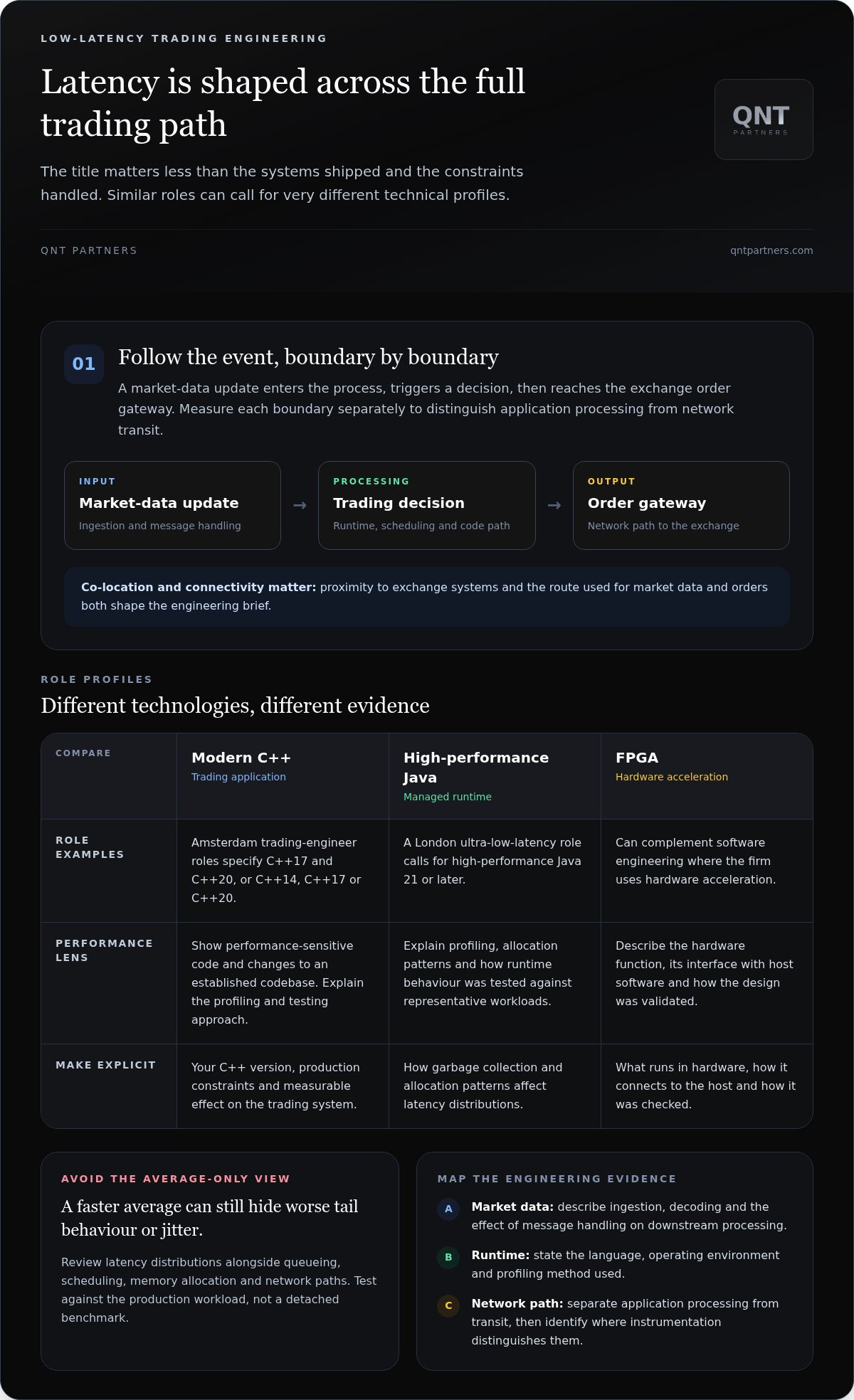
In a trading system, latency is a property of the full path, not one C++ function. A market-data update enters the process, triggers a decision and reaches the exchange order gateway. Engineers need to measure the work at each boundary separately.
That is why low-latency engineering differs from general application development. A change that improves average processing time can still worsen tail behaviour or create jitter. Engineers examine distributions, queueing, scheduling, memory allocation and network paths, then test against the actual production workload. A benchmark detached from the strategy’s flow is not enough.
High-frequency trading adds a specific operating context. A Sydney-based senior C++ engineering role describes real-time, performance-critical, low-latency, high-frequency and mission-critical systems. These terms point to systems that must process events reliably under demanding runtime conditions, not merely compile quickly or pass functional tests.
Co-location and exchange connectivity also shape the engineering brief. Co-location places trading infrastructure close to an exchange’s systems, while connectivity determines how market data and orders move between them. When assessing a tick-to-trade path, separate application processing from network transit, then identify where instrumentation can distinguish the two.
At the application layer, modern C++ remains central to some roles. An Amsterdam trading-engineer role involves modern C++, including C++17 and C++20. Another Amsterdam role requires experience with C++14, C++17 or C++20. Candidates should make their version-specific work clear, especially where a project involved performance-sensitive code or changes to an established codebase.
Java is part of the same hiring market, with different runtime questions. A London ultra-low-latency role calls for high-performance Java 21 or later. In a managed runtime, garbage collection and allocation patterns can affect latency distributions. A credible account explains how the engineer profiled the application, interpreted runtime behaviour and tested changes against representative workloads.
FPGA work can complement software engineering where a firm uses hardware acceleration. Relevant experience is more than naming an FPGA platform. Explain what function the hardware performs, how it interfaces with host software, and how the design was validated. If your experience is software-only, show how you measured and improved the surrounding system instead.
For a practical review of a role or candidate profile, map evidence to the system layers:
- Market data: Describe ingestion, decoding and the effect of message handling on downstream processing.
- Runtime: Explain the language, operating environment and profiling method used.
- Network path: State your responsibility for exchange connectivity or order routing.
- Production outcome: Give a concrete example of a measured change and its operational trade-off.
Work arrangements can be part of the technical brief. A Senior Linux Systems Engineer, Low Latency role in Chicago is 100% onsite and not open to remote work. That detail matters if the role depends on close interaction with production infrastructure or a trading desk. Confirm the working model early, alongside the system ownership and engineering remit.
Strong ultra-low latency trading engineer recruitment starts with the actual architecture. A title such as “low-latency engineer” may describe C++ application work, Java runtime tuning, Linux systems engineering or network infrastructure. A precise brief names the system layer, production constraints and evidence expected from candidates.
What skills and experience do trading firms require for low-latency engineering roles?
Trading firms assess evidence against the system they need built or maintained. A principal network engineer role in Chicago or New York requires 10+ years of hands-on network engineering experience in mission-critical, low-latency environments. That requirement signals a need for production judgement, not familiarity with networking concepts alone.
For network-focused candidates, explain the systems you have operated and the decisions you owned. Describe how you handled packet loss, congestion, route changes or capacity planning in a live environment. Hiring teams need to understand your role in the outcome, especially when exchange connectivity affected the trading stack.
Software engineers should make their language experience precise. An Amsterdam low-latency trading engineer role requires modern C++ experience, including C++14, C++17 or C++20. State which versions you used, what the code did, and how you handled performance-sensitive changes within an existing system.
Specific examples carry more weight than a list of tools. Explain how you traced a latency regression from an application change to a particular processing stage. Include the measurement method, the bottleneck you identified and the trade-off you made. Avoid claiming a performance improvement unless you can explain how you measured it.
Linux experience should reflect real operational responsibility. Describe how you diagnosed scheduling behaviour, investigated resource contention or maintained services under production load. If you supported a trading desk as a systems engineer, distinguish routine administration from work requiring close coordination with developers and infrastructure teams.
Concurrency knowledge matters when multiple threads, queues or processes interact. Explain how you reasoned about synchronisation, contention and data ownership in a specific codebase. For a C++ example, describe the design choice and its effect on system behaviour, rather than making a generic claim about “optimised code”.
Firms also look for engineers who can work across system boundaries. A market-data change may affect decoding, application logic and order handling. A network change may alter the conditions for software testing. Describe how you worked with adjacent teams and isolated the source of an issue.
Use a concise evidence structure when presenting experience:
- System: Name the component, such as a feed handler, order gateway or Linux service.
- Ownership: Separate your implementation work from the wider team’s contribution.
- Constraint: Explain the production condition that shaped the design or investigation.
- Result: State the observed outcome and how you measured it.
Do not assume every low-latency role is a C++ application job. One brief may prioritise modern C++, while another requires deep network engineering in a mission-critical environment. Compare the job’s core system with your strongest production evidence, then make the match clear in your CV and technical interviews.
For ultra-low latency trading engineer recruitment, a useful candidate profile links each claimed skill to a shipped system, a defined responsibility and a clear engineering decision. This gives interviewers a practical basis for probing your judgement instead of relying on keyword matches.
What education and certifications help qualify for low-latency trading engineering jobs?
A computer science or computer engineering degree can establish foundations in operating systems, networks and algorithms. For a low-latency role, the useful question is how that foundation appears in your work. A candidate who studied concurrency and later built a C++ market-data service can connect formal study to production engineering.
Other degrees can support a strong case, too. Electrical engineering may include digital systems and hardware design, while mathematics can develop analytical foundations. Neither degree title proves trading-system experience. Use a project, internship or production example to show how you applied that knowledge to software, networks or hardware.
Coursework matters when it maps directly to the job. An operating-systems module is relevant if you can discuss scheduling, memory or process behaviour in Linux. A computer networks project carries more weight when you can explain packet handling, routing or failure diagnosis. Name the topic, then connect it to a specific engineering decision.
Certifications are most useful when they support a defined part of the role. A networking certification may help frame evidence for infrastructure work, while a Linux credential can provide context for systems administration experience. Neither replaces hands-on work in a production environment. Explain what you learned and where you applied it.
For an engineering hiring team, a certificate’s relevance depends on the job’s technical remit. A principal network engineer role may prioritise extensive hands-on network engineering in mission-critical, low-latency environments. A software role may instead focus on C++ design and performance debugging. Choose credentials that reinforce your target role rather than collecting unrelated badges.
Practical projects can make education more legible. For example, describe a Linux service you profiled, the bottleneck you found, and how you tested a change. If the work used C++17 or C++20, name the version and explain the relevant implementation choices. Keep proprietary code private, but make your own contribution clear.
When presenting qualifications, organise the evidence around the role:
- Education: Name the degree and relevant subjects, such as operating systems or computer networks.
- Certification: State the credential and connect it to a specific responsibility, such as network operations.
- Applied work: Give an example linking coursework or training to a shipped system.
- Technical depth: Explain your decisions, tools and validation method without exposing confidential details.
For candidates without a directly related degree, a documented technical record can demonstrate the same foundations. A code sample, systems project or clear account of production ownership gives interviewers concrete evidence to explore. Focus on your decisions, not a list of technologies.
For ultra-low latency trading engineer recruitment, qualifications help most when they support evidence of relevant engineering judgement. Place the degree or certification beside the system where you applied its knowledge. This makes it easier to assess how your background fits the role’s technical demands.
QNT Partners: Quant Trading & Research Recruitment
QNT Partners can help sharpen a low-latency engineering search by defining the role and its technical remit. Our Technology & Engineering service places low-latency C++ and Rust engineers, as well as Python quant developers. We connect the hiring brief to the system being built, whether the need centres on C++, Linux systems or exchange connectivity.
For candidates, the same distinctions help present relevant experience: the production systems owned, engineering decisions made and constraints managed. For firms building a team or replacing a critical hire, QNT Partners focuses on the fit between those requirements and a candidate’s record. Our Trading & Research service is relevant when engineering hiring is part of a wider quantitative team build-out.
To discuss a specific search or engineering role, visit QNT Partners.
Define the brief before the search
The next step is to turn a technical need into a hiring brief that engineers and trading leads can assess consistently. Specify the system boundary, team ownership and production problems the hire must address. This gives interviews a clearer basis than a list of languages or job titles.
Candidates can make their evidence equally direct. Describe the systems you have worked on, your contribution and the engineering decisions you can discuss without exposing confidential details. A precise account distinguishes relevant production experience from adjacent technical work.
QNT Partners offers Quant Trading & Research Recruitment, Technology & Engineering Recruitment, and AI & ML Specialist Search. If you are building a team or considering your next role, a focused conversation can establish where the technical requirements and your experience align. Contact QNT Partners about recruitment, and take the next step with a clear brief.
Frequently Asked Questions
What does an ultra-low latency trading engineer do?
An ultra-low-latency trading engineer builds and maintains software or infrastructure that supports fast electronic trading. The role may centre on a feed handler, order gateway, network path or Linux systems. For example, an engineer investigating delayed order acknowledgements would trace the relevant system boundary, examine its measurements and isolate whether application processing or connectivity contributes to the delay.
Which programming languages and technologies are most in demand for ultra-low latency trading engineers?
Current role examples call for modern C++ and high-performance Java, with requirements varying by system layer. Some briefs specify C++14, C++17 or C++20; a London role calls for Java 21 or later. Rust also appears in low-latency engineering recruitment. Linux and exchange connectivity matter for systems-focused positions, while FPGA experience applies where hardware acceleration forms part of the role.
What are typical salaries and bonuses for ultra-low latency trading engineers in the United States?
Pay depends on role, seniority, location and technical remit. Some US job postings state a bonus separately from base salary. Treat that discretionary component as variable, and compare its terms separately rather than adding it to fixed pay as guaranteed compensation.
How can candidates find and apply for ultra-low latency trading engineer jobs?
Compare openings by system layer, language, production constraints and work arrangement. In applications, identify the systems you shipped, your specific responsibilities and measured performance outcomes.
What are the work hours, pressures, and risks of ultra-low latency trading engineering roles?
These roles can involve demanding production conditions where reliability, latency distributions and jitter matter. A change that improves average processing time may worsen tail behaviour. Work hours are not established here.