SMA Fundraising: Compare Available Strategies and Manager Factsheets

SMA mandates can differ on capacity, customisation and operating requirements, so a factsheet needs to show where the strategy fits. A polished factsheet alone cannot resolve a mismatch between a strategy’s capacity, its SMA structure and an investor’s mandate.
For managers preparing to raise capital, availability must be clear and the supporting material must explain the strategy without obscuring how it is run. Allocators may value SMA customisation, but every mandate still brings operational and portfolio requirements that shape the fit.
This article explains how strategy availability, manager factsheets and profiles support that assessment. It also considers what allocators may need from a quantitative manager, how to present the strategy’s operating requirements, and where specialist SMA sourcing and capital-raising support can fit into the process.
Key Takeaways
- Allocators may value customisation in quantitative SMAs, but mandate fit also depends on how the strategy can be implemented and supported operationally.
- There is no single AUM threshold that suits every strategy. The relevant level depends on the strategy’s financial and operational requirements.
- SMA fee terms depend on the mandate structure and its economics; compare them with pooled-fund arrangements by looking at what each structure provides.
- Clear factsheets and manager profiles help platforms and investment consultants assess a strategy’s process, capacity and fit with investor requirements.
- Specialist SMA sourcing can help managers identify relevant routes to market, while QNT Partners supports manager search and capital raising via SMAs.
Who invests in separately managed accounts for quantitative strategies?
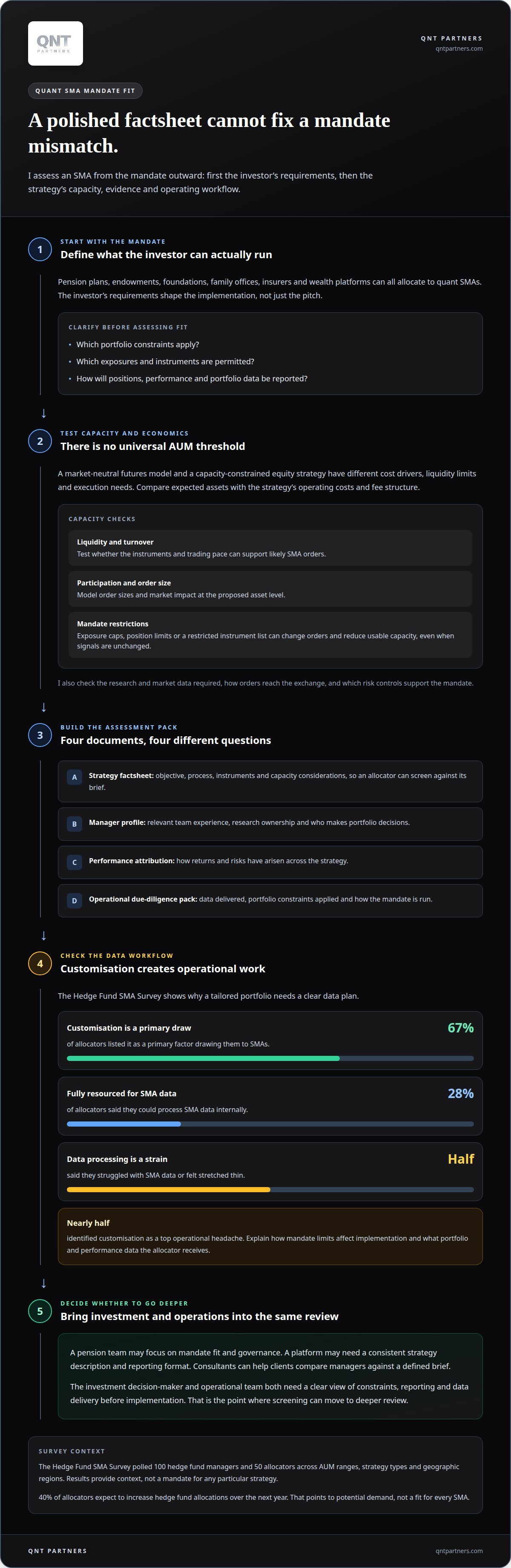
Pension plans, endowments, foundations, family offices, insurers and wealth platforms can all allocate to quant SMAs. The implementation terms matter as much as the strategy: investors need to know which portfolio constraints apply, how positions and performance are reported, and which exposures the mandate permits. In a Hedge Fund SMA Survey, 67% of allocators listed customisation as a primary factor drawing them to SMAs. For a quant manager, that can mean configuring portfolio limits to fit an investor’s mandate.
Data operations can determine whether an SMA is workable. In the same survey, 28% of allocators said they were fully resourced to process SMA data internally. Half said they struggled with the data or felt stretched thin. Nearly half identified customisation as a top operational headache. Investor materials should spell out how mandate constraints affect implementation and what portfolio and performance data the allocator receives.
Some investors assess strategies directly; others access them through wealth platforms or investment consultants. Each route has different implementation questions. A pension team may focus on mandate fit and governance, while a platform may need a consistent strategy description and reporting format. Consultants can help clients compare managers against a defined brief. Meanwhile, 40% of allocators expect to increase hedge fund allocations over the next year. That points to potential demand, not a mandate for any particular strategy.
Four materials help allocators assess an SMA:
- Strategy factsheet: Sets out the objective, process, instruments and capacity considerations, so an allocator can screen the strategy against its brief.
- Manager profile: Identifies the team’s relevant experience, who owns the research, and who makes portfolio decisions.
- Performance attribution: Shows how returns and risks have arisen across the strategy, supporting a closer review of its exposures.
- Operational due-diligence pack: Explains the data delivered to the allocator, the portfolio constraints applied, and how the mandate is run.
These documents answer different questions. The factsheet shows whether the strategy may fit; the manager profile explains how the research and investment decisions are organised. Attribution gives the allocator material for investment review. Operational details help identify requirements before implementation. For example, a platform assessing a market-neutral futures strategy may need to understand the instruments traded and the data workflow before deciding whether the mandate fits its setup.
SMA fundraising involves both the investment decision-maker and the operational team supporting that decision. The factsheet and manager profile should make the strategy and decision process clear. Supporting materials should explain how constraints, reporting and data delivery would work under a tailored mandate. That gives the allocator a basis to decide whether to move from screening to deeper review.
The Hedge Fund SMA Survey polled 100 hedge fund managers across AUM ranges, strategy types, and geographic regions, and 50 allocators across AUM ranges, strategy types, and geographic regions. The results provide context for how managers and investors approach SMA fundraising, but each allocator still assesses a mandate against its own requirements. Asset management systems can assign responsibility for fundraising pipeline tasks and fund-by-fund marketing initiatives. Clear ownership helps teams coordinate investor materials and follow-up across the pipeline.
For strategies with international holdings, tax characteristics may also enter an allocator’s review. Countries without US tax treaties account for about 3% of non-US developed markets. A developed-market strategy can have over 90% of its dividend income qualified, while an emerging-markets strategy can have over 50% of its dividend income qualified. Allocators may therefore ask managers to describe market exposure and relevant income characteristics during due diligence.
AUM Needed by Quant Managers to Attract SMA Investors
SMA investors want to know whether the proposed capital can trade within the strategy’s capacity and cover its operating costs. There is no universal AUM threshold. A market-neutral futures model and a capacity-constrained equity strategy have different cost drivers, liquidity limits and execution needs.
I start with the strategy’s operating setup: the research and market data it needs, how orders reach the exchange, and the risk controls required to manage the mandate. Then I compare those costs with expected assets and the fee structure. A systematic equity strategy with broad data coverage and higher turnover may need a different budget from a futures strategy trading a narrower set of instruments.
Capacity depends on liquidity, turnover, participation limits and market impact at the order sizes the SMA is likely to generate. The allocator’s restrictions matter too. Exposure caps, position limits or a restricted instrument list can change the portfolio’s orders and reduce usable capacity, even when the signals are unchanged.
These are the operating checks I would expect to see behind an AUM recommendation:
- Capacity model: Tests assets against instrument liquidity, turnover, participation rates and expected order sizes.
- Portfolio simulator: Shows how mandate limits, including exposure caps, change positions and portfolio behaviour.
- Execution-cost model: Estimates costs for the strategy’s order sizes and execution approach, including the effect of market impact.
- Operating budget: Sets out the required data, technology and staffing costs against the mandate’s expected economics.
The assumptions need to line up across the models. If the capacity analysis shows market impact rising as order sizes increase, the execution-cost estimate should include that increase. The budget should then show whether the expected mandate size can support the research and trading setup needed to run the strategy.
Firm AUM is not the same as capacity in the strategy being offered. A manager may run substantial assets in other strategies, while a new quantitative mandate has limited live history or needs separate data and execution infrastructure. A smaller firm can still make a credible SMA case if its capacity assumptions, controls and implementation plan fit the proposed mandate.
I would present recommended AUM as the result of these operating mechanics, not as a standalone threshold. Show how much capital the strategy can trade, what that capital costs to manage and how the allocator’s restrictions affect implementation. Those details let an investor judge whether the mandate is workable at the proposed scale.
What are typical SMA fees for quantitative investment managers?
No single fee schedule suits every quantitative SMA. The mandate, strategy, operating model and investor requirements shape the economics. A systematic futures account, for example, may have different execution and data needs from a market-neutral equity mandate. Those differences matter when defining what the manager’s fee covers.
Discussions commonly begin with a management fee, a performance-based fee, or a combination. The management fee can support ongoing investment and operational resources. A performance fee links some compensation to investment results. Each term needs a precise calculation method, particularly when the account has its own capital flows and restrictions.
Performance-fee terms should specify the calculation basis. A high-water mark can prevent charging again while recovering prior losses. A hurdle rate, if agreed, sets a return threshold before performance fees accrue. The agreement should also clarify crystallisation timing and how withdrawals are treated. These terms affect the economics even when the headline rate is unchanged.
Keep manager compensation separate from account expenses. Depending on the mandate, costs may include data, execution, financing, custody or platform services. The documents should explain which costs the account bears and how they are calculated. For example, a strategy trading several futures markets may incur different execution costs from one trading cash equities.
Several tools help analyse the proposed terms:
- Fee waterfall model: Shows how management and performance fees apply across account returns and capital changes.
- Scenario analysis: Compares fee outcomes under gains, losses and recovery periods.
- Expense allocation schedule: Separates manager compensation from account-level operating costs.
- Mandate term sheet: Records the agreed calculation basis, crystallisation terms and investor-specific provisions.
Scenario analysis can show how a withdrawal affects the fee calculation under the proposed account terms. The manager and allocator can then assess whether the treatment matches the mandate’s intended economics.
Compare proposals beyond their headline percentages. Check the calculation base, performance period, treatment of losses, expense allocation and any account-specific provisions. A lower management fee may leave operating costs elsewhere; a performance fee may depend heavily on its measurement rules. A clear term sheet lets both sides assess the same economics before implementation.
For quantitative managers, pricing should reflect the work of running the mandate. Research support, data requirements and trading implementation all affect the operating case. The useful comparison is not a market-wide “typical” number, but the full fee and expense structure against the SMA’s specific scope.
How do SMA fees and economics compare with hedge funds and pooled funds
An SMA puts one investor’s assets in a separate account, so fees and expenses can be calculated against that account’s capital and trading. A pooled vehicle applies its terms and portfolio to investors sharing the same fund. For a quant strategy, that distinction affects how account-level costs and performance fees are allocated.
In an SMA, the manager negotiates fees against the account’s mandate. The investor can review its holdings and account-level expenses, while the manager needs enough revenue to cover the research, data and operating resources used to run it. Any account-specific reporting or trading treatment adds to the work the fee must support.
A hedge fund pools capital under one investment structure. Trading and operating resources are shared through the vehicle, and investors pay fees under its terms rather than negotiating each portfolio constraint individually. This can make fee calculations and cost allocation more standardised, but leaves less room for account-level customisation.
Other pooled funds also combine investor capital, though their objectives and operating structures vary. A standardised pooled strategy may suit investors seeking exposure without a separate mandate. An allocator choosing a common systematic equity fund, for example, accepts its portfolio approach rather than requesting account-specific exclusions.
Compare the structures using the same return assumptions and show how each calculates fees and assigns costs:
- Fee comparison model: Applies each structure’s management and performance-fee terms to the same return assumptions.
- Expense allocation schedule: Identifies which costs are charged to the SMA account, pooled vehicle or manager.
- Cash-flow model: Tests how subscriptions and withdrawals change account-level fee calculations.
- Mandate comparison matrix: Records differences in portfolio restrictions, customisation and reporting.
Use the same return path to compare investor outcomes. An SMA and a pooled fund can produce the same gross return but different net returns after account expenses and fee calculations. Show gross performance, fees and expenses separately, so the investor can see what drives the difference.
Scale changes the manager’s economics. An SMA may require account-specific reporting or trading treatment, adding operating work that the manager must fund. A pooled vehicle can spread shared resources across investors, but may not meet every allocator’s restrictions. The test is whether revenue from the account or vehicle covers the work required to deliver it.
For a quantitative strategy, headline fees do not show the full cost of implementation. Tailored exposure limits in an SMA may affect portfolio construction or execution; a pooled vehicle may keep one process across investors. Compare the investor’s net outcome with the costs attached to the structure and the operating work it requires from the manager.
The Hedgeweek survey found 44% of hedge funds grew their SMA book over the past two years. In the Hedge Fund SMA Survey, half of respondents said they struggled to process SMA data or felt stretched thin.
How can professional SMA sourcing help quant managers identify platforms and investment consultants?
Platform access depends on strategy fit, not a contact list alone. I see systematic futures managers looking for platforms with futures infrastructure, while market-neutral equity managers need a route that supports their instruments and reporting. Specialist sourcing maps those requirements to potential distribution channels before introductions begin.
The useful starting point is the target mandate. Asset class, liquidity profile, capacity, dealing terms and portfolio constraints all shape the fit. A consultant advising a pension plan may assess different features from a wealth platform building model portfolios. Precise criteria help separate a plausible route from a name that only seems relevant.
Decision-making is rarely held by one person. A platform’s investment team may assess strategy fit, while its operational group reviews data and implementation. At an investment consultant, research analysts may screen managers before recommending further diligence. Mapping those roles helps get the factsheet and manager profile to the right audience.
Useful tools support each stage:
- Mandate matrix: Matches a quant strategy’s features to platform or consultant requirements.
- Relationship map: Records decision-makers, research contacts and operational stakeholders.
- Pipeline tracker: Organises introductions, follow-ups and each allocator’s review stage.
- Manager factsheet: Gives investment teams a concise account of process, instruments and capacity.
A pipeline tracker tells a more useful story when it records the reason for each interaction. A platform may defer review until its futures reporting process is ready. That is different from an investment committee declining a strategy because its mandate excludes a particular exposure. The distinction informs follow-up and keeps the pipeline meaningful.
Engagement also tends to follow a sequence. An investment consultant may need a clear strategy summary before considering deeper review. A platform may first need to understand account setup and reporting. Matching information to the stage avoids sending technical material before the recipient can assess basic fit.
Partnership structure can affect the route to market, too. An SMA-SVA arrangement, for example, can involve distinct responsibilities between parties. Clear role definition helps managers explain how portfolio management and implementation fit together. A useful SMA-SVA partnership framework can make those responsibilities easier to discuss.
Effective sourcing creates a qualified route, not simply more meetings. It connects a strategy with allocator requirements and decision-makers, then gives each audience relevant material. The next step in SMA fundraising is more deliberate when the conversation is grounded in mandate fit and implementation, rather than a generic pitch.
QNT Partners: Quant Trading & Research Recruitment
An SMA strategy needs the right route to investors and the team to deliver it. QNT Partners supports managers through Manager Search & SMA Sourcing and Quant Trading & Research Recruitment. These services are relevant when a firm is preparing a new mandate, building a systematic team or assessing where a strategy fits.
For sourcing, begin with the strategy’s actual profile. A futures model, a market-neutral equities process and a low-turnover signal each call for different investor conversations. We use details such as instruments, capacity assumptions, portfolio restrictions and operational needs to focus the search on relevant platforms and investment consultants.
Sourcing can be paired with manager search. A fund launching an SMA may need a portfolio manager responsible for the live process, or a researcher to extend its signal work. We assess roles against the strategy’s research and trading requirements, rather than treating quantitative experience as interchangeable. A build-out may also call for technology expertise when execution systems or market connectivity are central.
QNT Partners’ relevant work includes:
- Manager Search & SMA Sourcing: Connects strategy development and investor access with the manager profile and relevant routes to market.
- Quant Trading & Research Recruitment: Supports searches for the investment talent responsible for signals, portfolio decisions and trading.
- Technology & Engineering Recruitment: Addresses technical hiring tied to execution, data infrastructure or exchange connectivity.
- AI & ML Specialist Search: Focuses on specialist roles where machine-learning research forms part of the investment process.
When forming a team around an SMA opportunity, define immediate responsibilities separately from later build-out needs. For example, a new systematic strategy may need a portfolio manager to own portfolio decisions before adding research or engineering support. Clear sequencing keeps hiring aligned with the strategy’s operating plan.
QNT Partners’ work can include defining the investor route, shaping a key hire or planning a strategy build-out. These decisions are connected: the mandate affects team requirements, and the team’s capabilities inform how the strategy is presented. The firm brings Manager Search & SMA Sourcing together with quantitative trading recruitment when that combination fits the task.
QNT Partners works on manager searches, SMA sourcing requirements and quant team build-outs.
Frequently Asked Questions
What does SMA fundraising mean for quantitative investment managers?
SMA fundraising for quantitative investment managers means securing investor capital for a strategy run in a separately managed account. The manager implements the agreed mandate for that investor rather than allocating assets through a pooled vehicle. For example, a pension investor may set portfolio constraints that differ from a manager’s other mandates. The raise involves matching strategy, account setup and investor requirements, then progressing through diligence and implementation.
How does a specialist help quantitative investment managers raise capital for an SMA?
A specialist can map a manager’s strategy to relevant platforms and investment consultants, then support manager search and SMA sourcing. In the industry, capital raising via SMAs can be supported separately from recruitment, which may address a team gap tied to a mandate. A recruitment intermediary does not determine candidate suitability; the hiring organisation does. Candidate data may be retained for up to two years from last contact, and client and commercial data for seven years. Individuals have rights under UK GDPR.