SMA Capital Introduction for Hedge Fund Managers: How It Works

An SMA mandate can change how a manager trades before the first dollar is allocated, because the account runs under restrictions agreed with the allocator. SMA capital introduction connects that structure with allocators whose requirements fit the strategy. The trade-off is clear: a separate route to capital brings more account-specific oversight.
That operational burden is easy to underestimate. Bespoke restrictions can affect trading, allocation and reporting, while the investor relationship becomes more direct. Raising capital through SMAs makes sense only when the mandate fits the strategy and the manager’s operating model.
The key question is how an SMA changes the working relationship. This article explains how an SMA is structured, how capital introduction supports manager-allocator conversations, and what changes in portfolio oversight and reporting. It also covers when SMAs can support a manager’s capital strategy and when their operational demands may outweigh the benefits.
Key Takeaways
- Understand how an SMA separates investor assets from a commingled fund while giving the manager a defined trading mandate.
- Assess how account-specific restrictions and reporting needs affect the strategy’s trading and operating model.
- Consider whether operational support can handle the additional oversight and account-level workflows an SMA programme requires.
- Make allocator discussions specific to the mandate, the manager’s approach and the information investors need to assess the relationship.
- Weigh the potential capital-raising advantages against the practical demands SMAs place on strategy execution.
What is a separately managed account?
A separately managed account gives an investor a dedicated portfolio managed under an agreed mandate. Unlike a commingled hedge fund, the account keeps its assets and trading activity distinct. The manager follows the investment objectives and account-specific restrictions, then reports on that portfolio. For example, an allocator can set exposure limits that differ from those in the manager’s pooled fund.
For an emerging manager, an SMA can provide access to institutional capital without first launching a commingled vehicle. An allocator can appoint the manager to run a defined strategy while retaining account-level oversight. A platform may also provide execution and reporting, alongside portfolio monitoring, reducing the need for a new firm to build every function internally. It does not remove the manager’s responsibility for sound investment decisions and controls.
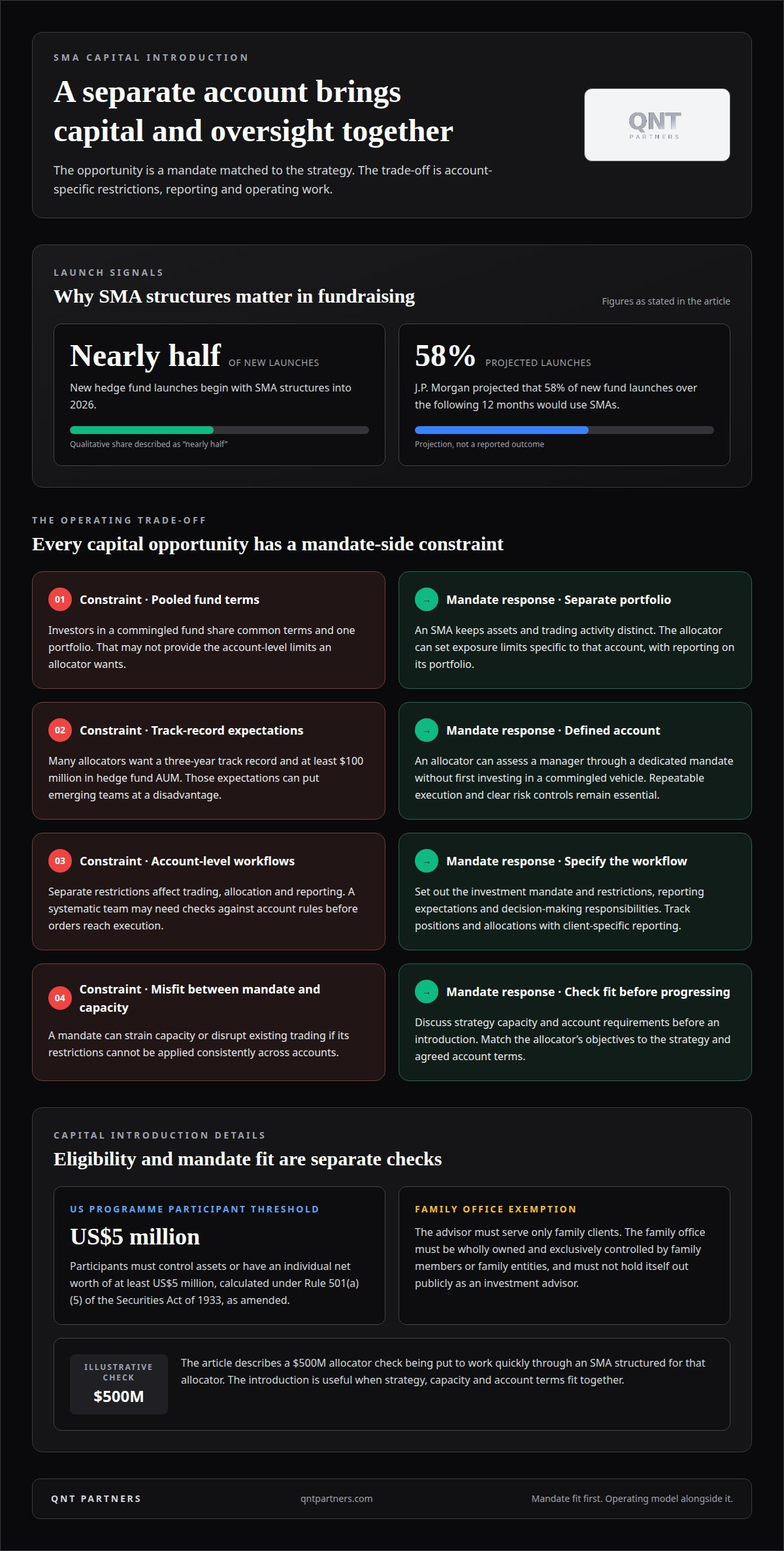
Investor requirements remain demanding. Many allocators want a three-year track record and at least $100 million in assets under management from a hedge fund. Those expectations can put emerging teams at a disadvantage, especially when their strategy has limited live history. An SMA mandate may give an allocator a way to assess a manager through a defined account. It still requires repeatable execution and clear risk controls, backed by reliable reporting.
There is no single typical minimum investment or fee for a hedge fund SMA. The minimum and agreed economics depend on the mandate, the strategy’s capacity and the investor’s requirements. A concentrated equity strategy may need different account terms from a market-making strategy with substantial infrastructure needs. The account agreement sets the relevant commercial terms, so a generic figure would not describe every structure.
Readiness depends on whether the manager can run a separate portfolio without disrupting existing trading. A systematic team, for example, needs processes that distinguish account restrictions from shared strategy signals. It must also track positions and allocations, with accurate client-specific reporting. Emerging hedge funds can struggle when a lean team takes on these tasks alongside research and execution. Before accepting a mandate, managers need a clear operating model for restrictions and reporting, with oversight that maintains consistent treatment across accounts.
Capital raising through separately managed accounts (SMAs)
SMA capital introduction for hedge fund managers connects a defined strategy with allocators whose mandates fit. The process works best when capital and strategy capacity align with the account terms.
Allocator Demand for SMAs
Separately managed accounts give allocators a dedicated portfolio instead of a pooled interest in a fund. Nearly half of new hedge fund launches begin with SMA structures into 2026. JP Morgan projected that 58% of new fund launches over the following 12 months would use SMAs. For an emerging manager, this demand creates another route to present a specific strategy to institutional investors.
Marketing and Capital Introduction Rules
US marketing and capital introduction depend on the manager’s structure, applicable exemptions and programme eligibility criteria. Capital introduction programme participants must control assets, or have an individual net worth, of at least US$5 million, calculated in accordance with Rule 501(a)(5) under the Securities Act of 1933, as amended. The SEC Family Office Exemption requires an advisor to serve only family clients. A family office must also be wholly owned and exclusively controlled by family members or family entities, and not hold itself out publicly as an investment advisor. These boundaries shape eligible audiences and introduction routes.
A focused SMA capital introduction for hedge fund managers programme starts by matching a strategy with an allocator’s objectives. A global macro manager, for example, might present a mandate with agreed exposure limits and reporting tailored to an investor. A $500M allocator check can be put to work quickly through an SMA structured for that allocator. The introduction is useful when the strategy, capacity and account terms fit together.
Compared with a commingled hedge fund, an SMA gives investors a separate portfolio and greater account-level visibility. Managers gain a direct mandate, along with responsibility for its specific restrictions and reporting. In a pooled fund, investors share common terms and one portfolio. An allocator seeking limits on selected exposures, for example, can set those requirements in an SMA mandate.
The account structure should set out the investment mandate and restrictions, then define reporting expectations and decision-making responsibilities. A systematic manager might apply account-specific position limits while using shared strategy signals. Allocation controls then become central to execution. The manager needs to assess whether a new mandate fits without disrupting trading or changing how existing investors are treated.
Raising capital through SMAs is an operational decision as well as an investor conversation. Managers should discuss strategy capacity and account requirements before progressing an introduction. A mandate that cannot be executed consistently across accounts may be a poor fit, even when the allocator’s objectives appear aligned.
Operational complexity of SMA programmes
An SMA adds account-level workflows to the manager’s existing portfolio operations. A systematic strategy, for example, may need separate checks against account restrictions before orders go to execution.
The main risks are capacity strain and allocation errors. Confidentiality failures are another concern. If an emerging manager runs several mandates, each account’s restrictions must remain distinct without creating inconsistent treatment. T+1 settlement adds pressure for family offices managing SMA portfolios, because reconciliation and exception handling have less time. Confidentiality controls also matter when investor-specific positions or reporting circulate across the manager’s systems.
Setup starts by mapping responsibilities across the manager, administrator, custodian and executing broker. For a futures SMA, the mandate and account identifiers must align before live trading. Trade files must also match the reconciliation process. The operating model should identify who resolves breaks and approves account-specific changes. If a firm outsources middle-office work, it still needs clear ownership of exceptions, data access and escalation.
Reporting adds to the workload. SMA portfolios can require more customised and frequent reporting, as well as more complex entity-level oversight, particularly when linked to multigenerational estate-planning structures. For example, a family office may need portfolio information organised across entities while the manager maintains a consistent view of exposures. A documented reporting calendar and data-owner map help prevent missed deliverables.
AI could support repeatable operational checks, such as matching trade records or flagging differences between a mandate’s restrictions and proposed orders. A team might use exception summaries to prioritise breaks for human review. These tools should support, not replace, accountable control owners. Managers should test outputs against known cases and restrict access to confidential account data.
Outsourcing can give a lean manager access to established middle-office workflows without building every function internally. It does not transfer the manager’s oversight responsibility. For instance, an external operations team can prepare reconciliations while the manager retains approval over unresolved differences and portfolio decisions. Service-provider arrangements should define data permissions, reporting formats and escalation routes.
Governance should cover the full account lifecycle, from onboarding through trading and reporting. A control matrix can assign an owner to each restriction, reconciliation and investor report. Managers should also assess whether a new SMA changes their existing operating or registration position. Taking even one SMA may mean losing an exemption previously relied on for registration, so the implications need careful assessment before launch.
Hedge fund investor and allocator relationships
Allocator relationships develop through repeated, relevant contact, not a single capital-raising meeting. For an emerging manager, each conversation should clarify the strategy’s edge and capacity, then explain how the operating model supports it. A systematic equity team, for example, can explain how its signals inform portfolio construction and where liquidity limits deployment. That specificity gives allocators a basis for assessing fit.
Allocators have sought better insight into manager portfolios for more than a decade. A manager can address that need by explaining the portfolio’s exposures and risk controls, including how positions behave under stress. For instance, a trend-following fund should distinguish signal drawdown from execution slippage. Investors need enough detail to understand the process without receiving confidential trading information.
Marketing materials should establish the manager’s case quickly. Besnard recommends explaining who the manager is, what the strategy does and what sets it apart within the first three pages. A market-making team might use those pages to describe its instrument universe, execution approach and capacity constraints. A concise account helps allocators decide whether a deeper diligence conversation is relevant.
Platform relationships can give emerging managers access to allocators and operational frameworks, but the manager remains responsible for the investment case. A portfolio manager joining an established platform should clarify which functions the platform performs and which remain with the investment team. For example, establish who produces exposure reporting and who answers allocator questions about a strategy’s drawdown.
An SMA can also change the shape of an allocator’s commitment. Limits on the share of a commingled fund an allocator may invest in may not apply in the same way to an SMA. A manager can therefore discuss a dedicated mandate when a pooled allocation does not meet the investor’s needs. The terms must still fit strategy capacity and account-level restrictions.
Tie each follow-up to a decision or new information. After a diligence meeting, a manager might send the requested exposure analysis, then explain how the portfolio handles a specified market regime. That is more useful than repeating the pitch deck. Consistent answers also help an allocator compare the manager’s stated process with subsequent reporting.
Strong relationships depend on disciplined communication after capital is committed. If a volatility event changes a systematic portfolio’s exposures, timely, clear reporting gives investors context for the position changes. Managers should keep portfolio explanations consistent across meetings and reports. That consistency lets allocators assess whether actual trading remains within the mandate and the manager’s stated authority.
Strategic benefits of SMAs for hedge fund managers
An SMA can align capital with a strategy’s actual capacity. A manager running a capacity-constrained equity book can accept a mandate sized to its liquidity rather than expand a pooled fund beyond its trading limits. That alignment matters most when additional assets would force larger positions or slower execution. The strategic benefit is capital matched to the opportunity, not capital raised for its own sake.
Account-level terms can also change how a manager plans deployment. An allocator may set cash or exposure parameters to suit its portfolio, while the manager remains responsible for trading within the mandate. For a global macro strategy, the account structure can accommodate investor-specific limits without changing the investment process for every other client. The trade-off is more bespoke portfolio oversight.
Capital optimisation can have direct performance implications. Improved capital optimisation alone can produce a 1-2% improvement in returns. For example, an allocator may optimise cash use and financing costs within an SMA instead of applying the pooled fund’s approach. Allocators have saved millions through SMA cash-use and financing-cost optimisation. The effect depends on implementation and the account’s financing arrangements, not simply on the SMA label.
Separate mandates can also help managers decide which strategies suit institutional capital. A low-turnover statistical arbitrage book may fit an allocator seeking a defined exposure, while a market-making strategy could face more complex account-level execution constraints. In either case, managers should discuss capacity and restrictions, then assess how these affect trading before accepting capital. A strategy that cannot maintain consistent execution across mandates may be a poor fit.
For a manager building an institutional business, an SMA can create a distinct relationship around a defined strategy. An allocator’s mandate may support a specialist team without requiring the manager to reshape every position in an existing fund. But separate accounts also add reporting and control work. A manager whose portfolio construction relies on shared positions needs to understand how account restrictions affect fills and allocations, as well as how clients are treated.
The clearest strategic case is when an SMA improves access to capital without compromising the strategy’s edge. A systematic manager, for instance, can assess whether a new mandate fits signal capacity and execution before adding it to the operating model. If restrictions distort the portfolio or consume too much trading attention, the account may cost more than it contributes. Assess fit first, then consider the capital opportunity.
QNT Partners: Manager Search & SMA Sourcing
QNT Partners works with managers on SMA sourcing and capital raising when a strategy is ready for conversations with institutional allocators. The fit is practical: a manager has a defined mandate and needs help developing relevant investor conversations, or is assessing whether an SMA belongs in the firm’s capital plan.
Capital Raising via SMAs is relevant when you’re considering a separately managed account as a route to capital. We facilitate capital raising through SMAs, helping connect managers with potential allocators. That work sits alongside the strategic questions covered here: whether account restrictions suit the strategy and whether its capacity supports a separate mandate. The operating model also needs to handle investor-specific oversight.
Manager Search & SMA Sourcing also addresses the people and leadership decisions around a fund build-out. For example, a systematic manager planning an SMA programme may need a portfolio manager with experience suited to the mandate, or a senior hire to support the strategy’s next stage. A search should reflect the fund’s actual investment approach and requirements, rather than treating every quant role as interchangeable.
That distinction matters in quant and HFT. A researcher building execution signals has different responsibilities from a portfolio manager overseeing risk and allocator reporting. If an SMA changes how a team allocates trades or manages account restrictions, the manager should assess whether the current team has the right experience. QNT Partners’ Quant Trading & Research Recruitment supports searches for these specialist roles.
Technology can be just as central. A fund expanding an electronic strategy may need engineering expertise in exchange connectivity or low-latency execution. QNT Partners also provides Technology & Engineering Recruitment for these technical hires. The requirement should reflect the strategy’s actual infrastructure needs, not a generic hiring template.
Our work around SMA launches and manager searches starts with the decision the fund needs to make. For an SMA, that means assessing the account’s fit with the strategy and the team’s ability to manage its restrictions. For a search, the focus is on the role’s requirements and how they relate to the fund’s trading approach.
QNT Partners’ contact page covers our SMA sourcing and manager search work.
Frequently Asked Questions
How does an SMA work?
An SMA gives an investor and manager a framework for evaluating a mandate separately. For example, a manager can report whether a global macro account’s results came from currency positions or rates exposure, rather than attributing returns across a pooled fund. The mandate also defines the scope of the manager’s investment authority. That clarity helps both parties discuss performance against the account’s objectives.
What criteria do you use to match hedge funds with the right investors?
We consider whether an investor’s mandate fits the manager’s strategy and capacity. We also assess whether the manager’s investment process suits the allocator’s requirements. For example, a market-neutral manager may be a closer match for an allocator seeking low directional exposure than a long-biased fund. QNT Partners operates as a recruitment intermediary; the hiring organisation alone determines candidate suitability. Candidate data is retained for up to two years from last contact, and client and commercial data for seven years. Individuals have rights under UK GDPR.
What does a successful cap intro strategy look like?
A sound strategy defines which allocator profiles merit an introduction and what evidence supports the manager’s case. For example, a manager can prepare distinct discussion materials for investors focused on execution quality and those assessing portfolio construction. Keep the underlying investment claims consistent while addressing each allocator’s stated priorities. This makes the conversation specific without changing the strategy’s description to suit each meeting.
What does an SMA do?
An SMA makes it possible to assess a manager’s decisions within a single account’s mandate. For example, an investor can examine how the manager deployed that account’s capital during a particular market regime, without blending the result with other investors’ activity. This can make the manager’s investment decisions easier to discuss in context. The account’s agreed objectives remain the reference point for interpreting its results.
What is Capital Introduction?
Capital introduction develops relevant conversations between investment managers and prospective allocators. In SMA capital introduction for hedge fund managers, the strategy and mandate shape which investor discussions make sense. For example, an allocator focused on systematic strategies may want to understand how research informs portfolio decisions. An introduction creates an opportunity to assess fit; it does not decide the investment on either party’s behalf.
Why are SMAs becoming more popular now?
SMAs can help allocators manage how a manager’s strategy sits alongside their existing portfolio exposures. For example, an investor with an established global macro allocation may prefer a distinct mandate that complements its current positions. This flexibility can make an SMA worth discussing even when an allocator already invests in commingled funds. The key question is how the account fits the investor’s broader allocation plan.
What does SMA mean in hedge fund capital introduction?
SMA means separately managed account. In a capital-introduction discussion, it identifies the account arrangement under consideration, not a type of hedge fund strategy or a promise of investment. For example, a manager might explain whether the firm’s existing investment process can support an allocator’s proposed mandate. This distinction keeps conversations focused on the structure under consideration.
How do hedge fund managers use capital introduction services to raise separately managed account assets?
SMA capital introduction for hedge fund managers helps focus outreach on allocators whose investment interests may fit the mandate. For example, a manager can present the strategy’s capacity and investment approach to a relevant prospective investor, along with details of the team structure. The service supports introductions and the development of those discussions. The allocator then conducts its own assessment and decides whether the mandate fits its portfolio and investment process.