Separately Managed Account Capital, Structure, and Fees

An SMA separates ownership from investment discretion: one entity owns the account’s securities, while the manager makes decisions within an agreed mandate. For managers, that distinction is the central appeal of Separately Managed Account capital solutions: a route to capital without pooling every investor into the same portfolio.
That structure has practical trade-offs. Minimums vary by programme, fees are commonly based on assets under management, and account terms should reflect the strategy, operating setup and risks. Assess those mechanics before treating an SMA as a simple alternative to a fund.
This guide explains how ownership and manager discretion work, what shapes account minimums and fees, and how risks such as liquidity and administration factor in. The starting point is clear: the investor owns the securities, while the manager runs the portfolio under agreed terms.
Key Takeaways
- An SMA gives an investor direct ownership of securities while a manager makes investment decisions within the account’s mandate.
- Account minimums depend on the strategy and programme, so assess the capital requirement alongside the mandate’s operating needs.
- Management fees are commonly based on assets under management; understand how the fee changes with account size and what other charges may apply.
- Direct ownership and tailored terms come with trade-offs, including administration, liquidity and agency risks that should inform the account structure.
- Manager search and capital sourcing are closely linked: the right fit depends on the strategy, operational setup and investor requirements.
What is a separately managed account?
In an SMA, the manager trades against a specific account mandate, while the account’s owner retains the investments. For quant managers, the key question is how that mandate translates into tradeable instruments, position limits and day-to-day operating rules.
Comparisons with Funds and Other Arrangements
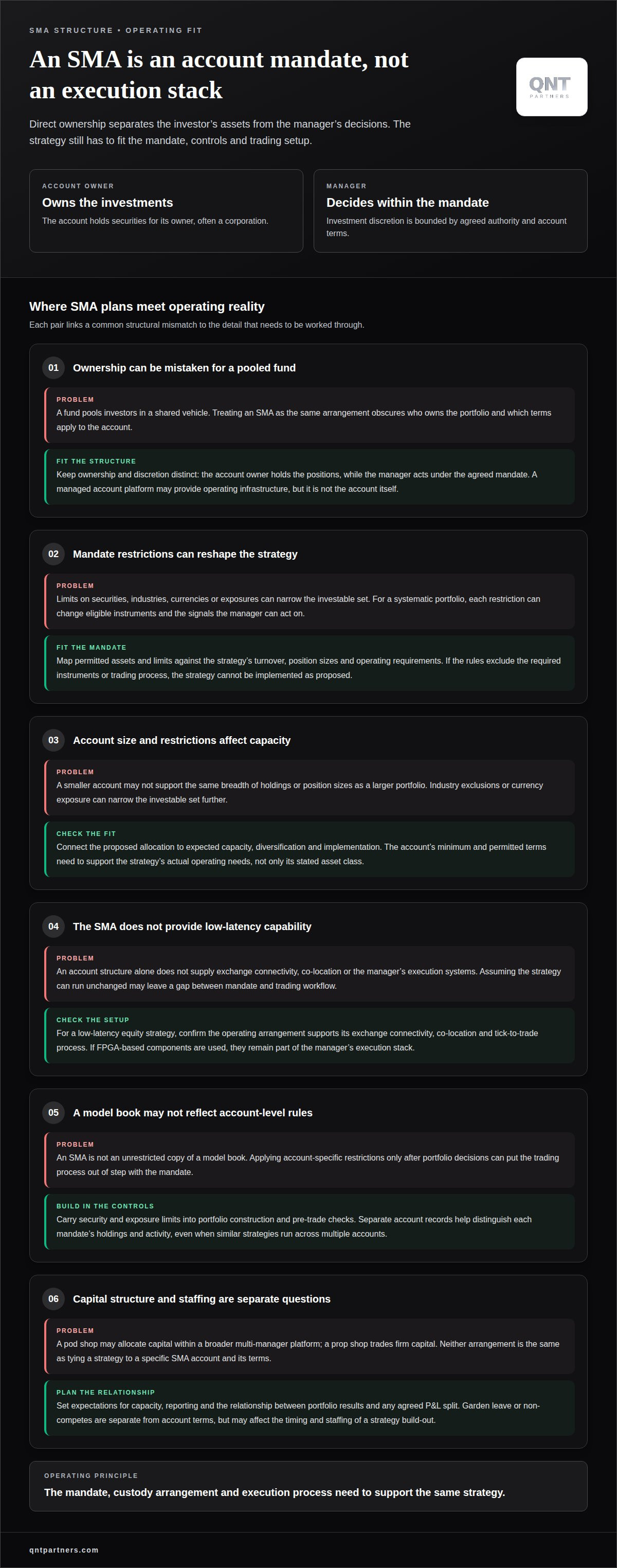
A fund pools investors in a shared vehicle; an SMA holds a portfolio for one account. A seed deal supplies capital under a separate negotiated arrangement. A managed account platform can provide operating infrastructure for accounts, but it is not the account itself. For a systematic strategy, these structures can differ in who controls the assets, how trading instructions reach the market and which restrictions apply.
In an SMA, one entity owns the account’s investments, often a corporation, and the manager has discretion over decisions within the agreed mandate. That distinction matters when a strategy needs account-level security exclusions, cash buffers or limits on particular exposures. Mutual funds offer professional management and access to varied strategies, but not the same direct ownership or personalisation. The U.S. Investment Advisors Act referenced for registered investment advisors is the Investment Advisors Act of 1940, according to U.S. Congress.
Capital Allocation and Eligible Strategies
Capital providers assess whether an account’s mandate supports the strategy’s trading mechanics, not just its stated asset class. For a quant manager, that can mean checking whether the allocation supports the intended turnover, instrument set and operating requirements. Emerging managers can present a defined approach and relevant evidence; established managers can explain how their strategy operates at its current scale. The investor and manager negotiate terms for that specific relationship.
Eligible strategies depend on the mandate and permitted assets. An SMA can be customised around securities, industries, currencies, duration and credit risk. For a systematic portfolio, each restriction can change the eligible universe and the signals the manager can act on. This can suit portfolios built around stocks or fixed income, provided the account’s investment policy permits the relevant instruments.
Custodian and broker-dealer platforms can provide a route to holding and administering account assets. Their operational fit affects how investment decisions reach the account and whether the intended trading process is supported. For example, a manager proposing a stock portfolio needs an arrangement that supports the permitted securities and trading process.
Customisation can also constrain a strategy’s capacity. A smaller account may not support the same breadth of holdings or position sizes as a larger portfolio, which can affect diversification and implementation. Industry exclusions or currency exposure further narrow the investable set. Parametric is one example of a portfolio customisation provider; the account’s instructions still determine which securities and restrictions apply.
Assess a manager by connecting the proposed strategy to its evidence and operating model. Prepare a clear description of the investment process, relevant performance history, risk controls, expected capacity and operational requirements. Providers can then assess the strategy’s fit with the mandate, including its allocation limits and restrictions. If those constraints rule out the required instruments or trading process, the strategy cannot be implemented as proposed.
SMA structure and direct security ownership
An SMA’s operating design matters as much as its portfolio mandate. The account holds positions for its owner, while the manager’s trading process must fit the account’s permissions, custody arrangements and execution setup. For a quant team, that means mapping the strategy’s actual trading workflow onto the account structure before assuming it can run unchanged.
Consider a low-latency equity strategy. Its implementation may depend on exchange connectivity, co-location and a defined tick-to-trade process. If it uses FPGA-based components, those systems remain part of the manager’s execution stack. The SMA structure does not supply these capabilities; the manager’s operating arrangement must support the trading decisions allowed by the mandate.
Capital is organised differently in a pod shop or prop shop. A pod shop may allocate capital to a team within a broader multi-manager platform, while a prop shop trades firm capital. An SMA ties a strategy to a specific account and its terms. This affects how a manager frames capacity, reporting and the relationship between portfolio results and any agreed P&L split.
Direct holdings also change how restrictions are applied operationally. A mandate can limit particular securities or exposures, and the manager’s trading controls need to enforce those limits before orders are executed. For a systematic strategy, this can mean incorporating account-specific rules into portfolio construction and pre-trade checks, rather than treating the account as an unrestricted copy of a model book.
Ownership and discretion sit on separate sides of the arrangement. The account owner holds the positions, while the manager acts within agreed authority. This makes clear which portfolio belongs to which investor, even when a manager runs similar strategies across multiple accounts. Separate account records also help distinguish each mandate’s holdings and activity.
Employment arrangements can matter during a manager transition. Garden leave or non-competes may affect when a trader can join a new platform or begin managing capital. These constraints are separate from the SMA’s account terms, but can affect the timing and staffing of a strategy build-out.
For managers weighing whether an account can support their trading model, discuss the SMA structure in the context of its execution and operational requirements.
Separately managed account benefits and risks
The key SMA trade-off is visible at the position level: an investor gets control over the mandate, while the manager takes on more restrictions and reporting. I’d only add that structure when the customisation or transparency has a clear purpose.
Benefits and Flexibility
A separate account lets the manager make investment decisions against a specific account policy. The mandate can set preferences for securities, industries, currencies, duration or credit risk. That matters when a pooled strategy cannot accommodate an investor’s restrictions or objectives.
Account-level transparency gives the owner visibility into holdings and makes it easier to discuss specific positions with the manager. Investors can also retain liquidity in their own holdings. For investors who want control over particular positions, that can be a better fit than exposure through a pooled vehicle.
Tax-loss harvesting may benefit eligible portfolios. The manager sells selected investments at a loss so those losses can offset gains from other sales. Systematic harvesting aims to capture losses while keeping the portfolio’s risk profile and relevant diversification parameters aligned with the strategy. It may improve tax efficiency, but it does not remove investment risk.
A Funds-of-One has a single investor, which gives the investor and manager room to negotiate terms within the vehicle. In a multi-investor fund, preferential treatment between investors can raise concerns. For managers, a Funds-of-One can make it easier to reflect account-specific objectives in agreed terms.
Potential Drawbacks
SMAs often require higher minimum investments and charge higher fees than mutual funds or similar investments. The manager may trade more frequently or buy securities unfamiliar to the account owner. Each trade can add reporting and administration, particularly when the account has detailed restrictions.
Customisation can reduce diversification. Excluding an industry shrinks the investable universe, while currency restrictions limit eligible exposures. A smaller account may face further constraints if the strategy needs positions across many securities. Its results may therefore differ from the manager’s unrestricted model portfolio.
Illiquid private-asset accounts carry particular fee and agency risks. The owner may be unable to exit positions when desired, so the manager’s decisions and valuation process need close oversight. An SMA or Funds-of-One platform also typically needs legal support, a third-party administrator and an auditor. That adds operational work beyond portfolio management.
Regular review is part of the operating model. Performance, compliance and risk are typically reviewed at least monthly, with metrics such as Sharpe and Sortino ratios helping assess outcomes. For managers, those reviews can flag mandate drift or risk concentration. The reporting burden needs to be accounted for in the operating design.
Customisation and account-level visibility come with expenses, constraints and oversight requirements. Before extending a pooled strategy into an SMA, I’d check whether the investor’s objectives justify the added structure.
Account minimums
SMA minimums depend on the programme and strategy, so there is no single entry threshold.
These figures are not universal programme rules. Minimums vary by programme, and the amount depends on the strategy’s design and account requirements.
That broad range reflects differences in programme structures and investment approaches, not one standard account size. A manager assessing a capital opportunity should distinguish the programme’s stated minimum from the capital needed to run the strategy as intended.
That distinction matters in systematic portfolios. A strategy trading a concentrated set of liquid equities may need different capital from one requiring broader diversification or fixed income exposure. Position sizing, the number of holdings and account restrictions all shape how much capital can be deployed effectively. A stated minimum establishes access, but does not by itself show whether the strategy can operate at that level.
Minimums also affect the investor’s portfolio. If the account is too small for the manager’s intended allocation, positions may need to be reduced or the eligible securities narrowed. Either change can alter implementation and diversification. The manager and investor should therefore consider the threshold alongside the mandate and expected holdings.
Compared with mutual funds and ETFs, SMAs typically require higher investment minimums. Pooled vehicles may therefore be more accessible to investors with less capital. For an SMA, direct ownership and account-specific customisation come with a threshold that can restrict participation. When discussing suitability, relate the minimum to the investor’s objectives and the proposed portfolio allocation.
Historical returns do not resolve the question of minimum capital. A strategy’s performance history does not show whether the account can support its intended position sizes, diversification or operating requirements. Managers should present the capital level needed for the proposed implementation, then explain how lower allocations could affect the portfolio. This clarifies the difference between programme eligibility and operational fit.
For investors, the minimum is a material part of the decision, not just an administrative detail. Compare the programme’s threshold with the capital required for the mandate’s securities and allocation. For managers, this distinction helps set realistic expectations before an account is funded.
How SMA managers work and charge fees
In a model-based managed account programme, the sponsor is the investment manager and implements trades. The manager applies the agreed strategy to the account, while the mandate defines the scope of investment decisions. Funds are typically invested over time rather than deployed in full on the first day, so implementation and cash deployment belong in the operating plan.
SMA management fees are typically calculated as a percentage of assets under management. The cited management fee range is 0.21% to 0.46%; median fees are 0.22% for fixed-income SMAs and 0.37% for equity SMAs. Those figures describe single-contract fees, not necessarily every cost an investor may pay.
Volume can change the arrangement: fees often decrease as assets increase, and managers and investors can negotiate the fee. An investor may also pay a financial professional’s fee in addition to the underlying investment management fee. Greater account assets can therefore affect the manager’s fee rate, while the contract and advisory arrangement determine which charges apply.
Managers and investors should distinguish the investment management fee from any separate professional charge. Whether a fee is fair depends on the mandate, service scope and account size, not the headline percentage alone. For example, read a negotiated fee for an equity account alongside its contract terms and assets under management, rather than comparing it mechanically with the fixed-income median.
Fees and performance are typically detailed separately on a quarterly basis. This helps investors assess the account’s results without confusing performance with charges. Managers should explain the fee calculation, including the assets used and any applicable contract terms. The reporting period also gives both parties a regular reference point for reviewing the arrangement.
Compliance and reporting need to support the mandate and its investment activity. A managed account or Funds-of-One platform typically requires legal support, a third-party administrator and an auditor. Quarterly statements should distinguish fees from performance, while records need to support trading and oversight.
Funding cadence matters, too. Because managers typically invest an account’s funds over time, the schedule affects how quickly capital enters the portfolio and how performance is reported during deployment. A systematic strategy’s implementation plan should account for gradual funding rather than assume full allocation at inception.
The practical reference point is the fee calculation, including the assets used and any contract terms that affect the charge.
QNT Partners: Manager Search & SMA Sourcing
QNT Partners supports managers and institutional investors through Manager Search & SMA Sourcing and Capital Raising via SMAs. These services are relevant when an investor is assessing a manager for a separately managed mandate or when a manager is seeking SMA capital for a strategy.
The fit depends on more than performance history. Strategy, portfolio requirements and the manager’s operating needs all shape the conversation. Where a mandate also requires specialist quant or technology talent, QNT Partners offers Quant Trading & Research Recruitment and Technology & Engineering Recruitment.
If you’re considering an SMA manager search or capital raise, contact QNT Partners to discuss the mandate.
Set the SMA mandate up for growth
The next decision is how an SMA fits the manager’s longer-term plan. Separately Managed Account capital solutions for managers are most useful when the mandate aligns with the strategy and the team needed to execute it. Consider the investor’s objectives alongside the manager’s capacity, investment process and future hiring needs before committing to a structure.
QNT Partners supports this work through Manager Search & SMA Sourcing and Capital Raising via SMAs. For firms building out specialist teams, QNT Partners also offers Quant Trading & Research Recruitment and Technology & Engineering Recruitment. AI & ML Specialist Search is relevant where that expertise is central to the strategy.
Bring the mandate and team requirements into one conversation. Discuss your SMA plans with QNT Partners and take the next step with a clearer view of the people and capital the strategy needs.
Frequently Asked Questions
What are the benefits of SMAs?
An SMA gives the manager and investor a defined set of account-level rules. That matters when a benchmark, permitted instruments or liquidity needs change the portfolio the manager can actually run. I’d focus on whether the mandate alters position sizing, turnover or execution. If it does not, the separate account may add administration without changing the investment outcome.
How do SMAs work?
The manager and account owner agree the investment policy, benchmark and operating terms, then the manager trades within that authority. The details matter: who handles cash flows, how quickly the manager is notified of a mandate change, and how trades are allocated when capital arrives in stages. A staged funding plan should distinguish intended positions from exposure that is live in the account. Otherwise, performance and risk can be hard to interpret during deployment.
What are the benefits of SMA customisation?
Customisation can accommodate constraints that would be awkward in a pooled vehicle, but every restriction has a cost. Before accepting one, I’d test its effect on the tradable universe, portfolio construction and execution. A restriction that removes a small number of names may still concentrate risk or reduce capacity. Record the instruction and its expected effect, so a later change to the account is not confused with a change to the core strategy.
Who typically uses an SMA?
An investor may choose an SMA when its investment policy or oversight requirements call for a dedicated mandate rather than an interest in a pooled vehicle. The useful test is whether account-specific terms affect portfolio decisions enough to justify separate operations and reporting. If the mandate is effectively identical to a standard pooled strategy, the additional account structure may not earn its keep.
What is an SMA capital solution for investment managers?
Separately Managed Account capital connects an investor’s mandate with a manager responsible for running the account. For a manager, the important questions are whether the investment authority fits the strategy, how capital is deployed, and how fees and reporting are defined in the account agreement. I’d separate those investment mechanics from the process of finding an investor or manager. The agreement should make clear who controls portfolio decisions and how any account-specific restrictions are handled.
What are typical SMA account sizes, minimums, and funding timelines?
There is no useful account size without reference to the strategy’s capacity and implementation. A manager should assess whether the capital can support the intended portfolio, including its liquidity and trading requirements, and whether staged funding changes the expected exposures. The schedule matters as much as the opening balance. A two-year deployment and a seven-year mandate describe different operating horizons, so the terms should state which timeline governs funding and portfolio management.
What fees and economics do SMA platforms charge managers?
Read the fee terms alongside the account agreement. Check the fee base, how it changes as capital enters or leaves, and which services are covered. The manager’s compensation may differ from the investor’s total costs if the investor pays a separate financial professional. Reporting should make those charges distinguishable from trading costs and strategy returns. For a manager, the key is understanding the economics on the capital actually deployed, not treating committed capital as equivalent to active exposure.
What risks and limitations should managers consider when accepting SMA capital?
The main risk is taking terms that prevent the strategy from being run as intended. Account-specific restrictions can change the tradable universe or portfolio construction, while cash flows and mandate changes can create a gap between model exposure and live positions. Agree in advance how changes are requested, assessed and implemented. If a restriction materially changes the process, treat that as a strategy-fit issue, not a minor administrative detail.