Quantitative Strategy Manager Recruitment for Trading Firms

A quantitative researcher and a portfolio manager can work side by side and still need very different mandates. Good quantitative strategy manager recruitment starts by defining where research ends, who owns portfolio decisions and what the role is expected to deliver in the trading system.
Firms can lose strong candidates when they hire for a title instead of the work. A search should define the investment strategy, risk ownership, research process and execution environment, then assess candidates against those requirements. The selection process matters too: it shapes how candidates view the firm and whether they stay engaged while considering other opportunities.
This article explains how firms recruit quantitative researchers and traders, distinguish research, portfolio management and trading mandates, and address factors that affect retention. It also covers how recruitment events can build a talent pipeline over time, rather than serving only as a source of immediate applicants. The focus is practical: define the role precisely, assess fit in context and give strong candidates a clear view of the work.
Key Takeaways
- Build shortlists around the strategy’s actual research and execution requirements, not job titles alone.
- Spot retention risks in the mandate, team structure and candidate experience before they affect an offer.
- Separate research, portfolio ownership and trading responsibilities so candidates know where decisions sit.
- Use recruitment events to develop relationships with potential hires before a role becomes urgent.
- Define what a quantitative strategy manager owns, from model development through portfolio decisions and implementation.
How do firms recruit quantitative researchers and traders?
Direct hiring works best when the mandate is clear before sourcing begins. Define the strategy, decision rights and technical environment, then build a shortlist against those requirements.
Candidate Personas and Job Descriptions
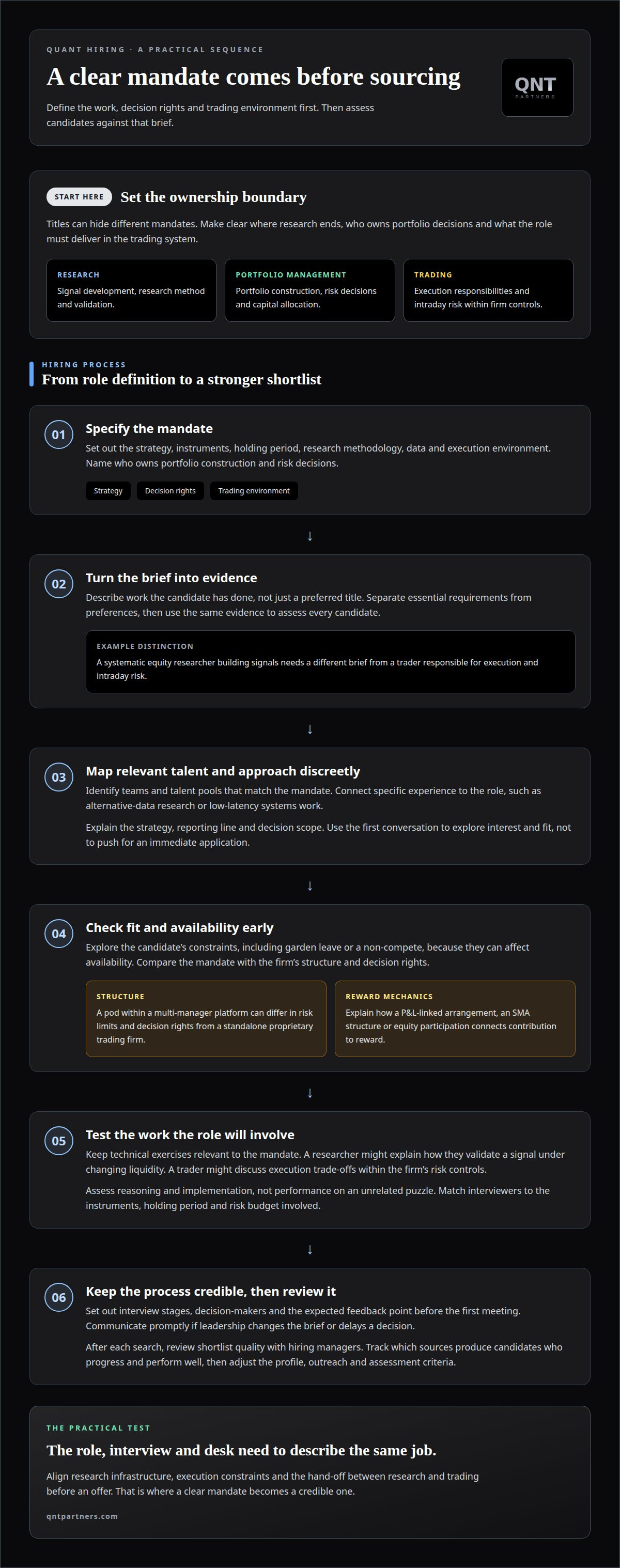
A useful candidate profile describes the work someone has done, not just a preferred title. For example, a systematic equity researcher building signals may need a different brief from a trader responsible for execution and intraday risk.
Build the job description around the mandate: instruments, holding period, research methodology, data and execution environment. State who owns portfolio construction and risk decisions. Separate essential requirements from preferences, then assess every candidate against the same evidence. This gives the shortlist a clear basis and helps candidates judge the role accurately.
Outbound Sourcing of Passive Candidates
Passive candidates rarely respond to a generic role summary. Outreach should connect a specific part of their experience to the mandate, such as a researcher’s work with alternative data or an engineer’s background in low-latency systems.
Recruiters can map relevant teams and talent pools, then approach candidates discreetly with a concise account of the strategy, reporting line and decision scope. The first conversation should explore interest and fit, not push for an immediate application. Record constraints such as garden leave or a non-compete early, as they can affect a candidate’s availability.
For direct hiring, agree on shortlist criteria with the hiring team before outreach. A practical sequence is to clarify the mandate, identify relevant experience, hold confidential conversations and present candidates with evidence against each requirement. Explain why each person fits, where their experience differs and what needs further assessment.
Interviews should test the work the role will actually involve. A researcher might explain how they validate a signal under changing liquidity; a trader might discuss execution trade-offs within the firm’s risk controls. Keep technical exercises relevant to the mandate. Evaluate reasoning and implementation, not performance on an unrelated puzzle.
Candidate experience shapes the employer’s image at every stage. Set out the interview sequence, decision-makers and expected feedback point before the first meeting. If leadership changes the brief or delays a decision, communicate that promptly. Candidates compare the process with the firm’s stated culture, so inconsistent messages can weaken interest even when the mandate is compelling.
A talent community helps maintain contact with people who fit future roles but are not ready to move. Organise relationships by strategy and technical focus, and share relevant updates rather than repeated vacancy messages. Candidate-facing material should explain how the firm works; concise candidate resources can support that picture without replacing a direct discussion.
Measure which sources produce candidates who progress and perform well, not simply how many profiles are submitted. Review shortlist quality with hiring managers after each search, then adjust the candidate profile, outreach and assessment criteria. This feedback loop keeps direct hiring focused on fit rather than activity.
Barriers to recruitment and retention
Many hiring problems begin when the role described to candidates differs from the work they inherit. A clear mandate helps, but firms also need consistent decisions, credible interview stages and a realistic account of the trading environment.
Firm structure is a frequent source of mismatch. A pod within a multi-manager platform may have different risk limits and decision rights from a standalone proprietary trading firm. Candidates need to understand where the strategy sits, who controls capital allocation and how performance is reviewed. If leadership cannot explain those mechanics, an experienced hire may interpret the uncertainty as operational risk.
Compensation discussions can stall when a firm describes potential upside without explaining how it is calculated. A P&L-linked arrangement, an SMA structure and equity participation each connect contribution to reward differently. Explain the relevant calculation and which decisions the role controls. This helps professionals assess the relationship between risk ownership and potential compensation.
Retention depends on whether the mandate matches the reality of the desk. A researcher hired to develop signals may lose confidence if data access, compute capacity or implementation support differs from what was discussed in interviews. Before making an offer, align on the available research infrastructure, execution constraints and hand-off between research and trading.
Interview design matters. A candidate asked to defend a strategy should meet people who understand its instruments, holding period and risk budget. A generic assessment can miss practical judgement, while an overly broad process may leave candidates unclear about the decision. Set out each stage, who leads it and what evidence the team needs.
For quantitative research and trading jobs in the United States, licensing depends on the specific position. According to the U.S. Bureau of Labor Statistics, some financial analyst positions may require licensure, and most licenses require employer sponsorship, so applicants generally do not need them before starting a job. Visa requirements also depend on an individual’s work-authorisation circumstances, so employers should factor them into the hiring process.
Garden leave and non-competes can affect a candidate’s start date or ability to move between strategies. Treat these as individual constraints, not assumptions about every hire. Establish expected availability early, then coordinate any transition around the candidate’s existing obligations and the firm’s onboarding plan.
Candidates judge an employer by what they experience, not only by what the firm says. If interviewers describe different risk limits or reporting lines, the discrepancy can undermine confidence. Assign one person to coordinate feedback, keep leadership aligned on the mandate and give candidates a clear update after each decision point.
For a build-out or a sensitive replacement, a discreet search can help keep conversations focused. Discuss a specialist search when the mandate, team structure or timing needs careful handling.
Portfolio management, trading, and research roles
Titles can conceal different decision rights. Start the search with the mandate: what the hire owns, which decisions remain with leadership and how the role contributes to the strategy.
Quantitative research, portfolio management and trading are distinct mandates, not interchangeable labels. In a systematic fund, a researcher may develop and validate signals, while a portfolio manager allocates risk across positions. A trader may focus on execution within agreed limits. Define those boundaries before assessing candidates, or interviews may reward experience the role will not use.
Research roles require alignment between models and the firm’s actual data and execution environment. A candidate’s methodology may be strong, but its value depends on the available data, instruments and implementation path. Assess how they test for leakage, evaluate signal decay and communicate assumptions to portfolio managers. Focus on the reasoning behind the work, not a model description detached from production.
Portfolio managers need a mandate that makes risk ownership explicit. Clarify authority over portfolio construction, liquidity constraints, risk limits and available research or trading infrastructure. A PM joining a pod within a multi-manager organisation may have different decision rights from one joining a proprietary trading firm. The same performance record can mean different things under different mandates, so assess it in context.
Trading roles centre on execution and controls suited to the strategy. For a low-latency mandate, discuss exchange connectivity, co-location and tick-to-trade latency in relation to the actual trading system. For a slower strategy, those mechanics may matter less than execution quality across the relevant instruments. Assess the job as it is, rather than treating every trader as a latency specialist.
Firm structure changes the proposition. A pod shop, a standalone proprietary trading firm and an SMA-backed strategy can differ in capital allocation, autonomy and how performance connects to compensation. These mechanics also shape culture. Explain who sets risk, who can change the portfolio and how the team handles a drawdown. Candidates can then assess the opportunity against their own record and preferred operating model.
For a new strategy, acquisition or spinout, map the role to the build plan. Identify which research, portfolio and trading responsibilities must be in place at launch, then decide which capabilities can develop as infrastructure matures. A competitive offer cannot compensate for a mandate that promises independent risk ownership but leaves capital decisions elsewhere.
Use evidence suited to each discipline. Researchers can present validation choices; PMs can explain portfolio construction under constraints; traders can analyse execution trade-offs. A shared interview rubric should assess investment judgement and role-specific controls without forcing one profile into another. This helps firms hire for the work ahead, rather than the title on a résumé.
Recruitment events and talent pipelines
A recruitment event works best when it gives candidates a direct view of the work. A trading firm can host a technical session on signal validation, execution design or market microstructure, then continue conversations with people whose skills match its hiring plans. Target a defined talent pool, rather than maximising attendance.
College recruiting can introduce early-career applicants to quantitative research before they have chosen a specific career path. A practical session might ask attendees to analyse a small dataset or discuss how a signal could fail in production. The goal is to observe how people reason, explain assumptions and respond to evidence, not to treat one event exercise as a complete hiring assessment.
Experienced candidates need a different format. A small discussion with researchers and traders can show how a team approaches model review or execution constraints. Keep the conversation substantive and specific to the firm’s strategy. Candidates use these exchanges to assess the actual work, while employers learn which parts of the mandate attract interest.
Build the pipeline after the event. Record each applicant’s or attendee’s technical focus, relevant experience and preferred role, with notes that support future follow-up. A researcher interested in alternative data may suit a different opening from an FPGA engineer focused on low-latency systems. Share updates relevant to each person’s role interests, rather than sending every contact the same vacancy announcement.
Compare event sources with other recruiting sources using yield ratios and cost per hire. A yield ratio is the percentage of applicants who advance from one recruitment stage to the next. Cost per hire includes total talent acquisition costs, from sourcing through onboarding. For the same or similar jobs, firms can use cumulative yield ratio alongside cost per hire to compare sources.
Interpret those measures alongside outcomes. A high share of event-sourced applicants reaching interviews may indicate a strong match, but hiring managers should also review job performance, turnover and the diversity of hires. These measures show whether an event attracts useful skills, rather than simply generating a large contact list.
Set an evaluation rhythm and use it to change the programme. Review recruitment goals monthly or quarterly, then compare event attendees with applicants who progressed, accepted offers and joined. If a university session attracts strong researchers but few experienced traders, keep its purpose narrow and use a separate format for senior talent.
Talent pipelines need clear ownership. Assign a recruiting lead to maintain event relationships, and invite technical staff to contribute when a candidate’s interests match their work. A short follow-up about a research topic can keep a useful relationship active without implying an immediate vacancy. That connection gives future hiring a more informed starting point.
What does a quantitative strategy manager do?
A quantitative strategy manager connects research decisions to portfolio outcomes. The precise mandate varies, but the role needs clear ownership across strategy design, validation and implementation. For example, a manager may coordinate researchers developing signals, then decide how evidence informs portfolio construction and live trading.
The manager sets the strategy’s research agenda. This can include choosing which market behaviour to investigate, how to test a hypothesis and what evidence justifies further development. If a signal works in historical data but degrades after transaction costs, the manager must decide whether to refine it, constrain its use or stop development. Quantitative strategy manager recruitment should test how candidates make these decisions.
Research quality depends on the data and trading environment. A manager should understand the strategy’s instruments, holding period, data limitations and execution assumptions. For an intraday futures strategy, that means examining whether fill assumptions reflect the intended execution approach. For a slower equity strategy, the manager may focus more on signal stability across market conditions.
Portfolio responsibility means translating research into risk decisions. The manager may set position-sizing logic, monitor exposures and assess how a strategy interacts with the wider book. If correlations shift or liquidity falls, they need to decide whether to reduce risk, adjust portfolio construction or investigate the model’s behaviour before changing the mandate.
The role also connects research and trading. Researchers can identify a signal, but implementation depends on market access, execution controls and the system running it. A manager working with a low-latency team needs to understand constraints such as exchange connectivity and tick-to-trade latency. They do not need to write every component, but must make trade-offs explicit.
People leadership is another part of the job. The manager sets priorities, reviews research and creates a process for challenging assumptions. A useful review might ask a researcher to explain data selection, validation choices and expected failure modes. This helps the team distinguish a promising result from an artefact that will not survive live deployment.
Assess success against the authority and resources attached to the role. A manager accountable for performance needs clarity on risk limits, portfolio construction rights and available infrastructure. If another team controls capital allocation or execution, those dependencies belong in the mandate. Quantitative strategy manager recruitment should assess whether candidates have worked effectively within those decision boundaries.
For hiring, define which responsibilities are essential from the outset and which can expand as the strategy develops. A new build-out may need a hands-on manager who shapes research priorities; a mature desk may need someone focused on portfolio decisions and team development. If you're defining this mandate, discuss a quantitative strategy manager search.
QNT Partners: Quant Trading & Research Recruitment
I see searches lose focus when a strategy build-out, spinout or team change is reduced to a title and a list of generic requirements. Quant trading and research roles need a clear account of portfolio authority, risk ownership and research responsibilities from the outset.
For manager appointments, an SMA structure or portfolio mandate shapes the role itself. The same applies to wider talent planning and technical hires: engineers working directly on trading systems and infrastructure need a remit that reflects where their work meets the trading stack.
Before a search starts, I would pin down the mandate, team structure and hiring constraints. That clarity gives both sides a useful basis for assessing the role. It is the starting point for our work at QNT Partners.
Set the mandate before the next hire
The next step is to turn the strategy into a clear hiring brief: define the decisions the manager will own, the resources available and how success will be assessed. This gives candidates a concrete view of the role and gives the hiring team a consistent basis for evaluating fit.
Quantitative strategy manager recruitment works best when the search reflects the actual mandate, rather than relying on a title to carry meaning. QNT Partners offers Trading & Research recruitment alongside Technology & Engineering recruitment. For specialist modelling needs, QNT Partners also offers AI & ML recruitment.
If you’re planning a hire or building a team around a new strategy, contact QNT Partners about recruitment. A well-defined mandate is a strong place to start.
Frequently Asked Questions
How do you measure the quality of your hire for quant roles?
Measure quality against outcomes agreed before the hire, then review evidence from the work itself. For a researcher, that could mean whether their analysis informs sound strategy decisions, not simply how many models they produce. For a trading hire, consider execution and risk decisions within the mandate. Include feedback from colleagues who rely on the person’s work, and consider retention alongside contribution.
What qualifications and experience are required for quantitative strategy manager roles?
There is no single qualification that defines a strong strategy manager. Relevant experience depends on the mandate: a systematic equities role may call for a record in signal research and portfolio decisions, while a new futures strategy may need experience building a process from research through implementation. Assess how candidates explain their decisions, limitations and lessons from live work. Academic credentials can add context, but do not replace evidence of sound judgement.
What programming languages and quantitative skills do employers expect?
Expectations depend on whether the role centres on research, portfolio decisions or system implementation. Python is used in quant development roles, while low-latency engineering searches may focus on C++ or Rust. The language alone says little about fit. Assess how candidates work with data, test assumptions and communicate implementation constraints. For a manager, the key is often understanding technical trade-offs well enough to set priorities and challenge results.
What is the typical quantitative strategy manager recruitment process?
A focused process moves from defining the mandate to assessing candidates, conducting interviews and making a hiring decision. The stages should test the role’s responsibilities, rather than impose the same exercise on every candidate. QNT Partners operates as a recruitment intermediary; the hiring organisation alone determines candidate suitability. Candidate data is retained for up to two years from last contact, and client and commercial data for seven years. Individuals have rights under UK GDPR.
What are the differences between quantitative strategy manager, quant researcher, and quant trader roles?
A strategy manager connects research to strategy direction and portfolio outcomes, with authority varying by organisation. A quant researcher develops and evaluates models or signals, while a quant trader focuses on execution and trading decisions. The boundaries can overlap, particularly in smaller teams. For example, a researcher at a new desk may help monitor a live signal, while the manager remains accountable for how that work informs the strategy.
Which companies and financial institutions are hiring quantitative strategy managers?
Trading firms, including systematic funds, multi-manager platforms and standalone proprietary trading firms, recruit for quantitative strategy roles.
How can candidates build a portfolio or resume for quantitative strategy manager jobs?
Highlight experience that matches the mandate, such as strategy-specific research, instruments, data and execution. Explain how you validated models, assessed risk and contributed to portfolio decisions or trading controls.