Quantitative Risk Management Recruitment for Senior Roles

A senior risk hire’s remit is defined by the decisions they own, not the title on the requisition. I see a model validator, a market risk lead and a quantitative credit analyst face very different judgement calls, even when all three need strong modelling skills.
A CV shows where someone has worked and which tools they have used. It tells me less about how they challenge assumptions, explain model behaviour or turn analysis into a decision the business can use. That gap matters when hiring at mid and senior levels.
I focus on defining the mandate, assessing quantitative skills and shaping the search around the team’s needs. Technical depth matters, but so does ownership of the models, stakeholders and risk decisions the person will handle.
Key Takeaways
- I see searches sharpen once the risk mandate and decision ownership are clear. Seniority and title come after that.
- Quantitative skill shows up in the work itself: model assumptions, validation judgement and how candidates explain analytical results.
- Interview stages work best when they reflect the role’s remit, testing technical depth separately from stakeholder judgement.
- Risk responsibilities vary by institution, particularly in the balance between independent oversight and proximity to trading or product teams.
- Team structure and hiring constraints shape the search, from reporting lines and candidate availability to mobility restrictions.
Mid-level to senior placements
I look first at who owns the decisions, not the job title. A mid-level analyst might build or maintain a model; a senior hire may set limits, challenge how a model is used or explain risk to business leaders. I define the decisions the role owns before settling on its title. That gives me a clearer search than years of experience alone.
Recent New York listings show how varied the remit can be. A Risk Appetite & Limits 1st LOD Lead Analyst role appeared 5 hours ago. A Market Risk - Cross Asset role appeared 2 weeks ago. A Senior Quantitative Model Analyst role focused on Counterparty Credit Risk Modeling appeared 1 month ago. Each title points to a different risk domain and level of ownership.
Other listings show why a broad “risk” brief can miss the mark. A Quantitative Analyst, Private Credit role appeared 5 days ago, while a Senior Market Risk Officer role appeared 1 week ago. The first suggests an investment-focused remit; the second names market risk directly. I distinguish credit, market, counterparty and investment risk before assessing candidate profiles.
For a mid-level hire, I assess how they work through a model and its inputs. In credit risk, for example, analysis may estimate probability of default, exposure at default or loss using borrower and contract information. I ask candidates to explain assumptions, limitations and how the output informs a decision. For senior hires, I also assess ownership: how they set or challenge limits, communicate uncertainty and handle stakeholder disagreement.
Seniority means different things across organisations. The OCC Director, Quantitative Risk Management position requires a master’s degree in finance, financial engineering, financial mathematics or a related field, plus six years of relevant experience. That requirement applies to that specific role, not every senior risk position. I map experience to the actual mandate rather than treating one job specification as an industry-wide template.
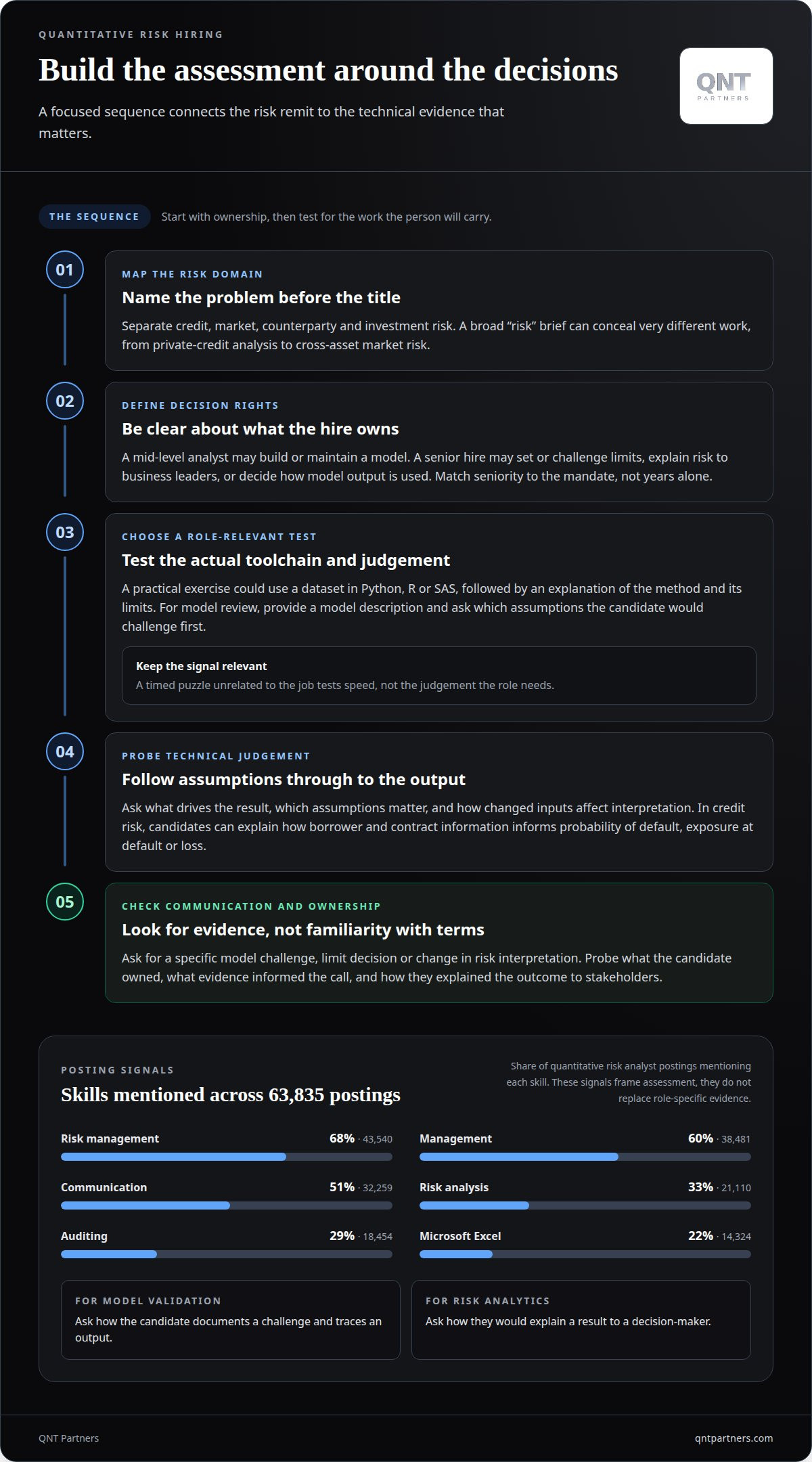
I use a consistent sequence to compare candidates: map the role’s risk domain, define its decision rights, then assess technical judgement against those responsibilities. A model validation hire might explain how they review derivative pricing models used for valuation and risk. A risk leader might instead show how they turn analysis into guidelines and limits. Both need quantitative depth, but the evidence of fit differs.
At senior level, I assess stakeholder judgement too. I ask for a specific example of a model challenge, a limit decision or a change in risk interpretation. I probe what the candidate owned, what evidence informed the decision and how they communicated the outcome. That detail helps me distinguish direct experience from familiarity with terminology and align the hire with the decisions the role must carry.
Quantitative analytics skills and recruitment
Quantitative risk roles need more than fluency in a modelling language. A useful assessment separates mathematical reasoning, implementation skill and the ability to explain model behaviour. Job-posting data covering 63,835 quantitative risk analyst postings gives one view of the skill mix. Risk management appeared in 43,540 postings, or 68%, while risk analysis appeared in 21,110, or 33%. In quantitative risk management recruitment, those signals help frame assessment, but they should not replace role-specific evidence.
Connect each skill to the work the hire will own. A market risk analyst might explain how a sensitivity changes under a stressed market move. A model-focused candidate may identify which assumptions drive an output. A focused search tests this reasoning rather than rewarding candidates for reciting terminology.
Interviews and technical tests often probe model assumptions, coding choices and interpretation. A practical exercise might ask a candidate to analyse a dataset in Python, R or SAS, then explain the method and its limitations. Follow-up questions should test whether they can defend a modelling choice and connect the output to a business decision.
Choose a test that reflects the role’s actual toolchain. If the team uses Python for statistical analysis, a short code review can show how a candidate structures calculations and handles edge cases. If the role centres on model review, provide a model description and ask which assumptions they would challenge first. A timed puzzle unrelated to the job tests speed, not relevant judgement.
Technical fluency needs context. Microsoft Excel appeared in 14,324 postings, or 22%, while auditing appeared in 18,454, or 29%. Neither figure means every candidate needs identical experience. For a validation role, ask how the candidate documents a challenge and traces an output. For a risk analytics role, ask how they would explain a result to a decision-maker.
Communication also deserves direct assessment. It appeared in 32,259 postings, or 51%, and management appeared in 38,481, or 60%. Ask candidates to explain one modelling decision, then probe the trade-offs without supplying an answer. Strong explanations distinguish assumptions from evidence and show how changed inputs affect interpretation.
Assess mathematical foundations against the role’s remit. Econometrics, stochastic mathematics and statistics can support quantitative risk work, but the required depth depends on the models in use. Ask candidates to connect a mathematical concept to a practical modelling choice. This reveals more than treating a degree title as proof of applied skill.
For a search, the technical brief should name the model family, coding environment and decision interface. That gives interviewers a consistent basis for comparing candidates across employers. If the team is defining that scope, a focused technical role discussion can anchor the search to the work itself.
Recruitment networks and tailored hiring solutions
A useful network search starts with the role’s risk remit, not a generic list of quantitative job titles. I also want to know whether the need is ongoing or tied to a defined build-out.
Permanent and temporary hiring
A permanent hire suits an ongoing ownership gap, such as a senior analyst responsible for credit risk methodology or a lead who maintains market risk limits. I ask the team to define the mandate and reporting line, then spell out which decisions the person will own. That makes it easier to distinguish a long-term team hire from someone engaged for a specific piece of work.
Temporary hiring can suit a defined workload, such as a model remediation project or a team build-out before the permanent structure is settled. I ask the team to clarify the assignment’s outputs and data access, then agree what the handover needs to cover. For example, a temporary model analyst might document validation findings while the permanent team retains ongoing model ownership. Garden leave and non-competes can also affect candidate mobility, so I factor them into search planning.
Role-specific hiring process
For quantitative risk management recruitment, I start by mapping the team structure and the role’s relationship with decision-makers. A bank risk function may need someone who can challenge model assumptions across business lines. A systematic fund may need risk expertise closer to portfolio construction. The same job title can conceal different work, so I ask the team to name the risk domain and the decisions the hire will influence.
Next, I map candidates by relevant experience rather than title. A credit risk specialist who has worked with probability of default models may suit a team assessing borrower exposures, even if their current title differs. A market risk candidate may bring transferable scenario analysis skills, but I check their familiarity with the target portfolio and its limits.
Then I structure the process to test distinct evidence. In an initial discussion, I establish the candidate’s remit and motivation. A technical interview can show how they review assumptions or interpret model outputs. I use a final conversation with the hiring lead to assess how they communicate risk when stakeholders disagree. Keeping each stage focused makes comparisons more useful than repeating the same broad interview.
I extend the search beyond active applicants. I map adjacent teams and spinouts, then approach candidates whose work matches the mandate with a precise description. Someone considering a move may need time to assess reporting lines and risk ownership, as well as any mobility constraints. This matters particularly when a build-out depends on several hires joining in a workable sequence.
I treat feedback as part of the search design. If a hiring panel rejects a candidate for lacking model ownership, I update the criteria before the next interview instead of adding more profiles against the original brief. That keeps the search focused on the actual gap and prevents a temporary project need from being mistaken for a permanent leadership mandate.
What is the hiring process for quantitative risk management roles?
Quantitative risk management recruitment works best when the hiring team agrees on ownership before approaching candidates. The reporting line, business sponsor and decisions the role supports all shape the brief. For a counterparty risk vacancy, for example, whether the team sits within an independent risk function or reports through a business unit affects who needs to be involved.
A clear process gives candidates a consistent account of the role. It also makes decision ownership explicit, so risk, trading and human resources are not giving different descriptions of the remit.
- Confirm the vacancy. The hiring lead and relevant stakeholders share a clear reason for the hire, reporting line and team context. Any change from the original headcount plan is accounted for.
- Approve the brief. The role description, seniority and essential experience are settled before the search begins. Consistent language across recruiter discussions, internal approvals and candidate materials helps avoid confusion.
- Coordinate introductions. Candidates get the same context on the role and meet the decision-makers who can explain the mandate accurately.
- Collect feedback. Interviewers give a clear view against the agreed requirements. The hiring lead has a consolidated picture before making a decision.
- Manage the offer. The hiring team is aligned on role scope, reporting and start constraints before terms are communicated. Relevant garden leave or non-compete considerations are part of the planning.
Interview coordination works best with one clear owner. A hiring lead can manage availability across the risk team and business sponsor, then share the agreed schedule with candidates. When a stakeholder becomes unavailable, revising the sequence is usually better than adding an unplanned conversation without a clear purpose.
One agreed channel for feedback keeps the panel’s views together. A short decision meeting gives people a chance to resolve differences while discussions are still fresh. If the risk lead supports a candidate but the business sponsor has a concern, the hiring lead can establish whether it is about role scope, reporting or team fit.
Reference and offer discussions are easier to manage once the panel has made its decision, rather than running them in parallel. The hiring lead can identify which claims need context from a referee and bring relevant information back to the decision-makers. Candidate communications should stay direct, particularly if internal approvals change the role or its reporting line.
In quantitative risk management recruitment, each stage needs a clear owner and outcome. Candidates should hear a consistent account of the opportunity, from the first discussion to the final decision. Agreeing who communicates changes and who can approve the offer before opening the search helps keep things aligned when several teams share responsibility for the hire.
How do quantitative risk management roles differ across banks, hedge funds, insurers, and fintech companies?
The same risk title can describe different work across employer types. A bank may separate model validation from market risk oversight, while a hedge fund may place risk analysts closer to portfolio decisions. Hiring criteria should reflect the organisation’s products and data, along with how decisions are made, not just the role name.
In banks, quantitative risk teams often work across several exposure types, including credit and counterparty risk. A credit analyst might assess probability of default, exposure at default or loss. A model validation specialist may review derivative pricing models used for valuation and risk. The distinction matters: one role develops or applies analysis, while the other challenges how a model behaves.
Hedge fund roles often connect risk analysis with portfolio construction and investment decisions. At a multi-manager fund, a risk hire may support teams with different strategies and exposures. At a prop shop, the role may sit closer to trading activity and position-level controls. Establish who acts on the analysis and how risk information reaches the portfolio manager.
Insurers approach quantitative risk through underwriting, with claims data informing portfolio exposure. A candidate assessing credit risk in banking may bring useful modelling foundations, but insurance work can require different familiarity with policy and claims data. Industry listings for quantitative risk analysts included agencies and brokerages, along with other insurance-related activities, at 8.2%. That share signals a distinct talent pool, not interchangeable experience.
Fintech companies may place risk analysts near product and engineering teams, often with data at the centre of the work. For example, someone supporting a digital credit product may need to interpret borrower behaviour alongside model outputs. Assess how candidates reason about data quality and communicate risk implications to product decision-makers. Banking experience may transfer, but the ability to work across technical and commercial teams also matters.
Industry categories show why sourcing should extend beyond banks. Depository credit intermediation represented 22.5% of listed industries for quantitative risk analysts. Management of companies and enterprises represented 11.7%, while other financial investment activities represented 9.3%. These categories suggest broader pools, including investment firms and corporate environments, but each candidate’s actual remit still needs close examination.
Compare candidates against the organisation’s operating model. A bank may prioritise experience with model validation or regulatory capital analysis. A hedge fund may favour portfolio-level judgement and concise communication with investment teams. An insurer may focus on claims data, while a fintech may value collaboration with product engineers. Shape the interview around these differences.
Across these employer types, a clear operating model helps focus interviews on the decisions a hire will actually support. The role and target talent pool can be defined before the brief is locked.
QNT Partners: Quant Trading & Research Recruitment
QNT Partners supports specialist hiring where quantitative risk sits close to trading, research or portfolio decisions. Its Trading & Research service helps firms define a role’s mandate and identify candidates whose experience fits the team’s structure, from mid-level analysts to senior hires.
For searches involving infrastructure or modelling technology, QNT Partners’ Technology & Engineering and AI & ML services may also be relevant. Manager Search & SMA Sourcing fits requirements centred on leadership or an SMA structure. Start with a clear account of the risk remit, decision ownership and technical environment.
If you’re shaping a quantitative risk hire, contact QNT Partners to discuss the search.
Set the mandate before opening the search
The next hire can shape how risk decisions are made, not simply add capacity. Before opening a search, define the decision the role must improve, who owns it and what evidence would change it. This gives quantitative risk management recruitment a sharper starting point than a broad title or inherited job description.
Agree the trade-offs early. Is the priority deep model expertise, influence across teams or experience in a particular risk domain? Which capability can be developed after joining, and which must already be in place? Clear answers keep interviews focused and make candidate feedback more useful.
Once those choices are settled, the search can be built around the team’s actual operating needs. Discuss your recruitment requirements with QNT Partners, and take the next step with a defined mandate.
Frequently Asked Questions
What qualifications are required for quantitative risk management jobs?
Requirements depend on the role’s modelling remit and seniority. Quantitative risk analyst roles may ask for a master’s degree in engineering specialising in econometrics, stochastic mathematics or statistics. For a specific Director, Quantitative Risk Management role, the OCC required a master’s degree in finance, financial engineering, financial mathematics or a related field, plus six years of relevant experience. These are role-specific criteria, not universal entry requirements.
What skills and programming languages matter in quantitative risk management?
Applied modelling ability, sound statistical reasoning and clear explanations of analytical work matter across quantitative risk roles. Python, R and SAS are used for statistical analysis. The relevant language depends on the team’s workflows, and a concrete project can show how the approach was chosen and its results interpreted. For senior roles, communication of technical findings to decision-makers also matters.
How do quantitative risk teams work with recruiters?
Risk teams can compare specialist recruiters’ role updates with the careers pages of firms whose teams match their remit. QNT Partners recruits across quantitative trading and research, technology and engineering, and AI and ML roles. It operates as a recruitment intermediary; the hiring organisation alone determines suitability. Candidate data is retained for up to two years from last contact, and individuals have rights under UK GDPR.
What are the most common quantitative risk management job titles?
Risk managers and risk analysts are the most commonly listed titles: risk managers account for 8.6% of posted job titles shown, and risk analysts account for 7.3%. Other listed roles include market risk officer, quantitative model analyst, and credit risk analyst.
What are the current hiring trends and demand for quantitative risk professionals in the United States?
Listings show demand across credit, market, counterparty, investment, and model risk roles. In data from 63,835 quantitative risk analyst postings, risk management appeared in 68% and risk analysis in 33%; LinkedIn lists more than 2,000 such jobs in New York.
Which U.S. cities and employers hire the most quantitative risk professionals?
New York has more than 2,000 quantitative risk analyst job listings. Employers with listed openings there include Morgan Stanley, Citi, JPMorganChase, Societe Generale, Nomura, Neuberger, Bloomberg, U.S. Bank, Point72, UBS and EmblemHealth.