Quantitative Modelling Recruitment: How to Hire for Model Quality

Model quality is a better hiring brief than “quant” on a CV. In quantitative modelling recruitment, start with the work the person needs to own: the same title can cover very different research decisions, data and production constraints.
Strong credentials and a fluent interview are not enough. A candidate may explain a method well but make weak choices about validation, or know the right tools without understanding the desk’s data and workflow. Those differences show up in the model, not the job title.
This article sets out how to define the role around its modelling work and assess how candidates reason about research quality and implementation. The aim is a hiring decision based on what a person can build, the trade-offs they understand and how they make the work usable.
Key Takeaways
- Define the role by the model’s purpose, constraints and decision ownership, not by the title on a CV.
- Use Quantitative modelling recruitment to assess how candidates reason about assumptions, data and validation against the actual mandate.
- Compare role-relevant evidence and trade-off judgement, rather than relying on generic rankings.
- Structure the process around a clear brief, consistent assessment and an explicit hiring decision.
- Align the search with the team’s technical context so candidate experience maps to the work the desk needs done.
Quantitative modelling recruitment starts with the work, not the title
The same title can describe materially different modelling work. One “quantitative modeller” may build valuation models for structured products, while another researches signals for a systematic strategy or estimates execution costs from market data. Quantitative modelling recruitment should start with the model’s purpose, the constraints it must operate within and the decisions its output will inform.
That distinction matters because a valuation role and a quantitative research role call for different evidence. A valuation hire may need to reason about pricing assumptions, calibration and scenario analysis. A research hire may need to form and test hypotheses against noisy data, then judge whether a signal survives transaction costs and trading constraints. The boundary is not always neat, so define responsibilities rather than relying on the label.
Candidates may first encounter a role through a job-search page, where broad categories help them find vacancies. For an employer, that category is only a starting point. The Quantitative analyst entry outlines the breadth of specialisations associated with quant work, but the hiring brief still needs to state which work this particular team owns.
What does a quantitative modeller need to produce?
Specify the output and its user. Is the modeller expected to deliver a valuation framework used by a risk or trading team, a scenario model that informs portfolio decisions, or an execution model that estimates how orders interact with the market? Each purpose changes the relevant data, assumptions and acceptable trade-offs. Name the decision the model supports, not just the method or asset class.
Separate research from implementation and ongoing oversight. A researcher might develop and validate a model, while an engineer or another quant takes responsibility for production integration. In a smaller team, one hire may own both; in a larger organisation, those tasks may sit with different people. Make ownership explicit so candidates know whether the mandate ends at a research result or includes monitoring model behaviour after deployment.
Why job titles are weak hiring specifications
“Quantitative analyst” can refer to work across rates, credit, equities or systematic trading, with different model objectives in each. Even within one asset class, a valuation model and a strategy signal answer different questions. A title match says little about whether someone has made the decisions your mandate requires. Look for evidence of comparable modelling work, including how the candidate handled data limitations and explained trade-offs.
The same precision helps when evaluating search partners. A useful guide to quant trading recruitment firms should help employers distinguish specialist understanding from broad title-matching. In the hiring brief, record the model’s intended use, the team that consumes its output and who owns implementation. That gives the next stage of assessment a concrete mandate to test against.
Assess quantitative modelling skill through research decisions
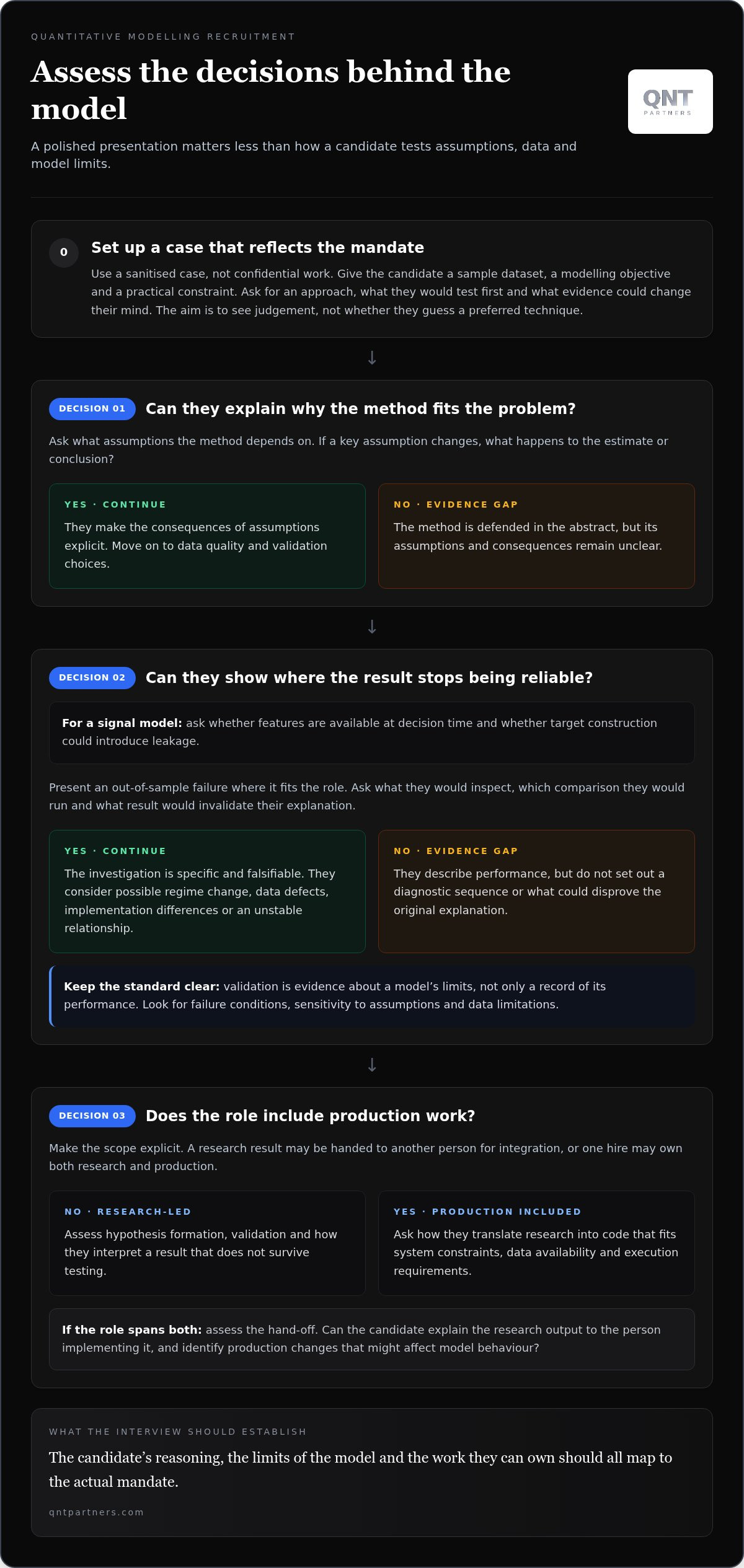
A polished presentation can conceal weak research. I’d assess the decisions behind a model: why a method fits the problem, what the data can support and how the candidate would establish where the result stops being reliable. In quantitative modelling recruitment, that evidence is more useful than a generic test that rewards speed or familiarity with interview puzzles.
Use a problem close to the mandate, without asking candidates to reproduce confidential work. A sanitised case can provide a sample dataset, a modelling objective and a practical constraint. Ask them to outline an approach, identify what they would test first and explain what evidence would change their mind. The discussion should reveal judgement, not whether they guess the interviewer’s preferred technique.
Test assumptions, data and validation choices
Ask why the candidate chose a method for that problem, then probe the assumptions it depends on. For a signal model, ask how they would check that features are available at decision time and that target construction has not introduced leakage. If a key assumption changes, what could that do to the estimate or conclusion? Strong candidates make the consequences explicit rather than defending a method in the abstract.
Include an out-of-sample failure scenario where it fits the mandate. If performance weakens in a later period, ask how they would distinguish regime change from data defects, implementation differences or an unstable relationship. Listen for a diagnostic sequence: what they would inspect, which comparison they would run and what result would invalidate the original explanation. The point is not to reward one answer, but to see whether their investigation is falsifiable and disciplined.
Model validation is evidence about a model’s limits, not just a record of its performance. A candidate who can describe failure conditions, sensitivity to assumptions and limitations in the data gives you more to assess than someone presenting a strong backtest without its boundaries.
Distinguish research depth from implementation skill
Be clear whether the role prioritises model design, production work or both. For a research-led hire, explore hypothesis formation, validation and how they interpret a result that does not survive testing. For a production-focused role, ask how the candidate translates research into code that fits the system’s constraints. In trading, a model’s value depends partly on whether its output can be used in the relevant workflow, given data availability and execution requirements.
If the role spans both, assess the hand-off as well as each discipline. Can the candidate explain what the research output means to the engineer implementing it, and which production changes might affect its behaviour? We recruit across quant research and technology, connecting these technical requirements with candidate experience so the interview tests the actual remit rather than an abstract profile.
Take one recent model decision from the desk and turn it into an interview prompt. The candidate’s assumptions, tests and response to failure will show whether their judgement fits the work.
Compare modelling candidates against the mandate, not a generic scorecard
A candidate comparison only helps if each person is judged against the same work. In Quantitative modelling recruitment, a universal ranking of methods, asset classes or credentials can obscure the evidence that matters to the desk. Use a short scorecard tied to the model’s purpose, and record what each candidate demonstrated rather than relying on interview impressions.
Keep the comparison compact. For each candidate, capture:
- Modelling judgement: How they framed the problem, selected assumptions and responded when evidence challenged their initial approach.
- Mandate fit: Where their past work matches the model’s use, data and operating environment, and where it does not.
- Trade-off communication: Whether they can explain limitations and consequences to the people who will use or implement the output.
- Development areas: Which gaps are teachable in the team and which would prevent them from owning the required work.
Mark essential requirements separately from skills that can be developed after joining. If the role requires independent research judgement in a specific market, that may be essential. Familiarity with an internal library or code convention may be learnable. Don’t turn every preference into a hard filter, but be explicit about the gaps the team can absorb.
Match evidence to the model’s use case
For valuation or risk work, compare how candidates understand model inputs and the decisions its outputs inform. For systematic research, look at how they frame a hypothesis, choose tests and interpret a result that weakens out of sample. For execution modelling, focus on whether their experience reflects the trading environment the model is meant to represent. Similar techniques do not guarantee similar judgement.
That does not make one background or modelling method inherently superior. A candidate from a different asset class may bring useful transferable reasoning, but the interview should establish where that experience maps to the mandate and where it leaves a gap. Record the evidence and uncertainty rather than turning either into a false-precision score.
Account for team and trading structure
The organisation changes what the modeller owns. At a prop shop, the work may sit close to a trading team and its tools. In a pod shop or multi-manager, responsibilities can be distributed across portfolio managers, researchers and central technology groups. Fit depends partly on who sets research priorities, who makes the trading decision and who carries the model into production.
This is an organisational-design question as much as a technical one. Place the role in the actual workflow before comparing candidates. A researcher expected to advise a PM needs a different working interface from a modeller focused on engineering hand-offs. That context gives the scorecard meaning and prevents a strong candidate from being marked down for solving a different problem.
Build a focused hiring process for quantitative modelling roles
A disciplined process makes the hiring decision easier to defend. For Quantitative modelling recruitment, keep the sequence simple: define the mandate, specify the evidence, assess candidates consistently, then decide against the work the team needs done. If the brief changes halfway through interviews, the comparison stops being useful.
Before opening the search, agree who owns the model’s output and what the successful hire must deliver. A researcher developing a signal for a trading team has a different remit from a modeller adapting an existing framework for production. The title can describe either. The brief should make the distinction clear.
- Define the mandate. State what decision the model supports and who uses its output. Clarify where the role sits in the research or trading workflow.
- Specify the evidence. Decide what candidates need to demonstrate, such as a relevant research case, a model review or experience with implementation constraints.
- Assess consistently. Use the same core criteria and comparable prompts, while allowing follow-up discussion to reflect each candidate’s actual experience.
- Make the decision. Compare demonstrated evidence with the role’s essential requirements, and record the reason for the final choice.
Write a role brief that surfaces the real problem
Describe the model’s job, not just its category. A brief might say the modeller will develop outputs used to inform a portfolio decision, or assess execution under the desk’s defined trading conditions. Include enough of the research and data context for a candidate to judge fit without exposing sensitive information.
Spell out how the person will work with the trading or research team. Will they set research direction, interpret results with a PM, or hand work to engineers for implementation? State who makes the final decision on model use. This helps candidates distinguish an individual research mandate from a role built around supporting an existing team process.
Make interviews comparable without making them generic
Give each candidate a consistent structure for discussing a modelling decision: the problem they faced, the evidence they used and how they handled a limitation or trade-off. The technical prompt can differ by mandate, but interviewers should assess the same underlying capabilities. That makes the debrief about comparable evidence rather than who gave the smoothest account.
During the debrief, separate clarity of explanation from depth of reasoning. A concise answer can be strong if the candidate identifies the key assumption and its consequence. A polished presentation carries little weight if it avoids the hard question or treats a model result as conclusive without testing its limits.
If you’re defining a search around a specific modelling mandate, discuss a quantitative modelling search with QNT Partners. A clear brief gives the search and interview process a common standard.
How QNT Partners approaches quantitative modelling recruitment
A search is only as precise as the brief behind it. I’ve seen the same modelling title used for work with very different users, constraints and decision rights. At QNT Partners, we start with the actual mandate: what the model supports, where the role sits in the team and what the hire will own.
We specialise in quantitative trading, research and technology recruitment, working with HFT firms and hedge funds. That focus matters because a modeller’s experience has to be read in its trading context. A research role at a systematic fund may centre on signal development and interpretation. A role closer to execution may depend more on how research interacts with order flow, data and the trading system. The title alone will not tell you which experience transfers.
Bring quant and trading context to the search
We work with the hiring team to describe the role accurately before approaching talent. That means distinguishing model design from implementation, identifying the relevant asset class and data environment, and clarifying how the modeller works with researchers, traders or engineers. Where a role combines responsibilities, we make that combination explicit so candidates can assess the remit on its merits.
As a co-founder with industry experience, I know small differences in team structure can change what “good fit” means. A modeller joining a new build-out may need to establish research practices with a PM. In a more established group, the immediate need may be to improve or extend an existing model. We keep firm and candidate details discreet, and describe examples without identifying the organisations involved.
That role-specific context shapes our conversations with candidates. We discuss the work they have actually owned, the constraints they have encountered and how those relate to the mandate. Their experience need not match the role word for word, but the connection between past decisions and the work ahead should be clear.
Start with the hiring problem
For a useful first discussion, a hiring team can set out the model’s purpose, the group that will use its output and the immediate gap the hire needs to address. Explain whether the priority is research depth, production delivery or both. Those details give us a sound basis to align the role definition, technical requirements and candidate experience.
Quantitative modelling recruitment works best when the search begins with the problem the desk needs solved, rather than a familiar title or broad list of credentials. If you’re hiring for a quant research or trading role, discuss your quantitative modelling hire with us. We can start with the model mandate and the team’s immediate need.
Make the next hire fit the model’s real demands
A modelling hire can shape how a desk tests ideas and acts on research. Before opening the role, write down the decision the model needs to support and the judgement the hire must bring to it. That gives the team a clearer basis for the search and candidates a more honest picture of the work.
That’s where I’d begin with any Quantitative modelling recruitment mandate: not with a long list of methods, but with the problem the team needs this person to own. QNT Partners is a boutique firm founded by former industry operators, specialising in quantitative trading, research and technology recruitment. We bring that focus to searches where the technical context matters.
If you’re preparing a search or refining a role that’s proving difficult to define, talk with us about the mandate. A precise brief is a practical first step towards finding someone whose modelling judgement fits the desk.
Frequently Asked Questions
What does a quantitative modelling recruiter do?
A quantitative modelling recruiter works with hiring managers to translate the role into a candidate brief, then manages the conversation between the team and potential hires. In Quantitative modelling recruitment, that can include clarifying seniority, reporting lines and the balance between independent work and collaboration. A specialist recruiter can also communicate the desk’s context accurately, so candidates can judge whether the opportunity matches their experience and career priorities.
How do you assess a quantitative modeller in an interview?
Use a consistent interview record so each interviewer captures evidence against agreed criteria before the debrief. One interviewer might document technical depth while another records how the candidate handles uncertainty or explains a limitation to a non-specialist. Compare those observations before discussing overall impressions. This reduces the risk that a confident presentation or memorable answer dominates the decision, and helps identify where interviewers reached different conclusions.
Do quantitative modelling roles require a PhD?
No, the requirement depends on the role. For research-intensive positions, a doctorate may show sustained work in a relevant mathematical or statistical area. Other candidates may demonstrate comparable depth through industry research, technical publications or substantial project ownership. Review the substance of that work: the problem addressed, the candidate’s contribution and how they defended their conclusions. Education is one signal among several, not a reliable stand-in for demonstrated capability.
What is the difference between a quantitative modeller and a quantitative researcher?
The labels vary, but the distinction often comes down to emphasis. A modeller may spend more time developing, adapting or maintaining a model, while a researcher may focus more on investigating new questions or methods. In practice, a researcher might hand a prototype to a modeller for refinement, or one person may own both stages. Clarify where the role sits in that lifecycle, including who maintains the work after the initial research.
Should quantitative modelling candidates complete a coding test?
Use a coding test when code quality is a material part of the role, but a code review can sometimes reveal more than a timed programming task. Ask candidates to inspect a short, relevant example and explain how they would improve its readability, testing or handling of edge cases. Set expectations in advance and have reviewers assess against the same criteria. This gives candidates room to show how they work with code, not only how quickly they type.
When should a firm use a specialist quantitative modelling recruiter?
Consider specialist search when stakeholders disagree about which adjacent backgrounds could transfer into the role, or when the brief spans quantitative research and trading technology. Resolving that question early can keep the search focused and help the team describe the opportunity consistently. QNT Partners works across quantitative trading, research and technology roles, bringing sector focus to the discussion. Start with the hiring team’s immediate need and the experience it considers relevant.