Quantitative Machine Learning for Talent Acquisition

More hiring data won't solve a talent shortage if it describes the wrong market. Quantitative machine learning in talent acquisition connects historical hiring outcomes with skills data and talent supply to inform where qualified candidates may be found and how well they fit a role. It supports decisions; it doesn't make specialist judgement redundant.
The appeal is clear: models can surface patterns across applications, job descriptions and hiring outcomes that are difficult to spot in isolated records. But their output is only as useful as the data and assumptions behind it. If past hiring favoured a narrow profile, a model trained on those decisions can reproduce that bias.
This article explains how hiring data can inform candidate sourcing and success estimates, how skills mapping can identify relevant experience beyond exact keyword matches, and why external talent supply matters when a role is hard to fill. It also covers where human review remains essential, particularly in senior and specialist searches, where context, motivation and technical depth cannot be reduced to a score.
Key Takeaways
- Use historical hiring outcomes to inform sourcing, while treating model predictions as decision support rather than hiring decisions.
- Map skills and adjacent experience to role requirements instead of relying on exact CV keywords.
- Include external talent supply in workforce planning, especially when specialist AI and machine-learning skills are scarce.
- Understand what machine-learning models learn from data, and where biased or incomplete inputs can distort their outputs.
- Use automated screening to organise candidate information, then apply human judgement to assess technical depth and role fit.
Machine learning and historical hiring data
Historical hiring data can reveal which candidate attributes correlate with later performance. A model may compare education, previous work experience and skills with recorded outcomes. That can help direct sourcing, but correlation does not prove that an attribute causes success. If a firm has historically hired from a narrow set of universities, the model may favour those institutions without showing that they predict stronger performance.
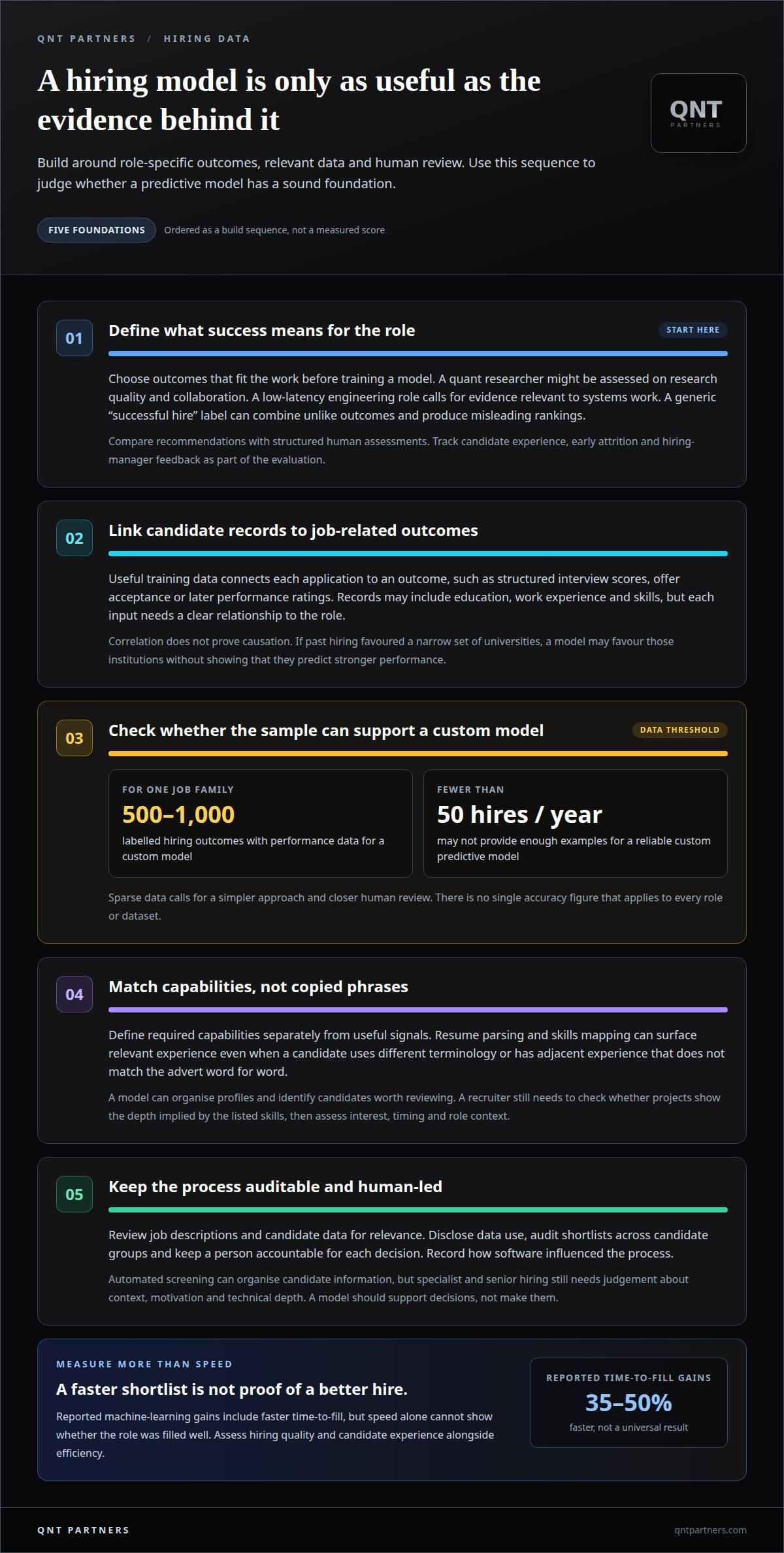
Useful training data links each application to a job-related outcome, such as structured interview scores, offer acceptance or later performance ratings. For one job family, a custom model typically needs 500 to 1,000 labelled hiring outcomes with performance data. A role with fewer than 50 hires per year may not generate enough examples for a reliable custom predictive model. Sparse data calls for a simpler approach and closer human review.
How accurate and effective are machine-learning hiring tools compared with traditional recruiting? There is no single accuracy figure that applies to every role or dataset. Models can process applications consistently and help speed up screening, while recruiters assess context, motivation and technical judgement that historical records may not capture. Effectiveness depends on whether a model predicts role-specific outcomes and improves quality of hire, not merely whether it reproduces past decisions.
Define success before training a model. For a quant researcher, evaluation might consider research quality and collaboration, while a low-latency engineering role calls for evidence relevant to systems work. A generic “successful hire” label can combine unlike outcomes and produce misleading rankings. Compare model recommendations with structured human assessments, then track candidate experience, early attrition and hiring-manager feedback.
Bias can enter through past hiring patterns, proxy variables or incomplete records. A model trained on historical applications might downgrade candidates whose career paths differ from previously selected profiles. Review job descriptions and candidate data for relevance, disclose data use to candidates, and audit generated shortlists across candidate groups. Keep a person accountable for each decision and maintain an auditable record of how software influenced the process.
Compliance is part of model design, not a final procurement check. According to the European Union, the EU AI Act’s full enforcement begins in stages through 2026. Organisations need governance that supports transparency, review and human oversight as requirements take effect. For efficiency, measure time-to-fill alongside hiring quality and candidate experience. Reported machine-learning gains include 35-50% faster time-to-fill, but speed alone cannot show whether a role was filled well. A faster process that filters out relevant candidates is a poor result.
Recruiters remain accountable for the fairness and transparency of algorithm-influenced hiring decisions. Recruitment AI should therefore be governed with auditability and human oversight.
AI tools are better suited to chatbot interactions in high-volume recruitment and early-stage candidate engagement than to specialist, senior or sensitive hiring that requires human judgement and empathy. Machine-learning algorithms process recruitment data to predict candidate success, reduce hiring time and improve hiring quality. Historical hiring patterns can include education, previous work experience and skills. Models can also use hiring data, attrition trends and skills gaps to predict future talent needs. AI trained on historical hiring data can reinforce past hiring biases unless it is actively monitored and corrected.
Skills mapping and talent matching
A useful match starts with role requirements expressed as skills, not phrases copied from a job description. For a quant researcher, this distinction can bring relevant candidates into view even when their CVs use different language.
Candidate sourcing and screening
Machine learning supports sourcing by identifying candidates whose documented skills and career paths align with a role. During screening, natural language processing can parse a resume and compare its content with defined requirements. This matters when a researcher describes similar work using different terminology, or an engineer’s profile shows relevant adjacent experience without matching the advert word for word.
A practical step is to separate required capabilities from useful signals before ranking applications. For a systematic research role, the hiring team might distinguish research experience from proficiency in a specific programming language, then assess candidates against both criteria. A model can surface profiles worth reviewing, while a recruiter checks whether the candidate’s projects demonstrate the depth those terms imply.
Skills mapping can also help reuse existing talent pools. An applicant screened for one opening may suit a later role with different requirements. Matching software can identify that connection from recorded skills and qualifications, but a recruiter still needs to assess interest, timing and role context before making contact.
Data and skills requirements
Quantitative talent acquisition requires job-related candidate information, clear skill definitions and criteria linked to the role. Useful inputs can include resume content, education, work history and skills. What data and skills are required? Candidate records need consistent, relevant fields, while the hiring team must define the capabilities it intends to match. Without that structure, a model can rank wording rather than competence.
Skill categories should reflect the actual work. A low-latency engineering search might distinguish exchange connectivity experience from general software development. A research search could separate empirical analysis from model deployment. These distinctions help a system interpret related terms without treating every candidate who shares a keyword as equivalent.
Natural language tools can infer skills from a candidate’s CV, education, job history and volunteer work. That broader reading can reveal capabilities obscured by inconsistent language, but inferred skills should remain traceable to evidence in the application. A recruiter can check the relevant project or responsibility instead of accepting an unexplained score.
Matching performance should be evaluated against outcomes, not ranking volume alone. Companies using machine-learning-based candidate matching reported an average 35% reduction in time-to-fill. For a specialist search, pair that measure with role-specific hiring quality and review whether the shortlist includes candidates with credible adjacent experience. The resulting model supports sourcing decisions without making the hiring decision.
AI and machine-learning talent supply
Talent supply analysis changes a hiring decision from “where should we post?” to “where does relevant capability sit?” In the United States, technical talent in AI applications was growing at about 26.5% per year. That growth indicates expansion, not an even supply of candidates across specialisms, seniority levels or locations.
A hiring team should define the capability it needs before estimating supply. “Machine-learning engineer” could mean production infrastructure, model research or applied natural language processing. Those profiles draw on different experience. A search for an inference engineer, for example, may require systems expertise alongside ML knowledge, while a research scientist role may prioritise experimental work.
Algorithms can combine internal recruitment records with external labour-market information to identify patterns in role demand and candidate movement. Useful outputs show where relevant skills appear, which career paths lead to them, and how often those profiles enter a search. Decisions are more grounded when each signal maps to a specific capability rather than a broad job title.
For a quant firm building an AI research group, candidate sourcing might look beyond people whose title already includes “machine-learning researcher.” A data scientist who has moved into model research, or an engineer with experience deploying ML systems, may bring relevant adjacent skills. Natural language processing can help identify those profiles across varied descriptions, but the evidence still needs interpretation.
Supply also depends on a role’s operating conditions. A position requiring in-person work near a particular team draws from a different pool than one open to remote candidates. A role tied to a specific trading system or research stack may call for a narrower combination of skills. These constraints affect recruitment before screening begins, so include them in the initial market definition.
Forecasting should connect talent supply with expected demand. If a firm plans to add a research pod, analysis can map required skills against current teams and known hiring needs. That exposes gaps early, helps set realistic sourcing priorities, and clarifies whether the immediate action is external hiring or developing existing capability. Model outputs inform planning, not candidate-level decisions.
Measure supply analysis against outcomes that matter to the search: whether qualified candidates enter the funnel, progress through assessment and accept offers. A large pool of profiles is not useful if few meet the technical bar. Compare sourcing channels and skill clusters against those outcomes, then adjust the search definition if the evidence shows a mismatch. This keeps market analytics tied to hiring decisions.
Machine learning
Machine learning is the part of artificial intelligence that learns patterns from data and adapts to a task. Implementation starts by defining the hiring decision to support, then preparing relevant data, selecting a method, testing outputs and monitoring results.
That sequence matters because a model can learn only from the examples it receives. In a hiring process, its purpose might be to prioritise applications for human review, not decide who gets an offer. Clear boundaries make the assessment useful and keep accountability with the people making hiring decisions.
Start with a narrow use case, such as sorting applications for a specific engineering role. Define the ability being assessed and the evidence that counts, such as experience with FPGA development or exchange connectivity. Keep criteria tied to job requirements. A general “culture fit” label gives the model little precise information and can encode subjective preferences.
Next, prepare data that matches the use case. A model designed to identify research candidates needs different examples from one supporting a low-latency engineering search. Remove irrelevant fields, standardise inconsistent labels and connect each example to a meaningful outcome. If historical outcomes are incomplete, the training set may teach the wrong relationship between candidate attributes and hiring decisions.
Choose a method suited to the data and task. A supervised model learns from examples labelled with known outcomes. A natural language processing system can interpret free-text applications, while a rules-based process handles fixed criteria. These methods solve different problems. Artificial intelligence platforms may combine them, but automation alone does not make an assessment valid.
Test the model against cases it was not trained on. Compare its rankings with structured human assessments, then inspect errors: did it miss a candidate with relevant adjacent experience, or prioritise a profile based on superficial keyword overlap? For a research role, reviewers can check whether cited projects demonstrate the claimed work. The test should measure decision quality, not just processing speed.
Use structured interviews alongside machine learning. Companies were reported to be three times more likely to improve quality of hire when ML was paired with structured interviews than when using ML alone. Consistent questions give hiring teams comparable evidence, while interviewers can probe reasoning that an application cannot show.
Finally, monitor performance after deployment. Track shortlist relevance, candidate experience and hiring quality, then review errors and adjust criteria. Keep records of model versions and the reasons for human overrides. A model that improves efficiency in one role may perform differently in another, so test it separately before expanding its use.
Adoption plans are rising: 79% of talent acquisition leaders surveyed by Aptitude Research said they planned to increase investment in ML tools over the next two years. That investment should follow a defined use case and governance plan. Talent Strategy Advisory can help connect workforce priorities with the capabilities a hiring process needs to assess.
How is machine learning used to source and screen job candidates?
Machine learning supports candidate sourcing by finding relevant profiles across applications and existing talent pools. In screening, algorithms can parse resumes, compare evidence with role criteria, and rank applications for recruiter review. The value lies in prioritisation, not an automated verdict on who should be hired.
An applicant tracking system can hold candidate records from earlier searches and match them against new openings. For a low-latency engineering role, a search may look for exchange connectivity experience even when a candidate’s current title uses different language. AI-enabled sourcing can identify adjacent career paths rather than requiring an exact phrase match.
Resume parsing turns free-text documents into structured fields, such as skills, qualifications and work history. Parsers are reported to achieve 90-95% accuracy for standard fields. That figure does not establish whether a candidate is suitable. A correctly extracted programming language or job title still needs context, especially when the role requires production ownership or research depth.
Screening models compare applications against predetermined criteria. A recruiter might set the required evidence for a quant developer role, then use ranked results to decide which profiles deserve closer review. The criteria should reflect the work itself. If a model rewards familiar job titles or repeated keywords, it can suppress candidates whose relevant experience uses different terminology.
Automated scores need explanations that reviewers can inspect. For each shortlisted profile, show which stated skills or experience contributed to its rank. A hiring manager can then distinguish a candidate with hands-on model deployment experience from one whose application only mentions machine learning. That review also exposes weak criteria before they shape later decisions.
Bias is a practical failure mode. Amazon abandoned its resume-screening tool in 2018 after it downgraded resumes containing the word “women's.” The example shows why historical application patterns and model features need active scrutiny. A shortlist should be checked for systematic omissions, with a human responsible for the decision and an audit trail for model influence.
Automation can also affect the candidate experience. Chatbots suit high-volume recruitment and early-stage engagement, where they can handle routine questions. A senior researcher discussing a move, or a candidate weighing a sensitive career decision, needs direct human interaction. Use software to reduce administration, not to make a nuanced conversation feel transactional.
Measure the recruitment process beyond screening speed. Track whether suitable candidates progress, whether offers are accepted and whether hires perform against role-specific expectations. A shorter time to screen means little if the process removes strong applicants. Keep the model’s purpose narrow, review its rankings, and let human judgement determine the next conversation.
AI-powered tests and video interviews using face-recognition software can also assess candidates. Natural language processing can identify suitable candidates from resumes, job descriptions and communications between candidates and recruiters, while AI-enhanced applicant tracking systems can rank and score candidates according to their fit for a role.
QNT Partners: Quant Trading & Research Recruitment
QNT Partners helps firms turn a defined hiring need into a focused search for quant trading and research talent. When a team is building a systematic strategy, adding a researcher or hiring for a new technical build-out, role context matters as much as a candidate’s model score.
Our services include Trading & Research, Technology & Engineering, AI & ML, and Manager Search & SMA Sourcing. They are relevant when a search calls for judgement about research track records, production systems, or the fit between a manager and an SMA structure. Quantitative tools can organise evidence, but they cannot replace market-specific assessment.
If you’re planning a search in these areas, contact QNT Partners to discuss the role and the talent profile you need.
Turn the model into a hiring decision
The next step is to connect your talent data to a specific build plan. Decide which capability the team needs next, what evidence would demonstrate it, and where that experience is likely to be found. A model can help structure those decisions, but the hiring process still needs people who understand the work behind each candidate profile.
Quantitative machine learning in talent acquisition is most useful when it sharpens that definition rather than adding another score to the workflow. For a new research or engineering build-out, that means translating strategy into a role with clear technical scope, relevant experience and realistic sourcing criteria. The result is a more focused search brief and a stronger basis for assessing fit.
When you’re ready to discuss a quant, research, technology or AI and ML search, contact QNT Partners. A clear hiring brief is a practical place to start, and we can work from there.
Frequently Asked Questions
What is quantitative machine learning talent acquisition?
Quantitative machine learning talent acquisition uses structured hiring data and statistical models to inform sourcing and selection decisions. For example, a systematic fund could use skills evidence and role requirements to prioritise candidates for recruiter review. The model supports assessment rather than deciding who gets hired. QNT Partners operates as a recruitment intermediary, and the hiring organisation alone determines candidate suitability.
What metrics measure ROI and performance in machine learning talent acquisition?
Measure whether the tool improves qualified-candidate progression, offer acceptance, time to fill, hiring quality and candidate experience. Compare results with the process before adoption, and review them by role rather than combining unrelated searches. A shorter screening time has limited value if suitable candidates drop out. Personal data is retained for up to two years after last contact, and individuals have rights under UK GDPR.