Quantitative Investment Manager Headhunters for Senior PMs

A senior portfolio manager search depends on whether the investment process can transfer to a new platform, not just on a headline track record. Quantitative investment manager headhunters assess the strategy, risk mandate and research-to-execution setup behind the returns. A fund’s location, including whether it is outside New York, is one part of the search brief; the mandate and target market matter too.
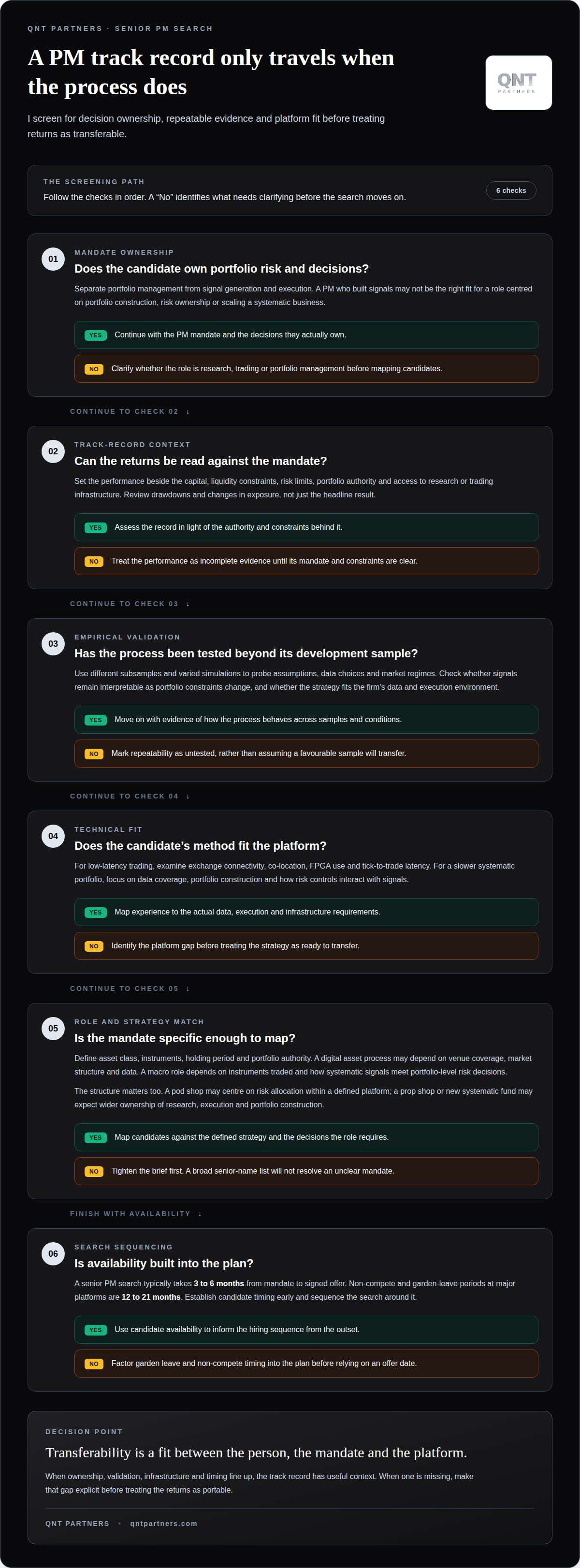
That distinction matters because portfolio management, quantitative research and trading are separate mandates. A portfolio manager who built signals may not be right for a role focused on portfolio construction, risk ownership or scaling a systematic business. Assessment should connect performance to the capital, constraints and infrastructure behind it.
A senior PM search typically takes 3 to 6 months from mandate to signed offer, while non-compete and garden-leave periods at major platforms are 12 to 21 months. Those timelines make a precise brief and discreet early planning consequential.
Key Takeaways
- Judge a PM’s track record against the capital, risk limits and portfolio authority behind it, not as a standalone number.
- Test whether the investment process holds across different subsamples and simulations, and fits the firm’s data and execution environment.
- Define the strategy, instruments and infrastructure before mapping candidates; these details shape who can succeed in the role.
- Build garden leave and non-compete constraints into search sequencing so candidate availability informs the hiring plan from the outset.
- Choose a headhunter who can distinguish PM, research and trading mandates and assess the technical demands of the platform.
Which quant recruiters place senior PMs at hedge funds?
The right recruiter can distinguish a portfolio manager’s transferable edge from returns tied to one platform. For a senior hedge fund search, that means testing mandate fit, strategy mechanics and the evidence behind the track record.
Senior PM Search and Mandate Fit
Multi-strategy and hedge fund searches start with the mandate, not a performance headline. A portfolio manager’s record needs context: portfolio authority, liquidity constraints, risk limits, and access to research or trading infrastructure all affect how well it transfers. A single-stock volatility portfolio manager who has priced the quote for a decade may bring a clear, specialised edge, but the new role still needs to fit that process.
At a pod shop, the role may focus on risk allocation and performance within a defined platform. A proprietary trading shop or a new systematic fund may instead expect broader ownership of research, execution and portfolio construction. I look for a close match between those responsibilities and the portfolio manager’s actual decisions, rather than treating all senior portfolio roles as interchangeable.
Strategy-Specific Quant Recruiting
Digital asset and macro mandates call for different candidate maps. A digital asset portfolio manager’s process may depend on venue coverage, market structure and the data used to form signals. Macro searches depend on the instruments traded, the holding period, and how the portfolio manager combines systematic signals with portfolio-level risk decisions. Recruiters should establish these requirements before presenting candidates.
Empirical validation helps separate repeatable process from a favourable sample. Strategy review should test different subsamples and use varied simulations, then examine whether the model fits the firm’s data and execution environment. A strategy that works in one venue or regime may not transfer unchanged. For teams assessing a TradFi-to-crypto move, the practical issue is which parts of the research process remain usable across markets, as discussed in this TradFi-to-crypto transition.
Boutique and Executive Search Firm Models
Boutique quant recruiters typically focus on technical mandates and narrower candidate networks; large executive search firms may offer broader leadership coverage. Firm size alone is not the useful distinction. What matters is whether the recruiter can discuss strategy, portfolio construction and platform constraints without reducing the role to a generic investment title.
There is no single typical fee for investment management recruiting. For a search, the fee depends on mandate scope and engagement terms, and is given after a quote request.
Head-hunter Selection and Potential Conflicts
Ask how the recruiter distinguishes a portfolio manager mandate from quantitative research or trading, and how they assess performance evidence. Confirm who manages candidate communication, how confidential information is handled, and whether the recruiter represents overlapping mandates. These questions matter when a hiring firm is building a team or pursuing a discreet spinout.
Search fees are agreed with the hiring firm under the engagement terms. Candidate-side charges, if any, should be disclosed before a process starts; don’t assume one payment model applies across firms. Conflicts can arise when a recruiter serves competing mandates or shares information without clear permission, so agree on boundaries before names or strategy details circulate.
Technical and performance-based candidate screening
A quantitative investment manager should approach a headhunter with a defined mandate and a concise explanation of the strategy. Describe the portfolio decisions you own, the evidence behind your track record, and the platform conditions needed to run the process. This gives the recruiter a basis for assessing fit and approaching relevant candidates discreetly.
Screening starts by separating reported performance from the decisions that produced it. A recruiter should establish the strategy’s instruments, holding period, risk budget and portfolio authority. Then examine how returns behaved in different market conditions, including drawdowns and changes in exposure. A trader’s results mean little without context about the mandate and its constraints.
Empirical validation should test whether the strategy’s behaviour persists beyond its development sample. Use different subsamples and varied simulations to probe sensitivity to assumptions, data choices and market regimes. Review whether the model’s signals remain interpretable as portfolio constraints change. This helps distinguish a research process that can be scrutinised from one that depends on a narrow historical fit.
Technical assessment should connect the candidate’s methods to the hiring firm’s infrastructure. A researcher’s model needs to fit the available data and execution environment. For a low-latency trader, that can mean discussing exchange connectivity, co-location, FPGA use and tick-to-trade latency. For a slower systematic portfolio, the relevant questions may focus on data coverage, portfolio construction and how risk controls interact with signals.
Candidate mapping starts with those requirements, not a broad list of senior names. Distinguish portfolio managers who own portfolio risk from researchers who generate signals and traders who optimise execution. Then map relevant experience by asset class, instruments, holding period and research process. A systematic equity search, for example, calls for different evidence from a macro role built around cross-asset positioning.
Confidential outreach should reveal the opportunity in stages. An initial approach can describe the mandate and platform without disclosing the fund’s identity or sensitive strategy details. After a candidate expresses interest, the recruiter can coordinate what information is shared and when. This keeps early discussions focused and limits unnecessary circulation of the firm’s plans.
For senior candidates, screening should also test the operating model. Clarify whether the portfolio manager would join a pod shop, a proprietary trading platform or a new build-out, and how decision rights are divided across research, portfolio risk and execution. Compensation discussions may involve P&L participation, equity or an SMA structure, but terms only make sense in the context of the role’s actual responsibilities.
A useful process records why each candidate fits or misses the mandate. Compare each candidate’s strategy, evidence, technical requirements and platform needs against the same criteria. This makes trade-offs visible, whether the gap concerns data infrastructure, risk ownership or the ability to scale a research process.
The screening brief should record the mandate, evidence reviewed and any gaps in technical or portfolio fit.
Quantitative investment firm recruitment
A quantitative fund hires for the business it intends to build, not simply to fill a vacancy. A new systematic equity team, for example, may need a portfolio manager whose research process can generate signals and manage portfolio risk. Define the strategy, instruments and capital mandate first. Those choices shape whether the search targets a portfolio manager, researcher or trader.
Recruitment should connect a candidate’s record to the firm’s operating model. A portfolio manager joining a pod shop may inherit established data and execution infrastructure, while a spinout may need to build those capabilities alongside its portfolio. This distinction affects decision rights and which parts of the candidate’s previous process can transfer.
For quantitative researchers and traders, the candidate market depends on instrument coverage, data infrastructure, research methodology and execution environment. A team trading listed futures needs different experience from one building equity signals from fundamental data. Define the instruments and workflow before sourcing begins. Otherwise, a strong technical record can still be a poor match for the role.
Portfolio construction belongs in the specification, not as a late-stage interview topic. A firm should establish how the PM will translate signals into positions, manage factor interactions and control unwanted concentration. One reported hiring figure puts portfolio optimisation expertise as a critical criterion for 76% of investment firms. That makes the candidate’s decision process as relevant as the model’s predictive performance.
Factor expertise also needs context. A candidate may combine value signals with volatility controls, but the hiring team should understand how those inputs affect portfolio exposures and capital use. Demand for Kelly criterion and utility-based portfolio expertise was reported to have increased by 42%. The practical test is whether a candidate can explain how position sizing responds to uncertainty and changing risk budgets.
For a firm building a scalable systematic business, interview stages should test distinct parts of the mandate. Start with research decisions and evidence, then assess portfolio construction and risk ownership. Finish by examining how the candidate would adapt the process to the firm’s data and execution setup. Each stage should add evidence rather than repeat the same performance questions.
Recruitment can also support a new capital structure. A manager launching through an SMA may need to explain the strategy, investment process and operational requirements to prospective allocators. That differs from joining an established internal platform. Before opening the search, define whether the firm needs a portfolio manager to manage capital, a team to develop signals, or both.
Once requirements are clear, the firm can map talent against the actual build-out: strategy, instruments, infrastructure and decision authority. That precision focuses the search on candidates whose record and working methods fit the business the firm intends to create.
Search timelines and non-compete periods
A senior portfolio manager search typically takes 3 to 6 months from mandate to signed offer. At major platforms, non-compete and garden-leave periods are 12 to 21 months. Plan the search against both clocks: hiring can finish well before a candidate can start trading.
Candidates should expect an initial mandate discussion, confidential outreach, strategy and track-record assessment, interviews, and offer discussions. The sequence may vary with the firm’s investment process, but each step should clarify the role’s decision rights. For example, a portfolio manager joining a multi-manager platform needs to understand the portfolio remit and how the firm evaluates risk.
For candidates, the first practical step is to state availability accurately. Separate any notice period, garden leave and non-compete period, then identify which dates are contractual and which are planning assumptions. Don’t treat the 3 to 6 month search duration as a start-date estimate. It measures time from mandate to signed offer.
Hiring firms should plan backwards from the required start date. A search can map portfolio managers while a candidate remains employed, but interviews and offer discussions need to account for actual restrictions. The process should also include internal approvals and agreement on the mandate. A late change to strategy or seniority can force the search to restart.
The 12 to 21 month periods reported at major platforms make early planning important. They can affect when a PM can join, what work can begin, and how the firm sequences team build-out. The relevant question is not simply whether a candidate has a restriction. It is how the specific agreement affects that candidate’s proposed role and timing.
Market timing can add pressure. A 60-day window is described for senior multi-strategy portfolio managers signing in May to July. That window can concentrate decisions, but it doesn’t remove the need to assess strategy fit or work through an existing restriction. Firms should have interview steps and decision-makers organised before that period opens.
Global searches add coordination across locations and trading teams. Interview schedules may need to accommodate teams in different time zones, while candidates remain bound by their current commitments. A clear process identifies who makes each interview decision and how feedback reaches stakeholders. This helps prevent a strong candidate from waiting while the firm resolves internal scheduling.
For a portfolio manager considering a move, keep early conversations focused on the mandate, platform and timing. Share sensitive details in stages, and avoid promising a start date before relevant restrictions are understood. Hiring teams should distinguish clearly between signing and joining, especially when the strategy depends on a specific portfolio manager to lead a build-out.
Search planning works best when the recruiter, candidate and hiring team use the same timeline. Set the mandate, interview sequence and decision points first, then align them with the candidate’s restrictions. In a market where a search may take 3 to 6 months and platform restrictions may last 12 to 21 months, the start date is a separate planning decision.
How do quantitative investment managers choose a headhunter?
Choose a recruiter for mandate fluency, not the size of their database. A search for a systematic equity portfolio manager needs a different candidate map from a low-latency trading build-out. Before approaching candidates, the recruiter should be able to translate your strategy, platform and decision rights into a precise brief.
Start by testing whether the recruiter can distinguish adjacent roles. A quantitative researcher may develop signals without owning portfolio risk. A senior trader may optimise execution without making investment decisions. Ask how the search will distinguish those profiles, then compare the answer with the responsibilities your team needs covered.
Technical fluency matters when the mandate depends on infrastructure. For a market-making role, the recruiter should understand how exchange connectivity, co-location, FPGA work and tick-to-trade latency shape the candidate profile. For a systematic macro portfolio manager, the discussion should instead focus on instruments, research process and portfolio construction. If both roles receive the same generic brief, the mapping is too broad.
Assess the search method before sharing sensitive details. A useful process defines the mandate, maps the relevant talent pool, approaches candidates discreetly and reports against agreed criteria. For example, a new fund build-out may need a portfolio manager who can shape research priorities, while an established pod may need someone ready to work within existing risk parameters.
Test how the recruiter evaluates track records. They should ask what capital, authority, liquidity limits and infrastructure supported the results. They should also distinguish an individual’s decisions from the contributions of the wider team or platform. This helps avoid presenting a candidate whose headline returns seem relevant but whose actual remit differs from the role.
Agree on confidentiality boundaries before names circulate. Decide what the recruiter can disclose in an initial approach, who receives candidate information, and how updates reach your hiring team. For a spinout, early disclosure of strategy or team plans can create unnecessary exposure. A clear communication path keeps the search controlled while giving serious candidates a clear view of the opportunity.
Give commercial terms and conflicts the same care. Put the fee arrangement, exclusivity, candidate ownership and replacement terms in writing. Ask whether the recruiter is working on competing mandates drawing from the same small talent pool. For a specialist options search, overlapping instructions may affect candidate access and create divided incentives.
Finally, judge the recruiter by the quality of the initial candidate map. It should explain why each profile fits the mandate, where the gaps are, and which adjacent backgrounds may transfer. A list of names without that reasoning offers little basis for a hiring decision.
If you’re defining a search around a specific quant mandate, discuss the role and candidate brief.
QNT Partners: Quant Trading & Research Recruitment
QNT Partners works on quant trading and research searches where the role depends on a specific strategy, platform or technical skill set. For a senior portfolio manager mandate, Manager Search & SMA Sourcing supports searches shaped around portfolio responsibility and the intended structure. Technology & Engineering and AI & ML address specialist hiring needs alongside investment roles.
Bring us in when you’re defining a build-out, replacing a senior investor or mapping talent for a systematic strategy. A clear brief covering the mandate, decision rights and infrastructure gives the search a practical starting point. We can then align the candidate profile with the work the firm needs done.
If you’re planning a quant search, contact QNT Partners to discuss the mandate.
Set the search up for the next stage
The best next step is to define what the hire needs to make possible, not only what they’ll manage on day one. A new portfolio manager may need to shape a research team, adapt a strategy to a different platform, or work alongside engineers building trading infrastructure. Include that future remit in the brief. It gives the search clearer direction and helps candidates assess whether the opportunity matches the work they want to own.
Quantitative investment manager headhunters should understand how a role connects investment decisions with the firm’s technical setup. QNT Partners supports this work through Trading & Research, Technology & Engineering, and AI & ML recruitment. Start with a direct conversation about the mandate and the capabilities the firm needs to add.
Contact QNT Partners about your search and set the brief around the next stage of the business.
Frequently Asked Questions
How do firms recruit quantitative researchers and traders?
Firms recruit by defining the work each hire will own, then matching candidates to that mandate. For example, a systematic trading team may need researchers to develop signals and traders to implement them within a specific execution setup. The process can include research discussions, technical interviews and reviews of previous projects. Clearly separating research, trading and portfolio responsibilities helps candidates understand the role before committing time.
How long does a quant PM search typically take?
A senior portfolio manager search typically takes 3 to 6 months from mandate to signed offer. That period covers the search and offer process, not necessarily the candidate’s start date. Internal approval steps, changes to the role and interview availability can affect progress. For a PM moving from an existing platform, contractual restrictions and notice arrangements also influence when they can begin the new role.
What do quantitative investment manager headhunters do?
Quantitative investment manager headhunters connect investment firms with candidates whose experience fits a defined role and manage communication throughout the search. QNT Partners operates as a recruitment intermediary; the hiring organisation alone determines candidate suitability. Candidate data is retained for up to two years from last contact, while client and commercial data is retained for seven years for accounting and legal purposes. Individuals have rights under UK GDPR.
Which executive search firms specialize in quantitative investment managers in the United States?
QNT Partners is a specialist search firm focused on quantitative trading, research and technology roles, including manager searches for institutional mandates. For a US search, define whether the hire will lead a portfolio, develop research or build a trading capability. Those distinctions help establish whether the firm’s search expertise fits the role. QNT Partners also works across international markets, so the search scope can reflect the fund’s talent requirements.
Which headhunters recruit quant portfolio managers, researchers, and systematic traders?
Specialist quant recruiters work across these roles, but relevant experience differs by mandate. A portfolio manager search centres on investment ownership; a researcher search may focus on modelling and signal development; a systematic trader role may require execution expertise. When assessing a recruiter, look for a clear explanation of how they distinguish these profiles. The discussion should connect candidate experience to the team’s responsibilities, not rely on job titles alone.
What qualifications and experience do headhunters seek in quantitative investment managers?
There is no single qualification for every quant investment manager role. Recruiters assess experience against the strategy, instruments and responsibilities involved. A candidate for a systematic equities mandate, for example, should be able to explain their contribution to research and portfolio decisions. Relevant technical depth matters too, particularly when the role depends on specific data, modelling or execution methods. The hiring organisation sets the final suitability criteria.