Quantitative hedge fund recruitment agency for hiring timelines

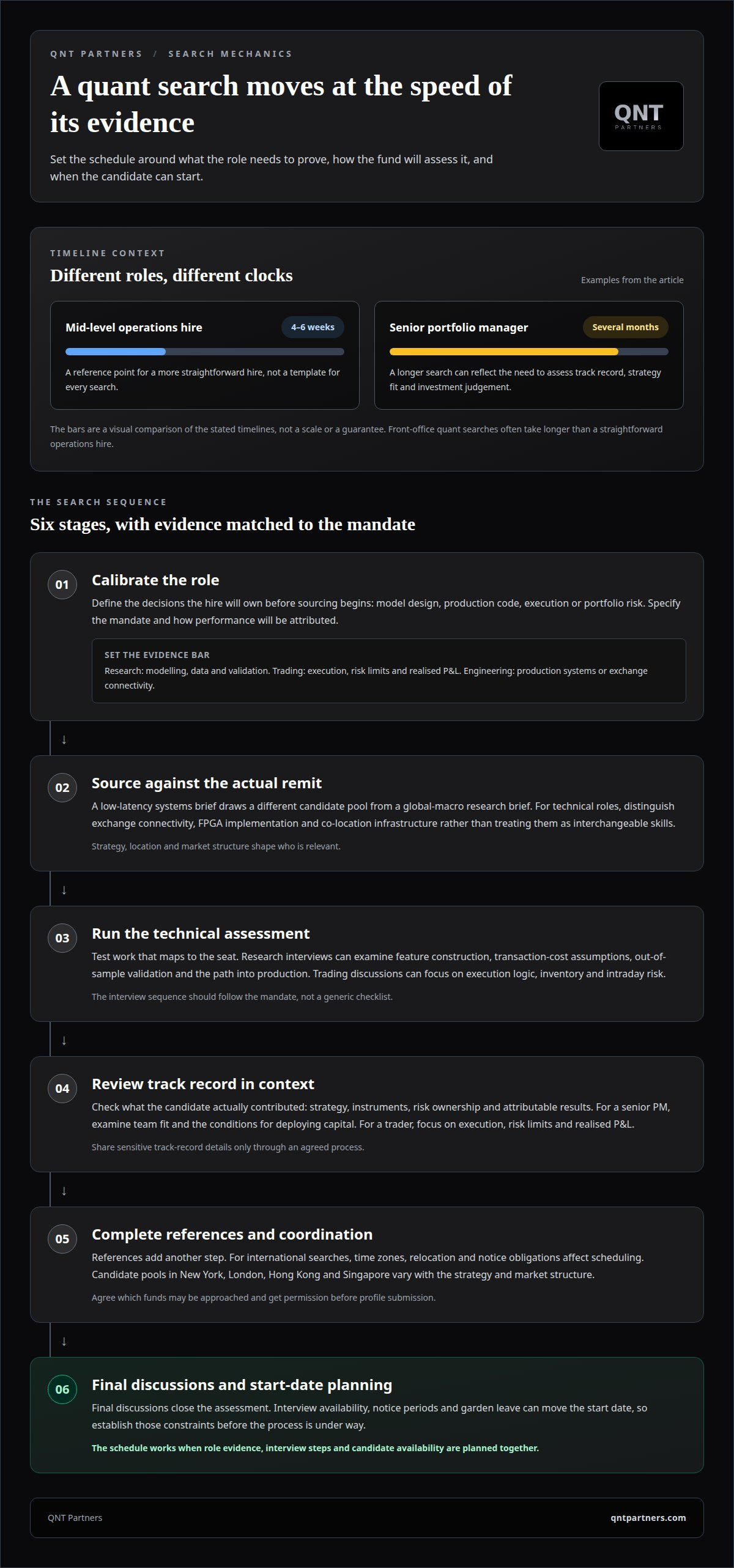
Senior portfolio-manager searches can run for several months; a mid-level hedge fund operations hire might take 4-6 weeks. A quantitative hedge fund recruitment agency can help set the search around the role’s evidence requirements, interview process and candidate availability, but those timelines are not interchangeable.
That distinction matters in quant hiring. A front-office search may hinge on a verifiable track record, strategy fit, and a credible explanation of how research translates into live P&L. Technical interviews and internal decision-making add steps, while notice periods or garden leave can affect a candidate’s start date.
Here, I’ll outline what typically shapes hiring timelines, which quant trading, research, portfolio management and engineering roles specialist recruiters work on, and how compensation benchmarks and market intelligence inform a search. The focus is on the practical mechanics: what needs to be assessed, where searches tend to slow, and how to set a process that respects the demands of both the desk and the candidate.
Key Takeaways
- Build the hiring schedule around the evidence each role requires, the interview sequence and candidate availability.
- Define whether the mandate calls for research, trading, portfolio management or engineering skills before sourcing begins.
- For AI and machine learning searches, assess how candidates’ methods fit the fund’s research and investment process.
- Use location, strategy and seniority to frame compensation discussions, then compare the package with live market signals.
- Choose a search approach that matches the structure of the hire, whether it is a specialist appointment or a broader team build-out.
How long does it take to hire for hedge fund roles (mid-level, senior, front office)?
A mid-level hedge fund operations hire might take 4-6 weeks; a senior portfolio-manager search can take several months. Front-office quant searches often take longer than a straightforward operations hire because the fund must assess track record, strategy fit and investment judgement. Interview availability, notice periods and garden leave can also move the start date.
A search typically moves through role calibration, targeted sourcing, technical assessment, track-record review, references, and final discussions. A quant researcher may be assessed on research design and how signals perform out of sample. For a trader, the focus may be execution, risk limits, and realised P&L. A senior PM search also examines team fit and the conditions for deploying capital.
International searches require coordination, but not a different standard of evidence. Candidate pools in markets such as New York, London, Hong Kong, and Singapore vary with the strategy and market structure. A role requiring exchange connectivity or low-latency systems experience draws a different pool from one seeking a global-macro researcher. Time zones, relocation, and notice obligations affect scheduling, so define these constraints before interviews begin.
Candidates should compare a mandate with their actual contribution: strategy, instruments, risk ownership, and attributable results. Clarify whether the role is at a pod shop, prop shop, or multi-manager platform, and how P&L attribution works. Share sensitive track-record details only through an agreed process, and give permission before a recruiter submits your profile to a fund.
When choosing a quantitative hedge fund recruitment agency, assess its understanding of your strategy and mandate, as well as how it handles confidential information. Ask how it will present your track record and get your permission before submitting your profile. Agree which funds may be approached and coordinate any other submissions to avoid unwanted disclosure or duplicate approaches.
Candidates generally should not pay a recruiter to access a role; the recruitment mandate is arranged with the hiring firm. Before proceeding, clarify the recruiter’s role and how your information will be shared. This keeps the process clear without confusing candidate representation with the employer’s search arrangement.
Quant funds look for evidence relevant to the role, not a generic list of credentials. For research positions, explain the modelling, data, and validation behind a strategy. For trading or engineering positions, be ready to discuss execution mechanics, production systems, or exchange connectivity. The process may move from recruiter screening to technical interviews, track-record checks, and references, with the sequence tailored to the mandate.
Quant research, development, trading and portfolio management roles
Quant mandates differ in which decisions a person owns: model design, production code, execution, or portfolio risk. Define those responsibilities before sourcing, then assess candidates against the work they will actually do.
Quant Research and Development Roles
Research interviews should test whether a candidate can turn data into signals that survive implementation, not just produce attractive backtests. Examine feature construction, transaction-cost assumptions, out-of-sample validation, and how research reaches production. Development roles sit closer to the live stack, where code quality, data pipelines, and deployment discipline matter. For low-latency work, specify whether the engineer will focus on exchange connectivity, FPGA implementation, or co-location infrastructure. These are distinct responsibilities, not interchangeable keywords.
Trading and Portfolio Management Roles
Quant traders make decisions about execution, inventory, and intraday risk; portfolio managers have a broader allocation and P&L remit. This distinction changes how a fund assesses track record, risk limits, and capital allocation. A PM search should establish whether the candidate brings a portable strategy, joins an existing book, or builds under an SMA structure. For a trader, assess execution logic and interaction with engineering. Tick-to-trade latency may matter for one role, while portfolio construction matters more for another.
Investment Role Types
Investment roles carry responsibility for capital, while research roles create or test investment signals. Trading roles implement positions and manage execution. Quantitative investing relies on systematic rules and data-driven decisions; fundamental investing centres on company or asset analysis and investment judgement. Some roles combine these disciplines, so the mandate should specify which decisions the hire owns and how performance will be attributed.
London contract day rates for quant and technology roles depend on the assignment’s technical scope, duration and engagement terms. Outside-IR35 contract day rates are typically 15-20% higher than inside-IR35 rates. For a trading-systems engineer, specify whether the work concerns exchange connectivity, production reliability or a low-latency build; that technical remit shapes the candidate profile and rate discussion.
Permanent compensation examples help frame role level, but they are not contract day rates. A senior quantitative-researcher listing across New York, Chicago and London advertised base salary up to 400K. Compare package structure with remit, strategy and responsibility, rather than treating a listing as a universal benchmark.
Match the evidence to each role: research quality for a modeller, production ownership for a developer, realised execution for a trader, and attributable portfolio results for a PM. This keeps interviews focused and helps managers assess candidates against the decisions and systems they will own.
AI, machine learning, and data science hiring
AI and machine learning roles need a clearly defined place in the investment process. Distinguish research capability from production ownership before interviews begin.
AI and Machine Learning Hiring
For an AI or machine learning specialist, define the problem they will own. Developing predictive features differs from adapting models for live portfolio use. Interview candidates about their contribution, validation methods, and how their outputs inform investment decisions. Ask them to distinguish individual work from team infrastructure while respecting confidentiality around previous strategies.
Data Science Hiring
Data science mandates may cover data evaluation, feature engineering, or analytical support for researchers. Define the hand-off: will the analyst prepare datasets, test hypotheses, or maintain a research pipeline? Candidates should explain how they handle missing data, leakage, and changing market conditions. A case exercise using an unfamiliar dataset can reveal their reasoning, rather than relying on a polished presentation alone.
Diversity, equity, and inclusion can be built into the search process. Recruiters can source candidates from underrepresented groups, work with professional networks, and advise on inclusive hiring. For a fund, agree on role criteria before reviewing profiles, then assess every candidate against the same requirements. A balanced shortlist should reflect the mandate without lowering its technical bar.
Location and strategy shape the talent pool. Quantitative and multi-strategy funds recruit across markets such as New York, London, Hong Kong, and Singapore, as well as for long/short equity, global macro, and credit teams. A New York quant research search may prioritise systematic signals experience, while a Singapore trading-systems role may centre on market connectivity. Name the strategy and working location in the brief so candidates can assess fit early.
Employer hiring support starts with role calibration. Define the reporting line, investment remit, and technical interfaces, then decide whether the search targets one specialist or a broader team build-out. For an AI group joining a systematic fund, clarify how researchers, data scientists, and engineers will divide responsibilities. Recruiters can source talent, coordinate interviews, and manage feedback; hiring managers retain responsibility for technical assessment.
For equity and inclusion, track where candidates enter the process and whether the agreed criteria stay consistent. A specialist recruitment partner should distinguish a research prototype from a model used in production. That precision helps hiring teams assess expertise against the actual work, rather than relying on titles alone.
Hedge fund recruiters can support diversity, equity, and inclusion hiring by sourcing candidates from underrepresented groups, working with professional networks, advising on inclusive hiring, and helping build balanced shortlists.
Compensation benchmarks and market intelligence
Hedge fund compensation varies by location, strategy, and seniority. Front-office investment roles often combine base salary with performance bonuses, so comparing base figures alone can mislead. A useful benchmark separates guaranteed cash from P&L participation and other stated terms, then matches each component to the role’s actual responsibilities.
Recruitment fees aren’t a candidate compensation benchmark. For an employer, the fee depends on the case and is provided after a quote request; relevant cost factors include role seniority, search scope and whether the mandate is contingent or retained.
Live role examples show why context matters. Those packages describe different markets and functions, not equivalent roles that can be compared directly.
Other listings illustrate how headline compensation can obscure the structure. Treat each as a role-specific data point, not a rate that transfers to another fund, location, or seniority level.
For a useful benchmark, define the peer group first. Match strategy, location, seniority, and responsibility, then compare like with like. A researcher with a defined signal remit differs from a PM accountable for a portfolio. A trader’s package may also reflect how the fund measures P&L contribution. Market data and live searches help funds assess offers against current hiring conditions.
Negotiation works best when candidates and funds consider each part of an offer separately. Confirm base salary, bonus mechanics, and any stated P&L share. For a portfolio manager, clarify how attribution is assessed and how capital allocation affects the opportunity. For an engineer, weigh the technical remit and reporting line alongside cash compensation. Compare offers using the same components.
Market intelligence can also help interpret changes during a search. If qualified candidates repeatedly decline at the same stage, review the role scope and package together. If finalists accept, record which terms mattered without treating one outcome as a market-wide benchmark. A specialist recruiter can connect live candidate feedback with comparable mandates, helping teams decide whether to revise an offer or reset the search.
Combining market data with live searches helps funds assess compensation in context. Because compensation varies by location, strategy, and seniority, interpret those inputs against the relevant peer group. Front-office investment roles often pair base salary with performance bonuses, so a benchmark is most useful when it reflects both components and the specific role.
Quantitative and systematic hedge fund recruitment
Systematic searches depend on strategy and contribution, not job titles alone. A research hire for credit signals needs different evidence from a developer supporting execution.
Quant recruiters differ from general finance recruiters in their focus on systematic investment work. They should distinguish research, trading, and engineering mandates, then assess candidates against the fund’s actual requirements.
Quant Recruiter Specialization
A quantitative hedge fund recruitment agency specialises in talent for research, portfolio management, trading, and technical roles. Look for a recruiter who can discuss how a candidate’s work connects to a strategy, from signal development through portfolio use. That expertise helps translate a mandate into relevant evidence, rather than relying on broad finance experience or job titles.
For a systematic role, define the investment process and ownership boundaries first. Does the researcher develop signals, validate them, or support a PM’s portfolio decisions? Does the developer own research tooling or production systems? A clear brief lets hiring managers compare candidates on relevant work and gives candidates a precise view of how their contribution will be judged.
United States Quant Role Placements
In the United States, specialist recruiters handle focused mandates for quant researchers, developers, and traders. Choose a recruiter with experience relevant to the role and strategy, then agree on the candidate profile, interview sequence, and confidentiality boundaries. This is more useful than choosing a firm solely because it handles general finance hiring.
LinkedIn lists more than 9,000 quantitative hedge-fund jobs in the United States. That broad count does not indicate fit for a particular mandate. New York and Chicago searches can involve different teams and operating models, while a systematic fund may hire across long/short equity, credit or multi-strategy investing. Specify the strategy and desk location before screening.
Recruitment needs also vary by employer structure. A pod shop may seek a portfolio manager with a defined strategy and attributable results. A prop shop might prioritise trading or development talent for a specific build-out. A multi-manager platform may need a coordinated search across research and execution. These distinctions shape the candidate profile and determine who should assess technical fit.
For candidates, assess whether a recruiter can explain the mandate without overstating access or outcomes. Ask how your profile will be presented, what information will be shared, and whether submissions require your consent. For hiring leaders, align stakeholders on ownership and evaluation criteria before interviews. That discipline keeps a US search focused on relevant candidates, not simply a larger pipeline.
QNT Partners: Quant Trading & Research Recruitment
QNT Partners supports hedge funds hiring across quantitative trading and research. For a mandate that spans strategy ownership and technical delivery, define the roles, interfaces, and evidence each hire must bring before the search begins.
Trading & Research covers investment-side appointments, while Technology & Engineering focuses on roles supporting trading systems and infrastructure. AI & ML is suited to teams adding specialist modelling expertise. For firms seeking a portfolio manager or an SMA-related mandate, Manager Search & SMA Sourcing addresses that need.
Bring the role’s strategy, team structure and key hiring criteria into the conversation. That gives the search a clear basis, whether the need is one senior appointment or several connected hires. To discuss a quant or systematic hiring mandate, visit QNT Partners online.
Set the mandate before the market moves
A useful next step is to turn the hiring need into a brief the desk can assess consistently. Define what the new hire will own, how success will be evaluated, and which decisions remain with the PM or engineering lead. For a team build-out, map the hand-offs between research, trading, and infrastructure before interviews begin. This gives candidates a clearer view of the role and helps hiring teams distinguish genuine fit from an impressive but misaligned track record.
QNT Partners works across quant trading and research recruitment, technology and engineering recruitment, and AI and machine learning specialist search. A quantitative hedge fund recruitment agency should understand how these mandates differ in practice, from strategy ownership to production responsibilities. A clear brief gives that expertise a useful starting point.
If you’re planning a search or refining an existing mandate, contact QNT Partners about your search. A well-defined role gives both the desk and prospective candidates a stronger basis for the next conversation.
Frequently Asked Questions
What methods do recruiters use to check hedge fund candidates?
Recruiters may assess candidates through technical interviews, track-record reviews, reference checks, and performance confirmation where applicable. A practical review might ask a researcher to explain how a signal was validated, while a trader may need to clarify their individual contribution to desk results. Cultural fit assessments can examine how someone communicates risk and works with portfolio managers. Regulatory record validation may also form part of screening.
Where are hedge fund roles most often recruited, and for which strategies?
Common hiring hubs include New York, London, Hong Kong, and Singapore. Searches span long/short equity, global macro, credit, quantitative, and multi-strategy funds. The relevant candidate pool depends on the mandate: a quant role may call for systematic research experience, while a credit team may prioritise familiarity with its instruments and investment process. For international searches, clarify the strategy and working location early.
Which US cities have the most quantitative hedge fund recruiting activity?
New York and Chicago are prominent US centres for quantitative hedge fund hiring. Searches may target quantitative researchers and portfolio managers in New York, as well as quant and trading-systems roles across New York and Chicago. The right city depends on the team’s operating base and the role’s technical remit. For example, a low-latency infrastructure search may be shaped by its connection to the fund’s trading operation.