Quant Trading Executive Search for Hedge Funds and Trading Firms

In quant hiring, a CV rarely reveals who owns the trading signal, manages risk or builds the production system. A Quant trading executive search firm identifies and assesses senior talent for hedge funds and trading firms, from portfolio managers and traders to execution quants and trading technology specialists. The distinction matters: a strong researcher may not have managed a live book, and a capable engineer may not have worked with a latency-sensitive trading stack.
Hiring teams know these roles can be difficult to fill. The challenge is finding people whose record, technical depth and working style fit the mandate, whether the need is to build a strategy, take ownership of P&L, improve execution or support the systems behind the desk.
This article explains what specialist search involves, how firms assess candidates for investment and technology roles, and what changes when a search is confidential or supports a new build-out. It also considers hedge fund and trading technology placements, which illustrate how specialist hiring connects with the day-to-day needs of a trading operation.
Key Takeaways
- Separate trading, research, engineering and bank-model roles before defining the search; each calls for a different assessment of technical depth and contribution.
- Assess portfolio managers and speculative traders against their book ownership, risk remit and fit with the fund’s structure, not title alone.
- For execution hires, pin down the actual systems remit, from tick-to-trade performance to FPGA work and exchange connectivity.
- Build confidentiality and candidate timing into the search plan, particularly where garden leave or non-compete provisions affect a move.
- Use recent placements to see how specialist hiring spans investment seats and the trading technology that supports them.
What is a quantitative finance executive search firm?
A quant trading executive search firm is a specialist search partner for investment, research, engineering and bank-model roles. The practical test is whether the recruiter can distinguish who owns live risk, who develops research and who builds or validates the systems behind the work.
When choosing a recruiter, look for clear experience in the relevant strategy and technical discipline. Ask how they distinguish a researcher’s contribution from a PM’s book ownership, or an engineer’s work on trading systems.
Quant Role Coverage
Search mandates can cover quantitative research, trading, portfolio management and algorithmic execution. Technology searches may include quantitative developers, data engineers, software engineers, hardware and FPGA engineers, and AI and machine learning specialists. Banks also hire quants to develop or validate pricing models, where relevant experience includes working with model assumptions and validation.
Team structure changes the brief. A multi-manager pod may need a PM with a defined mandate and risk remit; a prop shop may prioritise strategy development and execution. For machine learning roles, I’d ask how model development connects to research or production, rather than focus on a list of frameworks. A firm's firm profile and focus can help clarify its specialisation.
Candidate Sourcing and Search Process
A specialist recruiter sources candidates through sector networks and direct conversations, then assesses them against the actual mandate. For a quantitative researcher, that means exploring research ownership and how work moved from hypothesis to implementation. For an engineer, it means asking for specific examples of system design, production responsibility and technical constraints.
A typical senior quantitative search shortlist takes four to eight weeks to build and calibrate. The full hiring cycle depends on the role and interview process. Candidates can prepare by mapping their contribution to a project, explaining their decisions and clarifying any garden leave or non-compete constraints without disclosing confidential information.
In the United States, quantitative trading talent is recruited by specialist quant and HFT search firms, as well as financial executive recruiters with dedicated trading coverage. Choose based on demonstrated familiarity with the strategy, seniority and technical discipline, then agree the search scope and assessment process.
Fees and engagement models vary by assignment. Common structures include retained, contingent and hybrid searches; the fee depends on the case and is given after a quote request, with factors including role seniority, search scope and assessment requirements.
Candidates can approach specialist recruiters with a concise account of their strategy, technology or research remit, along with the roles they would consider. Share enough to establish fit while protecting proprietary signals, code and confidential performance data.
Portfolio managers and speculative traders
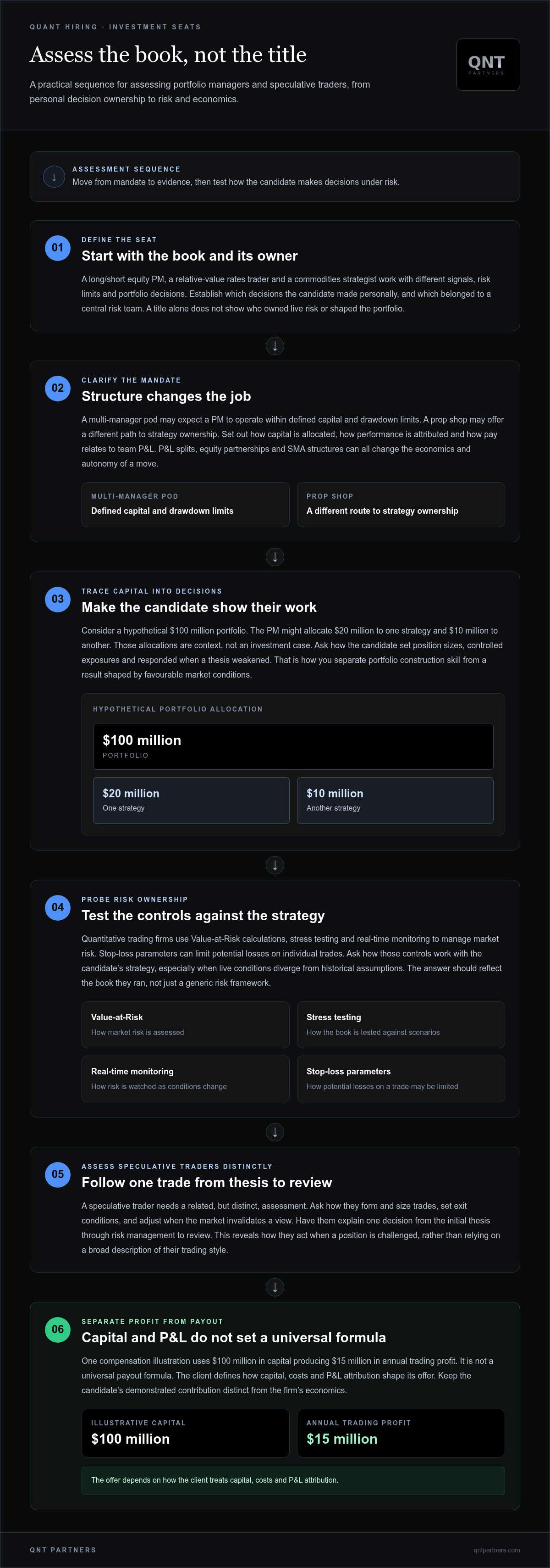
For a PM search, start with the book, not the title. A long/short equity PM, a relative-value rates trader and a commodities strategist own different signals, risk limits and portfolio decisions. Establish which decisions the candidate made personally and which belonged to a central risk team.
The mandate matters. A multi-manager pod may expect a PM to work within defined capital and drawdown limits, while a prop shop may offer a different path to strategy ownership. Clarify how capital is allocated, how performance is attributed and how pay relates to team P&L. P&L splits, equity partnerships and SMA structures can affect both the economics and autonomy of a move.
Take a hypothetical $100 million portfolio. Its PM might allocate $20 million to one strategy and $10 million to another. Those allocations alone don’t explain the investment case. In an interview, I’d want the candidate to show how they set position sizes, control exposures and respond when a thesis weakens. That helps separate portfolio construction skill from a result shaped by favourable market conditions.
Career progression can move from quantitative analyst or researcher into strategy ownership, then broader portfolio responsibility. Tenure alone does not prove readiness. For a PM search across equities, foreign exchange, relative value, rates or commodities, ask candidates to explain their research process, risk remit and contribution to returns. They should distinguish their own decisions from outcomes driven by the wider team.
Risk assessment belongs in the search brief. Quantitative trading firms use Value-at-Risk calculations, stress testing and real-time monitoring to manage market risk. Stop-loss parameters can limit potential losses on individual trades. Ask a PM how those controls work with their strategy, especially when live conditions diverge from historical assumptions. The answer should reflect the book they ran, not just a generic risk framework.
Speculative traders need a related, but distinct, assessment. I’d probe how they form and size trades, set exit conditions, and adjust when the market invalidates a view. Ask for one decision, from initial thesis through risk management to review. A compensation illustration uses $100 million in capital producing $15 million in annual trading profit. It isn’t a universal payout formula. The client defines how capital, costs and P&L attribution shape its offer.
For senior candidates, discretion matters as much as fit. Keep conversations focused on transferable experience, not another firm’s confidential book or live positions. A focused search compares mandate, strategy, capital and risk ownership before treating two PM seats as interchangeable.
Algorithmic execution quants and traders
Execution hiring turns on where the candidate affects the trading outcome. An execution quant may design algorithms for eFX, eFI or eCredit, while an execution trader manages how orders interact with venues and liquidity. The role may sit between research and the live desk, so establish who owns the model, deployment and monitoring.
Latency is one useful way to define the mandate. High-frequency trading tick-to-trade budgets can be roughly 5 to 50 microseconds. Traditional institutional execution tick-to-trade budgets can be under 50 milliseconds, while a 2026 benchmark places top institutional desks’ competitive window under 500 microseconds. These are distinct operating contexts, not interchangeable hiring targets.
That distinction should shape candidate assessment. Ask which part of the execution path the person owned and how they measured its effect. An algorithm developer might discuss order placement logic and backtesting assumptions. An engineer might focus on exchange connectivity, co-location, kernel-level work or FPGA implementation. A trader should explain how they adjusted execution as liquidity or market conditions changed.
The technology stack matters because an optimisation in one layer can shift constraints elsewhere. Map the role across the machine, network, platforms and trading infrastructure before approaching candidates. A low-latency team, for example, may need someone who works across C++ code and FPGA hardware, while another build-out may prioritise venue connectivity or production reliability. The brief should distinguish required ownership from useful exposure.
Interview signals should be specific. Ask candidates to describe a production change, the bottleneck they targeted and the evidence used to judge its effect. For a backtest, probe assumptions about historical data and execution costs. For a live system, ask how the candidate diagnosed a change in fills or order behaviour without disclosing proprietary code or signals.
Execution searches also span asset classes and geographies. A global eFX role differs from an eCredit mandate in its instruments, venues and workflow. Test whether candidates have worked on the relevant platforms rather than relying on a broad “electronic trading” label. A short technical screen can establish whether their experience matches the desk’s actual stack.
For traders, assess judgement alongside system familiarity. Ask how they communicate with researchers and engineers when an execution strategy behaves differently in production. A clear answer should outline how they identify the issue, isolate its source, then decide whether to adjust the model or trading workflow. This reveals how they work across a desk, not just how they describe past results.
A specialist search should define the execution problem before sourcing begins. Specify the asset class, system ownership and latency context, then align interviews with those requirements. This gives candidates a precise picture of the role and helps the desk compare relevant experience.
Confidential quant and trading job searches
I prefer to start a confidential search well before a seat becomes urgent. Funds hiring senior quantitative talent are advised to begin conversations eighteen months before the role is needed. Senior professionals running books may already be having private discussions a year or more before a seat is filled. Early contact gives both sides room to test fit without forcing a rushed process.
For the hiring team, agree what can be disclosed at each stage. An opening description might identify a systematic quant trader for a new equities build-out without naming the fund or exposing its proprietary models. Share more detail once a candidate’s remit and interest are clear. This staged approach lets the recruiter explain the opportunity without broadcasting the strategy.
Make the role concrete enough to assess. A New York City systematic quant trader search has a different brief from a first-hire role combining quantitative research and systematic trading in Greenwich. Before outreach, define whether the seat owns research, live trading, portfolio risk or model development. Candidates need enough context to decide whether a conversation is relevant.
In an initial conversation, focus on the candidate’s scope and working preferences. An analyst considering a PM path can describe their contribution to research decisions without naming proprietary signals or revealing live positions. That detail helps establish the person’s judgement and ownership while respecting their current employer’s confidentiality.
Confidentiality also requires a clear process within the hiring team. Decide who sees candidate profiles, who gives interview feedback and when the fund’s identity can be shared. For a small spinout, limiting early information to decision-makers can reduce unnecessary exposure while the team assesses whether a researcher fits its models and intended trading frequency.
Candidates should set their own boundaries before entering the process. Decide which strategy details are safe to discuss and which examples should stay high-level. A useful account can cover the research question, the candidate’s role and the decision process without disclosing code or confidential performance data. Clear boundaries make technical conversations more productive.
Keep the recruiter and candidate aligned on where a profile may be presented. Candidates should know the mandate before their details are shared, and the search team should avoid duplicate approaches to the same person. These steps matter in a compact market, where an unexpected approach can reveal more than the hiring firm intended.
Confidentiality should not make the opportunity obscure. Explain the strategy type, reporting line and expected ownership at the right point in the process. A systematic researcher or senior trader can then judge the mandate on its substance, while the fund controls when its identity becomes part of the discussion.
Recent hedge fund and trading technology placements
Placement titles show how a hedge fund build-out extends beyond investment seats. Examples include a Head of Linux Engineering in London, a Lead Trade Support Engineer in New York and a Senior FPGA Engineer in London. These roles support the operating environment around trading strategies rather than the research mandate itself.
A Quantitative Developer role focused on Equities and medium-frequency trading in London adds another signal. It sits closer to strategy implementation than infrastructure support. Together, these placements show demand across the systems that run a desk, the support that keeps it operating and the development work connecting research to execution.
That range matters when comparing search firms by specialisation and track record. Look for placements that match the role family, market and seniority, then assess whether the recruiter understands the team’s operating context. A Linux engineering placement is relevant evidence for infrastructure hiring, but does not by itself demonstrate depth in quantitative research or PM searches.
For a technology leader, a title is only the starting point. A Head of Linux Engineering may have a different remit from a Senior FPGA Engineer, even when both support low-latency trading. Define systems responsibility, reporting line and interaction with traders before treating either profile as a match. The same discipline helps distinguish trade support from software engineering.
Machine learning hiring adds another dimension. A hedge fund may seek researchers who build models, while another role may centre on ML infrastructure or software engineering. Do not confuse vacancies with completed placements. For a specialist search, separate advertised roles from filled seats, then compare the candidate’s work with the required research or production remit.
Placement patterns also help candidates understand a firm’s focus. London examples span Linux, FPGA and quantitative development, while the New York example covers trade support. This is useful context, not a guarantee that every search firm covers each location or function. Ask what the recruiter handled personally, what the role required and how the candidate’s experience aligned with the desk.
For hiring teams, assess search evidence at role level. A firm’s record in senior technology hiring may suit a systems build-out, while a fundamental PM mandate calls for different market access and assessment. Match the recruiter’s demonstrated work to the seat rather than relying on broad claims about hedge fund coverage.
Candidates can apply the same test. Identify whether the opportunity is a research, investment or technology seat, then compare its remit with the recruiter’s relevant placement experience. A Linux engineer, for example, should look for evidence of infrastructure searches, while a quantitative developer should look for strategy-linked development work.
QNT Partners: Quant Trading & Research Recruitment
QNT Partners supports hedge funds and trading firms hiring across quantitative investment and trading technology. Turn to us when a search needs to distinguish live-book ownership from research contribution, or when a new team needs specialist capability in quantitative research, engineering or machine learning.
Our services include Trading & Research, Technology & Engineering, AI & ML, and Manager Search & SMA Sourcing. For a PM mandate, this can mean defining the strategy and portfolio remit before approaching candidates. For a trading technology role, it means grounding the search in the systems and engineering requirements.
If you’re planning a quant or trading team hire, visit QNT Partners to start a conversation about the search.
Define the mandate before opening the search
The next hire can change a desk’s research direction, risk ownership or production capability. Before starting a search, write down the decisions the role will own, the interfaces it will depend on and the evidence that would make a candidate credible. This gives interviews a common frame and reduces the risk of selecting for a title rather than the work.
A Quant trading executive search firm should understand how requirements differ across investment and technical seats. At QNT Partners, our Trading & Research, Technology & Engineering, and AI & ML services address distinct parts of that hiring brief. Start with the actual gap: strategy ownership, system delivery or specialist machine learning capability.
Settle confidentiality, interview ownership and candidate communication before outreach begins. These choices matter in a small market, where a poorly handled approach can expose a build-out or create friction with a current employer.
If you’re shaping a quant or trading hire, contact QNT Partners about your search. A clear mandate makes the first conversation more useful.
Frequently Asked Questions
What does a quantitative trading executive search firm specialize in?
A Quant trading executive search firm specialises in recruiting for quantitative investment and trading teams. Its remit can include researchers developing systematic signals, PMs responsible for investment mandates, and specialists building trading technology or machine learning systems. The useful test is whether the search partner can distinguish adjacent roles by their actual responsibilities. For example, a Python quant developer and an ML research scientist may support the same desk but require different technical assessments.
What roles do quant trading recruiters fill, such as portfolio managers, researchers, and traders?
Quant trading recruiters fill investment, research and technology positions across hedge funds and proprietary trading firms. Searches may cover portfolio managers, systematic researchers, speculative traders, execution quants, quantitative developers, low-latency engineers and AI or ML specialists. For a new team, define which role owns the strategy, which supports implementation, and where trading decisions sit. That distinction helps candidates understand the mandate and helps hiring teams assess experience against the work.
What risks and confidentiality concerns arise in quant trading executive searches?
Confidential searches can expose a planned build-out, a senior departure or sensitive strategy details if outreach is poorly controlled. Share information in stages, limit internal access to candidate details, and avoid circulating proprietary code, live positions or models. QNT Partners operates as a recruitment intermediary, and the hiring organisation alone determines candidate suitability. Candidate data is retained for up to two years from last contact, and client and commercial data for seven years. Individuals have rights under UK GDPR.