P&D Quant Roles: Skills, Careers and What Quants Do

Yes, a P&D quant researcher needs to code. Python is the minimum coding requirement because research depends on testing hypotheses against data and translating useful findings into models. The depth of coding varies by role: researchers develop and test ideas, while developers focus on the systems that run them.
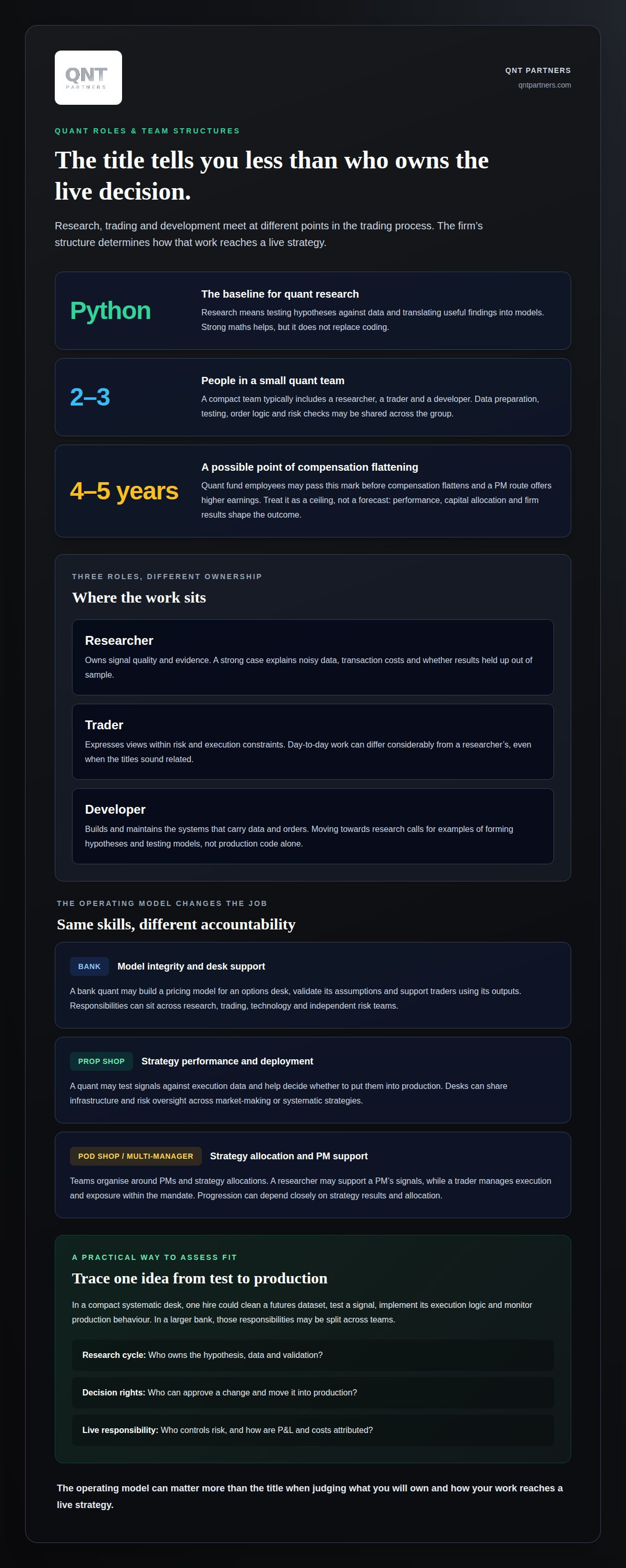
That distinction matters when you’re weighing a role or planning your next move. Strong mathematical skills help, but they don’t replace the ability to work with data and code. A quant trader’s day-to-day work can also differ considerably from a researcher’s, so the title alone rarely reveals what the role involves.
This guide explains what quant researchers, traders and developers do, the technical skills each role uses, and how qualifications can shape a career in quantitative finance. It also explores how roles differ across trading firms and investment teams, helping you assess which path fits your strengths and where your skills could lead.
Key Takeaways
- Python is a baseline for quant research; the role’s real demands depend on how models are tested and put into production.
- Researchers, traders and developers contribute at different points in the trading process, so job titles alone don’t reveal the day-to-day work.
- Qualifications matter, but progression also depends on how your skills connect to strategy performance and responsibility for risk.
- Bank, prop shop and multi-manager structures shape how quant teams operate, including how research and trading decisions are made.
Quant qualifications and career development
A quant qualification may get you to the interview; evidence of research judgement takes you further. A degree in mathematics, statistics, physics, computer science or engineering can provide the foundations, while postgraduate study can deepen expertise in stochastic modelling or machine learning. Credentials matter less when you can explain how you turned a hypothesis into a tested strategy. For example, show how you handled noisy data, accounted for transaction costs and tested whether a result held up out of sample.
Learning continues after you’re hired. A new researcher might start by reproducing an existing result, then build a research pipeline and test a variation under review. This progression reveals practical gaps that coursework may not cover, such as data quality, survivorship bias and execution assumptions. Keep a clear record of each experiment: its hypothesis, data, validation method and reason for rejecting or advancing it. A research notebook or well-organised code repository can help your team understand your contribution.
Progression to portfolio manager is not simply a promotion for tenure. A researcher needs to show that their work can support a live allocation, operate within risk limits and retain capacity as capital changes. Quant fund employees may pass the 4-5-year mark before compensation flattens and a PM route offers higher earnings. Treat that as a ceiling, not a forecast: strategy performance, capital allocation and firm results shape the outcome.
Comparing roles can clarify your options. Researchers are accountable for signal quality and evidence; traders focus on expressing views within risk and execution constraints. Developers build and maintain the systems that carry data and orders. A researcher who enjoys model design may seek ownership of a strategy, while someone drawn to live risk decisions may move towards trading. A developer seeking broader investment responsibility needs to demonstrate market judgement, not just production code quality.
Choose a path by starting with the work you want to own. Review a role’s research cycle, decision rights, risk exposure and contact with production systems. A pod shop may link progression closely to strategy results and allocation, while a prop shop may place greater emphasis on desk-level trading and execution. For a P&D quant, that distinction can matter more than the title when assessing fit. Ask how research moves from testing into production and who can approve changes.
Career development also depends on the structure around the role. In a multi-manager, a researcher may work alongside a PM whose capital allocation depends on strategy performance; in a prop shop, team contributions may be assessed through desk outcomes. For a senior researcher considering independence, an SMA can provide a separate mandate and operating structure. Focus on practical questions: who owns the signal, who controls risk, and how are P&L and costs attributed?
Exit opportunities depend on the skills you can demonstrate. A quant researcher with strong experimentation and data skills can move into systematic asset management or applied machine learning. A trader may take market-making and execution experience to another desk or a strategy-led PM role. A developer can move towards low-latency engineering or financial infrastructure. Before changing direction, compare your production experience, research ownership and risk exposure with the target role. Specific examples make your next step credible.
Quant roles in banks and trading firms
A bank quant usually works within a product or control function; a trading-firm quant is closer to live strategy decisions. At a bank, a researcher might build a pricing model for an options desk, validate its assumptions, then support traders using its outputs. At a prop shop, a quant might test signals against execution data and help decide whether to put them into production. The difference lies in accountability: model integrity and desk support in one setting, strategy performance and deployment in the other.
Team structure shapes the job more than the title. A small quant team typically has 2-3 people, including a developer, a trader and a researcher. One person may own data preparation and testing, while another handles order logic and risk checks. In a larger bank, those responsibilities can sit across research, trading, technology and independent risk teams. Before comparing roles, identify who owns each step from model design to live monitoring.
Pod shops and multi-manager platforms organise teams around individual PMs and strategy allocations. A quant researcher might support one PM’s signals, while a trader manages execution and exposure within that mandate. Prop shops more often organise around trading desks, where market-making or systematic strategies share infrastructure and risk oversight. These differences affect decision-making. A candidate moving from a bank desk into a pod should understand who controls allocation and how research reaches the PM.
Moving between quant roles is possible, but your evidence needs to fit the destination. A bank researcher moving to a prop shop should show how their analysis connects to trade selection, transaction costs and realised outcomes. A developer moving towards research needs examples of forming hypotheses and testing models, not just clean deployment. A trader moving into systematic research can show how market knowledge shaped a signal or execution rule. In each case, explain the work through a specific project and its decision points.
Full-stack quant roles combine work that separate teams might otherwise own. For example, a hire at a compact systematic desk could clean a futures dataset, test a signal, implement its execution logic and monitor production behaviour. That breadth can support faster iteration, but it also requires judgement about where specialisation is needed. A strategy that depends on exchange connectivity or tight tick-to-trade latency may require dedicated engineering depth rather than a researcher handling every layer.
At high-frequency trading firms, trading code must execute trades in microseconds. That puts quant developers close to systems design, profiling and exchange connectivity; at some desks, FPGA work is part of the engineering remit. A researcher or trader entering this environment needs enough technical knowledge to discuss how an idea behaves in production. For example, a promising signal can lose value if an order arrives after the relevant market movement.
Risk management roles also vary by employer. A bank risk quant may assess model behaviour, sensitivities or portfolio stress within defined controls. At a trading firm, risk professionals may monitor positions, limits and intraday losses alongside desk activity. A quant moving between these roles should distinguish model risk from trading risk, then explain how their analysis informs a decision. A scenario test that changes a hedge or limit is stronger evidence than a list of risk tools.
When comparing banks, prop shops and multi-manager firms, assess each role against four points: strategy ownership, production responsibility, risk authority and proximity to trading. A researcher who wants direct influence on capital deployment may prefer a PM-aligned seat; an engineer who prefers infrastructure may value a desk with substantial exchange-connectivity work. These specifics make role comparisons more useful than title or firm type alone.
Quantitative researchers, traders, and developers
A researcher’s output is a tested claim about market behaviour, not a model in isolation. For a P&D quant, that claim needs to connect to trading decisions and systems that can implement it. A short-horizon futures signal, for example, needs clean timestamps, defined features and out-of-sample validation. Researchers test whether an effect persists across instruments and regimes, then document where it weakens. The work calls for statistical reasoning, sound experiment design and the discipline to reject attractive results when costs or data errors explain them.
Traders turn research into decisions under live market conditions. They assess whether a signal should change order placement or inventory, then monitor execution quality and risk. A trader reviewing a market-making strategy might separate adverse selection from temporary spread changes before adjusting quoting behaviour. The role requires market knowledge and sound judgement: model outputs inform trading, but do not dictate it.
Quant developers make research and trading decisions executable. Their work can include market-data handlers, order gateways, simulation tools and production monitoring. A developer profiling an order gateway might trace the time spent parsing messages, remove unnecessary copying and measure the result. In less latency-sensitive strategies, reliability and correct recovery from dropped messages can matter more than raw speed.
Automated strategy development brings these responsibilities together through a controlled research-to-production process. A researcher defines the hypothesis and test, then a trader checks whether simulated behaviour makes sense given market mechanics. A developer implements the order logic and data handling. For a futures strategy, the backtest must represent contract rolls and exchange sessions consistently with live trading. Otherwise, simulated returns may reflect a data mismatch rather than a tradable effect.
A high backtest Sharpe alone is not enough. Researchers should examine transaction-cost assumptions and signal decay across instruments. Developers can help reproduce results by keeping data transformations consistent. Traders can compare simulated fills with live execution to identify where queue position changes outcomes. Each review tests a different part of the strategy: whether the effect exists, whether implementation is faithful, and whether trading supports the assumptions.
Production work continues after deployment. Suppose a model’s live fill rate changes sharply after an exchange data-feed update. Before changing the strategy, the team can compare message timestamps and order acknowledgements with those from prior sessions. This investigation helps distinguish a market change from a system issue. Clear ownership of monitoring helps the team identify the cause and decide whether to pause, adjust or continue running the model.
The strongest role fit depends on which part of the cycle you want to own. A researcher should explain an experiment from data selection through to the final decision. A trader can describe a live decision and its execution consequences. A developer should trace a system change from design through testing and production monitoring. These examples show practical skills more clearly than a list of languages or frameworks.
In a compact team, responsibilities can overlap without blurring accountability. A researcher may write analysis code, while a developer contributes to simulation infrastructure and a trader challenges assumptions based on live flow. For a P&D quant, the practical distinction is who signs off on each change and who monitors it afterwards. That detail shows whether a role offers strategy ownership or focuses on one component of the trading stack.
A P&D quant strategy or indicator can be viewed as a hypothesis about market behaviour that may inform trading decisions and be implemented in trading systems. Validate it beyond the data used to develop it, and assess costs, data errors and whether its effect persists.
Skills in mathematics, coding, and financial markets
Quant work draws on three core areas: mathematics, coding and financial markets. A researcher may use probability to estimate signal strength, Python to test it and market mechanics to judge whether it can be traded. These disciplines overlap, but a weakness in any one can invalidate the result. A sound statistical model built on incorrect contract data is still a poor trading model.
Mathematics is practical, not decorative. Probability and statistics help quantify uncertainty; linear algebra supports optimisation and factor modelling. Time-series methods help distinguish persistent behaviour from noise. For example, a researcher testing a futures signal needs to account for correlated contracts and changing volatility. The key question is whether the effect remains after those dependencies are included in the analysis.
Python is the minimum coding requirement for quant researchers. It supports data analysis, experiment design and model testing, often using libraries for numerical work. Researchers should be able to inspect a dataset, reproduce a result and explain the code’s assumptions. For example, compare a signal’s performance before and after transaction costs, applying the same data filters consistently.
Production research also requires software discipline. Version control helps a team identify which code generated a result, while tests can catch errors in transformations or feature calculations. A researcher working with daily equity data, for example, needs to check that corporate actions and missing observations are handled consistently. Code that runs once is not enough; other team members must be able to reproduce the analysis.
Developers need a different emphasis. C++ can matter when performance and predictable execution are central, while Python often remains useful for research tools. The right choice depends on the system’s bottleneck. A developer profiling an order gateway should measure where time is spent before changing the code. An FPGA may suit a specialised hardware task, but it does not replace careful systems design or correct exchange-message handling.
Market knowledge connects a model to actual trading conditions. Equity, futures and options markets differ in trading hours, liquidity patterns and contract mechanics. A researcher working on futures should understand rolls and settlement conventions; an options researcher needs to account for volatility surfaces and Greeks. These details affect which observations belong in a dataset and whether a backtest represents executable trading.
Execution assumptions need careful scrutiny. A strategy that buys at the midpoint in every backtest may look stronger than one modelled with realistic fills and adverse selection. Traders can compare simulated fills with observed execution, while researchers test how results change under less favourable assumptions. The aim is to understand what drives performance, not to optimise a single headline statistic.
For an interview or internal move, combine these skills in one worked example. Explain the market hypothesis, your data choices, the Python analysis and the result that changed your view. Then describe a failure mode, such as survivorship bias or an unrealistic fill assumption. This account shows how mathematics, coding and market knowledge work together to inform decisions.
Role requirements still vary by desk. A systematic equity team may prioritise reproducible research, while an HFT engineering role may focus on C++, exchange connectivity and profiling. Read the technical remit as a description of the system’s constraints. Your strongest evidence is a project demonstrating the specific skill the role needs, with clear reasoning behind each implementation or modelling choice.
Large quant firms may ingest and store terabytes of market data daily through their data pipelines, so researchers need to understand the data behind market decisions.
QNT Partners: Quant Trading & Research Recruitment
QNT Partners works with quant teams and candidates on searches requiring a precise understanding of strategy, research ownership or technical scope. Its Quant Trading & Research service supports hiring across quantitative trading and research roles. Technology & Engineering and AI & ML cover specialist technical mandates.
For firms building a new desk, appointing a PM or structuring an SMA mandate, QNT Partners’ Manager Search & SMA Sourcing supports the search. Start by defining the role’s decision rights, production responsibilities and connection to P&L. This helps distinguish a researcher who owns signal development from one focused on validation or infrastructure.
If you’re planning a quant hire or considering a move, visit QNT Partners.
Make your next quant move deliberate
The next step is to define what you want to own: research direction, trading decisions or the systems that bring a strategy into production. Then compare roles by mandate, decision rights and proximity to live risk, rather than relying on titles. This makes a conversation about a P&D quant career more concrete, whether you’re considering a move or building a team.
QNT Partners works across Quant Trading & Research Recruitment, Technology & Engineering Recruitment, and AI & ML Specialist Search. For a candidate, the discussion can focus on how your experience maps to a role’s actual remit. For a hiring team, it can clarify which capabilities the search needs to reach. The right match depends on the work, not the label.
Contact QNT Partners about quant careers to discuss your next move or hiring brief. A clear view of the role you want is a strong place to start.
Frequently Asked Questions
Do quant researchers need to know how to code?
Yes. Quant researchers need to code well enough to investigate data, test ideas and make their analysis reproducible. In practice, that means inspecting a dataset, finding errors in its construction and explaining how the code produced a result. Python is a common starting point, but the useful measure is whether you can turn a research question into a reliable experiment and communicate its limitations to colleagues.
Wait, But What is a “Quant”?
A quant is a professional who applies quantitative methods to problems in finance. Depending on the role, that can mean researching market signals, building models, developing trading systems or analysing risk. The term covers a broad range of jobs, not one standard position. For example, a quant researcher may focus on the evidence behind a strategy, while a quant developer builds the software that handles its data or orders.