Network Engineer Recruitment for High Frequency Trading Roles

In high-frequency trading, a network engineer’s value depends on how reliably the trading stack performs under pressure, not on a list of vendor certifications. Effective network engineer recruitment for high frequency trading prioritises low-latency design, exchange connectivity and the ability to diagnose performance issues along the full path from strategy to market. Co-location experience can help, but it does not replace understanding where latency and jitter enter the system.
Small network changes can affect execution. The challenge is finding candidates who can work across switching and routing, packet-level analysis and trading infrastructure, while making sound decisions in production. A strong fit depends on the firm’s architecture and the work the engineer will own.
This article explains what HFT firms need from network engineers and how to assess experience beyond job titles. It covers the technical capabilities that matter, how requirements vary between firms and how a focused recruitment process can match candidates to roles in exchange connectivity, network build-outs or operational performance.
Key Takeaways
- Assess engineers against the trading system they’ll support, not their job titles alone. Exchange connectivity and production troubleshooting experience can be more revealing than a broad networking résumé.
- Match the role to its latency constraints and architecture, including how co-location, network design and the trading stack interact.
- Separate hands-on network engineering from adjacent infrastructure experience, then test how candidates investigate performance issues across system boundaries.
- Define ownership before recruiting: a network build-out, ongoing operations and a targeted latency project call for different candidate profiles.
Network engineer recruitment for high frequency trading
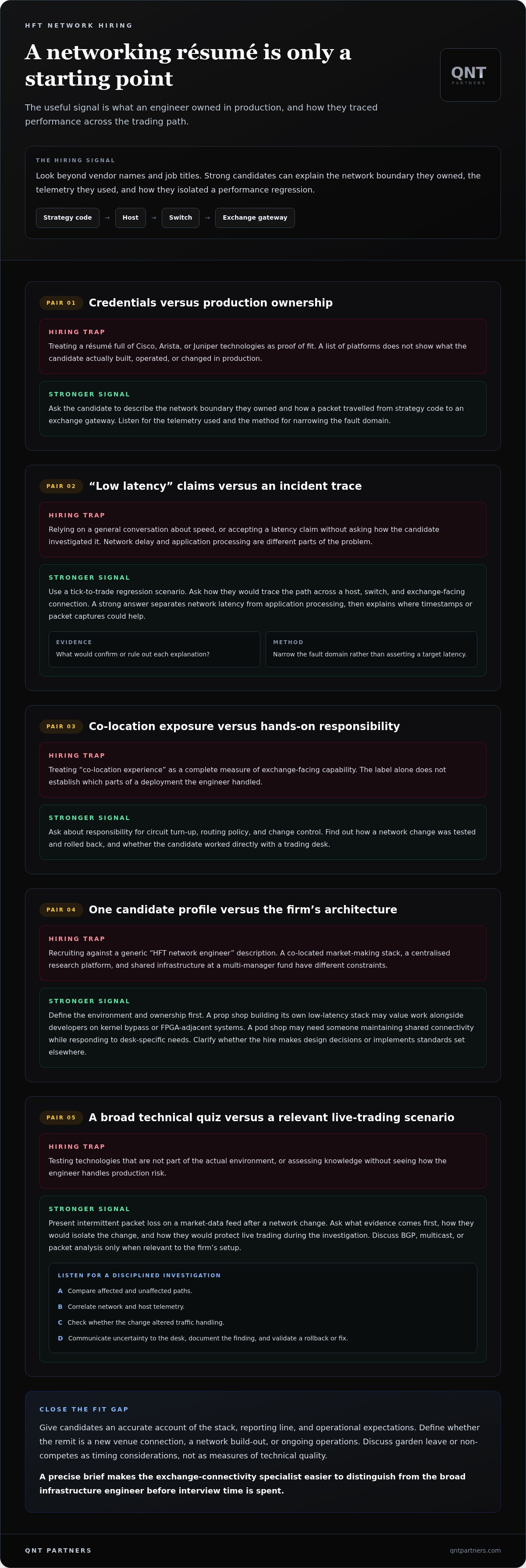
Strong HFT network candidates can explain how a packet travels from strategy code to an exchange gateway. Their account should identify the network boundary they owned, the telemetry they used and how they isolated a performance regression. A résumé listing Cisco, Arista or Juniper technologies is only a starting point. Recruitment should establish what the engineer actually built, operated or changed in production.
Start by defining the system the hire will support. A co-located market-making stack has different constraints from a centralised research platform or a multi-manager fund’s shared infrastructure. Specify the exchange connectivity and network architecture, and clarify whether the role owns design, production operations or both. For example, an engineer supporting a new venue connection may need to coordinate network changes with trading and systems teams.
Assess latency knowledge through a real incident, rather than a general discussion about speed. Ask the candidate how they would trace a tick-to-trade regression across a host, switch and exchange-facing path. Strong answers distinguish network latency from application processing and explain where timestamps or packet captures could help. Look for a disciplined method of narrowing the fault domain, not a claim of achieving a particular latency.
Co-location experience matters when the role includes exchange-facing infrastructure, but the label alone proves little. Ask which parts of a deployment the candidate handled, from circuit turn-up to routing policy and change control. An engineer who worked alongside a trading desk should be able to describe how a network change was tested and rolled back. This detail distinguishes operational ownership from occasional exposure to a trading environment.
Architecture also shapes the candidate profile. A prop shop building its own low-latency stack may value engineers who work closely with developers on kernel bypass or FPGA-adjacent systems. A pod shop may need someone to maintain shared connectivity while responding to desk-specific requirements. Establish whether the role has authority over relevant design decisions or mainly implements standards set elsewhere.
Use a structured technical screen. Present a concise scenario, such as intermittent packet loss on a market-data feed after a network change. Ask what evidence the candidate would collect first, how they would isolate the change and how they would protect live trading during the investigation. Ask about BGP, multicast or packet analysis only when those technologies are part of the actual environment.
Market listings show why role scope needs to be clear. These are distinct listings, not a universal pay scale. Seniority, ownership, firm structure and the role’s connection to trading infrastructure all shape how candidates assess an opportunity.
Close the process by testing fit on both sides. Give candidates an accurate account of the stack, reporting line and operational expectations, then ask which parts align with their experience. Discuss garden leave or non-competes as practical timing considerations, not as measures of technical quality. A precise brief helps distinguish an exchange-connectivity specialist from a broad infrastructure engineer before interview time is spent.
A useful follow-up is to ask what evidence would confirm or rule out each explanation, and how the candidate would keep the investigation safe for live trading. Look for a clear sequence: compare affected and unaffected paths, correlate network and host telemetry, and check whether the change altered traffic handling. The candidate should explain how they would communicate uncertainty to the desk, document the finding and validate a rollback or fix. This tests judgement as well as technical knowledge, particularly when a network change can affect market-data delivery or order flow.
Recent listings show several distinct hiring needs. The Senior Low Latency Network Engineer | High-Performance Trading listing in New York was marked as posted 1 week ago. The HPC Network Engineer | High Frequency Trading listing in the New York City Metropolitan Area was marked as posted 2 days ago, while the Lead Network Engineer (Quant Trading Firm) listing there was marked as posted 1 week ago. The Lead Network Engineer: $500k + (FinTech) listing in New York was marked as posted 2 days ago. The Senior Network Operations Engineer listing by CME Group in Chicago was marked as posted 13 hours ago. These examples underline why recruiters should clarify the role’s operating environment, ownership expectations and compensation scope before assessing candidates.
QNT Partners: Quant Trading & Research Recruitment
QNT Partners helps trading firms recruit for network roles with a clearly defined technical remit. Its Technology & Engineering service connects the hiring brief with candidates whose experience fits the infrastructure they will own, rather than relying on job titles alone.
That distinction matters for a new exchange connection, a network build-out or an operational role supporting an established trading stack. A clear brief should describe the environment, the decisions the engineer will own and how the role works with trading and systems teams. QNT Partners uses that context to focus the search and assess relevant experience against the actual requirements.
If you’re defining a network hire or considering your next move in trading technology, contact QNT Partners to discuss the role.
Set the Next Hire in Motion
A network hire can shape more than current infrastructure. The right person may influence how a trading team approaches future venue connections, platform changes and operational ownership. The hiring brief is therefore a strategic decision, not just a list of technologies to match against a CV.
Network engineer recruitment for high frequency trading works best when the search reflects the team’s direction as well as its immediate technical needs. QNT Partners works across Technology & Engineering and Trading & Research recruitment, with AI & ML search where those capabilities form part of the wider build-out.
If you’re planning a hire or considering a move into a trading technology team, bring the role’s scope and priorities into the conversation. Contact QNT Partners about network recruitment to discuss a focused next step.