Market Data Engineer Search for HFT: Skills and Systems

A market data engineer search for HFT should focus on engineers who can build and tune the full path from exchange feed to strategy, not just work with one low-latency tool. In a well-designed pipeline, a single application thread can handle over one million packets per second. The work spans feed handling, network design, and the systems that deliver clean, timely market data to trading logic.
Latency depends on how the components interact. An FPGA may parse or filter data close to the network interface; a kernel-bypass NIC and DPDK can keep packet processing in user space, while RDMA and multicast support data movement and distribution. The right design depends on the feed, hardware, and trading system it serves.
If you know that reducing latency involves more than choosing fast hardware, this guide explains the engineering judgement behind the stack. It covers how FPGAs, kernel-bypass NICs, DPDK, RDMA, and multicast feeds contribute, their trade-offs, and what to look for when hiring engineers to build or improve an HFT market data system.
Key Takeaways
- Assess candidates by how they reason about feed integrity, packet loss and recovery, not by their familiarity with technology names alone.
- Match the role’s technical requirements to the actual bottleneck, then distinguish hands-on system ownership from exposure to a particular tool.
- Compare compensation in context: firm structure, contribution to P&L and the balance between salary, bonus and longer-term incentives all matter.
- Use interview exercises to test practical judgement, including how a candidate diagnoses sequencing issues, concurrency problems and performance regressions.
- Evaluate experience through production responsibility and clear technical trade-offs; a candidate’s education is only one part of that assessment.
Low-latency networking and multicast feeds
The main challenges are latency variation, packet loss, and data that arrives late, out of order, or incomplete. Engineers must keep feed handling predictable, detect gaps, and restore a valid market state before strategies act.
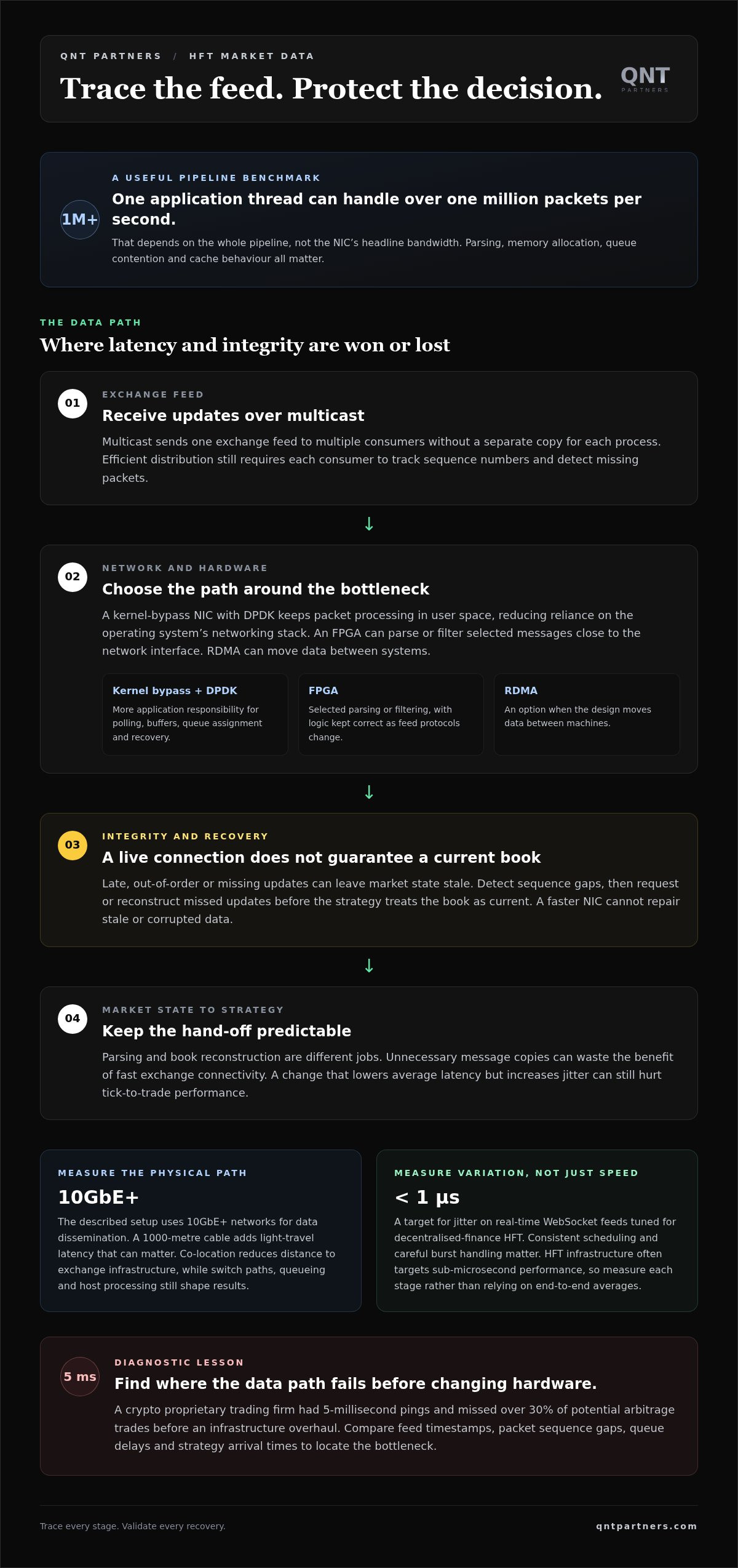
Multicast distributes one exchange feed to multiple consumers without sending a separate copy to each process. This makes distribution efficient, but consumers must track sequence numbers and identify missing packets. A gap can leave a book stale even when the network remains connected. Recovery logic must request or reconstruct missed updates before a strategy treats the book as current.
In a well-designed pipeline, a single application thread can handle over one million packets per second. That figure depends on the pipeline, not just the NIC’s headline bandwidth. Engineers examine packet parsing, memory allocation, queue contention, and cache behaviour. A busy path that repeatedly copies each message can waste the advantage of fast exchange connectivity.
Kernel-bypass NICs and DPDK move packet processing into user space for nanosecond-scale I/O. This reduces reliance on the operating system’s networking stack, but shifts more responsibility to the application. The engineer must manage polling, buffers, queue assignment, and recovery behaviour. A change that reduces average latency but increases jitter can still hurt tick-to-trade performance.
FPGA processing can handle selected tasks close to the network interface, such as parsing or filtering incoming messages. The trade-off is implementation complexity: logic must match feed formats and remain correct as protocols change. RDMA offers another way to move data between systems, while multicast remains useful when several consumers need the same market updates. The right design depends on the data path and its failure modes.
Network capacity matters, but it does not remove physical and architectural bottlenecks. The described setup uses 10GbE+ networks for data dissemination. A 1000-meter cable adds light-travel latency that can matter to HFT performance. Co-location reduces distance to exchange infrastructure, while switch paths, queueing, and host processing still shape the observed result.
Jitter is as important as the fastest observed packet. Real-time WebSocket feeds tuned for decentralised-finance HFT are described as targeting jitter below 1 microsecond. That target requires consistent scheduling and careful handling of bursts, not simply a faster link. HFT infrastructure often targets sub-microsecond performance, so engineers must measure each stage rather than rely on end-to-end averages.
A crypto proprietary trading firm illustrates the cost of shared infrastructure: it had 5-millisecond pings and missed over 30% of potential arbitrage trades before an infrastructure overhaul. The specific lesson is diagnostic. Compare feed timestamps, packet sequence gaps, queue delays, and strategy arrival times to locate the bottleneck. A faster NIC cannot repair stale or corrupted data.
What skills and technologies are required for HFT market data engineering roles?
C++ is central to many low-latency market data roles because engineers need control over memory, concurrency, and execution cost. Strong candidates can explain how a parser handles variable message fields without unnecessary allocation. They should understand object lifetimes, cache locality, and the cost of copying data between stages. Syntax alone is not enough. Candidates should be able to trace a message through production code and explain each source of delay.
Linux knowledge goes beyond everyday command-line use. Engineers should be comfortable investigating process scheduling, CPU affinity, NUMA placement, and memory behaviour. For example, a feed handler pinned to a CPU on one NUMA node can perform poorly if its buffers are on another. Tools such as perf help locate hotspots, while flame graphs make call paths easier to inspect. Candidates should explain what they measured and what changed after a specific optimisation.
Market data expertise means understanding how raw exchange messages become a usable book. A candidate might discuss decoding an ITCH feed, applying incremental updates, and handling a sequence gap without presenting stale state as current. They should distinguish message parsing from book reconstruction and explain how they validate state after recovery. One useful test is to ask them to reason through a crossed book caused by missed or misapplied updates.
Concurrency is another practical skill. Ask how the engineer would pass updates from a feed handler to a strategy without unpredictable contention. A lock-free queue may suit one design, while a simpler single-producer, single-consumer path may be easier to reason about. Strong answers cover memory ordering and ownership, not just the name of a data structure. Candidates should recognise when extra threads add coordination costs instead of useful throughput.
Hardware skills depend on the system boundary. An engineer working with an FPGA should understand how software and programmable logic divide parsing or filtering tasks. Kernel-bypass systems call for familiarity with user-space networking and the operational demands of managing buffers and queues. RDMA experience is useful when a design moves data between machines. Candidates should connect each tool to a measured bottleneck, rather than treating it as a credential.
Testing distinguishes production engineers from benchmark specialists. Look for experience with deterministic replay, synthetic traffic, packet capture, and regression tests. For example, replay a burst around a sequence gap, then check the reconstructed book state and downstream timestamps. Engineers should explain how they compare latency distributions, investigate tail events, and ensure a performance change does not weaken correctness.
Define the system boundary before assessing technical depth: exchange protocol, host software, FPGA logic, or the strategy-facing interface. That scope determines whether deep C++ or hardware design should carry more weight. It also clarifies which team owns changes to message schemas and downstream APIs. The strongest evidence is direct responsibility for the components the role will maintain or extend.
What are typical market data engineer salaries and bonuses at HFT firms in the United States?
There is no single useful US compensation figure for every HFT market data engineer. A Chicago proprietary trading firm and a New York multi-manager may value the same title differently because their mandates, bonus systems, and hiring needs differ. Compare the full package and the role’s decision-making scope, not base salary alone.
Base salary is the fixed component. It reflects the engineer’s level, the system they will own, and the firm’s hiring structure. A role focused on maintaining an established feed handler differs from one building exchange connectivity for a new strategy pod. The title may be the same, but accountability and technical expectations can vary.
Bonus design needs a separate discussion. In a pod shop, an engineer may support a team whose results influence variable compensation. A prop shop may assess contribution through a different internal framework. Ask how the firm connects engineering impact to bonus decisions, who evaluates that impact, and whether the arrangement is discretionary or tied to defined performance criteria.
Do not assume an engineer receives a trader’s P&L split. Their relationship to strategy performance, team structure, and compensation policy all matter. For example, someone building a shared market data platform may support several strategies without owning a trading book. Their contribution may be assessed through platform reliability, delivery, and the trading teams they enable.
For a multi-manager role, clarify whether the position sits centrally or within a specific pod. A central infrastructure engineer and a pod-embedded engineer may have different reporting lines and bonus discussions. Ask how performance is reviewed when a system serves multiple teams. That detail explains the package more clearly than the role title alone.
Treat equity or partnership participation as a distinct component, not as interchangeable with cash. Ask what the instrument represents, how it vests, and what conditions apply if the engineer leaves. A spinout may discuss ownership differently from an established prop shop. Do not assign a cash equivalent without understanding the terms.
Compare offers using a consistent breakdown: base salary, target or discretionary bonus, deferred compensation, and any equity or partnership component. Then examine the review period and assessment criteria. A larger stated bonus means little if its calculation, timing, or level of discretion differs from another offer.
Candidates should document the scope of their contributions before compensation discussions. A clear account of exchange integration, production incidents resolved, or systems delivered gives the hiring team concrete evidence. Employers should define the role’s ownership and performance measures before setting a package. This makes comparisons between a platform hire and a strategy-specific engineer more grounded.
What interview questions and coding tests are common for HFT market data engineers?
HFT interviews should test how an engineer reasons through failure, not just whether they can recite C++ features. Start with a concrete incident: a feed handler receives a sequence gap during a busy market. Ask what the candidate would inspect first, how they would prevent stale book state from reaching a strategy, and what evidence would show that recovery succeeded.
Coding exercises often focus on parsing, state, and correctness under pressure. Give the candidate a simplified exchange message format and ask them to decode updates into an order book. Then introduce malformed input or a missing sequence number. Look for explicit validation, clear recovery behaviour, and careful state handling. The implementation matters, as does the candidate’s explanation of assumptions and edge cases.
A second exercise can test concurrency without turning the interview into a puzzle contest. Ask the candidate to design a producer-consumer path between a feed handler and a downstream strategy. Have them explain queue ownership, memory ordering, and what happens when the consumer falls behind. A strong answer identifies the required consistency guarantees before proposing a lock-free structure.
Performance questions should focus on measurement, not instinct. Show a small C++ hot path that allocates memory or copies each message. Ask how the engineer would investigate its cost, what they would measure, and how they would confirm an optimisation helped. Specific discussion of profiling, cache misses, or tail latency is more useful than claiming one coding style is always faster.
- Feed recovery: Present a sequence gap and ask how the candidate detects it, rebuilds valid state, and resumes updates.
- Book logic: Request an implementation for adding, modifying, and cancelling orders, including duplicate or out-of-order messages.
- Production diagnosis: Provide timestamps showing delayed processing, then ask the candidate to isolate network, queue, and application stages.
Interviewers should assess correctness separately from speed. For an order-book task, check whether price levels and order identifiers remain consistent after cancellations. For a latency diagnosis, assess whether the candidate distinguishes network arrival from application processing. This prevents a polished explanation from masking a broken implementation.
Keep the exercise close to the actual role. A team hiring for exchange connectivity should test protocol handling; a group building internal distribution should assess interfaces between consumers. Avoid obscure algorithm questions unrelated to production work. The best signal is a candidate who states assumptions, tests failure cases, and can defend design choices with evidence.
Candidates can prepare by practising a complete path: decode a message, update state, detect an invalid transition, and explain recovery. They should also be ready to discuss a real production issue without disclosing confidential details. A clear account of the symptom, investigation, change, and measured result gives the interviewer concrete evidence to assess.
What experience and education do HFT firms require for market data engineering jobs
Production ownership usually carries more weight than a degree title in HFT hiring. A DeepFin Research role required 3-7+ years of data engineering experience, a role-specific benchmark rather than a universal threshold. Firms look at the systems an engineer has operated, the incidents they have handled, and how closely that work matches the team’s remit. The depth of responsibility matters as much as tenure.
Relevant experience can come from an exchange, a trading firm, a market data vendor, or a demanding systems group. Focus on what the candidate personally owned. Someone who integrated a venue’s instrument reference data, for example, should explain how they handled symbol changes and downstream consumers. A résumé listing technologies alone reveals little about their judgement or the consequences of their decisions.
Ask candidates to describe a system they took from design into production. Which decisions did they make, and how did they validate the result? A useful example might involve a new venue integration or a change to a feed schema. Listen for a clear distinction between individual contributions and team output, and an explanation of how the engineer maintained compatibility for existing consumers.
Adjacent experience can transfer, but identify the learning curve. A Linux engineer from a networking team may bring strong operating-system knowledge yet need to learn exchange protocols and market semantics. A data engineer from a slower environment may know stream-processing patterns but have less exposure to tight tick-to-trade constraints. Assess each gap against the work the hire will own.
Computer science, computer engineering, electrical engineering, and mathematics can each provide relevant foundations. Coursework in operating systems or computer architecture can help explain a candidate’s technical grounding. A degree alone does not demonstrate production judgement. Someone with another academic background may show relevant ability through shipped systems, technical projects, or a careful account of a difficult engineering decision.
For FPGA-focused positions, assess digital-design experience alongside software knowledge. The candidate should explain how hardware logic interacts with host software and how they tested that boundary. For software-heavy roles, examine C++ experience, Linux debugging, and the engineer’s ability to explain trade-offs between optimisation and maintainability. Let the system’s hardware boundary determine which experience is essential.
Career history needs context. A move between a prop shop and a multi-manager may reflect a different reporting line or a change in system ownership. Ask what the engineer delivered in each environment. Candidates should explain any garden leave or non-compete constraints plainly, without sharing confidential information from a current or former employer.
Set the essential criteria before screening, then assess candidates against specific evidence rather than employer prestige. If you’re defining that profile or considering a move into HFT engineering, contact QNT Partners to discuss the search and the experience the role requires.
QNT Partners: Quant Trading & Research Recruitment
QNT Partners supports firms hiring for specialist market data and low-latency engineering roles through Technology & Engineering Recruitment. This service is a strong fit when a team needs to define the role clearly, distinguish essential production experience from useful adjacent skills, and assess candidates against its actual systems.
That can involve shaping a search around exchange connectivity, market data infrastructure, or the boundary between software and FPGA work. We align the hiring brief with the engineering scope, so interviews test the capabilities the role requires rather than isolated technology keywords.
If you’re building a team or considering your next HFT engineering role, contact QNT Partners to discuss the search.
Set the search around the system you need to build
The strongest hiring brief starts with the engineering problem, not a list of fashionable tools. Define which components the role will own, how the team will assess production judgement, and where the engineer will work with trading or research. That clarity helps candidates evaluate the opportunity based on its real technical scope.
A market data engineer search for HFT also needs a realistic view of adjacent hiring needs. QNT Partners offers Technology & Engineering Recruitment for specialist systems roles, alongside Quant Trading & Research Recruitment and AI & ML Specialist Search. The right search starts by matching the mandate to the capability required, whether you’re building a team or considering a move.
Contact QNT Partners to discuss your needs. A well-defined brief gives the conversation a practical starting point.
Frequently Asked Questions
What does a market data engineer do at a high-frequency trading firm?
They own the operational controls that keep market data integrations aligned with venue requirements and internal trading rules. This can include maintaining instrument eligibility, coordinating configuration changes, and documenting the impact of a venue update before it reaches production. For example, a new contract’s reference data may need approval before a desk enables it. Clear ownership helps trading and operations teams understand when a change is ready to use.
Which HFT firms are hiring market data engineers in the United States?
US openings tend to appear at proprietary trading firms building their own execution stack and at market makers expanding venue coverage. Multi-manager platforms may hire for central infrastructure teams or individual pods. Hiring activity changes with new strategies, exchange access, and internal build-outs, so role descriptions often reveal more than an employer’s broad label. Look for positions that identify the team’s users, production ownership, and the systems being developed.
What market data protocols and feeds should an HFT market data engineer know?
Understand the difference between direct venue feeds and vendor-normalised feeds, as each offers different levels of control over message detail and data handling. Know whether a feed is market-by-order, showing individual order events, or market-by-price, aggregating activity at each price level. Also learn how snapshot data relates to incremental updates. These distinctions help engineers assess what information reaches a strategy and what reconstruction work the consuming system must perform.
Where can I find current HFT market data engineer job listings and recruiter contacts?
Check trading firms’ career pages for vacancies, and contact specialist recruiters when a role’s technical scope needs context. You can reach QNT Partners through its website with a role or candidate profile in mind. QNT Partners operates as a recruitment intermediary; the hiring organisation alone determines candidate suitability. Candidate data is retained for up to two years from last contact, and client and commercial data for seven years. Individuals have rights under UK GDPR.