Manager due diligence for asset allocators: assess fit

A backtest can look convincing right up to the point when live fills, market impact and capacity start to matter. I’d judge a strategy by what its live results say about the edge, and whether the team’s trading infrastructure and risk controls can support it at the proposed scale.
A strong return stream is useful only if you can identify what produced it and how it may interact with the rest of the book. Separate live performance from backtested results, examine execution and capacity, and look for evidence that the team understands both the strategy’s edge and its failure modes.
I’d assess the investment approach, performance and supporting documents alongside operational risks. The key question is whether the strategy’s exposures, liquidity profile and risk budget fit the rest of the book, rather than whether the returns look attractive in isolation.
Key Takeaways
- Separate live results from backtests, and trace returns to the strategy’s actual markets, execution and risk sources.
- Keep research and strategy decisions in a central audit trail so approvals, evidence and later reviews stay connected.
- Assess operational controls alongside the trading process, including valuation, reconciliation, access controls and business continuity.
- Judge a strategy’s fit against existing exposures, liquidity needs, investment horizon and risk budget, not standalone performance alone.
- Use scoring frameworks to structure comparisons, while keeping qualitative judgement for risks a score cannot capture.
1. What Quant Manager Due Diligence Reveals
In quant funds, mandate constraints show up in the details of the strategy and its operating model. A pension fund may need liquidity aligned with benefit payments, while an endowment may have a different spending horizon. A fund of funds also looks through underlying managers to identify exposures and overlap. The practical questions are where returns come from, which markets and instruments are traded, how long positions are held, and what leverage and capacity look like. Reported performance can then be checked against administrator, broker or exchange records.
Manager, fund and strategy data often sit across several systems and teams. A controlled record links each approval to its supporting documents, reviewer and date. Retaining versions of performance reports, risk exposures and operational materials makes changes traceable when staff or strategy details shift. Access controls are relevant to the trading team too: raw trading data can reveal execution, position sizing, turnover and potentially the strategy itself.
LP engagement can shape what a quant manager reports and how often. Regular dialogue gives LPs a way to discuss progress against agreed objectives, even when they represent a smaller share of fund capital. For an impact mandate, reported indicators need to connect to the stated thesis. Reviewing progress over time and, where relevant, at portfolio-company level gives context. The manager’s data-collection process can affect how those outcomes are reported.
Regulatory obligations sit alongside fund structure and governance. In the Cayman Islands, regulations 3(1) and 33 of the Anti-Money Laundering Regulations require a fund to designate natural persons at managerial level. They serve as compliance officer, money laundering reporting officer and deputy reporting officer; the fund must notify CIMA. For a quant firm, those roles need named owners and a clear route for escalating compliance issues.
Cybersecurity, compliance, valuation and continuity checks touch the systems and processes that support trading. They include access controls, incident response, compliance reporting, valuation governance, reconciliations and recovery arrangements. A SOC 1 report can support review of service-provider controls where one exists. Valuation processes need a recorded method, approval path and treatment of exceptions. Continuity planning determines how trading and oversight proceed if a critical system or service provider becomes unavailable.
The AIMA DDQ offers a starting point, but strategy and fund structure shape the useful questions. An operational due diligence analyst can review the questionnaire before a manager visit and test its answers during the visit. Ongoing monitoring tracks changes against the approved investment case. For impact commitments, recording progress toward stated objectives and the manager’s actions gives LPs a basis for continued engagement.
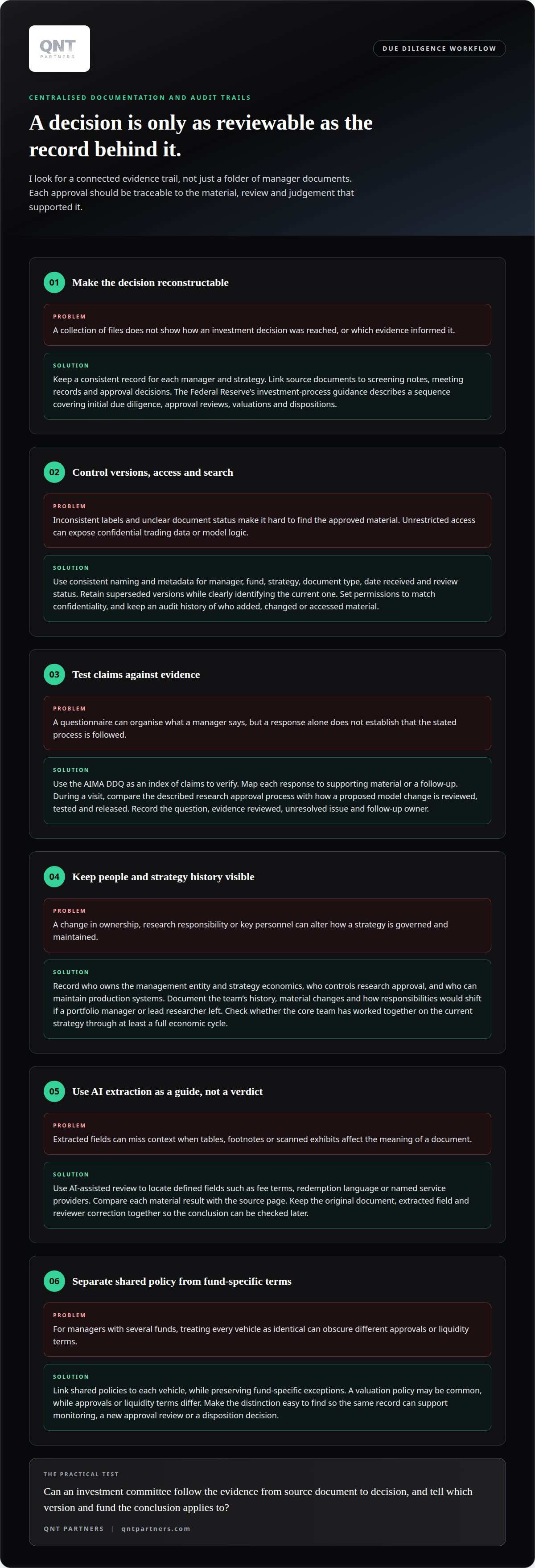
3. Centralized due diligence documentation and audit trails
A document repository is useful only if an investment committee can reconstruct how a decision was made. Give each manager and strategy a consistent record, then connect source documents to screening notes, meeting records and approval decisions. The Board of Governors of the Federal Reserve System says investment processes should document initial due diligence, approval reviews, valuations and dispositions. That sequence creates a usable governance audit trail, not simply a folder of files.
Set document controls before collecting materials. Use consistent naming and metadata for manager, fund, strategy, document type, date received and review status. Keep superseded versions available while making the current version clear. Access permissions should reflect confidentiality: raw trade data and model documentation may expose execution logic or intellectual property. Search should surface the relevant approved record, while an audit history shows who added, changed or accessed material.
Questionnaires are an index, not proof. Use the AIMA DDQ to identify claims that need evidence, then map each response to a document or follow-up. During a site visit, test those claims against the manager’s actual workflow. For example, compare the described research approval process with how a proposed model change is reviewed, tested and released. Record the question, evidence reviewed, unresolved issue and follow-up owner.
Apply the same documentary discipline to the team, ownership and key-person risk. Record who owns the management entity and strategy economics, who controls research approval, and which individuals can maintain production systems. Ask how responsibilities would change if a portfolio manager or lead researcher left. The manager’s core team should have worked together on the current strategy through at least a full economic cycle; document the team’s history and any material changes.
AI-assisted review can help extract defined fields from lengthy documents, such as fee terms, redemption language or named service providers. Treat extracted text as a navigation aid, not an authoritative answer. Compare each material result with the source page, especially when tables, footnotes or scanned exhibits affect its meaning. Keep the original document, extracted field and reviewer correction together so later users can see how a conclusion was reached.
For a manager with several funds, link shared policies to each vehicle while preserving fund-specific exceptions. A valuation policy may be common, while valuation approvals or liquidity terms differ by fund. Search should make that distinction easy to find. The same record can then support monitoring, a new approval review or a disposition decision without confusing one vehicle’s evidence with another’s.
For a manager search involving an SMA mandate, discuss the mandate’s documentation requirements before the review begins.
5. Strategy fit, diversification, and risk budgets
A quant strategy can look compelling in isolation and still add little to a firm’s existing book. Start with the role it is meant to play, such as diversifying equity beta or contributing returns across different volatility regimes. Then compare that role with existing strategies’ exposures instead of relying on labels. Two funds described as market-neutral may still share crowded factors, liquidity risks or drawdown patterns.
Map the strategy’s realised and expected exposures against the firm’s existing risk budget. Review maximum drawdown, volatility, downside risk, leverage, concentration, liquidity and tail exposure. Correlation can shift under stress, so test how the strategy performed when volatility rose, liquidity weakened or cross-asset correlations changed. Low historical correlation alone is not sufficient evidence of diversification.
Size the strategy against its capacity and the firm’s liquidity needs. For a high-turnover equity strategy, examine traded volume, position sizes, execution costs and likely market impact at the proposed scale. Then assess whether the team can tolerate slower exits in stressed markets. Strategy liquidity and the firm’s liquidity needs are related, but they are not interchangeable.
Investment horizon also affects fit. A strategy with scheduled cash outflows may place greater weight on redemption terms and liquidity under stress. A longer-horizon strategy may accept a different liquidity profile, provided its drawdown behaviour fits its spending and risk constraints. Record the rationale for the strategy’s scale and the conditions that would trigger a review.
Diversification also applies to AI exposure. Spread exposure across asset classes rather than concentrating it in thematic strategies. Assess what drives each strategy’s returns: direct ownership of AI-related companies, broad equity exposure to firms adopting AI, or systematic approaches using machine learning. Similar labels can conceal very different concentrations and shared underlying risks.
For diversity, equity and inclusion, assess evidence tied to the team’s investment and organisational processes. Review how hiring, retention and decision rights work across the team, and whether different perspectives inform research challenge. In an emerging quant team, for example, identify who can approve a model change and who can halt deployment. These details connect stated commitments to actual governance.
Keep the conclusion specific to the firm. Document which exposure the strategy is expected to add, where it overlaps with existing positions, and what risk budget it uses. Set monitoring triggers for changes in correlation, concentration, liquidity or key exposures. Reassess the strategy’s fit when its behaviour or the firm’s constraints materially change.
4. What operational areas should quant teams scrutinise?
Operational controls can fail even when the model works as intended. When I assess a quant build-out or a potential spinout, I start with the legal structure, custody arrangements and administrator responsibilities. Trace a subscription from investor instruction through cash receipt, unit allocation and reporting. For a quant fund, map who can change production code, approve deployments and halt trading. Any gap between documented authority and actual system access needs direct follow-up.
Reconciliation is a practical test of controls. Compare positions and cash across the manager’s books, administrator records and prime broker statements. Investigate breaks by cause, owner and resolution rather than accepting a final balance alone. For an SMA, identify which party instructs the broker and how trade allocations reach the custodian. These workflows show whether ownership and oversight remain clear across service providers.
Valuation governance needs evidence beyond a policy document. Trace a less-liquid position from pricing input to recorded value, challenge process and approval. Check how stale prices, model changes and pricing disputes are escalated. If the portfolio holds exchange-traded instruments, compare the manager’s marks with broker or exchange records. Test the actual holdings and valuation methods, rather than relying on a generic control description.
Assess technology infrastructure against the strategy’s trading requirements. A high-frequency system may depend on co-location, exchange connectivity, FPGA logic and tightly controlled software releases. A medium-frequency strategy may rely more on research pipelines, data integrity and repeatable batch jobs. In either case, trace a market-data change through testing, approval and production monitoring. The operational setup should match the strategy.
A business continuity review should show how trading and oversight work when a critical dependency fails. Use a concrete scenario, such as loss of a primary data feed or an unavailable key operator. Examine the recovery sequence, escalation owner and records needed to resume safely. Key-person risk matters too: a systematic portfolio still depends on people who maintain models, infrastructure and risk controls.
Managers can delegate analytical work, but remain responsible for decisions and oversight. The Board of Governors of the Federal Reserve System says third parties should be independent, reliable and qualified. Map each outsourced function to its provider, internal owner and review process. Identify who challenges administrator reporting and who escalates unresolved exceptions to management.
Record each operational finding and its consequence. Classify issues by their effect on custody, trading, valuation or reporting, then assign an accountable owner and remediation evidence. An unresolved reconciliation break may warrant a different response from a delayed policy update. That distinction gives the team a clear basis for deciding what to fix before launch and what to monitor once trading starts.
5. How do allocators compare manager due diligence frameworks and scoring models?
A framework makes reviews consistent, but it should not make unlike strategies appear comparable. The AIMA DDQ gives hedge fund reviews a common starting point, while an allocator can add questions for a specific mandate. Private markets use a different reference point: the ILPA DDQ plays a role similar to the AIMA DDQ in hedge fund due diligence. The useful test is how well each framework covers the strategy, vehicle and risks under review.
A scorecard works best when it separates pass-or-fail conditions from qualities that can be weighed. Legal authority, custody arrangements or unresolved control failures may require a clear gate. Research depth, team continuity or portfolio fit can support comparative assessment. Define what each rating means before reviewing managers. For example, “evidenced” should point to a specific document or observed process, while “unresolved” should identify the missing evidence and its impact on the decision.
Ratings should follow evidence, not presentation quality. A polished deck should not receive the same credit as reconciled live trading records or a tested operational workflow. For each assessment, record the source, reviewer and rationale. If reviewers disagree about a manager’s capacity, preserve both views and identify whether they differ on market impact, execution costs or position sizing. That gives the score a decision trail.
Weights should reflect the mandate. A short-horizon systematic strategy may place greater emphasis on execution and infrastructure than a slower-turnover strategy. A fund with limited liquidity may need closer scrutiny of redemption terms and portfolio cash needs. Keep the underlying assessment visible when weights change, so an aggregate score cannot conceal a weak result in a critical area.
Compare managers within a relevant peer set, then record the reasons for any exception. A high total should not override a material weakness in custody, valuation or key-person coverage. A lower rating in a secondary category may not disqualify a strategy with a clearly evidenced role in the portfolio. Committee papers should show both the component ratings and the allocation decision they informed.
Calibration depends on monitoring existing investments. Compare initial ratings with later events, such as a change in the investment team, deteriorating liquidity or a shift in strategy capacity. If the score failed to flag a meaningful change, revise the question or evidence threshold. That keeps the model useful as managers and market conditions evolve.
A mandate-specific manager review should make the allocation criteria explicit before scoring begins.
QNT Partners: Manager Search & SMA Sourcing
When an allocation needs a specialist quant manager or an SMA, the mandate has to fit the strategy, team and operating model. I look at those together, so the search has a clear investment context.
For a new allocation, spinout review or tailored mandate, a useful brief sets out the expected return source, capacity needs and portfolio role. That keeps discussion focused on fit, not broad claims or headline performance alone.
A manager search or SMA mandate should start with those requirements. Manager Search & SMA Sourcing is the relevant work when an allocator needs that fit assessed.
Turn your mandate into a focused search
A portfolio gap is only useful as a starting point if the mandate explains what needs to change. Define the return source, risk role and operating requirements first. Performance targets alone rarely tell you whether a manager’s process fits the job.
For teams building around a specific strategy, the structure matters as much as the return target. A pod shop, prop shop and multi-manager platform can offer very different capital, risk limits and operating support. Put those requirements in the brief before comparing candidates.
Document the portfolio rationale and key selection criteria before discussions begin. A clear manager profile makes it easier to distinguish a genuine fit from a strategy that simply looks good on paper.
Frequently Asked Questions
What Should I Check Before Joining a Quant Team?
For an emerging manager or spinout, establish which parts of the prior strategy and team have carried over. A track record associated with a former platform may not describe the current operation. Clarify who owns the research, controls the strategy and is accountable for investment decisions. Those details shape your remit and how your work will be assessed.
Which Performance Metrics Matter When Evaluating a Quant Role?
Ask for a gross-to-net return bridge showing how trading costs and other strategy expenses affect investor returns. For a high-turnover strategy, examine whether reported performance reflects realistic execution assumptions and actual trading conditions. Consistent definitions matter: compare like-for-like reporting periods and check whether methodology changes are identified. That helps distinguish a change in strategy economics from a change in how results are presented.
What Should I Ask About a Team’s Trading and Research Processes?
Ask about the trade error policy, position-allocation methodology and records of material strategy changes. These can show how the team handles exceptions that may not appear in headline returns. For an SMA, review the mandate’s trading and reporting arrangements, including how the manager allocates orders across accounts. QNT Partners’ privacy notice states that candidate data is retained for up to two years from last contact and client and commercial data for seven years; individuals have rights under UK GDPR.
How Should I Assess a Potential Move to a Quant Fund?
Define your non-negotiable requirements before comparing roles, then identify the evidence that can resolve each decision point. Separate issues that would block a move from those that can be addressed through role conditions. Set out remaining uncertainties and agree who will resolve each one. Before accepting, keep a clear record of the terms and expectations so you can distinguish a deliberate trade-off from an overlooked requirement.
What Are Common Red Flags When Evaluating a Quant Team?
Watch for unexplained changes in reporting definitions, selective performance start dates or material claims that cannot be reconciled across team materials. A sudden change in data vendors or research inputs also warrants scrutiny if the team cannot explain its effect on the strategy. These signals do not prove misconduct, but they weaken the case for joining until the discrepancy has a clear, documented explanation.
What Regulatory Issues Should I Check Before Joining a US Fund?
The United States Securities and Exchange Commission withdrew its 2023 safeguarding proposal on 17 June 2025, while Rule 206(4)-2 under the Investment Advisers Act remained the operative custody rule. QNT Partners operates as a recruitment intermediary, and candidate suitability is determined solely by the hiring organisation. QNT Partners does not provide financial, investment or regulatory advice. The applicable regulatory analysis depends on the relevant fund and parties.
How Often Should I Reassess My Role and Team?
Distinguish routine updates from a full reassessment of your role. Regular conversations can cover current responsibilities and changes in reporting, while a material change in strategy ownership or mandate may warrant a fresh discussion. Agree escalation criteria in advance so you know which developments need prompt attention and which can wait for the next scheduled review.