Machine Learning Strategist Executive Search for Senior AI Leaders

A polished AI résumé doesn’t show whether someone can lead. Look for evidence of decisions owned, teams built and work that changed how a business operates. That is what machine learning strategist executive search must uncover, beyond keyword matches and impressive titles.
For a senior hire, technical fluency is the baseline. The harder question is whether the candidate can connect research priorities to the company’s operating needs and take responsibility for the trade-offs.
This guide explains how to assess leadership experience, shape a brief and shortlist, and adapt a search for a growing company. It also covers the executive remit and why a well-defined placement starts with clear expectations on both sides.
Key Takeaways
- Assess senior AI candidates by the decisions they owned and the business impact they delivered, not by résumé keywords alone.
- Define outcomes, reporting lines and board relationships in the search brief before candidate sourcing begins.
- Shape a shortlist around evidence of fit for the company’s mandate, including the candidate’s ability to move work from research into production.
- For a growing company, clarify which leadership gaps need solving now and how the executive remit may change as the business scales.
- Set the strategist’s scope around technical direction and organisational impact, including how they build and mentor machine learning research teams.
How do you assess senior AI executive search candidates?
Assess senior AI candidates by how they connect research decisions to an operating environment. In quantitative trading and HFT, that means testing technical judgement alongside leadership and commercial ownership.
Industry and Regional Demand
Demand in the United States varies by sector. Financial firms need leaders who understand the constraints of moving research into production, while healthcare and life sciences organisations prioritise scientific workflows and validation. Regional demand often follows specialist teams and infrastructure: New York and Chicago are associated with trading talent, while the Bay Area has a strong technology focus. Boston’s life sciences concentration can also shape searches.
For a trading firm, test whether the candidate can assess model performance alongside exchange connectivity, co-location and tick-to-trade latency. A research result that cannot meet deployment requirements is not an executive outcome.
Executive Role Scope
At executive level, a machine learning strategist sets research priorities and connects them to the firm’s operating model. In a systematic fund, that could mean defining how researchers, software engineers and portfolio managers share ownership as a model moves from research into a live strategy.
Examine how the candidate handles technical disagreement. Can they challenge a backtest, explain deployment trade-offs to a portfolio manager and secure engineering capacity without blurring accountability? The strategist should also establish review practices that help researchers develop while keeping production standards clear. Team engagement shows in whether people raise failed experiments and operational issues, not just in stated values.
Qualifications and Experience
There is no single required credential. Relevant qualifications may include advanced study in machine learning, statistics or computer science, but experience that fits the mandate is a stronger test. For an HFT search, look for leadership across research and deployment, along with the judgement to assess latency constraints and the consequences of model changes.
Ask candidates to walk through a decision they personally owned: the hypothesis, evaluation method, production handoff and operational change that followed. Probe their role in hiring and mentoring researchers, resolving disagreements with engineering, and setting priorities when compute or data access is constrained. Strong candidates distinguish their contribution from the team’s, explain where an approach failed and show how that experience changed subsequent research practice.
Executive search brief and candidate shortlist
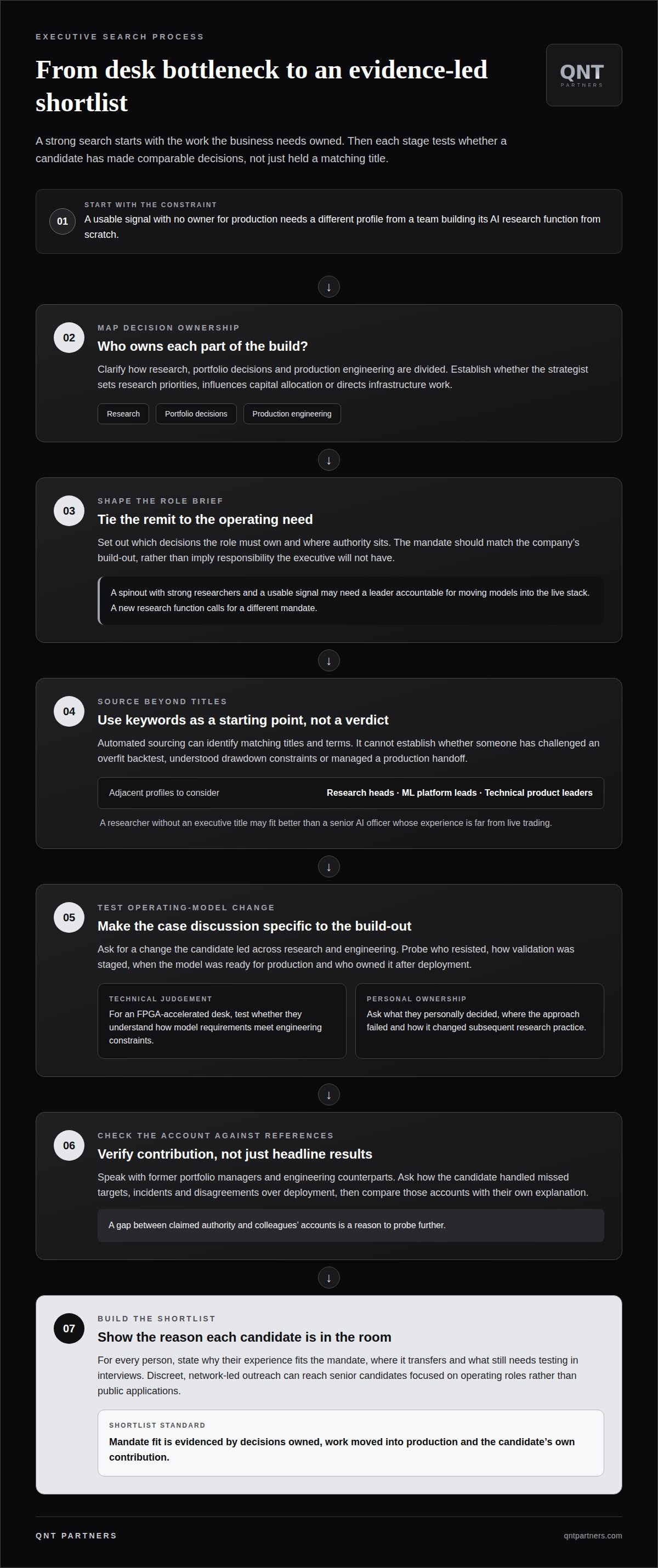
Start a quantitative AI search by identifying the desk’s actual bottleneck. A spinout from a Chicago prop shop might have strong researchers and a usable signal, but no leader accountable for moving models into the live stack. That requires a different profile from a group building an AI research function from scratch.
For the spinout, map who owns research, portfolio decisions and production engineering. The brief should clarify whether the strategist can set research priorities, influence capital allocation or direct infrastructure work. Those distinctions affect which candidates will take the role seriously and whether the eventual remit matches their experience.
AI-driven sourcing can surface people with matching titles and keywords. It cannot show whether someone understands a portfolio manager’s drawdown constraints, can challenge an overfit backtest or has managed a production handoff. Treat automated results as a starting point. A researcher without an executive title may be more relevant than a senior AI officer whose experience is far from live trading.
Adjacent functions can yield strong candidates. Consider research heads, ML platform leads and technical product leaders, then test how their work connects to investment decisions. For a desk using FPGA acceleration, for example, the candidate should explain how model requirements interact with engineering constraints. They do not need to be the FPGA designer, but they should understand where ownership and trade-offs sit.
Test operating-model change
Use a case discussion based on the firm’s actual build-out. Ask the candidate to describe a change they led across research and engineering, including who resisted it and how they handled the friction. Then test the details: how did they stage validation, decide when a model was ready for production and assign responsibility after deployment? Specific answers show how they work across teams.
References should focus on the candidate’s own contribution, not the strategy’s headline result. Speak with former portfolio managers and engineering counterparts about how the person handled missed targets, incidents or disagreements over deployment. Compare those accounts with the candidate’s explanation. A gap between claimed authority and colleagues’ accounts is a reason to probe further.
Network-led outreach matters because senior candidates may be focused on operating roles rather than applying publicly. Map relevant research teams, spinouts and technical adjacencies, then approach people discreetly. The shortlist should explain why each person fits the mandate, where their experience transfers and what needs testing in interviews. This gives the hiring group a grounded basis for discussion, rather than a stack of similar profiles.
AI executive recruiting for startups and growth companies
For a scaling AI company, the executive hire should address its next operating constraint. A startup moving from a research prototype to a customer product needs different leadership from an established enterprise standardising AI across business units. Define the constraint first, then recruit for the decisions and organisational change the role must own.
A machine learning strategist sets direction across technical work and business priorities. A chief AI officer usually has a broader enterprise mandate for AI adoption and governance. A chief data officer focuses on data strategy and management, while a head of machine learning commonly leads the ML function and its technical execution. Titles vary, so assess decision rights, reporting lines and scope.
At a startup, the strategist may work directly with founders and a compact engineering team. Test whether candidates can choose a tractable first use case, sequence model development and production, and explain trade-offs to commercial partners. A company building an AI product, for example, may need a leader who can set research priorities while keeping product delivery tied to customer needs.
An established organisation may instead need an executive to coordinate existing data, engineering and operating teams. The brief should identify which groups the role influences and where it holds authority. A candidate accustomed to a founder-led build-out may not suit an enterprise with layered approvals. Conversely, a large-company officer may be less suited to a startup role involving direct technical work and shifting priorities.
Board recruitment requires a clear distinction between governance and management. An AI company may seek a board member who can challenge investment priorities, examine model risk and assess whether the executive team can deliver. That person should complement, not duplicate, the chief AI officer or machine learning strategist. Define the board’s expertise gap before opening a separate search.
In both growth companies and mature businesses, compare candidates against the operating practices the role must establish. For a product business, that could mean deciding how research moves into engineering ownership. For an enterprise, it might mean setting model approval standards across several functions. Test how each candidate gained adoption, handled disagreement and kept accountability visible.
Competitive hiring depends on a coherent remit as well as an attractive title. Clarify the executive’s working relationships with the CEO, product leadership and technical teams, then align interviews with those interfaces. A shortlist can include leaders from adjacent AI functions when their experience fits the company’s stage and mandate. This helps organisations appoint an executive who can shape innovation without leaving delivery ownership unclear.
AI and machine learning executive placements
A placement is complete only when the executive can operate within the company’s actual decision structure. Before an offer, align the mandate with the CEO, hiring sponsor and future reporting line. For a venture-backed AI company, clarify whether the leader owns research direction, production delivery or both. Ambiguity at this stage can turn an accepted offer into a role mismatch.
Translate the assessment into a placement rationale. Record the candidate’s strongest evidence, material gaps and the conditions needed for success. A research leader joining a product company, for example, may need engineering authority and access to product decisions. A senior hire expected to establish AI governance needs clear sponsorship across the functions affected by those standards.
That governance remit is becoming more prominent in senior hiring. A recent Draup report on Fortune 500 hiring trends found demand for AI governance and model-risk skills increased by 81% year-over-year. Use that signal to probe practical experience: how a candidate assigned model ownership, managed review processes or handled disagreement about deployment risk.
Discuss initial priorities with the finalist before acceptance. Ask what they would learn, whom they would involve and how they would sequence early decisions. Keep the discussion tied to the agreed mandate, not a speculative promise of quick results. This gives both sides a concrete basis for judging whether expectations match the role.
Commercial terms should reflect the company’s structure and the executive’s contribution. A startup may discuss equity, while a trading business may use a different incentive framework. For a systematic fund using a Separately Managed Account, clarify how the executive role relates to the manager, investment mandate and operating team. Avoid borrowing assumptions from another firm’s compensation model.
Resolve practical transition issues early. A candidate moving from a financial firm may have garden leave or non-compete obligations that affect their start date or remit. Establish the relevant constraints with the candidate and hiring team before finalising the transition plan. A LinkedIn profile change is not proof that someone has left their current position.
After acceptance, the hiring sponsor should turn agreed priorities into an onboarding plan. Identify key technical and commercial counterparts, schedule the first decision forums and define how progress will be reviewed. For an AI executive joining during a team build-out, include research and engineering leads. This connects the leader’s development to the work they need to do.
A strong placement links assessment to execution. The candidate knows which outcomes they own, the CEO understands where decisions sit, and the team can see how the appointment changes its operating model. That clarity gives the executive a workable starting point, rather than a title carrying undefined expectations.
What does a machine learning strategist do at the executive level?
A machine learning strategist connects technical capability to business decisions. They determine which problems warrant machine learning, what evidence supports investment and who owns delivery. A retailer considering demand forecasts, for example, needs a leader who can weigh data quality, operational fit and the cost of changing planning workflows.
The executive sets a portfolio of work, not just a model roadmap. They distinguish projects requiring original research from problems existing methods can solve. A financial firm might prioritise fraud detection, while a manufacturer may focus on predictive maintenance. The strategist explains why an initiative should proceed, what dependencies it carries and which work should wait.
They also establish how research becomes an operating capability. This means setting clear interfaces between research, data engineering, product and the teams using model outputs. If a model informs credit decisions, the strategist defines ownership for monitoring, escalation and updates. Clear accountability keeps a technically successful model from becoming an operational orphan.
Technical judgement remains essential, even when the executive does not write production code. They need to challenge assumptions about training data, evaluation design, inference constraints and model drift. In a low-latency trading environment, a research approach may fail if inference time conflicts with execution requirements. The strategist must make that trade-off clear to decision-makers.
Team design is another core responsibility. The executive hires and mentors PhD-level machine learning researchers, while creating productive links with software and infrastructure teams. A research group focused on deep learning may need different leadership routines from a team maintaining ranking models. The strategist sets review standards and career paths without forcing every specialist into the same workflow.
Governance should reflect the system’s consequences. The leader defines who can approve a model, what evidence is required and how exceptions reach senior management. For a healthcare application, that means coordinating technical validation with clinical and operational stakeholders. For an internal forecasting tool, reviews can focus on data lineage, error patterns and the decisions affected by its outputs.
The strategist also translates performance into business terms. They distinguish model metrics from operational outcomes, then determine where the link between them is credible. A lower prediction error matters only if it improves a decision, such as inventory allocation or fraud review. The executive sets measurement practices that reveal this distinction rather than presenting technical gains as business impact.
In practice, the role is defined by decision rights across research, engineering and operations. A useful role charter names the executive’s remit, key interfaces and escalation path. This gives candidates a precise mandate to assess and the board a clear basis for evaluating the appointment’s impact.
QNT Partners
QNT Partners helps firms turn an AI leadership requirement into a focused search. The work starts with the mandate: what the strategist will own, where technical decisions sit and how the role connects with the business. That clarity helps distinguish a leader suited to building a function from one needed to scale existing teams.
Through AI & ML Specialist Search, QNT Partners supports organisations seeking senior machine learning talent. Where the mandate spans research, engineering or investment leadership, its broader recruitment and manager search services may also fit. The right approach depends on the role’s decision rights and the company’s operating model.
If you’re defining a senior AI appointment or shaping a shortlist, contact QNT Partners to discuss the search.
Set the mandate before the market moves
The next step is to define the leadership gap clearly enough to act on. Decide which decisions the incoming strategist will own, what must change across the organisation and how progress will be judged. This gives the search a practical anchor, rather than a title that means different things to each interviewer.
A machine learning strategist executive search works best when the mandate reflects the company’s actual operating model. If the role is still taking shape, define its scope before approaching candidates. This helps the right people assess the opportunity and gives the interview panel a consistent basis for evaluating fit.
QNT Partners can discuss the search and the leadership requirement with you. Contact QNT Partners about executive search to start that conversation. A clear remit is a strong foundation for bringing the right leader into the business.
Frequently Asked Questions
How should you define the role before the search?
Start with the decisions the executive must own, then describe the organisation’s current constraint. For a machine learning strategist executive search, specify whether the role leads research priorities, production deployment or enterprise-wide adoption. Name the executive sponsor and the teams the role must influence. A brief tied to an actual operating problem helps distinguish a strategist from a senior technical specialist without the authority to change delivery.
Where do you find head of AI search candidates?
Look beyond people whose profiles say “Head of AI.” Strong candidates may lead applied research, machine learning engineering, data science or technical product teams. Map organisations where relevant work happens, then use professional networks and referrals to reach leaders who are not actively applying. Assess candidates from adjacent functions against the actual remit, especially their experience directing teams and influencing business decisions.
Where does the executive search process go wrong?
Searches often lose focus when stakeholders use the same title for different jobs. A CTO may expect technical delivery, while a CEO expects enterprise-wide strategy. Align those expectations before sourcing. Another common failure is treating keyword matches as proof of executive capability. Interviewers should test specific ownership, decision-making and organisational impact rather than accepting polished claims or technical vocabulary at face value.
Which executive search firms recruit machine learning and AI strategy leaders?
QNT Partners recruits AI and machine learning specialists, including senior talent for financial and technology-driven businesses. Firms in this market differ in how they approach research, engineering and executive mandates, so the search should reflect the role’s technical context. For a position spanning machine learning and quantitative trading, knowledge of both research and technology can help clarify the candidate profile.
How do companies choose an executive search firm for a machine learning strategist role?
Choose a firm that can translate the mandate into relevant candidate evidence and explain how it assesses technical leadership. Ask how it approaches adjacent-function profiles, stakeholder alignment and discreet outreach. QNT Partners operates as a recruitment intermediary; the hiring organisation alone determines candidate suitability. Its privacy notice states that candidate data is retained for up to two years from last contact, and client and commercial data for seven years. Individuals have rights under UK GDPR.
What is the typical executive search process and timeline for filling an AI strategy leadership role?
The process typically moves from mandate definition to candidate mapping, confidential outreach, assessment, shortlist discussions and offer-stage coordination. Factors such as stakeholder availability, candidate interest and the role’s complexity can affect timing. Notice periods, garden leave or non-compete obligations may also affect a candidate’s transition. Agreeing decision-makers and interview steps in advance helps prevent avoidable pauses between stages.
What should employers assess when interviewing machine learning strategist candidates?
Use consistent questions to test how candidates make trade-offs, not just how they describe models. Ask for an example of a programme they stopped, changed or redirected, and how they explained that decision to senior stakeholders. Probe how they allocate research capacity, resolve tensions between engineering and research, and respond when model performance falls short in production. Compare the evidence with the agreed mandate.
What are the risks and challenges of hiring a machine learning strategy executive?
The main risk is appointing someone whose authority does not match the expected outcomes. A strategist cannot drive adoption if ownership, data access or executive sponsorship remains fragmented. Another risk is overvaluing research credentials while overlooking team leadership and operational judgement. Before appointment, clarify reporting lines, decision rights and how the role will work with existing technical leaders, so accountability does not become contested after the hire.