Machine learning executive search for hedge funds

I’ve found the hardest machine learning hire in a hedge fund is rarely the person with the longest list of models. It’s the leader who can connect research quality to portfolio decisions, backed by production systems that hold up under risk controls. A search should test that connection, not just match titles and technical keywords.
A strong candidate may have built models using alternative data or led the engineering behind research and execution infrastructure. The key is whether they can explain how their work holds up across changing market regimes, fits the fund’s investment process and supports sound decisions under pressure. That mix of technical depth and investment judgement can be difficult to assess through a conventional executive search.
I’d assess the mandate before judging a candidate’s model-building credentials. The role may cover AI, machine learning, quantitative or risk leadership, but the title matters less than the fund structure, technical scope and leadership fit.
Key Takeaways
- Research-model expertise and the engineering needed to run models in production are distinct capabilities, and a role may need to own one or both.
- A fund’s structure and mandate shape the search, since a pod, prop shop and multi-manager fund can require different leadership profiles.
- Model drift, version control and changing market regimes reveal more about a candidate’s approach than historical performance alone.
- Strong candidates can set technical direction while working closely with portfolio managers and risk teams.
- A research-led search can identify relevant talent beyond familiar titles, including leaders suited to a specific build-out or spinout.
Applied AI engineering and quantitative infrastructure
In US executive recruiting, I protect candidate confidentiality and obtain consent before sharing identifiable profiles. I review conflicts, garden leave and non-competes against the relevant agreements and jurisdictions. Search timing depends on the mandate, candidate access, interview cadence and notice periods, including garden leave.
Applied AI Engineering Talent
In AI engineering searches, I distinguish research work from production ownership. A quantitative developer might build research tools, backtesting platforms or execution infrastructure close to a trading desk. Each requires a different mix of software engineering and quantitative fluency.
For low-latency systems, I look at experience with exchange connectivity, co-location and tick-to-trade paths. For research infrastructure, I ask how candidates ensure reproducible experiments and manage version control. I put more weight on specific systems they designed and operated than broad claims of AI expertise.
Quantitative Researcher and Trader Recruitment
In quantitative researcher and trader searches, I map the role to its investment mandate. A researcher developing signals from transaction data has different responsibilities from a trader tuning execution around market microstructure. I clarify where the hire sits across idea generation, portfolio construction and live trading.
I look at how candidates tested strategies across market conditions and translated results into decisions. I ask for a concrete example of a signal that changed after implementation exposed execution costs or unstable inputs. For a senior hire, I examine how they communicate research limits to portfolio managers.
Systematic Hedge Fund Talent
Systematic fund searches often span research, data and engineering. Alternative-data specialists may work with text feeds, web data, satellite imagery, transaction datasets or market microstructure data. I make sure the hiring brief specifies which data sources and investment workflows the role will own.
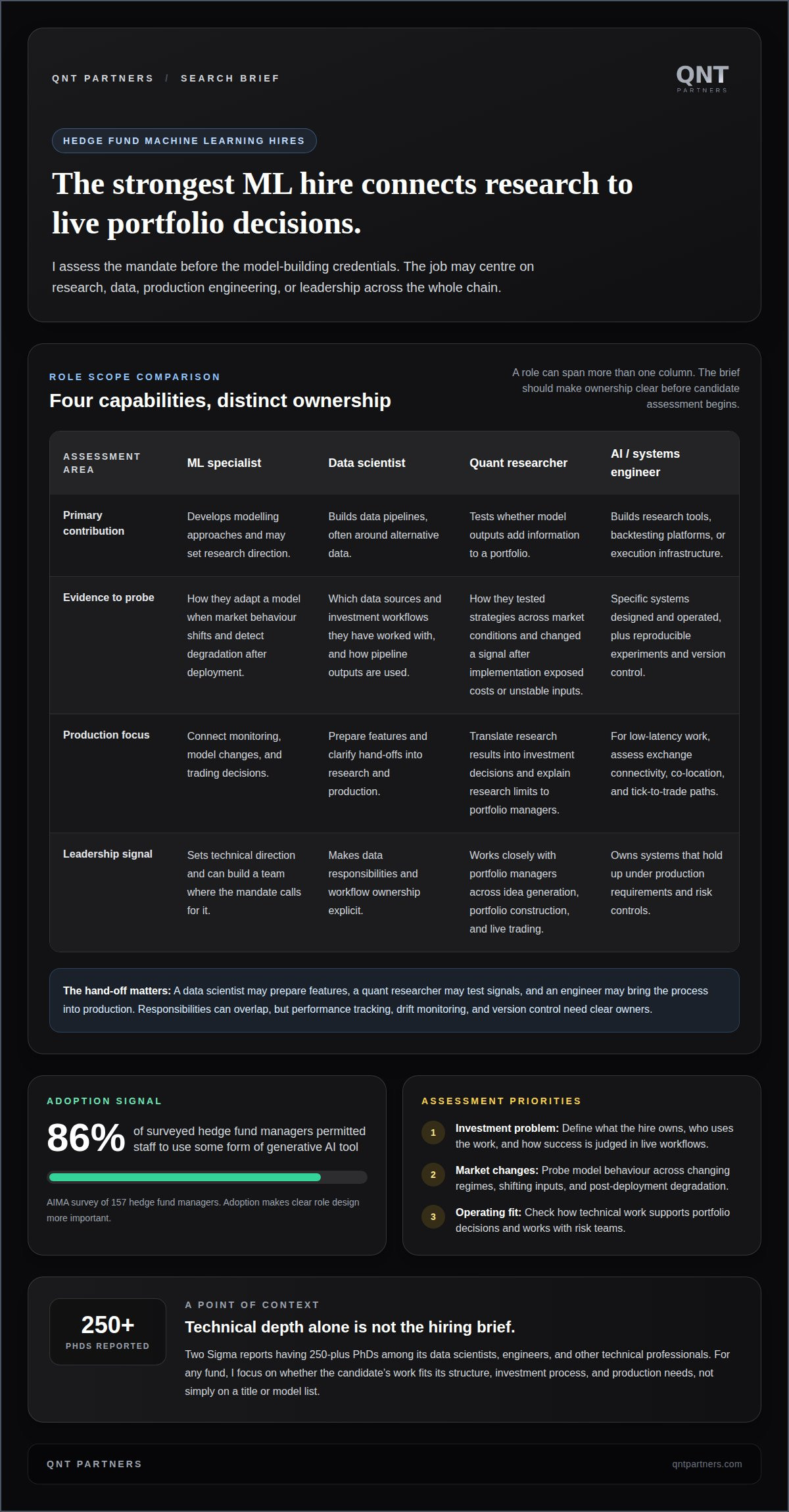
I also define the handoffs. A data scientist may prepare features, a quantitative researcher test signals, and an engineer bring the process into production. Responsibilities can overlap, but I want the fund to establish who owns performance tracking, drift monitoring and version control before I assess candidates.
AI Experts, Data Scientists, and Quants
AI experts, data scientists and quants bring different strengths. A machine learning specialist may develop modelling approaches, while a data scientist builds pipelines around alternative data. A quant researcher tests whether those outputs add information to a portfolio, rather than merely improving an offline metric.
For a head-of-machine-learning appointment, I look at research direction and team-building experience alongside technical depth. I ask how the candidate would adapt a model when market behaviour shifts and detect degradation after deployment. I want their answer to connect monitoring, model changes and trading decisions.
Two Sigma reports having 250-plus PhDs among its data scientists, engineers, and other technical professionals. Hedge fund AI systems need performance tracking, drift monitoring, and version control to support stability and auditability through market volatility.
AI and machine learning recruitment for hedge funds
AI hiring should start with the investment problem, not a generic machine learning job description. A fund building an alternative-data platform needs different leadership from a desk automating portfolio analytics. Define the mandate first: what the hire owns, who uses their work and how success will be judged in live investment workflows.
According to AIMA, 86% of surveyed hedge fund managers permitted staff to use some form of generative AI tool. AIMA’s survey covered 157 hedge fund managers. That adoption makes role design more important, not less. A hire may build internal tools, direct machine learning research, or govern the path from model development into production.
Retained search gives a recruiter an exclusive mandate and dedicated research process, commonly with fees agreed in stages. Contingent recruiting is generally non-exclusive, with payment tied to a successful placement. For a senior AI appointment, exclusivity can support confidential mapping of passive candidates and limit overlapping approaches to the same small talent pool.
Start the search by separating essential requirements from adjacent experience. A head of machine learning may need to set research direction and build a team, while a senior individual contributor may need direct experience shipping models. A recruiter can then map relevant functions across hedge funds, systematic trading firms and technology teams.
Screen candidates against evidence tied to the mandate. Ask how they evaluated a model beyond offline metrics, handled changing inputs and worked with portfolio managers or engineers. For a leadership role, probe how they set standards for model monitoring and version control. For an engineering role, examine ownership of data pipelines and production systems.
Candidate motivation matters just as much. A researcher leaving a stable pod may weigh autonomy, strategy ownership and access to data differently from an engineer joining a new build-out. Establish what would make a move credible, while handling current compensation, garden leave and non-compete obligations discreetly.
Fees depend on the case and are provided after a quote request; scope, seniority, exclusivity and agreed payment milestones shape the structure. A retained mandate and a contingent placement therefore differ in commitment and payment timing. For an executive search, define those terms alongside the role brief, interview stages and decision-makers.
Before approaching candidates, align the hiring group on decision criteria and interview ownership. A portfolio manager might assess investment judgement, while a technical lead tests research implementation. Clear criteria help keep the process focused on the work the hire will actually own. To discuss a search mandate, set out the role and its investment remit.
AI leadership, portfolio analytics, and risk modelling
An AI executive in a hedge fund must connect model outputs to portfolio decisions. The role may sit between researchers, portfolio managers and risk teams. I look for clear ownership of model selection, how signals enter portfolio construction, and who can pause deployment. Without those boundaries, technical leadership and investment accountability can drift apart.
Titles alone tell me little about an ML executive. I look for evidence of how they diagnosed overfitting, responded to a regime change and explained model limits to an investment committee. When a signal weakens after market conditions shift, their reasoning should link model behaviour to portfolio consequences.
Portfolio analytics involves more than ranking securities by predicted return. Strong leaders explain how forecasts interact with exposures, liquidity and concentration. For example, a credit model may forecast issuer spreads, but a portfolio manager still needs to understand liquidity assumptions and correlated positions. Model output is not an automatic trading instruction.
Risk modelling calls for a different kind of judgement. Hedge funds use AI in credit strategies for issuer analytics, spread forecasting, liquidity modelling and structured credit evaluation. I value leaders who distinguish a useful forecast from a risk estimate, then explain how each affects sizing or hedging. Their judgement shows in how they examine model behaviour when spreads widen and liquidity deteriorates together.
Commodity strategies offer another practical case. AI applications can include weather modelling, freight-flow analytics, refinery utilisation forecasting, inventory tracking and volatility prediction. Leadership shows in spotting where data quality or timing could distort a forecast, and in distinguishing outputs that inform a trading decision from those used for monitoring or scenario analysis.
Technical leadership is visible in validation and deployment decisions. When a model fails across a market regime, I look for a clear account of what changed and how the impact was communicated. A credible explanation separates a modelling issue from a data or implementation problem. It also shows how the leader brings researchers and portfolio managers to a shared decision.
Risk innovation still needs to protect capital and investor trust. For a senior hire, I assess how they balance new modelling methods with established portfolio controls. A review of a model’s assumptions, stress cases and intended use reveals whether they can make sound trade-offs. They should be clear about where human judgement remains necessary.
An estimate can also be expressed with an 80% confidence range around an asset’s estimated value. I look for a clear explanation of what that range means for position sizing and portfolio limits. The answer should address uncertainty, not present the central estimate as certainty. That distinction separates a statistical output from a decision the fund can defend.
Research-driven searches and global candidate networks
I find credible searches start by mapping where relevant work happens. A machine learning lead at a systematic fund may own research direction, while a technology executive at a prop shop may focus on data and production systems. Mapping by mandate rather than title surfaces candidates whose experience fits the actual build-out.
Geography can broaden that map. A search might include candidates in New York and Chicago, then extend to London, Singapore or Sydney when the role supports a distributed team. Location alone doesn’t establish a match. I compare investment strategy, data access, infrastructure ownership and the candidate’s experience working across time zones.
Search-firm conflicts can arise through overlapping mandates, undisclosed relationships or incentives that favour a quick placement over a close fit. I’ve found it helps to agree candidate ownership, confidentiality and any exclusivity before outreach, and to establish how overlapping introductions will be handled.
In my experience, a target map works best when it captures function and adjacent experience. A fund seeking a head of AI might consider leaders from a systematic research group, an alternative-data team or a financial technology business. I record each person’s remit, team context and relevant projects, rather than relying on employers and job titles alone.
In outreach, I explain the role without exposing sensitive strategy details. I might initially describe the asset class, reporting line and broad technical mandate, then share further context with the candidate’s consent. This staged approach helps protect a new strategy build-out while allowing serious candidates to assess the opportunity.
I also account for move constraints in the search. A candidate leaving a Chicago prop shop may have garden leave or contractual restrictions that affect timing. I handle those terms carefully rather than making assumptions. The search team captures candidate-reported constraints early and keeps them separate from the fund’s assessment of technical fit.
For each finalist, I compare evidence against the same role criteria. One candidate may have built a research platform; another may have led an ML team inside a trading business. A structured record of scope, decision ownership and delivered systems helps the hiring group distinguish relevant leadership from impressive but unrelated experience.
I find global mapping most useful when it expands access without diluting the brief. A London-based researcher may suit a role requiring close portfolio-manager interaction, while a distributed engineering leader may fit a platform build. Defining working requirements before outreach makes it easier to assess every candidate against them consistently.
The global hedge fund industry had $4.51 trillion in assets under management at the end of 2024, indicating the scale of the industry in which these searches operate.
ML Executive Qualifications Sought by Hedge Funds
An ML executive needs more than fluency in current modelling methods. The role may combine research judgement, production awareness and leadership across investment and technology teams. Assess those capabilities against the fund’s actual mandate. A head of AI joining a systematic build-out needs different evidence from a technical lead supporting an established trading desk.
Technical depth should be evident in specific decisions. Ask candidates to explain a model they developed, the data it used and how they tested its assumptions. Someone working with text feeds, for example, should explain how they handled noisy or changing inputs. Look for clear reasoning about limitations, not just a list of algorithms or tools.
Production experience matters when the executive owns systems used by researchers or traders. Ask candidates how a model moved from experiment to deployment, including monitoring and version control. A useful example is a model whose performance changed after release. The candidate should distinguish data drift, implementation issues and shifts in market behaviour.
Leadership credentials depend on the role’s scope. For a team-building appointment, examine how the candidate set research priorities, recruited specialists and resolved disagreements over methodology. Ask for an example involving a portfolio manager and a research team. The answer should show how technical debate informed an investment decision without overstating the model’s predictive power.
Investment fluency is equally important. An ML executive need not have traded every strategy, but should understand how model outputs affect portfolio construction, liquidity or risk limits. For example, ask how they would present a credit spread forecast to a portfolio manager. Strong candidates separate the forecast from the position decision and explain its uncertainty.
Research credentials can take several forms. A doctorate may signal deep methodological work, while a record of production research may demonstrate applied judgement. Neither should replace direct assessment. Ask candidates to walk through a project from data selection to decision use, then probe what they changed when results failed to hold across market conditions.
Fit also depends on the fund’s operating model. A prop shop may value close collaboration with traders and engineers; a multi-manager platform may require clear communication across teams. In either structure, assess how the candidate handles competing priorities, protects sensitive research and sets standards for model review. Those behaviours shape whether technical expertise translates into useful leadership.
Set the brief around the decisions this executive must own, then assess candidates against those criteria. For a focused discussion about an ML leadership mandate, outline the role and its scope.
QNT Partners
Senior AI, machine learning, quantitative and risk appointments work best when the mandate is clear. I look first at what the hire will own, how the role connects to portfolio decisions, and which technical and leadership experience matters. That distinction can separate a research leader from an engineering executive, or from a manager building a new team. Without it, those roles can blur together before the search has even begun.
Some mandates span investment research and machine learning. Others call for broader technical leadership, or a manager for a specific investment structure. The title alone rarely tells you which experience matters. The search needs to match the actual remit, whether that sits in AI & ML, Trading & Research, Technology & Engineering, or Manager Search & SMA Sourcing.
Set the mandate before the search begins
The next step is to turn the role into a clear operating brief. Decide which investment or infrastructure decisions the hire will own, where their authority starts and ends, and how they’ll work with the portfolio manager. This gives candidates a realistic picture of the role and gives the hiring team a consistent basis for assessment.
A machine learning executive search for hedge funds works best when the mandate reflects the fund’s actual build, rather than a generic list of skills. Be explicit about the problem the new leader needs to solve and what evidence would demonstrate progress. Details can remain confidential during initial outreach while the core scope stays clear.
If you’re shaping a search, contact QNT Partners to discuss the mandate. A focused brief is a practical starting point for finding a leader whose technical judgement fits the work ahead.
Frequently Asked Questions
What do machine learning executive search firms do for hedge funds?
Machine learning executive search for hedge funds starts by defining the mandate, mapping relevant candidates and assessing experience against investment and technical needs. For example, a fund can clarify whether its new executive will lead research or own production deployment before interviews begin. A search firm acts as a recruitment intermediary; the hiring organisation alone determines candidate suitability. Candidate data is retained for up to two years, and client and commercial data for seven years. Individuals have rights under UK GDPR.
Which executive search firms specialize in machine learning and quantitative hedge fund roles?
Specialist searches in this area often cover quantitative trading, research and technology roles. A machine-learning mandate may span technical and investment teams, depending on the role’s remit. Search firms differ in their coverage of AI and machine learning, quantitative research and trading, and technical engineering. The candidate market depends on the role’s actual responsibilities.
What ML leadership roles do hedge funds recruit for?
Hedge funds recruit heads of AI or machine learning, senior ML researchers and technical leaders responsible for research direction or team development. Some roles focus on investment applications, such as machine-learning approaches to portfolio analytics; others centre on technical leadership for research and trading systems. Titles can obscure the distinction, so define whether the executive will lead people, set research priorities or own technical delivery.
How much do executive search firms charge hedge funds, and how are fees structured?
Fees depend on the role’s scope and seniority, exclusivity and agreed payment milestones, and are provided after a quote request. Retained searches commonly use staged fees; contingent recruiting is generally non-exclusive, with payment tied to a successful placement.