Institutional SMA Sourcing for Investors and Institutions

I see account structure shape who controls a portfolio and how a mandate runs. A separately managed account (SMA) keeps an institutional investor’s portfolio separate from a pooled fund, while a fund of one gives a single investor a dedicated vehicle built around its mandate. When I assess an institutional SMA sourcing firm, I look beyond a manager’s performance record to operational fit.
Control over assets and mandate design can appeal to investors, but an SMA puts more weight on account setup, trading arrangements and reporting. In a model-based account, the manager provides portfolio instructions while a managed-account provider handles trading and reporting. That division affects decision-making and how the strategy operates.
I’ve set out what an SMA is, how a fund of one works and what to consider when selecting a provider. I also cover the distinction between the investment manager and the account structure, operational capabilities, and where sourcing support can help an institution seeking a manager or raising capital through an SMA.
Key Takeaways
- An SMA and a fund-of-one differ in portfolio ownership and in who handles trading and reporting.
- When assessing an SMA, look beyond strategy performance to mandate design, transparency and operational responsibilities.
- Match your sourcing approach to the strategy and manager you need to access.
- Keep investment-management fees separate from sourcing engagement terms, and understand what each covers.
- Specialist manager search and SMA sourcing can help when you need access to quantitative investment talent or capital raising through an SMA.
Choosing a sourcing partner
I look for a sourcing partner whose manager access, mandate expertise and operating model fit the investment, not a large directory of names.
Sourcing Firm Selection
I start with strategy fit, not the size of a manager directory. A systematic equity mandate needs different manager access and operational fluency from a discretionary macro allocation. I assess how the firm evaluates investment process, capacity, portfolio construction and reporting needs. Its firm structure and market focus should also align with the mandate’s geography and strategy.
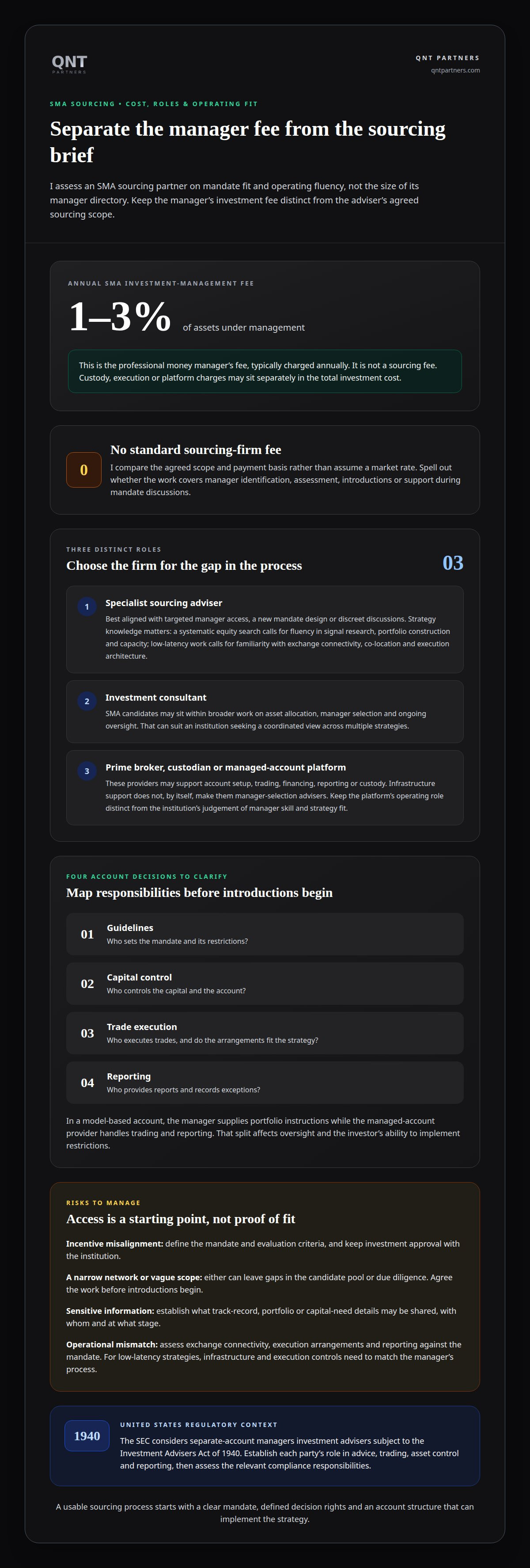
Next, I map the proposed SMA structure. I confirm which party sets guidelines, controls capital, executes trades and provides reporting. In a model-based account, the manager supplies the portfolio model while the managed-account provider handles trading and reporting. That division affects oversight and the investor’s ability to implement restrictions.
Sourcing Firm Fees
I keep sourcing engagement terms separate from investment-management fees. There is no standard sourcing-firm fee to assume, so I compare the agreed scope and payment basis. I define whether the work covers manager identification, assessment, introductions or support during mandate discussions.
For context, professional money managers’ fees for separately managed accounts typically range from 1% to 3% of assets under management, charged annually. That is a manager fee, not a sourcing fee. The distinction matters when modelling total investment costs, particularly where the SMA has separate custody, execution or platform charges.
Risks of Using a Sourcing Firm
I see misalignment between a sourcing firm’s incentives and the institution’s mandate as a central risk. A narrow network can limit the candidate pool, while a poorly defined scope can leave gaps in due diligence. I set out the strategy, capacity requirements and evaluation criteria before introductions begin, and keep investment approval with the institution.
Confidentiality matters when a manager’s track record, portfolio details or capital needs are sensitive. I agree what information can be shared, with whom and at what stage. Access to a manager is a starting point, not proof that the strategy is a fit.
In the United States, the SEC considers separate-account managers investment advisers subject to the Investment Advisers Act of 1940. I establish each party’s role in advice, trading, asset control and reporting, then assess the relevant compliance responsibilities.
Operational fit can determine whether a sound strategy is practical to implement. I assess exchange connectivity, execution arrangements and reporting against the mandate’s requirements. For a low-latency strategy, trading infrastructure and execution controls need to match the manager’s process. I establish how restrictions affect portfolio construction and how exceptions will be recorded.
Which firms source separately managed accounts for institutional investors?
Several types of firms can help an institution identify an SMA manager, but their roles differ. Specialist sourcing advisers focus on finding managers for a defined mandate. Investment consultants may include SMA candidates in broader asset-allocation work. Prime brokers and managed-account platforms support account infrastructure, but that does not make them manager-selection advisers.
A specialist adviser can be useful when a mandate calls for a narrow strategy or a manager the institution has not previously covered. For example, a systematic equity search may require familiarity with signal research, portfolio construction and capacity constraints. A low-latency mandate has different requirements, including exchange connectivity, co-location and execution architecture. The sourcing firm should understand the strategy well enough to distinguish a relevant track record from a superficial match.
Investment consultants typically work across portfolio-level decisions, including asset allocation, manager selection and ongoing oversight. Their SMA work may form part of that broader advisory relationship, which can suit an institution seeking a coordinated view across multiple strategies. A dedicated sourcing adviser is a closer fit when the brief calls for targeted manager access, a new mandate design or discreet discussions with a potential portfolio manager.
Prime brokers, custodians and managed-account platforms serve a different purpose. Depending on the structure, they may support account setup, trading, financing, reporting or custody. For example, a Chicago prop shop running a systematic strategy may need a platform that can meet its execution and reporting requirements. The platform’s role should remain distinct from the institution’s decision about manager skill, strategy fit and mandate terms.
Some managers source capital directly through existing institutional relationships. That can work when an allocator already knows the manager and understands the strategy. An independent sourcing adviser can help when the investor needs a broader candidate pool, a confidential process or support turning an investment brief into a manager profile. Clarifying each party’s responsibilities before introductions begin helps keep the process clean.
The right firm depends on the gap in the process. Where the constraint is investment research, strategy fluency matters. Where it is account implementation, platform and operational capability matter. For structures that combine managed accounts and strategic value arrangements, the mechanics discussed in SMA and SVA partnerships may be relevant.
In quant strategies and new portfolio builds, a clear mandate, defined decision rights and a realistic account structure give a sourcing process a usable starting point. QNT Partners’ contact details are available for industry peers who need them.
Account terms matter too. Separately managed accounts allow investors to set guidelines aligned with specific tax, risk or ESG requirements.
Nearly half of hedge fund managers offer separately managed accounts, and 10% of hedge fund managers plan to implement separately managed accounts over the next year. 63% of US hedge fund managers offer separately managed accounts. These details can help frame a search, but they do not replace assessing a candidate against the mandate.
Which investors use SMA sourcing firms?
Pension funds may use SMA sourcing when a mandate calls for a dedicated manager search. A public retirement plan, for example, might be assessing systematic equity exposure. The investment team can define the universe, risk limits and reporting requirements before manager discussions begin. That gives candidates a clear brief and keeps the search focused on strategies and operating models that fit.
Endowments and foundations may use an SMA to express a focused investment view. An endowment seeking a specialist alternative strategy, for instance, might want a manager with a distinct research process and clear capacity limits. A sourcing adviser can identify candidates and frame conversations around the mandate. The institution still makes the investment decision and oversees the portfolio.
Insurers often assess an SMA against investment risk and their own portfolio constraints. An insurer considering a credit strategy, for example, may need guidelines that reflect liquidity needs and internal risk controls. Those constraints should shape the manager search from the outset, so discussions stay focused on implementable strategies rather than performance alone.
Sovereign wealth funds and public investment entities may use sourcing support when a mandate is specialised or the relevant manager universe is difficult to map. A systematic global macro search, for example, may involve managers with different data and execution approaches. The institution needs to decide what is essential, such as decision-making ownership or capacity, and where it can remain flexible.
Family offices and investment offices serving multiple beneficiaries may also consider SMAs. Their requirements can differ from those of a large pension plan. One office might prioritise portfolio-level control, while another needs transparent reporting across a distinct strategy. A precise manager brief helps candidates understand which requirements matter.
Even an institution with an established investment team may bring in external sourcing for a targeted search. The team may have strong quantitative research expertise but few current relationships with managers in a particular sub-strategy. An institution without dedicated internal resources may instead need help defining the mandate before approaching candidates. The scope depends on where the internal process has a gap.
A practical way to assess whether external sourcing is useful is to identify the portfolio need, define the SMA structure, set manager criteria and decide who will assess each candidate. For a low-latency strategy, the brief could specify the importance of exchange connectivity and execution design. For a longer-horizon systematic strategy, research governance and portfolio construction may carry more weight.
Institutional type alone does not determine whether sourcing support is useful. The key is the gap between the mandate and the investor’s current access or capacity to run the search. A pension fund with an established manager network may need little external input. A foundation launching a specialist mandate may benefit from a focused search and a structured way to assess candidates.
How do institutional SMA sourcing firms charge fees?
In an institutional SMA search, the sourcing fee and the investment manager’s fee pay for different work. The sourcing firm runs the search; the manager runs the strategy. Treating them as one cost obscures who is responsible for each service.
Sourcing fees vary with the brief and the work involved. Finding managers running an established strategy is a different assignment from shaping a new systematic mandate and making discreet approaches to specialist portfolio managers. Scope and mandate complexity are the main drivers, so comparisons between engagements only make sense when the deliverables are similar.
The scope should specify what the sourcing firm will do. Candidate identification and introductions are one level of service. Refining the mandate, assessing a manager’s investment process and supporting discussions through selection require more work. If the institution broadens the search, the agreement should say how that change affects the fee.
Payment may be tied to the engagement or to defined milestones. An agreement could set payments for opening the search, presenting an agreed candidate slate and completing assessment work. Some arrangements link part of the payment to an outcome. That outcome needs a precise definition, such as a signed mandate, rather than an ambiguous reference to a “successful placement”.
An introduction does not guarantee an investment. A manager may meet the institution but fail its operational review, or the parties may not agree on account guidelines. The fee terms should distinguish search activity, defined deliverables and a completed appointment. They should also address duplicate manager relationships, which can arise when an institution already knows a candidate.
Manager fees sit outside the sourcing agreement. Professional money managers charge annual fees for their services, often as a share of assets under management. The investment agreement for an SMA should state how the fee is calculated and which assets it applies to. Combining that schedule with the sourcing charge makes the total cost harder to assess.
Other costs can sit elsewhere in the account structure, including platform, custody, execution and financing charges. In a multi-manager SMA, financing arrangements can affect implementation costs independently of the sourcing engagement. A cost map helps distinguish each provider’s service from the party responsible for paying for it.
The useful test is whether the agreement connects scope, milestones and payment, while keeping sourcing charges separate from manager and account costs. The treatment of scope changes and duplicate relationships should be clear before work begins. Engagement scope is one of the terms that should be documented explicitly.
QNT Partners: Manager Search & SMA Sourcing
I see manager searches work best when the mandate is clear before the search begins. At QNT Partners, we work with institutions and managers on mandate fit, investment strategy and SMA opportunities. This is relevant when an institution is shaping a specialist mandate or a manager is considering an SMA route to raise capital.
I start with the investment need. For an allocator, that may mean defining the strategy, desired manager profile and structure before beginning a search. A systematic equity mandate calls for a different discussion from a low-latency strategy that depends on exchange connectivity and execution design. A clear brief gives the search a practical foundation.
For managers, I find SMA sourcing is most useful when the strategy and the intended capital relationship are clear. A manager might be moving from a pooled vehicle to a dedicated account, or developing a strategy that needs a suitable capital partner. Key questions include how to frame the mandate, what role the manager retains and whether the account structure supports the investment process.
Finding a manager is distinct from recruiting the team needed to run the strategy. A search may call for a portfolio manager with a specific research approach, alongside quantitative researchers or engineers who can build and maintain the trading stack. We also work across Quant Trading & Research Recruitment, Technology & Engineering Recruitment, and AI & ML Specialist Search when those hires are part of the wider requirement.
I prefer to get involved while the mandate is still taking shape. That gives us time to clarify which criteria are essential and where flexibility is possible. If the investment structure is already set, a focused brief can centre on manager fit, relevant experience and operational needs. For a build-out, I would consider hiring requirements alongside SMA discussions rather than treating capital and team formation as separate workstreams.
For allocators, I see this work as most relevant when internal coverage does not extend to the required strategy or manager universe. For investment managers, it fits when an SMA is part of a capital-raising plan. We work on both sides of the process, with the mandate and intended outcome defining the scope.
Bring a defined investment question, a manager-search brief or an SMA capital-raising objective. I can discuss where Manager Search & SMA Sourcing fits and what the work should cover. You can contact QNT Partners to discuss the requirements.
Make the Next Move Deliberate
An SMA mandate provides a practical basis for aligning investment intent with the manager and team needed to deliver it. Before opening a search, decide what must remain under your control and where specialist expertise can make the greatest difference. That clarity turns a broad allocation idea into a focused discussion.
An institutional SMA sourcing firm can support the manager-search process, while strategy execution still depends on the right people and infrastructure. QNT Partners also works across Quant Trading & Research Recruitment, Technology & Engineering Recruitment, and AI & ML Specialist Search. These capabilities are relevant when a mandate involves building or strengthening a quantitative team alongside manager selection.
For a mandate, manager search or SMA capital-raising objective, QNT Partners’ work sits alongside the decision about who can execute the strategy. If the manager’s team and infrastructure are not in place, the mandate cannot be put to work as intended.
Questions on SMAs and manager sourcing
What does an SMA mean for a quant team?
An SMA is a portfolio held for one investor. Its results reflect that investor’s mandate, rather than other investors’ deposits or withdrawals from a shared pool. Tax reporting can also follow the account’s own cost basis, unlike pooled vehicles with embedded capital gains. I’d treat account-level records and portfolio reporting as part of the operating design, not back-office detail.
How do you assess an SMA manager sourcing firm?
I’d ask how the firm separates documented evidence from a manager’s own account of its process. For a quantitative strategy, useful diligence materials can include research governance, controls from signal to portfolio, and how the team handles model changes. Before investment committee review, ask for a written comparison of candidates against the mandate, with open questions clearly separated from established information.
What should be agreed before an SMA sourcing firm starts outreach?
Set process ownership before manager outreach begins. Identify who can receive candidate details, set rules for sharing confidential information, and agree how decisions and updates will be recorded. A short written brief can capture the mandate and approval path. That cuts ambiguity if investment, operations and legal teams enter the process at different stages.
What performance data should you request from an SMA sourcing firm?
A sourcing firm’s own investment-return record is not the right measure unless it also manages assets. Ask instead for relevant search examples: the strategy or manager profile, the sourcing work performed, and the stage each engagement reached. For the asset manager’s performance, request underlying records directly from the manager and assess whether they represent the strategy and account structure under consideration. Keep search outcomes separate from investment results.
What US due diligence and compliance rules apply to SMA sourcing?
In the United States, the SEC considers separate-account managers investment advisers subject to the Investment Advisers Act of 1940. Clarify each party’s role in advice, trading, asset control and reporting, then assess the related compliance responsibilities.