Institutional Capital Raising for Systematic Quant Strategies

A backtest may earn a meeting, but it won’t secure an allocation. Institutional capital raising for systematic quant strategies depends on whether allocators can understand return drivers, assess capacity and trust the live-market implementation.
That distinction matters. A strong signal can lose its appeal if execution costs rise with assets, realised performance diverges from the model, or the operating set-up can’t support institutional oversight. In my view, allocators look beyond headline returns to research discipline, risk controls, team depth and the terms attached to their capital.
This article explains how managers can present a strategy for institutional scrutiny, address capacity and implementation risk, and approach investor outreach without overpromising. It also covers the trade-offs between a fund and an SMA, including transparency, control and governance, as well as the operational demands of each structure. The goal is to clarify what must stand up to diligence, where negotiations affect the business, and when specialist support with manager search, SMA sourcing or capital raising through SMAs may help.
Key Takeaways
- Show how the strategy’s return drivers, live execution and capacity fit together, not just how the backtest performed.
- Explain how leverage, crowding and changing market impact could affect risk as assets grow.
- Match investor outreach and governance terms to the strategy’s structure, whether that is a fund or an SMA.
- Prepare for allocator scrutiny of research methods, operational controls and the team behind the models.
- Build a fundraising process around suitable investor fit and clear communication, especially when the manager is emerging.
Capital-raising challenges and risk controls
Investors hesitate when returns depend on crowded signals, fragile execution assumptions or hidden leverage. In 2025, relative-value credit hedge funds typically carried gross leverage exceeding 30 times net asset value, making small pricing errors consequential.
At 30 times leverage, a 3.3% adverse move in the underlying position can eliminate a hedge fund’s entire equity base. That exposure can interact with systemic risk: several managers may hold similar positions, then reduce them simultaneously during stress. Allocators therefore want to understand gross and net exposures, financing dependence, liquidity assumptions and how positions behave when correlations rise. A portfolio’s historical diversification may offer little protection if its holdings share the same underlying risk.
Capacity creates another fundraising challenge. More assets can increase liquidity constraints, execution costs and market impact, changing a strategy’s economics. Managers should explain which markets and instruments can absorb additional capital, where trading costs may rise, and how capacity monitoring can flag pressure before returns deteriorate. Being candid about potential alpha decay is more credible than treating a backtest’s capacity estimate as fixed.
Factor and risk-premia strategies need a clear explanation of their return sources. Value, momentum and carry can behave differently across market regimes, while overlapping exposures may leave an apparently diversified portfolio dependent on one underlying driver. Managers should connect portfolio construction to risk limits, stress scenarios and rebalancing rules. For example, a momentum signal can reverse sharply after a sustained trend, so allocators need to understand how exposures change when that signal weakens.
Credit factors bring additional model risk because both inputs and execution assumptions shape the signal. A model may look compelling in backtests but weaken when transaction costs are understated, observations are reused or a relationship reflects a narrow sample. Out-of-sample and walk-forward testing, an economic rationale for signals, and conservative transaction-cost assumptions help address overfitting. Allocators also examine whether live execution matches model assumptions and whether deployment and data controls can contain errors.
Diversification is an allocation question, not simply a holdings count. In the September 2021 BNP Paribas Prime Services Capital Introduction Flash Survey, 80% of respondents ranked diversification and correlation among their top three allocation factors for systematic credit. In that survey, 40% selected them as the first-choice factor. For market neutrality, 64% ranked it among their top three factors. Those results underline why managers must explain the portfolio’s role alongside its standalone risk: distinct signals matter only if their exposures diversify the allocator’s existing book.
Investor outreach, negotiation, and governance rights
Investor fit shapes the fundraising route, reporting package and terms worth negotiating. A pension mandate and a family office allocation rarely begin with the same requirements.
Investor Types and Investment Approaches
Institutional investors include public and private pension funds, endowments, foundations, insurers, sovereign wealth funds, asset managers and family offices. Systematic investing applies data-derived rules consistently, while discretionary investing leaves decisions to human judgement. Allocators need to understand how signals are generated, who can override them and how the strategy fits their existing portfolio. A family office may decide faster, while a pension fund may involve consultants and governance committees.
Fundraising Rules and Economics
Seed capital, an SMA and a fund launch each involve different trade-offs in control, transparency, operational demands and investor concentration. Seed backing may support an early build; an SMA gives an allocator a dedicated account, while a fund pools investor capital. Compare the options in terms of strategy capacity, reporting access, investment guidelines and the manager’s ability to maintain a consistent process.
U.S. fundraising rules depend on the offering structure and exemption. Businesses selling private equity to accredited investors may need to file Form D; public crowdfunding may require Form C, while Form 1-A can provide an exemption from a full registration statement. Fees and minimum investments have no single figure that fits every quant fund; they are set through fund terms and investor negotiations.
Pitch Materials and Investor Access
A pitch deck should connect the return objective to the research process, portfolio construction and live implementation. The data room supports diligence with track-record records, risk materials, team responsibilities and operational controls. A professional adviser can help structure these materials, keep claims consistent and prepare managers for allocator questions, but cannot substitute for the underlying evidence.
Access matters as much as presentation. An adviser can map suitable pensions, endowments and insurers, then coordinate introductions around mandate fit and investment process. Reporting expectations should be negotiated alongside governance rights, including the scope and cadence of portfolio information, permitted investment guidelines and escalation channels. An SMA may give an allocator greater transparency and control than a pooled fund, but it also creates account-specific operational work. SMA and SVA partnerships illustrate why structure belongs in the early conversation, not as a closing detail.
Negotiations need a clear boundary between oversight and investment control. Managers should define who can access positions, how material model or team changes are communicated, and which decisions remain with the investment team. This clarity helps pensions, foundations and family offices assess accountability without mistaking a systematic process for discretionary portfolio management.
Fundraising challenges for emerging managers
An emerging manager must present both a strategy and a business that institutional allocators can diligence. A capital-raising process may take months, depending on the funding amount, financing type and whether multiple rounds are required. For a quant spinout, runway planning needs to account for research continuity while investor discussions progress. A delayed commitment can affect hiring, infrastructure and launch timing. Institutional capital raising for systematic quant strategies also tests whether the manager can explain how the operation will function independently.
Track-record portability is often a central challenge. A portfolio manager leaving a multi-manager platform may have strong personal results, but allocators still need to separate individual decisions from firm-level performance. The manager must explain what came from the strategy, what depended on shared infrastructure and whether the process can run independently. That distinction shapes how investors assess the evidence and proposed equity terms.
Fundraising competes with launch work. A systematic team may need to complete model controls, establish data processes and prepare investor materials at the same time. Regulatory filings for a capital raise can take weeks to prepare, so the calendar needs to account for that work. Rushing documents while refining a strategy can create inconsistencies between the pitch, offering materials and operating plan. Assigning a clear owner to each workstream helps keep the materials aligned.
Early capital can come through a fund, an SMA or a seed arrangement, each with different implications. An SMA may provide a defined mandate but require account-specific reporting and investment guidelines. A seed investor may contribute capital in exchange for negotiated economics or equity. Before accepting an anchor commitment, managers should assess how its terms affect future fundraising, team ownership and decision-making.
Team credibility extends beyond the portfolio manager. An allocator may ask who owns research validation, model deployment, data controls and investor communication. If one researcher holds the full signal history, key-person risk becomes apparent during diligence. A named deputy and documented responsibilities make coverage clearer. Equity partnerships can also align ownership with the people building and maintaining the investment process.
Outreach works best when it reflects the mandate. A systematic credit strategy may suit an allocator seeking diversification, while a capacity-limited intraday strategy may fit a narrower investment brief. Broad distribution can consume time without addressing these differences. Institutional capital raising for systematic quant strategies means matching a strategy’s liquidity profile and operating footprint with investors whose requirements fit.
Fundraising should run alongside research and launch preparation, not replace either. The practical test is whether the strategy, team, documents and proposed equity terms present a consistent case when an allocator reviews them together.
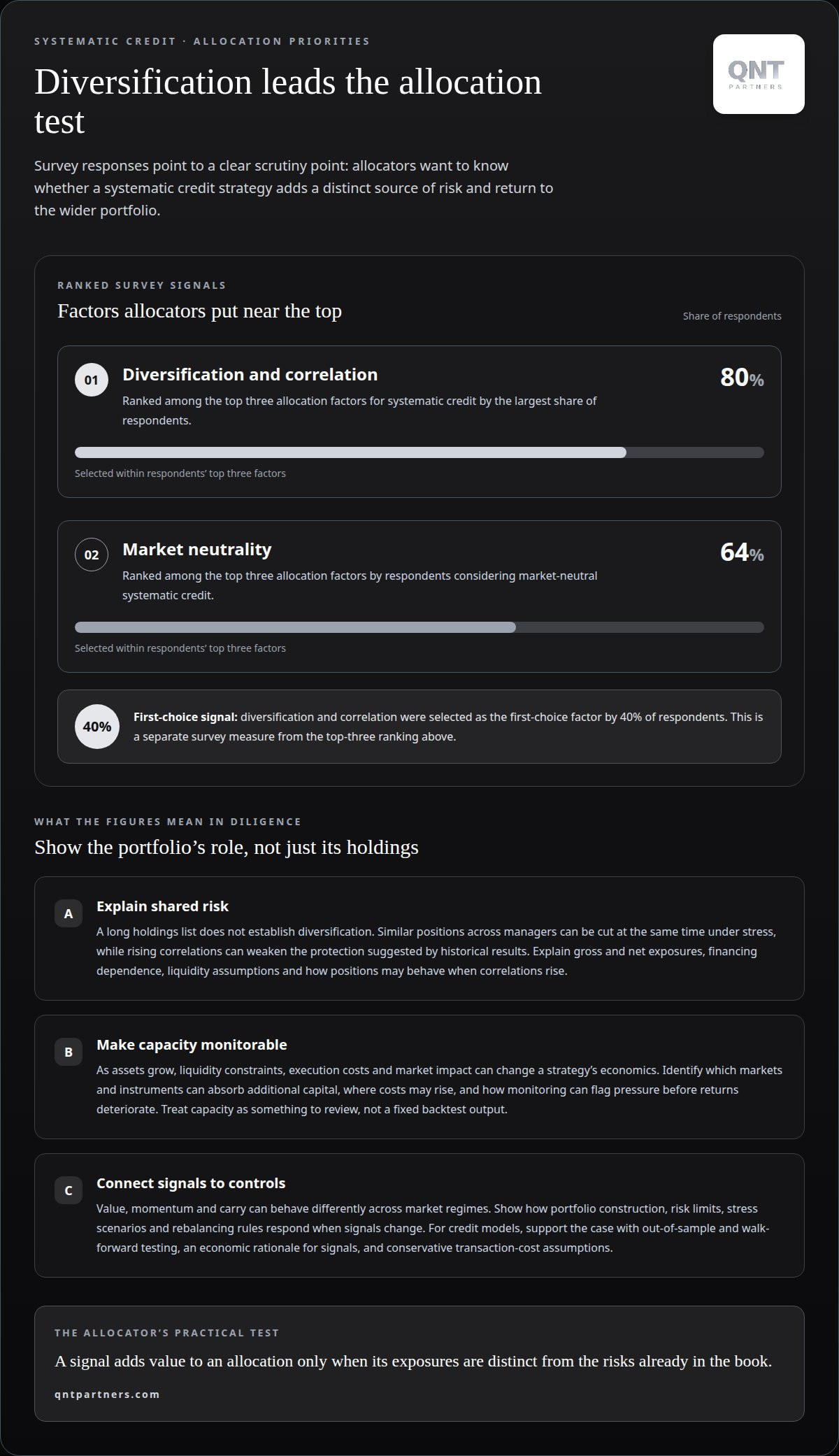
Institutional allocation priorities and diversification
No single track-record length or performance metric fits every institutional mandate. Allocators assess verified results alongside drawdowns, exposures and consistency across market regimes. A shorter record needs precise context: which decisions belonged to the manager, what instruments were traded, and whether live execution matched the model. Institutional capital raising for systematic quant strategies depends on making that evidence relevant to the allocation decision, rather than presenting returns in isolation.
Allocation starts with portfolio fit. A pension fund may compare a market-neutral strategy with existing equity exposure, while an endowment may assess its role among alternative investments. The same strategy can serve different purposes, depending on its return drivers and behaviour across regimes. Managers should describe the portfolio contribution without treating low historical correlation as permanent.
Survey results offer a dated view of allocator priorities. In the September 2021 BNP Paribas Prime Services Capital Introduction Flash Survey, 64% of respondents ranked market neutrality among their top three allocation factors for systematic credit. In that survey, 16% selected market neutrality as their first-choice factor. Credit managers can use that distinction to explain neutrality in portfolio terms, including exposures that may challenge it.
Correlation needs to be assessed against the allocator’s actual portfolio. A systematic credit strategy may appear distinct from a discretionary credit allocation, yet both could face similar spread or liquidity shocks. A useful discussion connects those dependencies to the investor’s existing holdings. This makes the allocation case specific to the mandate, rather than a generic claim of diversification.
Strategy breadth also shapes the decision. A trend-following programme seeks sustained price moves across markets; statistical arbitrage targets short-term relative-value relationships across baskets. Allocators assess how each approach earns returns, responds to regime changes and fits its opportunity set. In institutional capital raising for systematic quant strategies, distinct signals strengthen the case only when their exposures add something meaningful to the portfolio.
Managers can frame their case by defining the strategy’s portfolio role, substantiating its return record and linking both to the allocator’s mandate. A sovereign wealth fund and an insurer may have different liquidity, reporting and investment-guideline needs. Addressing those differences with portfolio-level evidence makes the proposed allocation more precise.
Institutional capital’s operational demands
Institutional due diligence tests a quant manager’s track record, risk controls, capacity, team, infrastructure and portfolio fit. For a systematic strategy, reviewers also examine research methods, safeguards against overfitting, live results against backtests, and controls around data and model deployment. The focus is whether the investment process can operate as described, not simply whether its results look attractive.
Operational review often involves several stakeholders. An investment team may assess the strategy, while an operations group examines trade support, valuation processes and service-provider dependencies. Governance committees can add further review, and consultants may help institutional investors assess managers and monitor investments. Each party needs consistent explanations, since conflicting accounts of a model change or incident can undermine confidence.
For a systematic manager, model deployment needs a controlled path from research to production. A signal update should have an owner, documented testing and a defined release process. Data lineage matters too: teams need to identify which inputs produced a position and how errors are detected. If a feed changes format, for example, monitoring should help distinguish a data fault from a genuine market signal.
Infrastructure diligence turns abstract resilience into practical operating questions. Reviewers may examine exchange connectivity, execution workflows, access controls and recovery arrangements. A low-latency strategy could depend on co-location or FPGA-based processing, so its operating design should explain those dependencies and their economic role. The team should show how it monitors failures, records incidents and restores normal trading while making clear what happened.
Reporting is another ongoing operational obligation. An SMA investor may expect account-level transparency and guidelines that differ from a pooled fund’s reporting package. Positions, exposures and material process changes need to reach the right investor contacts in an agreed format. Clear ownership between investment, client service and operations reduces the risk that a request goes unanswered between teams.
Diligence also tests team depth and key-person risk. If one researcher owns a critical model component, reviewers will want to understand documentation, access and coverage during an absence. A named deputy and maintained research records make responsibilities clear. For a manager adding institutional capital, hiring plans should align with the reporting workload and operating controls that new mandates require.
These demands continue after allocation. Investment teams, operations and distribution need a shared process for handling investor questions, reporting exceptions and strategy changes. A monthly exposure review, for example, can connect portfolio decisions with client reporting and operational incidents. When that process is clear, allocators can assess both the strategy and the firm’s ability to support it.
QNT Partners: Quant Trading & Research Recruitment
QNT Partners can help when a quant manager’s next constraint sits between strategy, team and investor structure. The need may be to find research talent, strengthen technical delivery or pursue capital through an SMA. These are distinct requirements, but each can affect whether a systematic business is ready to scale and meet institutional expectations.
Quant Trading & Research Recruitment supports managers looking to add a researcher, trader or portfolio manager to a build-out or spinout. The distinction between a pod shop, a prop shop and an independent fund matters: mandates, decision rights and economics differ. A search should reflect the actual research stack and investment process, rather than rely on a generic quant job description.
Capital Raising via SMAs is relevant when a manager is considering a separately managed account as an institutional route. The strategy may need to fit account-specific investment guidelines, reporting expectations and operational requirements. That structure affects how the opportunity is presented and which managers or allocators may be a fit. The capital itself is not provided by QNT Partners.
Technology & Engineering Recruitment can help when execution or infrastructure constrains a strategy. A team building exchange connectivity, co-location capability or FPGA workflows needs engineers whose experience matches the production environment. Tick-to-trade latency may matter for one mandate, while deployment controls and system reliability may matter more for another. The role specification should follow the system the team is building.
AI & ML Specialist Search supports managers whose research depends on machine-learning expertise. The hiring need may centre on feature engineering, model validation or production deployment. Those responsibilities should be explicit in the search, particularly where researchers and engineers share ownership of the model lifecycle. Clear role boundaries help avoid hiring for a research title when the immediate gap is implementation.
Start with the constraint currently limiting progress. If the strategy is ready but the team lacks a key capability, recruitment may be the right next step. If the manager is assessing an SMA route, capital raising through SMAs may be relevant. Where both needs are present, aligning the hiring plan with the investor proposition can help prevent mismatched expectations about capacity and delivery.
The start date can be the real hiring constraint: notice periods and garden leave may delay a hire even after the role is agreed. At QNT Partners, we account for that timing when assessing a search.
Frequently Asked Questions
What is Capital Raising?
Capital raising is the process of securing investment commitments to fund a business or investment strategy. For a quant manager, this can mean launching a pooled fund, securing seed backing or arranging an SMA mandate. The structure shapes investor access, reporting and control. Capital may come from institutions or other eligible investors, with terms negotiated around the strategy, operating model and portfolio mandate.
What institutional investors allocate to systematic quantitative strategies?
Potential allocators include pension funds, university endowments, foundations, insurers, sovereign wealth funds, asset managers and family offices. Their mandates differ: an insurer may assess how a strategy fits portfolio liabilities, while an endowment may seek exposure distinct from that of existing managers. A quant strategy’s fit rests on its return source, liquidity profile and interaction with the investor’s broader portfolio, not its systematic label alone.
What operational, compliance, and cybersecurity standards must a quant manager meet to raise institutional capital in the United States?
There is no single operational checklist for every US fund structure; allocators commonly examine documented controls and how they work in practice. They may review data permissions, access controls, model-change approvals, incident response, backup arrangements, vendor dependencies and how marketing claims are supported. Legal and compliance requirements vary by structure, so managers need advice specific to their offering. QNT Partners operates as a recruitment intermediary, and the hiring organisation alone determines candidate suitability. Its privacy notice states that candidate data is retained for up to two years and client and commercial data for seven years, and that individuals have rights under UK GDPR.
What are the SEC registration and fundraising rules for U.S. quantitative investment funds?
U.S. fundraising requirements depend on the offering structure and exemption. Businesses selling private equity to accredited investors may need to file Form D, public crowdfunding may require Form C, and Form 1-A can provide an exemption from a full registration statement.