How to assess manager sourcing needs and set a supplier strategy

In quant and HFT searches, I see teams lose time when they start sourcing before agreeing what the hire needs to deliver. A search plan is only as useful as the mandate behind it. Define the role, operating constraints and evidence needed to assess candidates before building a target list.
A strong track record alone does not establish fit. Capacity, strategy overlap, liquidity terms and the manager’s ability to operate within the firm’s structure can all affect the decision. A sound sourcing process makes these trade-offs visible instead of treating introductions as progress.
I shape the process around the mandate, from choosing sourcing channels to assessing candidates consistently. Useful measures include progression through each stage, time to decision and mandate fit. That gives the team a selective, measurable approach it can adjust when the hiring need or market changes.
Key Takeaways
- Match the sourcing model to the hire, including whether a direct team move or an SMA structure best fits the trading strategy and operating requirements.
- Set search criteria before building the target list, then use consistent interview stages to keep candidate comparisons focused.
- Screen for strategy fit, capacity and operational compatibility, not track record alone.
- Use data tools to organise candidate information and monitor search progress, while keeping the hiring criteria clear and reviewable.
- Build relevant compliance considerations into the process from the outset, with responsibilities and review points defined for the team structure.
How quant and HFT teams source their next role
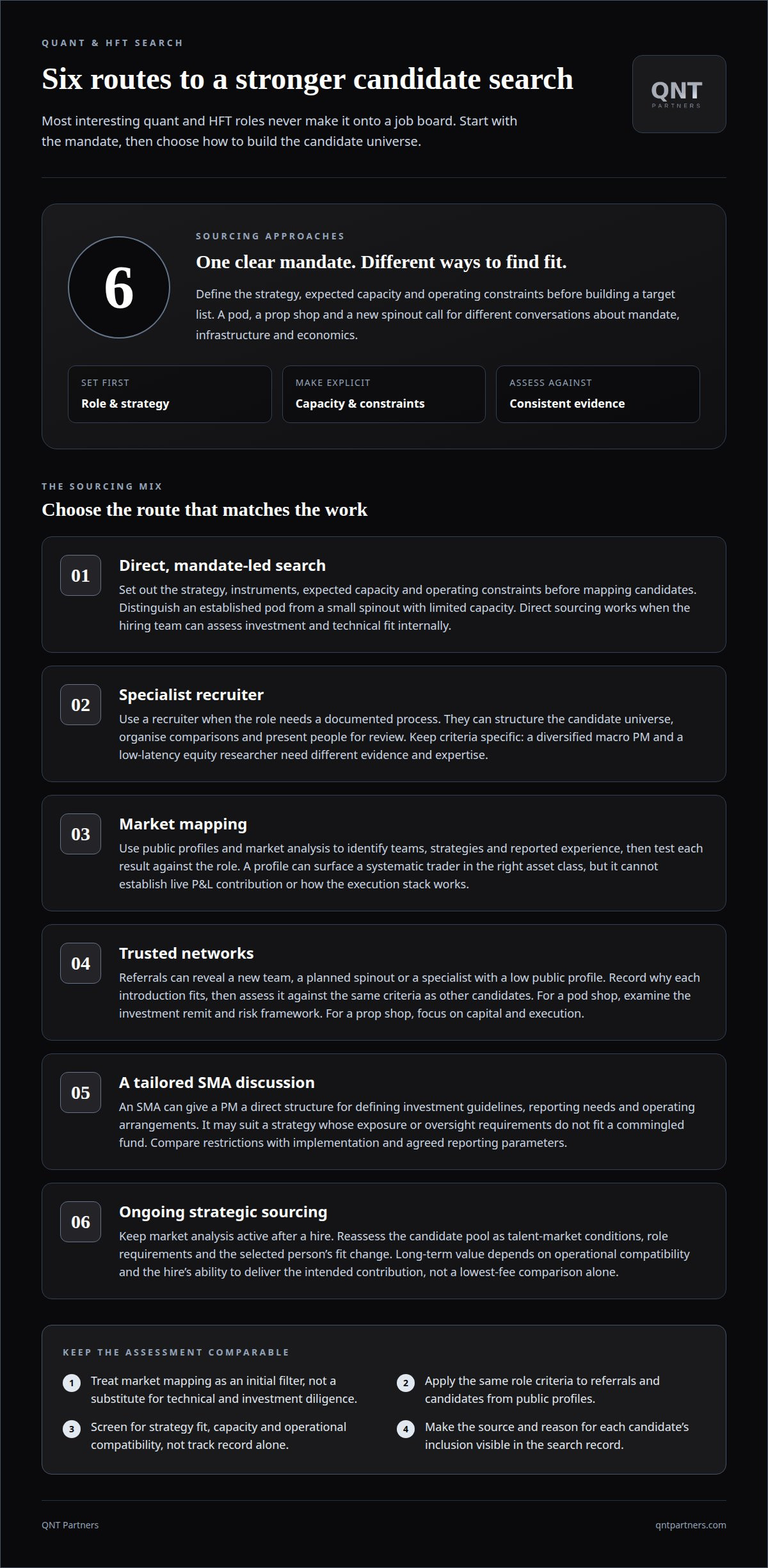
Most interesting quant and HFT roles never make it onto a job board. When I map a search, the key question is whether the team is hiring into a pod, a prop shop or a new spinout. Each structure calls for a different conversation about mandate, infrastructure and economics.
- Run a direct, mandate-led search. Set out the strategy, instruments, expected capacity and operating constraints before mapping candidates. A search for an equity market-neutral team, for example, should distinguish an established pod from a small spinout with limited capacity. Direct sourcing works when the hiring team can assess investment and technical fit internally. A clear brief gives an institutional client search a consistent basis for reviewing candidates.
- Use a specialist recruiter when the role needs a documented process. A recruiter can help structure the candidate universe, organise comparisons and present people for review. This suits a team that needs a clear record of how candidates were identified and assessed. Keep the criteria specific: a diversified macro PM and a low-latency equity researcher require different evidence and expertise.
- Build a targeted candidate universe from market mapping. Use public profiles and market analysis to identify teams, strategies and reported experience, then test each result against the role. A profile might surface a systematic trader in the right asset class, but it cannot establish their live P&L contribution or how their execution stack works. Treat market mapping as an initial filter, not a substitute for technical and investment diligence.
- Use trusted networks to find people beyond public profiles. Referrals can reveal a new team, a planned spinout or a specialist with a low public profile. Record why each introduction fits, then assess them against the same criteria as other candidates. For a pod shop, examine the team’s investment remit and risk framework. For a prop shop, focus on its capital and execution model.
- Discuss an SMA when the role involves a tailored mandate. An SMA can give a PM a direct structure for defining investment guidelines, reporting needs and operating arrangements with a firm. It can suit a strategy whose exposure or oversight requirements do not fit a commingled fund. Compare the structure with the objective, including how restrictions affect implementation and how the PM will report against agreed parameters.
- Keep strategic sourcing active after a hire. Strategic sourcing means ongoing market analysis, alignment with the team’s hiring goals and reassessment of the candidate pool. Track changes in the talent market, role requirements and the selected person’s fit. Do not reduce the decision to a lowest-fee comparison: long-term value also depends on operational compatibility and the hire’s ability to deliver the intended contribution.
What are the steps in a systematic investment manager sourcing process?
- Start with the portfolio job, not a list of names. I’d write down the mandate’s role, target exposure and constraints before looking at candidates. For a systematic equity strategy, that means being clear about the markets and instruments that matter, plus any liquidity or implementation limits. Mark hard gates separately from preferences. Otherwise, a team can be ruled out for a secondary preference, or a genuine mismatch can get lost in a strong presentation.
- Set decision rights before the first meeting. Get the people who will assess or approve the strategy into the process early. Investment staff may own the strategy assessment, with risk, operations and legal teams taking defined review roles. Agree who recommends a manager and who signs off. I’ve seen searches lose momentum when stakeholders arrive late with requirements that were never part of the original discussion.
- Record where candidates come from. Note whether a team surfaced through market mapping, a referral or a direct approach, and why it merits a closer look. That record is useful because the source mix can expose gaps in the universe. If every name comes from established funds, for example, you may be missing a relevant team preparing a spinout.
- Apply the same first-pass test to every candidate. Use the brief’s hard gates consistently, then record why each manager advances or gets screened out. A strategy can sound compelling in a presentation and still fail to fit the required portfolio role. Keep that distinction visible. An impressive meeting or a familiar name should not quietly move the goalposts halfway through the search.
- Make diligence answer decision-changing questions. Give each reviewer a clear area and capture the evidence behind their view. If a strategy depends on a small research team, for instance, examine how its process works when a key contributor is unavailable. Performance alone cannot answer that. I’d focus diligence on assumptions that affect implementation, rather than collecting information that will not change the decision.
- Compare proposals against terms agreed in advance. Set the information requested and intended mandate conditions before proposals arrive. Compare investment fit with contract terms and delivery requirements, rather than letting the first proposal set the frame. If negotiation exposes a material difference, record it and send the revised terms through the same approval route.
- Use each decision to improve the next search. Track where candidates progress, pause or exit, and why. If suitable managers repeatedly fall out at the same diligence stage, check whether the brief is unclear or the review sequence is creating friction. Refresh the approach when the mandate or market changes. Carrying old assumptions into a new search can narrow the universe for no good reason.
A clear sourcing brief matters most before the target universe is fixed. Once names are in the room, changing the criteria makes it harder to compare teams on the same basis.
What data and screening criteria are used to identify institutional investment managers?
- Break performance down by its drivers. Review monthly returns alongside drawdowns, volatility, beta and factor exposures. Separate live results from backtests, then test whether returns came from the stated signal or broader market exposure. For a market-neutral equity manager, examine performance across different equity regimes, not just the strongest period. Check reporting periods and return definitions before comparing candidates.
- Test capacity against the intended allocation. Consider assets under management, trading volume, turnover and position concentration. Ask how participation and market impact could change as assets grow. A short-horizon futures strategy raises different capacity questions from a slower equity portfolio. Break liquidity down by instrument and venue, since an aggregate portfolio figure can conceal crowded positions.
- For systematic strategies, examine execution quality. Review transaction-cost analysis, slippage, market impact and fill quality alongside gross and net returns. For an intraday strategy, ask how the execution model handles queue position, exchange connectivity and changing spreads. Tick-to-trade latency matters when the signal depends on a fast response. FPGA use matters only insofar as it fits the manager’s actual trading architecture.
- Look under the hood of the research record. Examine signal design, data provenance, testing assumptions and controls against overfitting. A backtest using point-in-time data tells a different story from one using revised datasets. Ask how the team handles survivorship bias and transaction costs. For a spinout, map which research, infrastructure and trading records belong to the team’s previous firm.
- Work out who actually runs the strategy. Review decision ownership, research coverage and operational dependencies. In a pod structure, understand how the PM’s risk budget and support functions shape results. In a prop shop, consider how capital allocation and execution resources affect the strategy. If a researcher or engineer is central to the model, assess how dependent the process is on that person.
- Use a scorecard, and keep the reasoning beside it. Assess investment fit, capacity, execution, research quality and operational compatibility against consistent criteria. Mark each item as evidenced, unresolved or unsuitable, and attach supporting data. A manager with lower historical returns may still diversify a portfolio’s exposures. Keep the rationale with each score so the committee can see what drove the decision.
For a manager search, I’d assess the person’s fit with the strategy, the team’s research process and the trading setup they’ll inherit. Check who owns the risk decisions, how P&L is attributed, and whether the role includes a pod-style risk budget, a prop-shop capital allocation or an SMA structure. A claimed 3.2x return in a 2025 track record needs the same scrutiny as any other result: establish whether it is live or backtested, gross or net, and attributable to the candidate’s own decisions. Then check practical fit, including co-location requirements, exchange connectivity, garden leave and any non-compete restrictions. These details can determine whether a strong candidate can start and trade as planned.
What technology platforms and databases support quant and HFT searches
- Use candidate databases to build the initial universe. Filter by role, strategy, location and market, then treat each result as a lead rather than a decision. A database may help identify a systematic trader or FPGA engineer, but it may not reflect current availability or a recent move. Record the date and source of each entry so stale information does not quietly shape the search.
- Keep a central search record for every candidate. A CRM or structured internal database should capture a candidate’s specialism, current firm, key experience, contact history and search status. Use consistent fields across candidates. For example, distinguish a researcher who has taken risk from one whose work has focused on execution, and separate verified details from candidate-provided descriptions. This makes handovers and hiring reviews more reliable.
- Connect interview notes to source documents. Store CVs, technical assessments, role briefs and meeting notes in the same candidate record. Add document dates and version labels. If a candidate’s account of their responsibilities changes between meetings, reviewers can distinguish the original description from the updated one.
- Use assessment tools to compare candidates consistently. A structured scorecard can organise evidence on strategy knowledge, coding experience and role fit, provided interviewers use the same criteria. Pair each rating with the relevant evidence. For instance, assess an HFT engineer against the role’s exchange connectivity and tick-to-trade requirements, rather than ranking them against candidates focused on unrelated systems.
- Use workflow tools to manage interview stages. Set clear owners, required feedback and recorded decisions for each stage. A shared workflow can track introductions, technical interviews, references and offer discussions. Keep status visible, but do not treat a completed process as evidence that a candidate is right for the role.
- Build reporting around live search decisions. Dashboards can combine candidate status, interview outcomes, feedback and role fit. Focus reporting on measures relevant to the search, such as where candidates drop out and how long decisions take. Track where searches stall and why, then adjust the brief or process when the evidence shows friction.
- Apply automation to repeatable data work, not hiring judgement. Tools can help reconcile candidate records, flag missing fields or identify changes across documents. Keep human review for assessing technical depth, role fit and motivation. A system may flag a new employment entry, for example, but a recruiter still needs to determine whether it changes the candidate’s relevance to the search.
What should quant and HFT firms check when hiring in the United States
- Understand the desk structure before defining the hire. A pod shop, prop shop and multi-manager platform can offer very different seats, even when the title is the same. Before approaching candidates, map who owns the strategy, how risk is allocated and who makes the hiring decision. That gives the search a clear brief without treating every quant role as interchangeable.
- Translate the desk’s needs into selection criteria. Tie each criterion to the work the person will actually do. A low-latency engineering role might require experience with FPGA or exchange connectivity, while a researcher role may call for a particular approach to signal research. Keep the rationale beside each criterion, so the team can assess candidates consistently rather than favouring familiarity or a polished interview.
- Check conflicts and restrictions before outreach. Ask early about garden leave, non-competes and any limits on contacting a candidate’s current colleagues. Agree who can review a disclosed restriction and who can take part in the hiring decision. Apply the same approach to someone introduced through a personal network and someone found through a search. That helps avoid inconsistent handling or exposing a candidate to unnecessary risk.
- Set rules for handling candidate information. Decide who can access CVs, interview feedback and details of a candidate’s current strategy or P&L. Store materials in approved systems, restrict access by role and record material changes. Keep sensitive strategy information separate from general interview notes where the firm’s process requires it, and follow its retention and information-security policies throughout the search.
- Separate technical assessment from commercial terms. The desk can assess research, trading or engineering capability, while designated reviewers handle the proposed package and contractual terms. Make sure unresolved points stay visible before an offer is approved. For a trading hire, clarify the expected remit and how any P&L split is defined. For an SMA or equity partnership structure, identify the responsible reviewers. A positive interview does not settle those terms.
- Keep a clear record of the decision. Store the role brief, assessment rationale, relevant disclosures and offer terms together. Note material changes to the candidate’s remit or proposed package during the process. If the team passes on a candidate, record the reason against the original criteria. A coherent file makes later review easier and helps maintain continuity when interviewers or decision-makers change.
- Get advice on the actual arrangement. The right legal review depends on the candidate’s circumstances, the firm’s structure and the proposed terms. Have qualified counsel assess the specific employment agreement, including any garden leave or non-compete provisions, rather than relying on a generic checklist. For a US quant or HFT search, discuss the sourcing mandate alongside the firm’s hiring process.
QNT Partners: Manager Search & SMA Sourcing
QNT Partners supports institutional clients seeking investment managers or considering an SMA structure. Its Manager Search & SMA Sourcing service suits mandates calling for a focused search across quantitative trading and research strategies, rather than a broad, undirected manager list.
This work can sit alongside a wider team build-out. QNT Partners’ Trading & Research, Technology & Engineering, and AI & ML services address specialist talent needs connected to a manager or investment team. This can be relevant when sourcing a strategy also raises questions about the people and technical capabilities needed to deliver it.
If you’re shaping an institutional manager search or SMA mandate, contact QNT Partners to discuss the requirement.
Set the mandate before the search begins
The search changes materially depending on whether the priority is a particular return stream, a defined risk contribution, or access to a team with limited capacity. Those criteria should be clear before outreach begins. Otherwise, introductions can look relevant on paper while missing the constraint that will determine whether a manager fits the mandate.
Systematic manager sourcing for institutional clients also depends on what happens after a manager is identified. A proposed mandate may require a new team, specialist research capability or a technology build-out. QNT Partners supports this adjacent work through its Trading & Research, Technology & Engineering, and AI & ML services.
When the mandate depends on a new team or build-out, those requirements shape the search from the start. Leave them unresolved and the manager may be identified before the people and technology needed to support the mandate are in place.
Frequently Asked Questions
What is systematic manager sourcing for institutional clients?
I treat systematic manager sourcing as a repeatable, evidence-led way to decide which managers merit evaluation against an investment mandate. Referrals, database results and emerging spinouts need the same basis for review, otherwise it is hard to compare them. At QNT Partners, we work on Manager Search & SMA Sourcing. The hiring organisation alone decides whether a candidate is suitable.
How does systematic manager sourcing compare with consultant-led or relationship-based sourcing?
Consultant-led sourcing adds an external process and can help structure committee materials. Relationship-based sourcing can surface teams before they appear in broad databases. I’d use both channels, then assess introductions against the same mandate. Track which sources lead to managers who progress through diligence. The number of introductions alone says little about whether a channel suits a particular search.
How can institutional clients measure the effectiveness of their manager sourcing process?
Shortlist size is a weak measure on its own. Record which sourced managers complete diligence, receive an allocation and remain aligned with the mandate after implementation. Attribute outcomes to their sourcing channel, and compare similar mandates rather than treating a complex SMA search like a liquid commingled fund search. For data transparency, QNT Partners retains candidate data for up to two years from last contact and client and commercial data for seven years. Individuals have rights under UK GDPR.