Hiring for Quantitative Investment Strategies: The Role of a Specialist Recruitment Firm

A role brief built around “quant researcher” can look precise and still miss the person your strategy needs. A Quantitative investment strategies recruitment firm should start with the investment process, not the title on the requisition.
I’ve seen generic briefs blur important distinctions. A researcher building signals for a market-making prop shop may need a different mix of research depth and implementation skill from someone joining a pod shop or a new SMA-led team. Technical fluency alone won’t show whether a candidate can connect their work to portfolio risk and P&L.
The challenge is assessing those dimensions together without exposing a build-out or spinout before the firm is ready. In this article, I’ll explain how we turn investment objectives into a focused search brief, assess fit across research and implementation, and run a discreet process. The aim is a search grounded in how the strategy will operate, including its team structure and infrastructure, rather than a list of fashionable tools or credentials.
Key Takeaways
- Translate the investment mandate into role scope and evidence of fit before writing a job brief.
- Assess research capability against production implementation, rather than relying on titles or credentials alone.
- Compare prop shop, pod shop and multi-manager structures by decision rights and role scope, not by assuming one model suits every strategy.
- A Quantitative investment strategies recruitment firm can shape a focused search around the strategy and team being built.
- Factor garden leave and non-competes into candidate timing and context, while keeping sensitive build-out plans discreet.
Quantitative investment strategy recruitment starts with the mandate
Identical job titles can conceal materially different investment work. A researcher at a market-making prop shop may develop signals against a short execution horizon, while a researcher supporting a systematic equity portfolio may work further upstream from live trading. The title says little about where the role sits in the investment process or what evidence should count as a strong fit.
Strategy-specific recruitment means translating the investment mandate into role scope, team context and evidence that a candidate can do the work. A Quantitative investment strategies recruitment firm should discuss how decisions are made and implemented, not simply collect keywords from a job description.
Quantitative analysis in finance spans work that can touch portfolio management and risk, but those broad categories don’t define the remit of a particular hire. The search brief needs to make that remit explicit.
Translate the investment process into a role brief
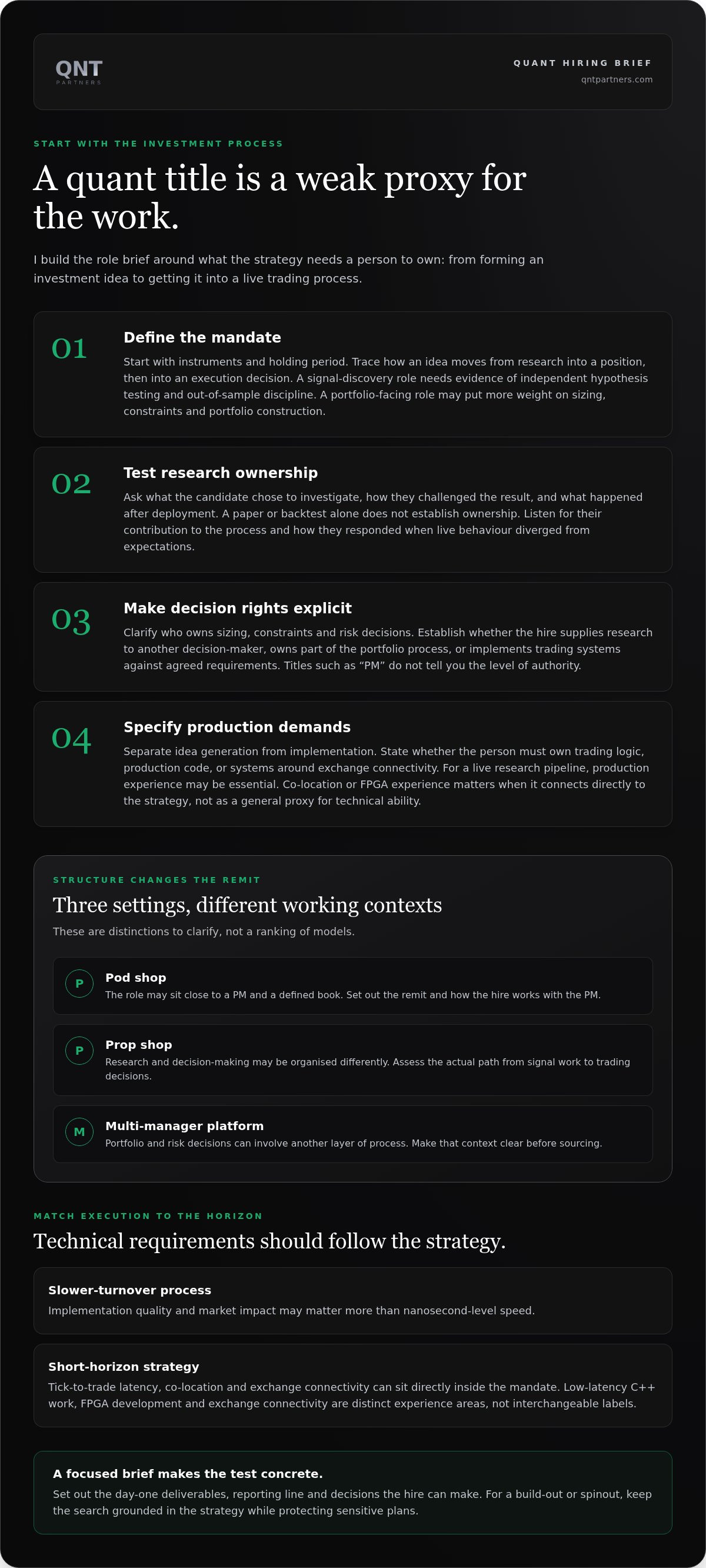
Start with the instruments and holding period, then trace how an idea moves from research into a position and, ultimately, an execution decision. A role focused on signal discovery may require evidence of independent hypothesis testing and out-of-sample discipline. A portfolio-facing role may place more weight on sizing, constraints and the way research informs portfolio construction.
Separate idea generation from implementation. For an execution-heavy strategy, establish whether the hire owns trading logic, production code or the systems around exchange connectivity. Co-location or FPGA experience matters when it connects directly to the mandate, not as a proxy for technical ability in general.
Be clear about what the person must deliver on day one and what can develop in-role. If the team needs someone to take ownership of a live research pipeline, production experience may be essential. If the hire joins an established engineering group, a different balance of research depth and implementation experience may make sense.
Set the team context before sourcing
Define the structure before approaching candidates. In a pod shop, the role may sit close to a PM and a defined book. At a prop shop, research and decision-making may be organised differently. A multi-manager platform can add another layer of process around portfolio and risk decisions. These are working distinctions, not a ranking of models.
State who the hire reports to, what decisions they can make, and how they work with PMs. Clarify whether success means producing research for another decision-maker, owning part of the portfolio process or implementing trading systems against agreed requirements. That context helps candidates assess the role accurately and lets the search assess experience against the actual remit.
QNT Partners was founded by former industry operators, and that background informs how we calibrate roles and assess technical and investment context. Our operator-founded firm background is relevant to searches where the team structure is still taking shape, including a build-out or spinout. A precise mandate gives the search a useful test: can this person contribute to the investment process as it is designed to operate?
Match quantitative roles to research, portfolio and execution demands
A strong candidate for one quant seat can be wrong for another, even inside the same strategy. The distinction often lies in what the person owns: forming investment hypotheses, deciding how capital is allocated, expressing a view through trades, or building the systems that make those trades possible.
I assess the work behind the title. A researcher may develop and test signals, then monitor how they behave as market conditions change. A PM may own portfolio construction and risk decisions, while a trader focuses on translating those decisions into execution. In a smaller team, one person may cover several functions, but the search still needs to identify which responsibilities are core and where accountability sits.
Assess research and portfolio responsibilities
For research roles, look for evidence of how a candidate moved from a hypothesis to a testable signal. Ask what they chose to investigate, how they challenged the result and what happened after deployment. A paper or backtest alone doesn’t establish ownership of the research process. The useful evidence is the candidate’s actual contribution and how they responded when live behaviour diverged from expectations.
Portfolio responsibility calls for a different assessment. Establish whether the candidate has shaped sizing, constraints or risk decisions, or supplied research to someone else who made them. Probe how they review a strategy as its exposures and performance change. A “PM” title can cover different levels of authority, so assess decision rights and portfolio ownership rather than inferring them from seniority.
Assess trading and infrastructure requirements
Execution requirements should follow the strategy’s time horizon. A slower-turnover process may care more about implementation quality and market impact than nanosecond-level speed. A short-horizon strategy may depend directly on tick-to-trade latency, co-location and exchange connectivity. Hiring for the latter without testing relevant production experience can leave a gap between an attractive model and an executable trading system.
Be precise about the engineering work. Low-latency C++ experience may suit a role focused on optimising software paths, while FPGA development and exchange connectivity can require distinct, hands-on experience. These are not interchangeable labels. Ask candidates to explain the systems they personally built or changed, the constraints they worked within and how the work supported the trading process.
Assess technical requirements by how they support the strategy’s investment decisions and execution horizon. That keeps interviews anchored to the mandate rather than turning them into a checklist of fashionable tools.
A Quantitative investment strategies recruitment firm should map each hire to the work they’ll own, then test for evidence at that level. At QNT Partners, we focus searches across quant research, trading and technology roles. Our search work with specialist quant teams starts with the role’s actual remit.
Compare hiring fit across prop shops, pod shops and multi-managers
The same quant can thrive in one firm structure and struggle in another. The difference often comes down to who owns the mandate, where decisions sit and how closely research, trading and risk work together. I don’t rank these models universally. I look at whether the candidate’s preferred way of working matches the structure being built.
| Structure | Decision rights | Team interaction | Typical role emphasis |
|---|---|---|---|
| Prop shop | May sit with a central group or be distributed across desks, depending on the firm. | Research and trading may work closely within a shared platform. | Can combine strategy development with trading or implementation. |
| Pod shop | Often centred on a PM or pod mandate, with ownership defined at team level. | Roles may interact closely within a pod, alongside shared firm infrastructure. | Can call for a clear contribution to a defined book or PM’s process. |
| Multi-manager | May involve a PM mandate within a broader platform and its risk framework. | Team-level work sits alongside central functions and platform processes. | Scope depends on how research, portfolio decisions and execution are divided. |
What changes between firm structures?
These are useful starting points, not fixed templates. A prop shop may centralise research, while another gives individual traders more autonomy. A pod may rely on PM-led research or draw on shared teams. In each case, mandate ownership shapes collaboration: a researcher contributing across portfolios will be assessed differently from one embedded with a single PM. Neither arrangement guarantees stronger investment outcomes. The hiring question is whether the candidate can work effectively within the actual decision process.
Before sourcing, define who sets research priorities, who can change portfolio exposures and how performance is reviewed. A candidate accustomed to owning a book may not want a role where investment decisions sit elsewhere. Someone who prefers deep research collaboration may not suit a team that expects independent mandate ownership. For broader search context, see this quant trading recruitment guide.
Where do compensation mechanics fit?
Compensation belongs in the role discussion, but it shouldn’t substitute for clarity on authority and accountability. A P&L split may be relevant where a PM or trader has direct responsibility for a mandate. An equity partnership may matter in a firm where ownership and longer-term participation are part of the proposition. Neither arrangement is standard across all structures, and the details depend on the role and firm.
I’d establish what the candidate is accountable for, what risks they control and how the incentive mechanism relates to that responsibility. A Quantitative investment strategies recruitment firm should make those distinctions clear early, so candidate interest is based on the real remit rather than an assumed title or payout model.
Run a focused search without losing candidate or firm context
A specialist search needs discipline at both ends: define the hire precisely, then protect the information shared with candidates. That matters particularly for a build-out or spinout, where a search can reveal a new strategy, team structure or planned market entry before the firm is ready to make it public.
I use a clear sequence to keep the work focused:
- Calibrate the role. Agree the mandate, reporting line and decisions the hire will own. Set out the technical and investment evidence that would demonstrate capability, rather than relying on a title or list of tools.
- Map relevant talent. Identify people whose experience connects to the strategy and team context. A candidate’s current remit matters as much as their past job title.
- Assess fit. Discuss research ownership, production implementation or trading decisions in terms of the work the person actually performed. Separate direct responsibility from exposure to a project or system.
- Manage the approach. Share enough context for a candidate to judge the opportunity, while keeping the firm and mandate confidential until disclosure is appropriate.
Calibrate and assess against evidence
Before any approaches, agree what strong evidence looks like with the hiring team. For a research hire, that may mean explaining how an investment hypothesis was formed, tested and monitored. For an implementation role, focus on the systems the candidate built or changed and how those changes supported live trading. For a trading role, establish which execution or portfolio decisions they owned.
Keep interview feedback specific. “Not technical enough” gives the search nowhere to go. “Has research experience, but hasn’t owned production implementation” identifies a real gap and helps refine the candidate profile. A Quantitative investment strategies recruitment firm should use that evidence to adjust the search, not widen it indiscriminately.
Protect context through the process
Confidentiality is practical, not cosmetic. Early conversations can describe the strategy and scope without naming the firm or revealing identifiable details about a new team. I also treat candidate motivations, garden leave and non-competes as individual context that can affect timing and appetite. These points need careful discussion, without assuming the same circumstances apply to every candidate.
Team design affects what information a candidate needs to make a considered decision. A central research function, a PM-led group and an independent trading pod each give the role a different working context. This organisational design for quantitative firms perspective can help clarify which details belong in the brief and when to share them.
We run discreet searches by aligning the approach with the mandate and the sensitivities of both parties. Our quantitative search work is built around that context.
How QNT Partners approaches quantitative investment strategy recruitment
I’m James, co-founder of QNT Partners, a boutique search and advisory firm focused on quantitative trading, research and technology businesses globally. We shape each search around the team’s mandate, then identify candidates whose experience fits the work and the way the group needs to operate.
My perspective on QNT Partners’ firm background informs how I interpret a search brief and discuss the role with candidates. For a new team or spinout, that means keeping the search grounded in the investment process while handling sensitive plans discreetly.
Search across quantitative and technical disciplines
We search across distinct roles, including quantitative traders, researchers, PMs and technology specialists. The right mix depends on the strategy: one build may need research ownership, another portfolio leadership, while a separate hire may focus on production systems. AI and ML specialists are relevant where those capabilities support the investment mandate, not simply because they appear in a generic role profile.
These disciplines can sit close together, but they call for different evidence of fit. A candidate’s title or familiarity with a technique won’t tell the whole story. We focus on the work they’ve owned and how it connects to the role being filled. In a compact team, unclear boundaries can leave critical responsibilities unowned.
Connect hiring decisions to team strategy
A search can also expose questions about the organisation itself: which capabilities belong in the team, where decision rights sit, and how roles should interact as the strategy develops. Our talent strategy advisory supports role design and organisational discussions where they’re relevant to the hiring plan. The aim is to make responsibilities clear before they become a source of friction.
As a Quantitative investment strategies recruitment firm, we treat a search as part of the team’s design, not a standalone exercise in matching CVs to titles. Misaligned scope can draw the wrong candidates, slow decisions and leave a new hire unclear about what they own. A precise brief gives the search a defensible starting point. Our strategy-specific search service starts with that brief.
Set the next hire up to matter
A new quant hire can influence what the team is able to pursue next. I’d look beyond the immediate vacancy and consider which capabilities the strategy may need as it develops, without hiring against a speculative org chart.
That calls for a clear distinction between what the team needs now and what may become relevant later. Keep the current remit anchored to real responsibilities, then revisit the team’s capability map as the investment process evolves. This gives future hiring decisions a stronger basis than simply replicating existing titles.
One useful next step is to review the role after the hiring criteria are agreed and identify any unresolved assumptions about ownership or priorities. Resolve those before the search begins. That gives the team a clearer view of what success in the role should look like, and leaves room to build with purpose.
Frequently Asked Questions
How does a quantitative investment strategy recruitment firm assess candidate fit?
A Quantitative investment strategies recruitment firm assesses fit by testing the match between a candidate’s actual contribution and the work the hire must deliver. That can include probing how they handled a research result that failed in production, or how they worked with a PM when evidence challenged an existing position. Specific examples help distinguish direct ownership from participation and clarify how the candidate responds when the investment process changes.
When should a quant fund use a specialist recruitment firm?
A quant fund should use a specialist recruiter when a role is difficult to define or the relevant talent pool is narrow. This often applies to a new strategy build, a senior hire requiring both investment and technical judgement, or a search that needs discretion. Specialist support can also help when internal teams lack time to map adjacent backgrounds, such as moving from market making into a different systematic trading approach.
What roles can a quantitative investment strategy search cover?
A search can cover investment managers, PMs, quantitative researchers and traders, alongside software engineers and infrastructure specialists. The remit may be an individual hire or a group with complementary responsibilities. QNT Partners also searches for AI and ML specialists where those capabilities have a defined use in the investment process. The useful starting point is the gap the team needs to fill, not a fixed list of titles.
How does hiring differ between prop shops, pod shops and multi-managers?
Hiring differs according to how each firm allocates authority and integrates the role with its investment process. A candidate who expects direct mandate ownership may be less suited to a position where research informs another decision-maker. In a shared platform, collaboration across functions may be central to the remit. Interviewers should make those operating expectations explicit, so candidates can assess the role beyond its compensation structure or title.
Can a recruitment firm support a confidential quant team build-out?
Yes. We can conduct an initial approach without naming the firm or disclosing details that would identify a confidential strategy. The brief can distinguish information candidates need to assess relevance from information that should remain restricted until later discussions. Confidentiality also works both ways: a candidate’s interest, current responsibilities and timing should be handled discreetly throughout the process.
How should a fund assess a quantitative researcher’s experience?
Ask the researcher to trace one project from initial question through evaluation and subsequent monitoring. Focus on their personal decisions: what they tested, how they interpreted an inconclusive result, and what changed after deployment. Where work was collaborative, clarify which parts they owned. This gives the hiring team a better view of judgement and research practice than a list of papers, tools or model types alone.
What should a quant fund include in a recruitment brief?
A useful brief explains the strategy’s instruments and time horizon, the purpose of the hire, and the decisions the role can make. It should also state how the position works with the PM or research group, which capabilities are essential at entry, and what can be learned in the role. Add any constraints on sharing the opportunity, so candidate approaches can be calibrated to the firm’s confidentiality needs.
If you’re defining a quant or technology hire, speak with QNT Partners about a strategy-specific search.