Hire Quant Researchers for AI and Experienced Quant Roles

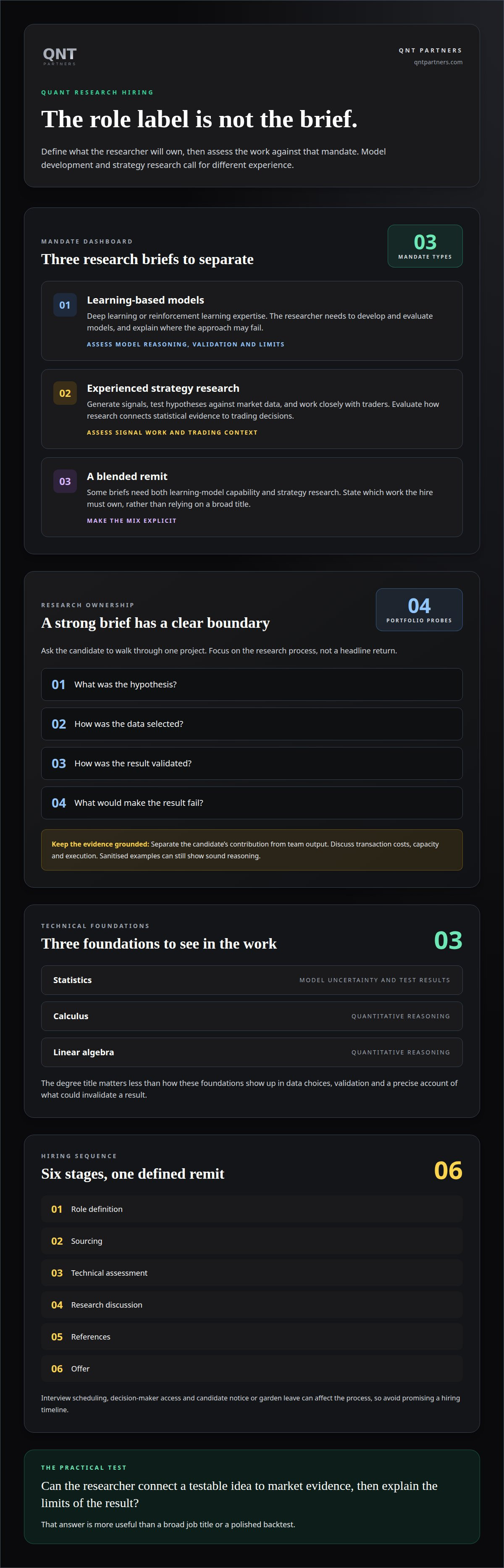
AI capability doesn’t replace experienced quant research; it changes what a team needs to test. When you hire quant researchers, define whether the gap is deep learning or reinforcement learning expertise, experienced strategy research, or a blend of both. The right profile depends on the work the hire must own, not the label on the role.
That distinction matters. A researcher building and evaluating learning-based models needs a different track record from someone developing signals, testing hypotheses against market data, and working closely with traders. A broad job description can blur those differences and make it harder to assess whether a candidate’s research experience fits the desk.
This article outlines the AI and experienced quantitative research roles to consider, the skills that distinguish them, and how to match a hire to the team’s research agenda. It also explains how specialist search can help when the brief calls for expertise spanning quantitative finance and machine learning.
Key Takeaways
- Match the research role to the work: developing learning-based models calls for different experience from generating and testing trading signals.
- Assess research fundamentals alongside domain expertise. Statistics, calculus and linear algebra matter, while a candidate’s ability to develop a new approach can matter more than prior finance experience.
- Hiring costs depend on the role’s scope, seniority and compensation structure, so define those factors before setting a budget.
- Separate research ownership from implementation: quant researchers develop and test ideas, while quant developers and data scientists typically focus on different parts of the technical workflow.
- Use interviews and practical exercises to test how candidates frame a hypothesis, work with data and explain the limits of a result.
Experienced quantitative research roles
An experienced quant researcher should own a defined part of the research process, from hypothesis to evaluation. In a systematic team, that might mean using market data to identify useful strategy metrics, then discussing their relevance to trading with traders. The role connects statistical evidence with decisions about signals, instruments, and implementation.
Specialisation matters. A stat-arbitrage researcher may investigate cross-sectional relationships, while an options researcher studies volatility surfaces and pricing behaviour. Execution research focuses on how order placement affects realised outcomes. In a prop shop, the researcher may work closely with traders; in a multi-manager structure, the role may sit within a specific team’s mandate.
Address confidentiality, intellectual-property ownership, garden leave, and non-compete terms during employment review. Align access controls with the firm’s trading, data, and information-barrier policies before the researcher receives sensitive material.
Evaluate portfolios by examining the research process, not a headline return. Ask the candidate to explain a project’s hypothesis, data selection, validation method, and failure conditions. Separate individual contributions from team output, and discuss how transaction costs, capacity, and execution affected the result. Even a confidential portfolio can demonstrate sound reasoning through sanitised examples.
A hiring process typically moves from role definition to sourcing, technical assessment, research discussion, references, and an offer. A clear sequence helps candidates understand whether the mandate involves independent signal research, close collaboration with traders, or model development. Avoid promising a hiring timeline: interview scheduling, decision-maker access, and candidate notice or garden leave can affect the process.
For university and PhD recruitment, target research groups whose methods align with the desk’s problem. A thesis on time-series inference may suit signal research; work in control theory may connect to execution or reinforcement learning. Use seminars, faculty networks, and technical discussions to assess how candidates approach a new problem.
Limited investment experience can leave a gap between a clean backtest and a deployable strategy. A researcher may underestimate market impact, changing liquidity, or the practical constraints traders face. Test this directly with a case study: ask how the candidate would diagnose a signal that weakens after costs and work with a trader to investigate it.
New ideas can matter more than prior finance experience, according to a quantitative researcher in systematic trading. The U.S. Bureau of Labor Statistics identifies statistics, calculus, and linear algebra as relevant quantitative skills. For an experienced hire, assess how those foundations appear in actual research: sound data choices, clear validation, and a precise explanation of what would invalidate the result.
What skills and qualifications should a quant researcher have?
Strong candidates move from mathematical reasoning to empirical tests without losing sight of the trading question. The U.S. Bureau of Labor Statistics identifies statistics, calculus, and linear algebra as relevant quantitative skills. Those foundations should be evident in how a researcher models uncertainty, transforms data, and tests whether a result holds up.
When you hire quant researchers, test their statistical judgement with a concrete problem. Give them a noisy signal and ask how they would distinguish predictive information from chance. Look for a defensible validation design, attention to data leakage, and awareness that repeated experimentation can create false confidence. A polished model cannot rescue a flawed test.
Programming skills should fit the research environment. Someone prototyping a cross-sectional equity signal may work mainly in Python, while a researcher close to execution systems may need to understand how research code moves towards production. Ask candidates to explain a data pipeline they built, including timestamp alignment and checks for corrupted inputs.
For deep learning roles, assess the reasoning behind model choices. Ask candidates to compare sequence models with simpler baselines for market data, then explain how they handle non-stationarity and overfitting. Strong researchers justify added complexity in relation to the problem, rather than treating architecture choice as evidence of predictive value.
Reinforcement learning calls for different questions. Ask candidates to define the agent, state, action, and reward in a trading or execution setting. Then probe how their simulated environment represents costs and changing market conditions. A key qualification is recognising where a simplified environment could lead to a poor policy.
Credentials can demonstrate technical depth, but the work matters more than the degree title. A PhD in applied mathematics, physics, computer science, or statistics may provide relevant training. Candidates from other disciplines can also demonstrate their methods through research or industry projects. Assess their contribution, not the institution’s reputation alone.
For experienced hires, examine how candidates work with traders. A researcher should turn a market observation into a testable hypothesis, explain assumptions clearly, and respond constructively when desk feedback challenges the thesis. If you hire quant researchers for a trading team, use an interview case to test how they critique a proposed signal and what evidence would change their view.
- For a statistical researcher, assess inference, validation and data hygiene.
- For a deep learning hire, probe model choice, baselines and out-of-sample behaviour.
- For a reinforcement learning role, examine how the simulated reward relates to the trading objective.
Match the assessment to the mandate. A signal researcher, deep learning specialist, and execution-focused researcher share mathematical foundations, but the strongest evidence differs for each. Teams that hire quant researchers through partners like QNT Partners should define the research problem first, then assess the methods and judgement it requires.
During these evaluations, pay close attention to whether candidates can challenge assumptions and suggest a stronger test. A Susquehanna quantitative researcher says developing a new idea or approach is valued more than having prior finance knowledge. This makes curiosity and original thinking useful hiring signals: ask what candidates would change in a proposed signal and how they would test whether the change adds evidence.
How much does it cost to hire a quantitative researcher in the US?
There isn’t one fixed cost for a quantitative researcher in the US. Build the estimate around the role’s scope, seniority, compensation structure, and location, then distinguish recurring employment costs from the effort required to complete the search. A researcher developing a new signal has a different mandate from a deep learning specialist building models for a trading team.
Start with the compensation architecture. A systematic trading role may include base compensation and eligibility for a discretionary incentive compensation programme. Benefits can also include medical and life insurance, retirement plans, and tax-free savings plans. The expected package depends on the firm’s structure and the candidate’s responsibilities, so compare like with like across the shortlist.
Next, define what the hire will own. A researcher expected to generate ideas, validate signals, and work directly with traders has a different remit from someone focused on model research or data analysis. For a pod shop, clarify how the role fits the team’s strategy and evaluation process. For a prop shop, specify the researcher’s relationship with traders and the systems supporting research.
Technical requirements also affect the search. A role requiring deep learning experience needs a different candidate pool from one focused on statistical signal research. If the mandate includes reinforcement learning, specify whether the work concerns research prototypes or a trading application. The narrower the combination of methods and market experience required, the more precisely the search needs to target relevant profiles.
Account for the hiring process without confusing it with compensation. Internal time spent defining the brief, reviewing candidates, and conducting technical interviews is part of the operational effort. Unclear ownership can lead to repeated interviews or delayed decisions. Set the interview stages in advance, identify who evaluates research quality, and agree who makes the final decision.
Use a consistent comparison method for each finalist. Record the scope of their research contribution, the methods they can apply, and the support they would need after joining. For example, a candidate with strong model research but limited trading experience may need closer collaboration with traders than someone used to desk-led research. That difference affects role design and onboarding, not just the offer.
For budgeting, document the mandate, expected seniority, compensation components, benefits, and interview plan before opening the search. Then review those assumptions against the candidates reached and the expertise they demonstrate. This gives the hiring team a clearer view of the full commitment, rather than treating a single compensation figure as the entire cost.
How do quant researchers differ from quant developers and data scientists?
The clearest distinction is ownership. A quant researcher owns the investment hypothesis and tests whether the evidence supports it. A quant developer turns research or trading requirements into reliable software. A data scientist analyses data to answer business questions, which may not involve a trading strategy or market risk.
Consider a proposed signal based on short-term price behaviour. The quant researcher asks whether the pattern persists across instruments, market conditions, and realistic execution assumptions. Their output might be a documented research result, a model specification, or a recommendation to reject the idea. The researcher must explain what the evidence supports, not simply produce a backtest.
A quant developer has a different brief. If a strategy needs to consume exchange data and submit orders, the developer builds or maintains the systems that make that possible. Work can include exchange connectivity, market-data handling, execution logic, and performance measurement. In a low-latency team, the role may involve C++ or FPGA work and attention to tick-to-trade latency.
A data scientist usually starts with a dataset and an analytical question. For example, they might build a forecasting model to understand client behaviour or identify anomalies in operational data. That work can use similar statistical and machine-learning methods, but its goal may be a business outcome rather than a tradable signal. The title alone won’t establish the candidate’s actual remit.
There is overlap. A quant researcher may write Python research code, while a quant developer may help make a prototype production-ready. A data scientist with market experience may have tested predictive signals. Define each role by its decision rights and deliverables, rather than assuming every candidate with a machine-learning background can own investment research.
Use the workflow to locate the hiring gap:
- Hypothesis and validation: assign ownership to the researcher who tests whether a market pattern has predictive value.
- Production implementation: assign ownership to the developer responsible for translating requirements into dependable systems.
- General analytical question: assign ownership to the data scientist who builds and interprets a model for a defined business outcome.
Interview tasks should reflect that distinction. Give a researcher a market hypothesis and ask for a testing plan. Ask a developer to explain system-design choices for processing market data. Ask a data scientist to structure an analysis and explain its limitations. Score each candidate against the work their role will own.
For a new desk, map the handoffs before opening the role. If the researcher can test ideas but lacks production support, the first hire may need engineering depth. If systems are ready but the strategy pipeline is thin, prioritise research ownership. That decision defines the role’s remit and prevents adjacent titles from competing for the same responsibilities.
What interview questions and tests assess quantitative research candidates
A strong interview tests how a candidate reasons when the data resist a clear story. Ask them to explain a research result that changed after a new test. Listen for the decision that changed, the evidence behind it, and what they learned from the earlier approach. A polished presentation matters less than clear ownership of the work.
Use a research case with a defined question and imperfect data. For example, give candidates a proposed signal with missing observations and ask how they would investigate it. Look for a plan that checks data construction, timing, and whether the result depends on a narrow sample. Ask what finding would make them reject the hypothesis.
Probe validation choices with specific follow-up questions. Ask why they chose a particular training and test split, then how they would guard against information leaking across those sets. A good answer should connect the design to the data’s structure. For time-dependent observations, ask how the candidate would prevent future information from entering a historical test.
A coding exercise should resemble the role’s actual research work. Provide a small dataset and ask the candidate to calculate a feature, test a hypothesis, or diagnose a faulty result. Assess whether their code is readable and whether they check inputs and outputs. The useful signal is their reasoning, not how quickly they type.
For machine-learning candidates, make the task specific to the method:
- Ask a deep learning candidate to compare a proposed architecture with a simpler baseline, then explain what evidence would justify the added complexity.
- Ask a reinforcement learning candidate to define the state, action and reward for an execution problem, then identify where a simulated environment could mislead.
- Ask an experienced researcher to describe how they would investigate a strategy whose simulated performance weakens under realistic trading assumptions.
Use a research presentation to assess communication and intellectual discipline. Ask the candidate to distinguish their own contribution from the wider team’s work. Then challenge an assumption in the presentation and observe whether they can revise the argument without defending a weak result. This tests collaboration with traders as well as technical command.
Keep the evaluation consistent across candidates. Use the same core case, scoring criteria, and follow-up questions, while allowing for role-specific depth. Record evidence against research design, coding judgement, and explanation quality. Reviewers should point to concrete answers, such as a proposed leakage check, rather than relying on general impressions.
Close with a discussion of a failed or abandoned project. Ask what evidence ended the work and how the candidate communicated that decision. Research judgement includes knowing when a result does not support further investment of time. That conversation can reveal more about their standards than another puzzle with a predetermined answer.
QNT Partners: Quant Trading & Research Recruitment
QNT Partners supports firms hiring across quantitative trading and research, including searches where research expertise needs to align with a specific desk mandate. Turn to us when the role calls for a specialist method, such as deep learning, or an experienced researcher who can work closely with traders.
Our services also include AI & ML, Technology & Engineering, and Manager Search & SMA Sourcing. The right search starts with a precise brief: what the hire will own, which research methods matter, and how the role fits the team’s structure. That focus helps distinguish a research mandate from an engineering or manager search.
If you’re planning a quant research hire, contact QNT Partners to discuss the role.
Set the mandate before opening the search
Decide what the research function needs to make possible in its next stage. A hire might establish a new research direction or deepen work already underway. Those are different mandates, even when the job title looks the same. The distinction affects how you define success and where the role sits within the team.
Before you hire quant researchers, identify the decision this role should improve and the authority the researcher will have. Clarify how their work connects to trading and portfolio leadership, then agree what progress should look like after they join. A specific mandate gives interviewers a shared basis for evaluating candidates and helps candidates judge whether the opportunity fits their strengths.
QNT Partners can support a search for specialist quantitative research talent aligned with that mandate. Discuss your quant research hire with QNT Partners.
Start with the problem the desk needs solved. A clear brief gives the search useful direction.
Frequently Asked Questions
Where can companies find and hire quantitative researchers?
Companies can source quantitative researchers through university research groups, referrals from trading teams, specialist industry networks, and focused executive search. For example, a desk hiring for machine-learning research can approach candidates whose academic work aligns with its modelling needs, then assess their ability to apply that work to market problems. QNT Partners supports quantitative research and AI & ML searches when a firm needs targeted access to those profiles.