High performance computing recruitment for trading roles

Trading HPC hires are made or missed at the boundary between compute infrastructure and the trading system it serves. High performance computing recruitment for trading means assessing candidates against the environment they’ll support: an HPC engineer role may call for a master’s degree in computer science or a related field, or equivalent experience, while systems roles can require programming depth and experience with InfiniBand or Ethernet at 400G or faster.
The technical overlap with general infrastructure is real, but trading teams need more than someone who can keep a cluster running. Details such as NVIDIA DGX or HGX GPU platforms, configuration management, network performance, and trading data-centre operations all shape the search.
This article explains what these roles involve and how to distinguish relevant experience from a list of familiar tools. It covers the technical signals to assess, the differences between HPC and low-latency engineering, and how to align a search with the team’s actual build and operating requirements.
Key Takeaways
- Start with the trading workload and infrastructure build, then define the role around what the hire will own.
- Separate large-scale compute operations from low-latency trading systems work; related experience does not automatically mean the same fit.
- Probe for specific examples of diagnosing performance issues and supporting production infrastructure, not just familiarity with tools.
- Match the search to the team’s hiring need, whether that is an individual technical hire or a broader quant and technology build-out.
High performance computing recruitment for trading
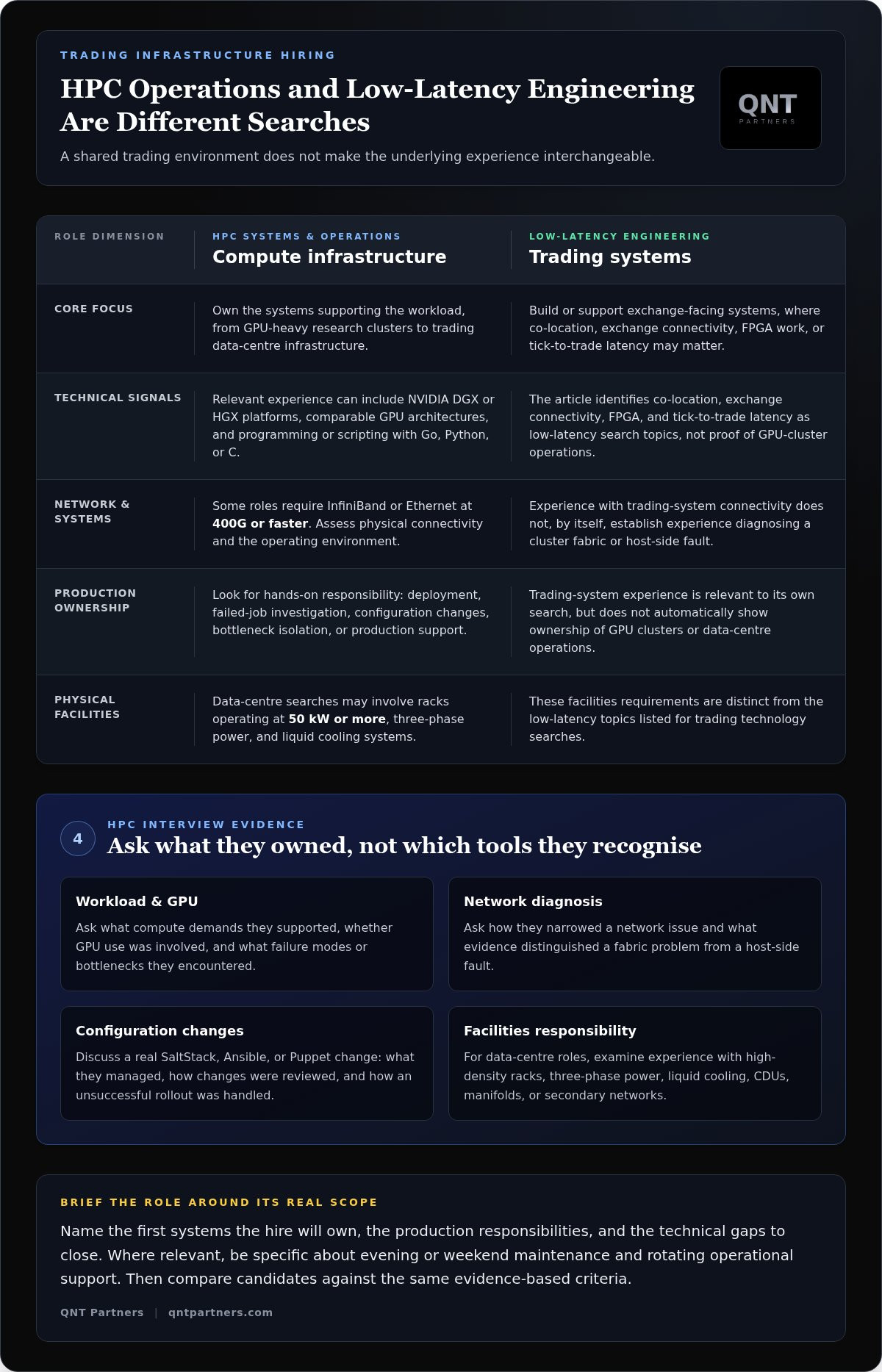
High performance computing recruitment for trading starts with the workload, not a generic infrastructure title. A cluster supporting GPU-heavy research has different demands from a trading data centre running live production systems. Define what the hire will own before comparing CVs. Otherwise, familiar tools can obscure a mismatch in day-to-day responsibilities.
Separate the search into compute systems, software, and data-centre operations. An HPC Systems Engineer may need strong programming or scripting skills, with Go, Python, and C among the relevant examples. Focus on what candidates have built or operated with those languages. Ask how they automated a deployment, investigated a failed job, or safely changed configuration across a cluster.
For large-scale GPU environments, look for direct experience with NVIDIA DGX or HGX platforms, or comparable GPU architectures. Ask candidates to describe a deployment they supported, the failure modes they encountered, and how they isolated a bottleneck. A platform name alone says little. Strong answers connect the hardware, workload, monitoring, and operational response.
Networking experience also needs context. Relevant roles can require knowledge of InfiniBand and Ethernet at 400G or faster. Test whether candidates understand the physical connectivity as well as the operating environment. Ask them to describe a network issue they diagnosed, how they narrowed its scope, and what evidence distinguished a fabric problem from a host-side fault.
Configuration management is another practical signal. Experience with SaltStack, Ansible, or Puppet can reveal how someone approaches repeatable infrastructure changes. Ask for a concrete example: what they managed, how changes were reviewed, and how they handled an unsuccessful rollout. The goal is to assess their operational judgement, not count tools on a CV.
Some trading HPC searches are predominantly data-centre roles. The requirements can include maintaining racks operating at 50 kW or more, understanding high-density three-phase power delivery, and deploying liquid cooling systems. Relevant cooling work may involve CDUs, manifolds, and secondary networks. Ask candidates to describe their responsibility for commissioning, maintenance, or incident response across the systems they have worked with.
The role’s operational scope should shape the interview. Someone whose experience centres on software-defined infrastructure may have a different background from a person responsible for physical power and cooling. Discuss the actual duties, including coordinated evening or weekend maintenance and rotating operational support where relevant. A precise description of the schedule is more useful than a broad label such as “production support”.
Structure the assessment around evidence from the target environment:
- Workload: Ask what compute demands the candidate supported, including GPU use where relevant.
- Network: Test their understanding of InfiniBand or Ethernet, including 400G or faster environments where required.
- Automation: Discuss a real SaltStack, Ansible, or Puppet change and its operational outcome.
- Facilities: For data-centre searches, examine experience with 50 kW racks, three-phase power, or liquid cooling.
Keep the role boundary clear: HPC systems work is not interchangeable with low-latency engineering. Co-location, exchange connectivity, FPGA work, and tick-to-trade latency may matter in a trading technology search, but they don’t demonstrate experience operating GPU clusters or high-density data-centre infrastructure. Likewise, deep HPC operations experience doesn’t necessarily mean a candidate has built exchange-facing systems.
Before opening a search, write down the first systems the person will own, the production responsibilities, and the technical gaps they must close. Then use the same evidence-based criteria across interviews. That makes it easier to distinguish someone who has encountered NVIDIA DGX, 400G networking, or liquid cooling from someone who has carried responsibility for those systems in production.
Someone whose experience centres on software-defined infrastructure may still be a fit, but assess whether that background transfers to the physical operations the role requires. Ask for examples that connect planning with implementation, and clarify where responsibility began and ended. This distinguishes design familiarity from hands-on ownership without treating either as a substitute for the other.
The Senior HPC Datacenter Engineer position is a permanent role based in Austin, Texas, United States. Use those terms alongside the operational scope when discussing fit, and invite candidates to explain which parts of the environment they can own. A clear discussion of accountability, collaboration, and site demands makes comparisons more grounded than broad claims of HPC expertise.
QNT Partners: Quant Trading & Research Recruitment
QNT Partners can help when an HPC hire sits between trading infrastructure and quant research. The search should reflect the work the person will own, whether that involves engineering systems or supporting a research and trading team.
Technology & Engineering Recruitment is suited to searches where infrastructure capability is the priority. Quant Trading & Research Recruitment fits roles connected directly to research or trading. Defining that boundary early keeps the brief focused on relevant experience rather than a broad list of technologies.
If you’re planning an HPC search or refining a role around a specific build-out, contact QNT Partners to discuss the hiring requirement.
Set the Search Around the Build
Before opening a role, decide which part of the build needs ownership first. A research platform, GPU cluster, and trading data-centre expansion create different hiring priorities. Set the mandate around the work the new hire will own, the teams they’ll work with, and the operational decisions they’ll be expected to make.
A focused approach to high performance computing recruitment for trading keeps the search anchored to these requirements. QNT Partners offers Quant Trading & Research Recruitment, Technology & Engineering Recruitment, and AI & ML Specialist Search for firms hiring across these disciplines.
If you’re turning an infrastructure plan into a hiring brief, contact QNT Partners to discuss hiring. A clear mandate gives the search a practical starting point.