HFT technology executive search fees and expertise

In HFT, a search firm’s specialism matters more than the size of its candidate database. A firm focused on HFT technology executive search identifies and assesses senior engineers and technology leaders against the systems they’ll actually need to build, from low-latency infrastructure to exchange connectivity. Fees depend on the mandate’s scope, the compensation attached to the role and how the search is structured.
That distinction is easy to miss. A general technology recruiter may understand senior hiring, but HFT searches require fluency in the constraints behind the role: tick-to-trade latency, co-location, FPGA development and production-critical systems. A specialist can discuss those trade-offs with candidates and hiring teams instead of relying on a broad job description.
This article explains what technology executive search firms do, how search fees are shaped without quoting a service price, and how to assess a firm’s technical and sector expertise. It also looks at the differences between search specialisms, the signals that matter in an HFT mandate, and where a focused recruitment partner fits when a build-out or leadership hire needs discretion and precision.
Key Takeaways
- Compare search firms by how closely their candidate networks and assessment methods match the technical mandate.
- Understand which parts of a search determine its fee before comparing proposals.
- Match the firm’s specialism to the role, including any potential conflicts from existing client relationships.
- Assess technology-sector expertise through the firm’s grasp of the systems and engineering trade-offs involved.
- Separate leadership hiring needs from specialist hiring needs when prioritising roles at a US HFT firm.
What Is a Technology Executive Search Firm?
An HFT technology executive search firm finds and assesses leaders for specialised roles, not broad technology vacancies. The key comparison is whether its recruitment work reflects trading systems, software and the organisation’s actual technical priorities.
HFT and Financial Services Recruiting
HFT executive search differs from fintech and traditional financial services recruitment because the technical remit is closely tied to trading performance. A candidate leading low-latency engineering may need to understand exchange connectivity, co-location and tick-to-trade latency, not just digital product delivery or bank technology controls.
Compare firms by the industries they cover and the questions they ask. Can they distinguish a prop shop’s engineering model from a multi-manager platform? Can they discuss how an FPGA build affects the team’s architecture? Those examples show whether a search partner can assess proven, relevant experience rather than simply match job titles.
When a candidate comes from a competing trading firm, treat confidentiality and contractual restrictions as separate issues. Do not solicit another employer’s strategies, source code or non-public data. Have qualified counsel assess the candidate’s agreements and applicable requirements before setting a start date.
HFT firms also face risks if interviews reveal sensitive plans or if a hire’s non-compete or garden-leave terms are overlooked. Share only the search materials candidates need, control access and document restrictions that could affect timing or role scope.
In-Demand Technology Leadership Roles
Technology leadership searches at US HFT firms often focus on roles responsible for execution infrastructure or technical teams. A CTO may set architecture and build-out priorities, while a head of low-latency engineering may lead work across C++, FPGA development and exchange connectivity.
Other mandates may focus on software engineering leaders responsible for research platforms, market data or production systems. The title alone tells little: compare decision rights, team remit and proximity to live trading. A head of platform engineering in a Chicago prop shop may have a very different brief from a technology leader supporting a multi-manager organisation.
Separate leadership requirements from individual-contributor criteria before interviewing. A senior engineer may be assessed on implementation depth, while an executive must also set technical direction, build teams and explain trade-offs to trading leadership.
Preparing and Running the Search
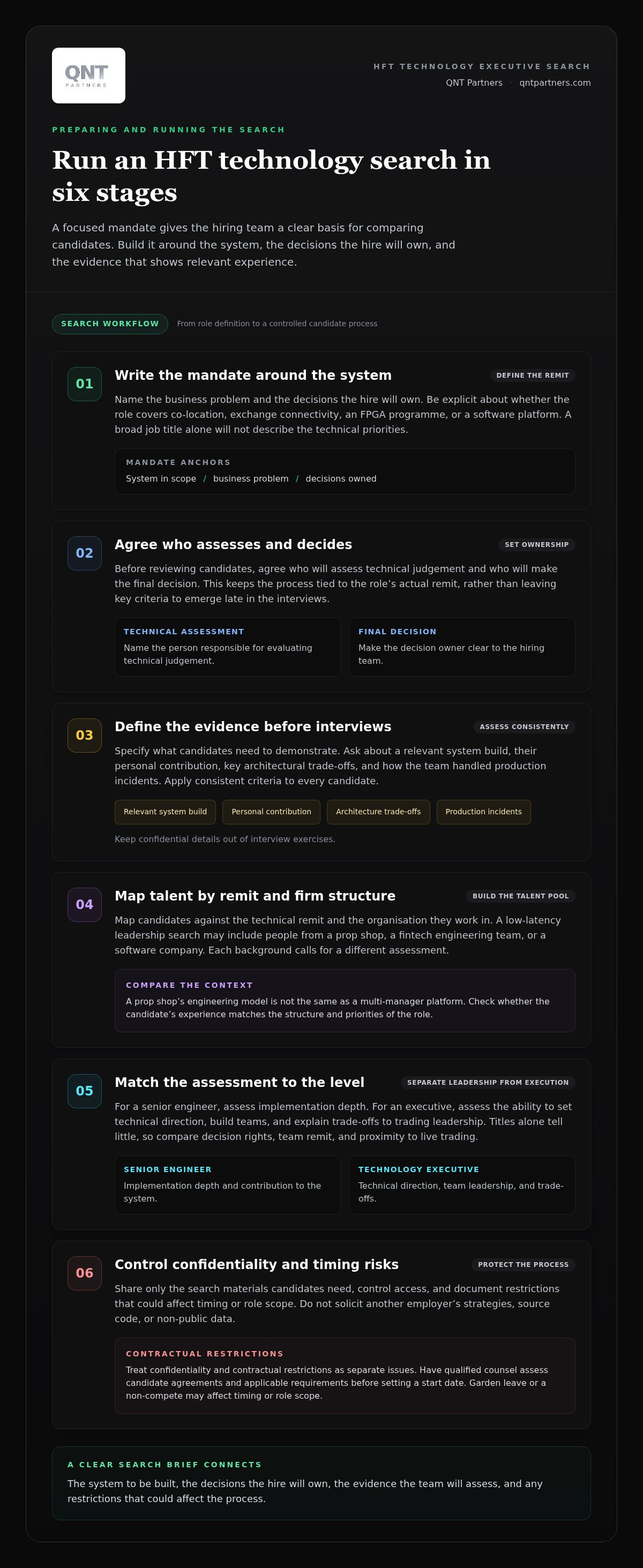
Start with a written mandate that names the system, business problem and decisions the hire will own. Specify whether the role covers co-location, exchange connectivity, an FPGA programme or a software platform. Then agree who will assess technical judgement and who will make the final decision.
Define the evidence you will assess before reviewing candidates. Ask about a relevant system build, the candidate’s personal contribution, key architectural trade-offs and how the team handled production incidents. Keep confidential details out of interview exercises and apply consistent criteria to every candidate.
Finally, map the talent pool by technical remit and firm structure. A search for a low-latency leader may draw candidates from a prop shop, fintech engineering team or software company, but each background calls for a different assessment. This preparation gives technology leaders a clear basis for comparing candidates and progressing the search.
Executive search fees
Search scope should reflect the role’s seniority, technical remit and target market. Define the work involved and the outcomes the hire is expected to own before agreeing the engagement terms.
Retained search is commonly used when a firm needs a senior leader and access to passive candidates. The client and search firm agree a mandate, then work through defined stages. By contrast, contingency recruitment generally ties payment to a successful hire. The distinction matters when a Chicago prop shop needs a confidential CTO search rather than a shortlist for an open role.
Compare proposals by deliverables, not the headline fee alone. One mandate might cover market mapping, candidate assessment and offer support; another may define a narrower brief. Ask how partners will report progress, who conducts interviews, and how the firm handles a changed role specification. A search for a head of FPGA engineering requires different market work from a general software leadership hire.
Compensation structure affects the fee calculation where a proposal uses a percentage of first-year cash compensation. For an executive with base salary and a target cash bonus, clarify which components count. Equity, sign-on awards and a performance-linked bonus can create different calculations, so the written agreement should define the basis before the search begins.
Also examine the replacement or continuation terms in the agreement. These provisions may address what happens if a placed executive leaves within an agreed period, but their scope depends on the contract. Check the conditions, exclusions and required client actions. A departure during a restructure, for example, may be treated differently from a voluntary resignation.
Geography and search complexity also shape the work. A US-based search focused on one trading hub differs from a mandate spanning several markets or targeting candidates with specialised exchange connectivity experience. Clarify whether the brief covers one role or several, how market research will be delivered and how the hiring team will receive updates.
Before signing, define the role’s outcomes and boundaries. Set out the executive’s decision rights, technical remit and reporting line, then separate essential experience from preferences. A brief asking a leader to own low-latency infrastructure, manage a team and deliver a transformation needs clear priorities. Otherwise, the search team may assess candidates against different versions of the organisation’s vision.
For HFT technology executive search, the fee discussion should connect directly to the work required, not a generic executive-search benchmark. Put the payment schedule, scope, assessment stages and any continuation terms in writing. That gives both sides a clear basis to deliver the agreed search.
Executive search firm specialties
A search firm’s specialism determines which candidates it can credibly identify and assess. In HFT technology executive search, distinguish functional expertise, such as engineering leadership, from sector expertise in trading systems and market structure.
A functional specialist may recruit senior technology leaders across software companies, banks and digital businesses. That breadth can suit a CTO search focused on organisation design or a broad transformation. A sector specialist understands why a head of low-latency engineering may need experience with exchange connectivity, co-location or FPGA development, rather than general software delivery alone.
Boutique technology search firms may offer deeper domain expertise and fewer conflicts arising from prior client relationships. That can matter when a client wants to reach candidates at a direct competitor. Ask how the firm defines relevant experience, handles confidential approaches and identifies restrictions affecting its network.
Network size alone says little about a firm’s ability to find the right executive. Ask for an anonymised example of a comparable mandate, including the candidate’s technical remit and type of organisation. A search for a platform leader at a prop shop may require a different network from a fintech seeking a chief technology officer.
Specialism should also shape the assessment. For a software engineering executive, examine how they set architecture standards and manage production risk. For an HFT infrastructure leader, explore decisions involving tick-to-trade latency and exchange connectivity. The search partner should translate requirements into specific evidence, not rely on job titles or keyword matches.
Understanding compensation can also help assess role fit. A candidate moving from a prop shop may weigh P&L participation differently from a technology executive joining a software company. Equity, bonus structure and decision-making authority can affect whether a role is suitable. Describe the package components accurately in the search brief rather than assuming that familiar titles mean comparable terms.
AI and ML mandates need a distinct assessment. Searching for an AI research lead differs from hiring a software executive to deploy models in production. Define whether the role owns research, engineering implementation or team leadership, then assess candidates against that remit. A general technology network may not reach specialists whose experience bridges quantitative research and production systems.
To compare search specialisms, assess relevant placements, candidate sources, technical evaluation and conflict management. For a spinout building its first execution platform, prioritise direct understanding of the build over a broad executive network. The best fit is a firm that can explain how its approach matches the mandate’s actual systems and leadership needs.
Technology-sector expertise
Technology-sector expertise means assessing a leader against the systems they will own, not just their title. According to McKinsey, 60% of companies cite tech talent scarcity as a top barrier to transformation. In HFT, that scarcity is especially relevant when a hire must connect engineering decisions with live trading requirements.
Recruiters can assess low-latency experience by asking candidates to explain a system they personally built or changed. Probe the architecture, measurement methods and trade-offs behind the design. A candidate discussing tick-to-trade performance should distinguish their own contribution from the wider team’s results, then explain how they evaluated changes.
Technology leaders also need to explain how their systems perform under operational constraints. A focused interview can explore exchange connectivity, co-location dependencies or an FPGA project without asking candidates to disclose confidential code. The goal is to assess technical judgement and ownership, not collect proprietary implementation details from a previous employer.
Sector expertise changes how a recruiter interprets a CV. A software leader from a digital business may have managed large engineering teams, while an HFT candidate may have owned a narrower system with direct trading impact. Test both contexts through specific examples, then explain clearly where experience transfers and where it does not.
Programming language experience can be a useful signal, but it does not establish leadership fit on its own. A role may call for C++, C# or R, yet the assessment should connect that experience to the system and team remit. Ask how the candidate sets code-review standards or resolves disagreements about a production change.
Communication matters because technology executives translate constraints between engineering and trading. Ask candidates to explain a technical decision to a head of trading, then describe how they handled disagreement with engineers. Their examples show whether they can make trade-offs clear without losing operational detail.
For global searches, assess candidates using one consistent scorecard. Define the core system, required leadership scope and evidence expected at each interview stage. Candidates from a US prop shop and an international software company may use different terms for similar responsibilities, so focus on the work itself.
Successful hiring depends on matching talent to the actual build, not chasing a fashionable title. A focused search distinguishes infrastructure leadership from AI research leadership, even when both involve innovation. That distinction helps the organisation assess candidates consistently and communicate technical priorities clearly.
Which executive roles are most in demand at U.S. high-frequency trading firms?
Leadership hiring in a US HFT firm usually follows the build: trading strategy, execution infrastructure or research capacity. Titles vary between a prop shop and a multi-manager platform, so assess the remit and decision rights, not the title alone.
Technology mandates often focus on executives who can set systems direction and stay close to trading requirements. A CTO may own architecture and engineering priorities, while a head of low-latency engineering leads work on exchange connectivity, FPGA development or production systems. In a smaller spinout, one leader may cover several responsibilities.
Platform and infrastructure leaders are important when a firm is building or reworking its execution stack. Their remit may include market data, co-location and systems supporting order flow. Ask candidates which components they owned, how they worked with traders and how they evaluated the effects of design decisions.
Quant trading and portfolio leadership roles sit beside technology, but their hiring criteria differ. HFT Talent hiring posts describe quantitative trader experience of 4-6 years, portfolio manager experience of 6-12 years, and at least 12 years for a partner or senior trader role. These examples are not a universal career ladder; they show how role scope and seniority can diverge.
At executive level, a firm may seek a technology leader to support a new team or strategy launch. A trader joining a pod shop may bring a track record and a defined mandate, while an engineering executive may be responsible for making the platform fit that mandate. Align both briefs before interviewing.
For a search, separate three questions in the role specification:
- Ownership: Which systems, teams or trading outcomes will the leader control?
- Technical depth: Does the mandate require hands-on low-latency experience, or leadership across a wider engineering function?
- Structure: Is the role in a prop shop, pod shop or multi-manager firm, and how does that shape the working relationship?
These distinctions also clarify whether the search is for an executive, senior specialist or manager. A candidate may have deep C++ or FPGA experience without having led an organisation; another may have managed a large software group without working close to live trading. Interview against the actual remit.
For a build-out, define the first systems and decisions the hire will own before approaching candidates. This gives the HFT search a sharper brief and helps the interview panel distinguish leadership evidence from technical credentials.
QNT Partners: Quant Trading & Research Recruitment
QNT Partners works with quantitative trading firms on searches where roles sit close to strategy, research or technology build-outs. For a mandate spanning execution infrastructure and trading, Trading & Research and Technology & Engineering address the distinct needs of both teams.
When the brief centres on machine learning leadership, AI & ML supports a focused search. For firms assessing a portfolio manager appointment or a separately managed account structure, Manager Search & SMA Sourcing is relevant. Start with a clear remit: the systems or mandate involved, the decisions the hire will own and the experience that matters most.
To discuss a search or talent requirement, visit QNT Partners.
Set the mandate before the market moves
The next step is to turn the hiring need into a clear mandate candidates can evaluate. Define what the person will own, which decisions sit with them and how the role connects to trading, research or engineering. That clarity gives an HFT technology executive search a practical starting point and helps candidates judge the opportunity by its actual remit.
QNT Partners works across Trading & Research, Technology & Engineering and AI & ML. The right fit depends on whether the need is in strategy, systems engineering or specialist model development. Define the mandate before the first candidate conversation so the search starts with the work itself.
Contact QNT Partners about your search to discuss the role and its requirements. A well-defined brief is a strong first move toward the leadership your build needs.
Frequently Asked Questions
How Long Does a CTO or CIO Search Take?
The time required for a CTO or CIO search depends on the mandate, candidate market and interview process. A role combining technology leadership with ownership of trading systems needs different assessment from a corporate technology appointment. Agree on decision-makers and interview stages early, then keep the role criteria consistent as candidates enter the process.
What does HFT technology executive search include?
HFT technology executive search typically involves defining the leadership remit, identifying relevant candidates, assessing their experience and supporting the hiring process. For an engineering leader, assessment may cover production-system ownership, team leadership and collaboration with trading teams. Separate essential criteria from preferences to keep discussions relevant to the organisation’s technical and management needs.
Which executive search firms specialise in HFT and quantitative trading?
Assess a firm’s specialism through examples of mandates involving comparable trading structures and technical responsibilities. Ask how it distinguishes leadership experience from individual-contributor expertise and manages confidential candidate approaches. QNT Partners operates as a recruitment intermediary; the hiring organisation alone determines candidate suitability. Candidate data is retained for up to two years from last contact, and client and commercial data for seven years. Individuals have rights under UK GDPR.
How much do executive search firms charge for HFT leadership placements?
Fees depend on the engagement terms and work involved, so compare the written scope rather than a headline figure. Review how the agreement defines its fee basis, payment stages and included search work. A mandate covering several markets or a specialised technical remit differs from a narrower leadership brief. The contract should also explain how a change to the role affects the engagement.
What is the typical timeline for an HFT executive search?
The duration of an HFT executive search depends on the role and the work involved. The process generally moves from agreeing the mandate to market mapping, assessment, interviews and offer discussions. A new platform build may need different evaluation from a leadership replacement. Set the interview panel, criteria and decision process before candidate discussions begin so each stage tests the same requirements and produces comparable evidence.