HFT Software Developer Recruitment for Trading Firms

In HFT software developer recruitment, the hiring firm and recruiter agree on the fee and payment terms. Candidates aren’t charged a recruitment fee under that arrangement. There’s no single rate across searches, as terms depend on the role and how the search is structured.
That distinction matters whether you’re considering a move or building a team. The fee is only one part of the decision: the technical bar, search process and time required to reach the right people all shape how a hire comes together.
This guide explains how candidate fees and hiring-company payments work, what firms look for in HFT engineers, and how recruitment methods and timelines vary. It also distinguishes backend and infrastructure roles from broader quant developer positions, helping you assess the work in terms of the systems you’ll build and maintain.
Key Takeaways
- Assess HFT candidates on strong C++ and systems programming, then probe networking, concurrency and performance tuning against the work the team needs done.
- Relevant experience may come from systematic trading, crypto or finance. The key is whether candidates can apply their technical skills to trading systems.
- Set the recruitment process around the actual remit, from low-latency infrastructure work to collaboration with traders and quants on strategy implementation.
- Separate backend and infrastructure requirements from broader quant development expectations before defining the role or evaluating candidates.
- For a specialist search across trading, research or engineering, QNT Partners can support firms with relevant recruitment and search work.
Candidate fees and hiring-company payment
In an employer-paid recruitment arrangement, the hiring firm pays the recruiter under their agreed terms. The candidate isn’t charged a recruitment fee. Keep the recruiter’s commercial fee separate from salary, bonus and sign-on terms: those form part of the employment offer, not the agency’s invoice. The contract between recruiter and employer sets out the payment obligation.
For a hiring firm, a useful first step is to define the fee trigger in writing. The agreement can specify when a fee becomes payable, which role it covers and how the search scope is defined. If a firm opens a second position during the process, clarify whether it falls within the original mandate or needs separate terms. Clear boundaries reduce the chance of later disagreement.
Contingent and retained searches allocate commitment differently. In a contingent arrangement, payment follows a successful hire. In a retained arrangement, payment follows the agreed search process and its stages. Neither structure determines the candidate’s offer or guarantees a hire. Before signing, hiring teams should align the internal budget owner, approval route and recruiter agreement.
Candidate support should remove avoidable uncertainty from the process. Before an interview, establish who will attend, what each discussion will cover and how feedback will be shared. For example, a technical interviewer might focus on design reasoning, while a trading lead discusses day-to-day interaction with the desk. Candidates can then prepare relevant examples instead of relying on generic interview scripts.
Guidance should also help candidates protect confidential information. When describing a production system, explain the problem, your contribution and the trade-offs, but leave out proprietary strategy logic, source code and sensitive performance data. If asked about an achievement, a high-level account of how it was measured can demonstrate your reasoning without disclosing restricted details.
Assess fit beyond technical fluency. A candidate may prefer clearly defined infrastructure ownership, while a trading desk may need frequent collaboration as priorities change. Make those working conditions explicit. For example, clarify how engineers receive requirements and how production issues are escalated. This gives both sides a concrete basis for judging day-to-day fit.
Candidates should distinguish recruiter communication from employer decisions. A recruiter can coordinate interviews, explain the process and relay feedback, but the hiring organisation decides whom to employ and sets the offer. Hiring firms should make that responsibility clear. Before proceeding, both parties can confirm the commercial agreement, candidate-facing process and decision owner in writing.
HFT career entry requirements
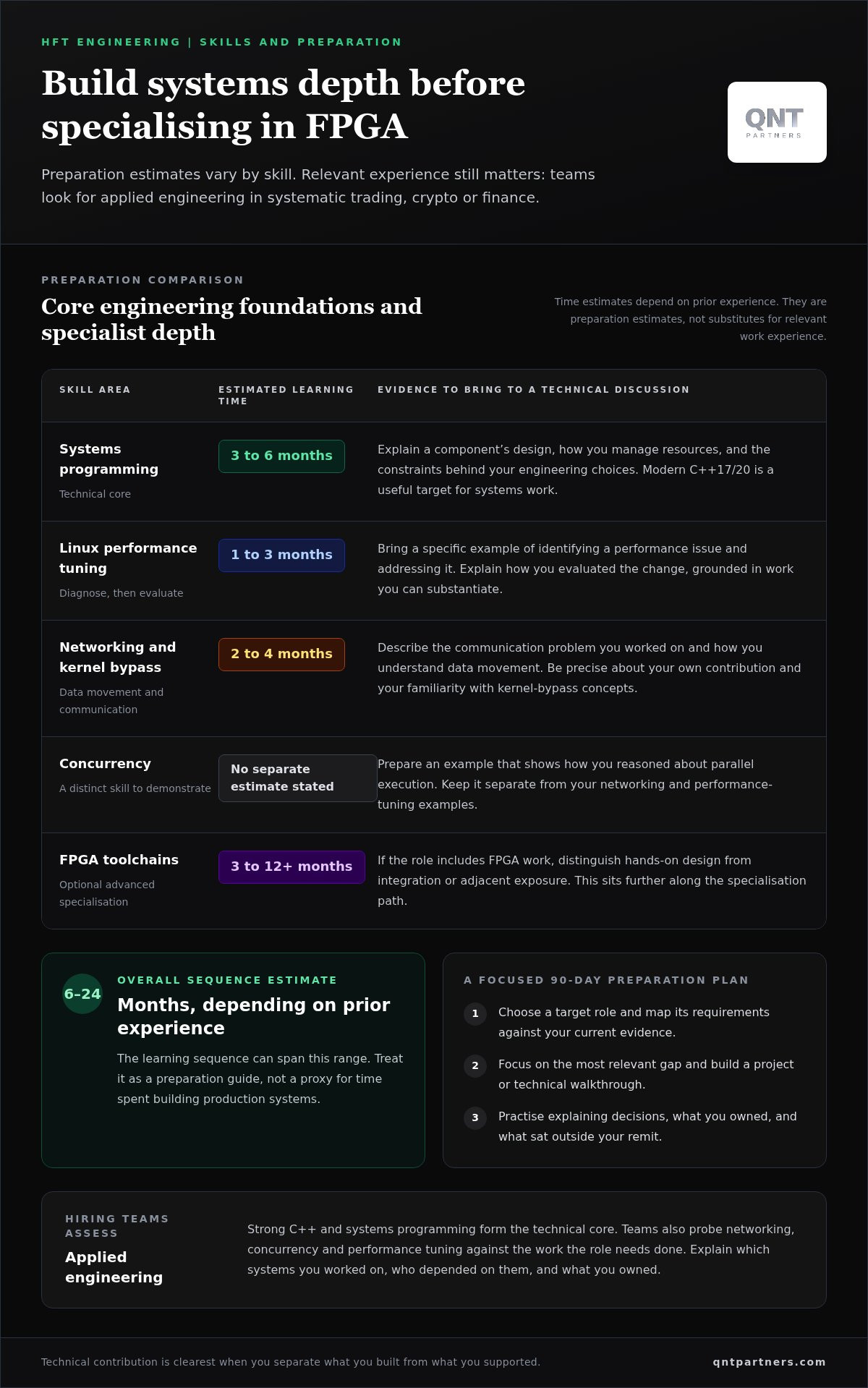
HFT engineering candidates are expected to have relevant experience in systematic trading, crypto or finance. That background helps connect software decisions to a live trading environment. The job title may differ, so explain which systems you worked on, who depended on them and what you owned. Hiring teams need evidence of applied engineering, not just a list of platforms on a CV.
Strong C++ and systems programming experience form the technical core. Modern C++17/20 is a useful target for systems work. Be ready to discuss how you structure code, manage resources and reason about performance. A clear example might trace a component from its inputs through its processing path, then explain the engineering choices and constraints involved.
Networking, concurrency and performance tuning are also expected. Prepare a distinct example for each, rather than treating them as one broad skill. For networking, describe the communication problem you addressed. For concurrency, explain how you reasoned about parallel execution. For tuning, show how you identified an issue and evaluated a change. Keep each explanation grounded in your own work.
For candidates building experience, the learning sequence depends on prior knowledge. Solidifying systems programming is estimated at 3-6 months. Linux performance tuning is estimated at 1-3 months, while networking and kernel bypass may take 2-4 months. The overall sequence is estimated at 6-24 months, depending on prior experience. Treat these periods as preparation estimates, not substitutes for relevant work experience.
- Systems programming: Practise modern C++17/20 and explain the choices behind a component’s design.
- Linux performance: Build a specific example of diagnosing and addressing a performance issue.
- Networking: Show how you understand data movement and kernel-bypass concepts.
FPGA toolchains sit further along the specialisation path. They’re optional advanced topics and may take 3-12 or more months to learn. If a role includes FPGA work, distinguish hands-on design from integration or adjacent exposure. That precision helps a hiring team match your experience to the actual remit.
A 90-day preparation plan can give your learning a practical structure. Choose a target role, map its requirements against your current evidence, then focus on the most relevant gap. Build a project or technical walkthrough that demonstrates your reasoning. Use the final stage to practise explaining decisions clearly, including what you owned and what remained outside your remit.
Use a concrete example to demonstrate your C++ and systems programming experience: explain the problem, your implementation choices and how the system behaved. Stick to work you can substantiate, and distinguish what you built from what you supported so your technical contribution is clear.
HFT recruitment methodology
A disciplined search starts by separating essential criteria from preferences. Treating every desirable skill as mandatory can exclude engineers with directly relevant experience. Mark each requirement as essential or trainable, then agree on what evidence would meet it. For example, direct ownership of a trading system may matter more than experience with a particular tool.
Market mapping should identify relevant work, not just familiar employers. Strong candidates may come from smaller systematic funds, digital asset firms or financial technology teams. Record the systems they’ve built, their level of ownership and the environments they know. This gives the hiring team a clearer view of transferable experience than employer names alone.
Before outreach, align the search team on a few operating rules:
- Protect confidentiality. Share role details in stages and avoid disclosing sensitive strategy information.
- Keep candidate records consistent. Capture experience and motivations in a format the hiring team can compare.
- Agree feedback ownership. Name the person responsible for consolidating interviewer views.
- Set communication expectations. Tell candidates what the next step is after each conversation.
- Revisit the brief when evidence changes it. Update criteria only after discussing the impact with the hiring team.
Outreach is more effective when it respects a candidate’s context. A passive engineer may need to understand the system’s purpose before considering a conversation. Explain the technical remit, reporting relationship and reason the role exists. Avoid claims about performance or team culture that the hiring manager can’t substantiate. Specific, accurate details help candidates decide whether to engage.
Candidate consent matters throughout the process. Confirm that someone wants to be represented for a specific opportunity before sharing their profile. Keep notes factual and relevant to the role. If the hiring firm already knows the candidate, resolve that overlap before progressing their details. Clear handling builds trust and avoids confusion over introductions.
Use a consistent evaluation record after each discussion. Capture evidence against the agreed criteria, then note any outstanding questions for the next interviewer. Separate observed capability from impression. For example, “explained the design trade-off” is more useful than “seemed sharp.” This grounds the final comparison and helps the hiring lead identify where further evidence is needed.
Keep calibrating the search as the team reviews candidate profiles. If suitable engineers consistently lack a preferred tool, consider whether it’s essential to the work. If candidates meet the technical bar but misunderstand the remit, improve the role explanation. Adjust the search based on evidence while keeping the core requirements stable.
For a build-out or spinout, document who owns each hiring decision and who can discuss the opportunity externally. This prevents inconsistent messaging across founders, traders and technical leads. A well-run process gives candidates a coherent account of the role and the firm comparable evidence for its final decision.
HFT recruitment timelines
An HFT hire moves at the pace of its slowest decision point. A search can stall before outreach if the team hasn’t agreed on ownership, interviewers or technical scope. For example, a C++ engineer supporting market data needs a different assessment from one building execution infrastructure. Set those distinctions before candidates enter the process.
Map the steps from approved role to start date. Each stage has its own dependencies, and several can run in parallel when the team is organised.
- Set the brief. Define the system, reporting line, technical remit and compensation structure before candidate outreach.
- Build the target pool. Identify relevant backgrounds, such as systematic trading, crypto or financial systems engineering.
- Run initial screens. Compare each candidate’s production ownership with the role’s specific requirements.
- Schedule technical interviews. Align the C++ assessment, systems discussion and trading-team conversations in advance.
- Make the decision. Gather interviewer feedback against agreed criteria, then communicate the outcome and offer terms.
Interview coordination often determines whether the process keeps moving. A desk involving traders, quants and engineers needs clear ownership of each discussion. If a candidate completes a systems interview but then waits for an available trader, the gap adds time without adding assessment value. Assign an interviewer and purpose to every stage before the first meeting.
Technical assessments should reflect the actual work. A live coding exercise may test implementation, while a systems discussion can explore failure modes in exchange connectivity. If a role includes FPGA development, assess that capability directly rather than adding an unrelated general coding round. Removing redundant steps preserves useful signal and reduces scheduling friction.
Candidate availability is another variable. Current project commitments, notice periods, garden leave and non-compete terms can affect when someone can move. Discuss those constraints early, alongside location and any transition from an existing trading system. Interview readiness and start-date availability are separate questions.
Offer decisions can also cause avoidable delays. Before final interviews, agree who approves the hire and how the firm will assess base pay, bonus mechanics or an equity partnership. At a prop shop, the discussion may centre on the role’s trading support and compensation structure. A pod-based fund may need closer alignment between the hiring manager and platform stakeholders.
For hiring teams, track the process by decision rather than vague status. Record which interview is complete, who owns the next action and what evidence remains. If a candidate is waiting after a technical round, close the feedback loop before adding another stage. This makes the recruitment timeline visible and keeps each interview tied to a hiring decision.
How do HFT developer roles differ from quant developer and general software engineer roles?
An HFT developer builds and optimises high-performance C++ trading infrastructure. The work centres on low-latency, multithreaded systems, where execution behaviour matters as much as correctness. For example, a change to a market-data handler can affect the path from exchange input to strategy logic. The role is defined by its proximity to live trading systems.
A quant developer often works closer to research workflows and strategy implementation. The distinction is practical, not absolute. One role may turn a researcher’s model into production code; another may maintain the infrastructure that carries market data and orders. In either case, clarify whether the engineer owns trading-system components, research tooling or both.
General software engineering covers a wider range of products and operating constraints. A web service team may prioritise reliability, maintainability and user-facing features. An HFT team needs those qualities too, but engineers also examine scheduling, contention and the cost of work on a critical path. The key question is how the code behaves under the trading system’s operating conditions.
Collaboration differs, too. HFT developers work with traders and quants to implement strategies, then refine the systems those strategies depend on. A general software engineer may work mainly with product managers or application teams. For a trading role, ask how requirements move from desk discussions into code, testing and production deployment.
Backend and infrastructure titles can conceal very different remits. One backend engineer might own order-management services; another might work on exchange connectivity or feed processing. A systems engineer could focus on Linux performance, while an FPGA engineer works closer to specialised hardware. Read the responsibilities, interfaces and ownership boundaries, not just the job title.
Interview questions should reflect the remit. For an HFT infrastructure role, discuss a multithreaded service, its bottlenecks and the trade-offs behind a design change. For a quant developer position, explore how research code becomes a production implementation. For a general software role, assess the system design expected by that product team. The same C++ question won’t provide equally relevant evidence for all three roles.
Candidates should describe the system they worked on, their specific contribution and how they evaluated its behaviour. Distinguish direct ownership from adjacent experience, especially around exchange connectivity, co-location or FPGA development. Hiring teams should define those distinctions before screening begins. A precise role brief helps match engineers to the actual system, rather than relying on broad labels such as “low latency” or “quant developer”.
QNT Partners: Quant Trading & Research Recruitment
QNT Partners supports trading firms hiring across quantitative research and low-latency engineering. Its Quant Trading & Research Recruitment and Technology & Engineering Recruitment offerings suit searches spanning strategy teams, trading systems and core infrastructure.
Bring QNT Partners in when a build-out needs specialist talent or when a role brief must distinguish a quant developer from a systems engineer. The firm also offers AI & ML Specialist Search and Manager Search & SMA Sourcing for relevant institutional mandates.
For a discussion about a specialist search, visit QNT Partners.
Set the search around the system you need to build
The next step is to turn the hiring need into a clear mandate. Specify the system the engineer will own, the trading or research teams they’ll work with and the capability the hire must add. An effective HFT software developer recruitment search starts with those decisions, not a generic job title.
QNT Partners supports this work through Quant Trading & Research Recruitment and Technology & Engineering Recruitment. When machine learning expertise is central, its AI & ML Specialist Search addresses that distinct talent requirement. The right route depends on the team’s remit and the capability it needs.
If you’re defining a search or building a specialist team, contact QNT Partners about HFT recruitment. A precise brief gives the hiring process a stronger starting point, and helps keep the search focused on the systems your team needs to run.
Frequently Asked Questions
What qualifications do HFT software developer jobs require?
HFT software developer roles typically call for strong C++ and systems programming experience, alongside practical knowledge of networking, concurrency and performance tuning. Relevant experience in systematic trading, crypto or finance is also expected. A degree title alone won’t show whether you can diagnose a production bottleneck. Prepare examples that explain your engineering decisions, such as how you investigated contention or profiled a critical code path.
How does the HFT software developer interview process work?
Interviewers assess how your experience matches the system and team you’d join. Be ready to explain a design decision in detail, including its constraints, alternatives and how you evaluated the result. For example, describe a performance issue you investigated and distinguish your contribution from the team’s. Clarify the role’s remit before each conversation so you can relate your experience to its infrastructure, strategy implementation or trading-desk interactions.
Do HFT firms hire new graduates, interns, or candidates without finance experience?
Finance experience isn’t the only relevant background: systematic trading and crypto experience also fit the stated requirements. However, HFT engineering roles expect relevant work experience, so a new graduate should show practical evidence of systems ability. An internship, substantial C++ project or performance-focused contribution can help demonstrate skills, but doesn’t replace experience where a role specifically requires production ownership.
What background checks, work authorization, and other hiring requirements apply to HFT jobs?
There’s no single international checklist for HFT hiring. Requirements depend on the employer, role and country of employment. Ask the hiring team what documentation it needs for work authorisation and which verification steps apply. Keep employment dates and role descriptions consistent across your CV and application. If you have garden leave or contractual restrictions, raise their practical impact early without sharing confidential information from your current firm.
How can candidates find HFT software developer openings and apply?
Candidates can contact a recruiter handling specialist trading searches, clarify the role and interview process, and confirm consent before their profile is shared for a specific opportunity.