Hedge fund manager search specialists for hiring timelines

A senior portfolio manager search can take several months, while a mid-level operations hire may take 4-6 weeks. The difference comes down to the size of the relevant candidate pool and the assessment needed for each mandate. In my experience, the timeline depends less on speed than on how clearly the fund has defined the role and the market it needs to reach.
Key-seat hires and succession mandates usually take longer, especially when the search must stay confidential. Mandate clarity, notice periods and confidentiality all shape the hiring window. Specialist firms map relevant candidates and calibrate the shortlist for portfolio manager and executive searches, but a realistic timeline starts with a clear brief.
Key Takeaways
- Search networks tend to differ by seat: portfolio managers and investment leaders draw on a different candidate pool from trading technology and operational roles.
- Mandates tied to measurable outcomes, rather than just a job description, keep candidate assessment connected to what the fund needs delivered.
- Discreet searches rely on controlled outreach and clear handling of candidate conflicts, peer-set overlap and off-limits firms.
- Market maps establish the candidate universe, while the first shortlist often leads to a more refined brief.
- In succession and executive searches, decision-making under uncertainty matters alongside the ability to execute across the organisation.
Global candidate networks and discreet engagement
Portfolio managers do not need one universal qualification. Funds assess strategy expertise, investment judgement and a track record relevant to the mandate. Candidate research can span global markets, including hubs such as London, New York, Hong Kong and Singapore.
Research-Led Candidate Identification
I find it useful to map funds where the strategy and seat experience are used. A systematic equities mandate calls for a different candidate pool from global macro or credit. The distinction between portfolio managers, analysts, researchers and traders matters, as does how each role works with investment and risk functions.
A useful market map records each candidate’s current remit and relevant strategy experience. It gives the hiring team a view of the talent pool before outreach, rather than a succession of unrelated CVs.
Off-Market Candidate Access
Some suitable candidates are not actively seeking a move. Reaching them calls for a discreet, measured approach that protects their identity and explains the mandate without revealing sensitive fund details too early. Before outreach, it helps to define which firms are in scope and how conflicts or overlap within the peer group will be handled.
For a sitting PM, interest is best established privately, with details shared in stages as discussions progress. I think the search process should make clear how it handles off-market approaches and candidate confidentiality.
Screening and Track-Record Checks
Candidates are best screened against the role’s investment process, not just a headline return or title. Review each track record in context, including strategy, portfolio remit, risk decisions and the candidate’s contribution. Where performance can be validated, establish what the candidate personally owned and how results were achieved.
Technical interviews can probe research or trading decisions, and regulatory records may be validated where applicable. Separate verified information from the candidate’s account, and record any gaps for follow-up.
Candidate Assessment and References
References are most useful when they test specific evidence. Former colleagues can speak to how the candidate made decisions under pressure, responded to drawdowns and worked with teams around the portfolio. A concrete example tied to the candidate’s responsibilities is more informative than a broad endorsement.
Consistent assessment themes make differences in risk posture, communication and execution easier to compare without treating performance across different strategies as directly equivalent.
For a global search, the process should remain consistent across locations while outreach adapts to each candidate’s context. A London-based PM and a researcher in Singapore may sit within different hiring networks, but the mandate, evidence standards and confidentiality protocol should remain clear throughout.
How long does it take to hire for hedge fund roles (mid-level, senior, front office)?
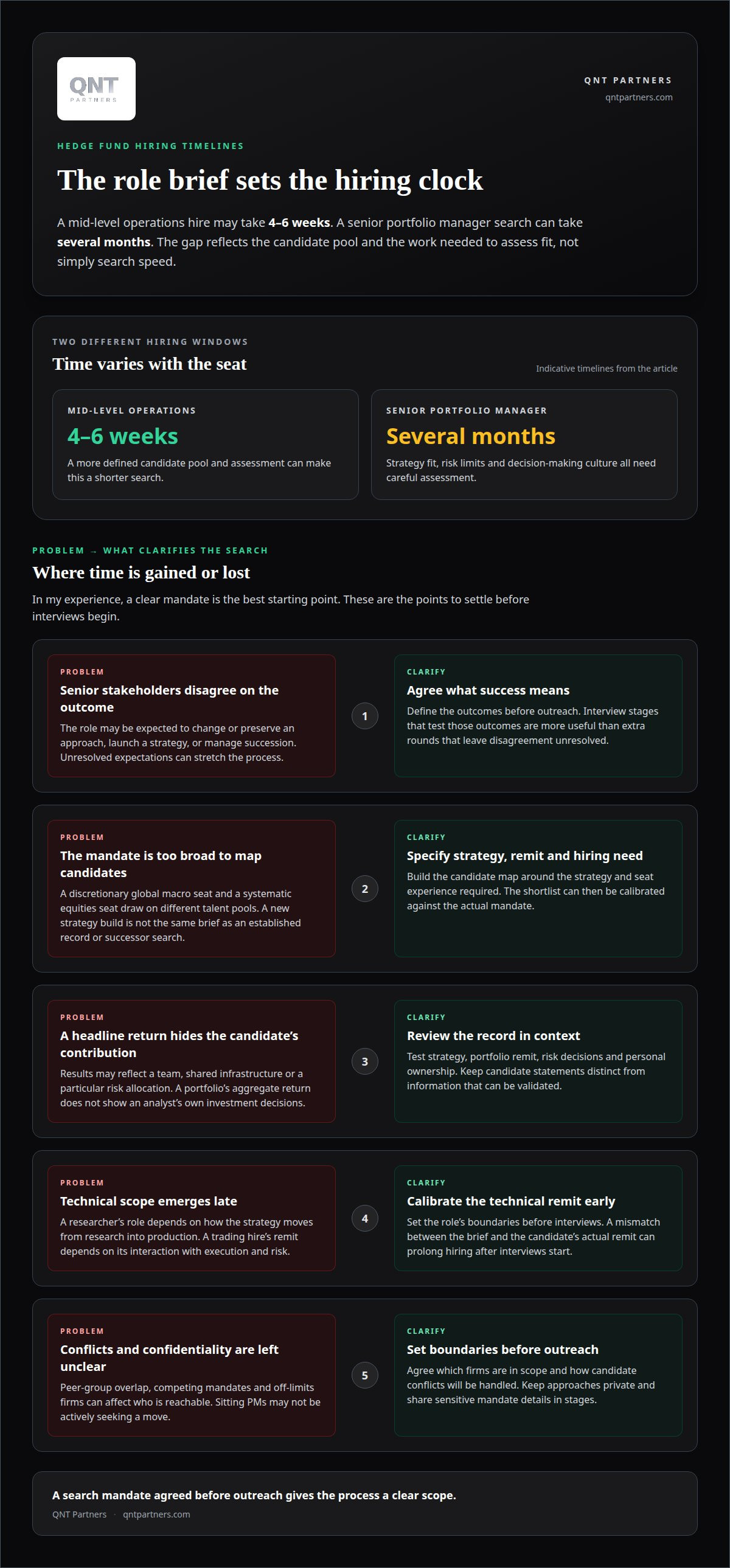
A mid-level operations hire may take 4-6 weeks, while a senior portfolio manager search can take several months. The gap usually reflects the time needed to test a PM’s fit with the fund’s strategy, risk limits and decision-making culture.
For a PM mandate, the investment remit shapes the search from the start. A discretionary global macro seat draws on a different talent pool from a systematic equities seat. The search also changes depending on whether the fund needs an established record, a new strategy build or a successor to an existing PM. Those differences shape the candidate map and interview focus.
For front-office candidates, a performance record needs context. A PM’s results may reflect a team, shared infrastructure or a specific risk allocation. Analysts moving into a PM seat are assessed on their own investment decisions, not only the portfolio’s aggregate returns. In a pod shop, the mandate may centre on a defined book. A prop shop may assess trading decisions within a different operating model.
Quantitative and systematic searches need technical calibration alongside investment assessment. For a researcher, the strategy’s path from research to production sets the scope of the role, including work across data and implementation. For a trading hire, the role’s interaction with execution and risk matters. A mismatch between the mandate and the candidate’s actual remit can prolong hiring once interviews begin.
Senior appointments take longer when stakeholders disagree on the role’s outcomes. The new leader might be expected to change or preserve an existing approach, launch a strategy or manage succession. Interview stages that test those outcomes directly tend to be more useful than extra rounds that leave the disagreement unresolved.
Search firms’ networks shape who appears in a candidate map, particularly for technically specific front-office mandates. In a PM search, peer-group overlap, conflicts and off-market approaches all affect which candidates can be reached. A firm focused on investment and portfolio manager hiring may have a different candidate network from a general provider.
Conflicts can arise when a search firm works with competing funds or has restrictions involving particular firms. How candidate information, overlapping mandates and off-limits relationships are handled affects the process. Clear boundaries reduce avoidable friction in a confidential search.
In the US, compensation varies by location, strategy and seniority. Front-office investment roles commonly combine base salary with performance bonuses. The full structure matters more than the title alone when comparing roles.
A search mandate agreed before outreach begins gives the process a clear scope.
How do you keep a portfolio manager search confidential?
Confidentiality starts before a candidate is approached. The fund and search team should agree on the mandate, what information can be shared and who can access candidate details. Identifying the fund too early can expose a sitting portfolio manager’s possible move. An initial brief can describe the strategy and remit without naming the employer.
In confidential searches, outreach often happens in stages. An initial conversation establishes whether someone is open to a private discussion. More about the fund is shared only with the candidate’s agreement. Candidate identities and interview notes stay within the agreed hiring group, rather than circulating through broad internal channels. A CIO search may require a different access group from a PM or analyst placement.
Confidential handling also means mapping conflicts before making contact. Search specialists clarify peer-group overlap, off-limits firms and existing candidate relationships. If a candidate is already in another process, that is resolved before identifying details are shared with the fund. These boundaries matter in a concentrated equity sector, where overlapping networks can quickly reveal a mandate.
For portfolio managers, the discussion centres on the investment decisions behind the record. Portfolio construction, risk limits, capital allocation and responses to positions moving against the thesis all help explain the PM’s approach. A headline return alone cannot show whether the PM controlled the risk or inherited a team-level result. The focus stays on the candidate’s own remit.
Quantitative candidates are handled with the same precision. A researcher may discuss signal development, portfolio implementation or collaboration with trading teams, with disclosure limited at each stage to what is needed to assess fit. An initial conversation, for example, can test the candidate’s research scope without requesting proprietary code or sensitive strategy details. The fund’s confidential material stays out of general search notes.
Reference checks are timed carefully. Candidate agreement comes before anyone is contacted, and referees are selected for their direct knowledge of the relevant work. A former risk partner may assess how a PM handled exposure changes; a research collaborator may clarify the candidate’s contribution to a quantitative portfolio. Informal back-channel checks are avoided because they could alert a current employer.
For CIOs, traders and analysts, the same principle applies: disclosure is controlled at each stage, with a record of who has received which details. Interview attendees and their access to information are agreed in advance. That discipline protects the candidate’s current position while giving the fund enough evidence to assess portfolio fit, risk judgement and working relationships.
Hedge fund executive search
In a strong executive search, the mandate describes outcomes rather than repeating a generic leadership job description. I usually see five measurable outcomes set for the new leader’s first 12 months. At a US hedge fund, those might cover investment oversight, a systematic strategy build, or closer coordination between investment and risk. They give interviewers a practical basis for testing candidates.
The search usually starts with a market map, not a pile of CVs. Candidates are grouped by function, fund type and relevant operating experience, then the search team works out where the required expertise sits. A CIO search for a multi-manager platform draws on a different pool from a technology executive search focused on production systems. A useful map makes the candidate pool and the reasons for its boundaries clear.
In interviews, the focus is on the decisions the leader will face. For an investment executive, that can mean talking through allocation decisions or a strategy review. A technology leader may be tested on production execution, then asked to explain trade-offs to investment leadership. The interview process works best when each discussion produces evidence relevant to the role, rather than a general impression of seniority.
For a search across the United States, the mandate needs to mean the same thing across locations and teams. Search teams can keep the criteria stable while looking at candidates by strategy and function, instead of treating geography as a proxy for fit. A fund building a systematic capability, for example, needs to distinguish research leadership from platform ownership. That distinction affects sourcing and who joins the interview panel.
The first shortlist often changes the shape of the search. Comparing candidate evidence with the agreed outcomes can expose a mismatch between the remit and the available profiles. If the role combines investment oversight with operational delivery, the hiring group needs to decide which responsibility takes priority. Making that call early helps later interviews test the same version of the job.
For hedge fund recruitment, stakeholder alignment is part of the search, not an administrative detail. The hiring group needs to settle who owns the decision, which leaders contribute and what evidence each interview stage should produce. That gives the fund a consistent way to assess candidates, even when investment, technology and risk stakeholders have different priorities.
For a high-impact leadership appointment, executive search gives the process a tighter focus than a broad recruiting programme. The search partner needs to understand the fund type and function, build a market map, and connect candidate assessment to the mandate. For US hedge funds, that structure keeps the process focused on leadership outcomes rather than title, reputation or a polished presentation.
Confidential searches and succession
A succession search changes the question from who can fill the seat to what the fund must preserve. A departing PM may own investment decisions, client relationships or institutional knowledge not captured in a role description. The responsibilities that need continuity often differ from the capabilities the incoming leader is expected to build.
Succession can take more than one form. A known retirement allows a staged handover; an unexpected departure may require an interim decision-maker while recruitment proceeds. In either case, ownership of portfolio decisions and communication with the investment team becomes a central issue. A CIO, for example, may retain allocation authority while a successor takes responsibility for a defined strategy.
Leadership roles may protect the downside or expand the upside. Risk leadership can safeguard controls and challenge portfolio exposure, while a strategy-building executive may add investment capacity. The priority often determines which candidates make sense. Without agreement, one stakeholder may favour continuity while another expects the incoming leader to set a new direction.
Succession planning also depends on a clear view of the incumbent’s remit. Documenting which decisions they make, where analysts or traders contribute and how investment views reach the portfolio helps clarify the role. This does not require proprietary models. It can distinguish a leader who sets direction from one whose record depends on a specific team or platform.
For a senior external appointment, the transition itself is a useful measure of candidate fit. How a candidate would learn the fund’s risk framework, work with existing analysts and respond to a portfolio already in motion all matter. A strong track record matters, as does the ability to preserve sound processes while building trust with the people already in the seat.
Succession plans are often kept separate from broad internal recruitment updates. Decision-makers generally receive information relevant to their roles, while communication with the incumbent is coordinated. When approaches begin before the fund has settled its mandate, mixed messages can travel through overlapping professional relationships and undermine confidence in the transition.
Hedge fund manager search specialists can structure discreet approaches around a fund’s succession objectives rather than treat the vacancy as a standard replacement. A clear mandate, candidate profile and set of transition responsibilities give the board or investment committee a consistent basis for comparing internal and external options.
A confidential succession search may begin before the mandate reaches the market, particularly when discretion around a leadership transition is important.
QNT Partners: AI & ML Specialist Search
QNT Partners supports funds hiring AI and machine-learning specialists, quantitative researchers, traders and investment managers. The right search depends on the mandate: an applied ML hire for research differs from a PM appointment or an SMA sourcing requirement.
For a role connecting models to live trading, define how research, engineering and investment teams will work together. This focuses the search on the experience the seat requires. QNT Partners provides AI & ML Specialist Search, Quant Trading & Research Recruitment, and Manager Search & SMA Sourcing for these hiring needs.
If you’re planning a specialist or manager search, contact QNT Partners to discuss the mandate.
Mandates often shift once the search starts
Searches can drift when the role’s scope changes after interviews begin. A seat may start out focused on quantitative research, then pick up investment authority or responsibility for trading technology. That shift changes what the team is assessing, and who gets to make the call.
Hedge fund manager searches can span investment leadership, quantitative research and trading technology. Those are different seats, even when they sit within the same fund. The distinction comes up in search discussions, particularly when the brief changes as the team meets candidates.
When the scope moves mid-search, the candidate process can end up defining the job by default. That can leave the team assessing people against different versions of the role, with no shared view of who owns the decision.
Frequently Asked Questions
What Makes Hedge Fund Recruitment Different from Other Finance Hiring?
Hedge fund recruitment turns on investment contribution and strategy fit, not just experience in a finance role. A candidate’s results may depend on the mandate, risk budget, portfolio structure and supporting team. For example, a PM from a pod structure may have worked within tighter book-level limits than a trader at a prop shop. Hiring criteria tend to reflect the fund’s operating model and the decisions the role owns.
What do hedge fund manager search specialists do?
Hedge fund manager search specialists map relevant talent, approach candidates discreetly and assess fit for an investment mandate. Search firms may cover manager search and SMA sourcing, alongside quant trading, research and technology roles. The hiring organisation alone determines candidate suitability. Search support informs the process; the fund makes the appointment decision.
How much do hedge fund manager search firms charge?
Search fees vary with seniority and mandate complexity, so a single market figure won’t reliably describe every engagement. A portfolio manager succession search can involve different work from a mid-level operations hire. The commercial terms depend on the engagement agreed between the fund and search firm. Those terms are typically considered alongside the search scope, candidate assessment and reporting expectations, rather than treating the fee alone as a measure of fit.
How do hedge fund recruiters source and vet candidates?
Recruiters identify candidates through strategy and role mapping, then assess evidence against the specific mandate. A sound process distinguishes a researcher’s contribution from a team’s aggregate performance and examines how the candidate handled risk decisions. Candidate data is retained for up to two years from last contact; client and commercial data is retained for seven years. Individuals have rights under UK GDPR.
How long does a hedge fund manager search typically take?
A senior portfolio manager search can take several months. The timeline depends on the mandate’s specialisation, the availability of suitable candidates and the fund’s interview and decision process. Notice periods, garden leave or non-competes may also affect a candidate’s start date. Succession and strategy coverage plans account for both the search and selection stages and the eventual start date.
Hedge fund manager recruitment trends and compensation benchmarks in the US
In the US, hedge fund hiring timelines vary by role: a mid-level operations hire may take 4-6 weeks, while a senior portfolio manager search can take several months. Compensation varies by location, strategy and seniority; front-office investment roles commonly combine base salary with performance bonuses.