Hedge Fund Capital Introduction: Institutional Guide

An introduction is useful only when the manager fits the mandate. Hedge fund capital introduction for institutional investors can open access, but a broad network won’t resolve questions about strategy capacity, account structure or operational fit. I’ve seen the distinction get blurred: an introduction starts a conversation; manager selection depends on the investor’s own evaluation and decision process.
The route matters. Prime broker capital introduction connects investors with managers in a brokerage network. Manager Search & SMA Sourcing starts with the mandate and identifies systematic traders or portfolio managers for consideration, including through a separately managed account. The SMA structure shapes how capital is allocated and overseen, so put it in the sourcing brief rather than treating it as an implementation detail. I’ll explain how these routes differ and where QNT Partners’ specialist sourcing role fits. We facilitate relevant introductions; we don’t make allocation decisions or provide investment advice. QNT Partners operates as a recruitment intermediary, and hiring organisations alone determine candidate suitability.
Key Takeaways
- Hedge fund capital introduction for institutional investors creates access to managers, but an introduction is not an allocation recommendation or a substitute for due diligence.
- Set mandate criteria before starting conversations, including the strategy’s intended portfolio role and the account structure you require.
- Prime broker introductions, specialist manager search and SMA sourcing serve different purposes. Choose the route to match your sourcing objective and investment structure.
- Keep access, manager assessment and the institution’s allocation decision distinct. A clear process makes it easier to judge whether an introduction is relevant.
- QNT Partners’ Manager Search & SMA Sourcing draws on quantitative trading specialisation and operating experience to facilitate relevant manager introductions.
Hedge fund capital introduction: what institutional investors should expect
An introduction can open a door. It can’t tell you whether the strategy belongs in your portfolio. Hedge fund capital introduction for institutional investors connects allocators with managers; it is not an allocation recommendation or an endorsement of investment merit.
Be clear about the objective before names are exchanged. You may be looking for systematic or quantitative managers, assessing whether an SMA suits the mandate, or widening an existing search beyond the networks you already use. Those are different sourcing tasks. Start with the problem you need to solve.
Prime brokerage capital introduction commonly connects investors with hedge fund clients of a prime broker. The mechanics can include events or direct introductions, as outlined in this account of prime brokerage capital introduction services. A broad platform can widen the field, but it doesn’t mean every manager has been matched to your specific mandate.
What does capital introduction mean for an allocator?
An introduction creates an opportunity for an investor and manager to start a discussion. It might put an allocator in front of a systematic team whose capacity or account structure is relevant to the search. That conversation is a starting point, not a completed assessment.
A mandate-shaped introduction should reflect investor-defined criteria, such as strategy, intended portfolio role and structure. If the institution needs an SMA, for example, the manager’s willingness to discuss a separately managed account matters from the outset. A general meeting list may offer breadth, but breadth alone doesn’t establish relevance.
Keep the stages separate. Access is the introduction. Due diligence is the investor’s examination of the manager and strategy. The allocation decision and portfolio construction remain with the institution. A meeting, presentation or referral doesn’t establish suitability.
Which institutional investors may find it relevant?
This route can help professional allocators looking beyond familiar long-only or discretionary strategies, particularly when sourcing systematic, quantitative or other specialist hedge fund managers. It may also suit institutions exploring an SMA, where account structure is part of the mandate rather than a later implementation detail.
Define the search in operational as well as investment terms. For a quantitative strategy, that may mean understanding the markets traded, capacity constraints and execution infrastructure. A manager dependent on exchange connectivity or low-latency execution calls for different operational questions from a team running a slower systematic book. Those details help frame the institution’s evaluation; they don’t replace it.
- Use introductions to source managers against a stated mandate, not as a proxy for due diligence.
- Make the required account structure clear before manager discussions begin.
At QNT Partners, our Manager Search & SMA Sourcing work draws on our quantitative trading specialisation and our founders’ experience running businesses like those of our clients. We facilitate sourcing and introductions as a recruitment intermediary. Hiring organisations alone determine candidate suitability.
Our privacy notice explains that candidate personal data is retained for up to two years from last contact, and client and commercial data for seven years for legal and accounting purposes. Individuals have rights under UK GDPR.
How mandate fit shapes a useful hedge fund introduction
Manager outreach works better when the investor can explain what the strategy needs to do in the portfolio. Define the mandate before approaching managers, so each introduction can be judged against a clear investment purpose and account structure.
For hedge fund capital introduction for institutional investors, mandate fit is a practical filter, not a promise that a suitable manager will emerge. It sets boundaries for the search: which strategies are relevant, what role they might fill, and which structural or operational conditions matter enough to rule a conversation in or out.
Translate the mandate into manager-search criteria
Start with the exposure sought and its intended portfolio role. An allocator looking for a diversifying systematic strategy should describe the portfolio need, rather than asking only for “quant managers”. The strategy’s market focus, trading horizon and capacity can then be discussed against that objective, without assuming that a particular return profile guarantees diversification.
Next, define the account structure. If the institution is considering an SMA, make that clear before outreach. The operating and oversight arrangements will shape the manager conversation. QNT Partners’ discussion of SMA and SVA partnerships offers further context for structure-specific conversations.
Separate non-negotiables from preferences. An essential criterion might be a strategy type or account format; a preference might concern a market or implementation detail that the investor is willing to explore. This distinction keeps genuine constraints visible without screening out a useful conversation too early.
- Strategy: specify the exposure and approach the institution wants to assess.
- Portfolio role: state the intended function within the existing allocation.
- Structure: clarify whether a commingled vehicle or SMA is under consideration.
- Operations: identify topics such as liquidity terms, trading venues or execution dependencies for later review.
Move from introduction to investor-led evaluation
With criteria in place, an initial manager discussion can test whether the stated approach and structure warrant further review. For a systematic team, the investor might clarify the trading horizon, markets traded and reliance on specific exchange connectivity. These are prompts for a substantive conversation, not evidence of suitability by themselves.
Keep the hand-off clear. The introduction supports access; the institution owns its analysis, due diligence and allocation decision. The SEC due diligence guidance for hedge funds can inform an investor’s review of operational risks, conflicts and manager background. It doesn’t replace the institution’s own process or mandate-specific assessment.
After a first discussion, record which criteria appear aligned, which remain unresolved and what evidence the institution needs to assess next. That gives the internal team a disciplined basis for deciding whether to proceed, without treating a warm introduction as an endorsement.
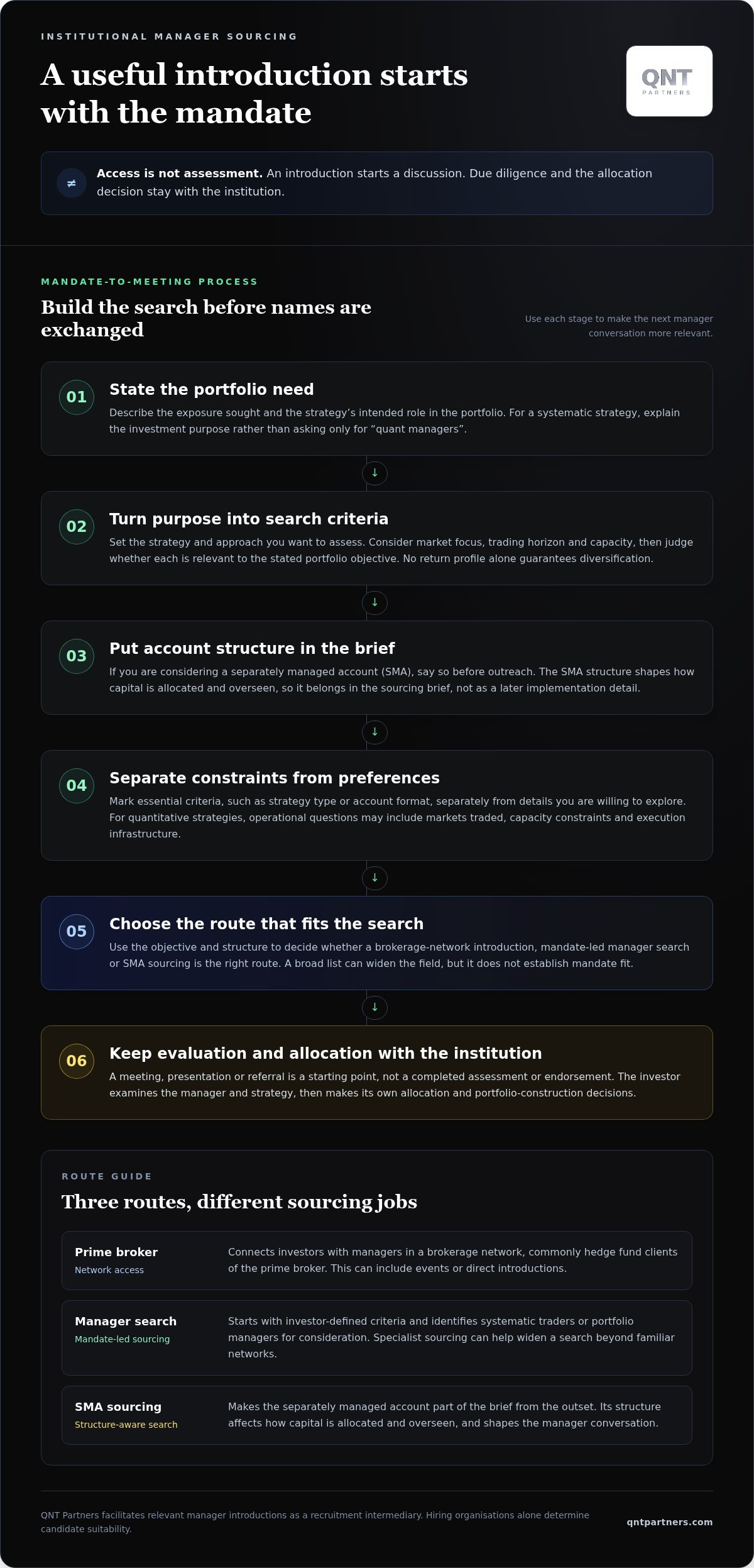
Capital introduction, manager search or SMA sourcing: compare the routes
These routes solve different sourcing problems. A prime broker introduction can open access to managers connected to a platform. Specialist manager search starts with the investor’s mandate. SMA sourcing focuses on finding managers for a separately managed structure. None replaces the institution’s own assessment, and no single route suits every mandate.
For hedge fund capital introduction for institutional investors, compare how each route shapes access and what remains under the allocator’s control.
| Route | Purpose | Investor control | Suitable use case |
|---|---|---|---|
| Prime-broker introduction | Connect investors with managers through a prime-broker programme or relationship. | The investor retains responsibility for evaluating managers and making allocation decisions. | Broadening access through a platform where participating managers and investor eligibility may shape the available pool. |
| Specialist manager search | Identify managers against a defined institutional mandate. | The investor sets the criteria and retains its own evaluation and selection process. | Searching for a specific strategy or manager profile beyond a general platform list. |
| SMA sourcing | Source managers where a separately managed account is being considered. | The investor determines the mandate and account arrangements, then evaluates the manager. | Exploring a manager relationship through an SMA rather than relying solely on a pooled vehicle. |
When a prime-broker introduction may fit
A prime-broker channel can help an allocator broaden its manager network or meet managers participating in a platform programme. Access may be shaped by the platform’s participating managers and investor eligibility. That can provide a starting point, but it doesn’t necessarily reflect a specific mandate or identify which conversations deserve priority.
Treat the meeting as access, not screening by proxy. The institution still needs to assess the manager’s strategy, operating model and portfolio fit through its own process.
When specialist manager search or SMA sourcing may fit
Specialist manager search is more mandate-led. The sourcing brief can centre on the strategy and portfolio role the investor wants to examine, rather than managers already visible through a particular platform. SMA sourcing is relevant when the allocator is considering a separately managed account and wants manager discussions to reflect that structure.
QNT Partners’ Manager Search & SMA Sourcing focuses on systematic traders and portfolio managers. We facilitate sourcing and introductions as a recruitment intermediary. We don’t make allocation decisions, and hiring organisations alone determine candidate suitability.
The CFA Institute's investment manager selection framework provides a useful reference for separating manager selection from the route used to source candidates. An introduction provider can support access, but the allocator remains responsible for investment and operational due diligence.
Choose the route around the mandate and structure. A platform relationship may broaden access; a defined search can focus manager outreach; an SMA sourcing brief makes the account format central to the discussion.
How institutional investors can assess an introduction process
A useful introduction process should make the investor’s next decision clearer. It should provide enough context to judge whether a manager warrants a first conversation, without presenting access as evidence of quality or fit. In hedge fund capital introduction for institutional investors, process transparency matters as much as the number of names surfaced.
Assess relevance before progressing a manager conversation
Use a short investor-side screen before accepting or progressing an introduction. The aim isn’t to apply a universal due diligence standard at this stage. It’s to check whether the opportunity connects to the mandate and whether the first discussion has a clear purpose.
- Mandate relevance: Does the manager’s stated strategy relate to the exposure and portfolio role the institution is seeking?
- Structure: Is the manager discussing a vehicle or account structure that fits the institution’s stated preference, including an SMA where relevant?
- Manager context: Is there enough information about the team and strategy to prepare focused questions, rather than relying on a name or short profile alone?
- Introduction process: Is it clear why this manager was surfaced and what the next step would involve?
A “no” on a core mandate requirement may be enough to pause the conversation. A missing detail may instead become an opening question. That distinction keeps the screen practical: it avoids spending time on an obvious mismatch without rejecting a potentially relevant manager because the initial introduction is brief.
Once a conversation proceeds, keep follow-up evaluation within the institution’s own governance and diligence process. The manager’s answers can clarify strategy and structure, but the allocator determines what evidence it needs, how it assesses that evidence and whether to advance the opportunity. No single checklist replaces those internal judgements.
Keep the roles and responsibilities clear
Access, assessment and allocation are separate steps. An intermediary can facilitate a manager introduction and help establish context for an initial discussion. That role does not amount to selecting an investment, endorsing a manager or taking over the institution’s analysis. A transparent process makes that boundary plain.
At QNT Partners, we operate as a recruitment intermediary. We facilitate sourcing and introductions; hiring organisations alone determine candidate suitability. The institution retains responsibility for its own manager assessment and allocation decision.
I’d also look for a clear record of why a manager was introduced, what information informed the approach and which points remain open for the investor to assess. That record helps an investment team distinguish a relevant lead from a conversation that simply came through an established network.
If you’re defining a mandate-led search for systematic managers or an SMA structure, review QNT Partners’ manager search and SMA sourcing work as a starting point for shaping the brief.
QNT Partners’ role in institutional manager search and SMA sourcing
QNT Partners works where quantitative manager sourcing meets the practical realities of running a trading business. We focus on quantitative trading and related technical sectors, bringing an operator’s perspective to conversations with systematic managers and institutional clients.
Where QNT Partners fits in the process
Our Manager Search & SMA Sourcing work identifies systematic traders and portfolio managers for firms deploying capital through separately managed accounts. A sourcing brief can reflect the strategy and account structure the institution is considering, keeping manager conversations grounded in the mandate.
Our founders have run businesses like those of our clients. That experience informs how we discuss a team’s operating context, from its strategy focus to the capabilities around it. We understand the people and businesses involved in quantitative trading, while keeping an introduction separate from an investment assessment.
For select firms and managers, our Advisory work covers talent strategy, market positioning and capital advisory. These areas can intersect with manager sourcing and SMA discussions, particularly where a firm is considering how its team and capital plans fit together.
RE7 Capital’s founder has praised QNT Partners for manager and trading-team introductions, alongside recruitment and capital-raising support. That testimonial reflects one client’s experience of our work.
Set expectations before discussing a mandate
A focused mandate discussion should establish the strategy sought and the account structure under consideration. It also gives us a basis for understanding which manager profiles may be relevant to source and what context will help frame an introduction.
Our Manager Search & SMA Sourcing work centres on systematic traders and portfolio managers. Share the mandate’s key parameters and the structure being explored, and we can make the initial discussion specific to the search.
Turn the mandate into a working search brief
A manager search becomes more useful when the brief can guide real conversations and adapt to what those conversations reveal. For hedge fund capital introduction for institutional investors, keep the mandate stable, but record where evidence from manager discussions raises a question the investment team needs to resolve.
That discipline stops access from quietly redefining the objective. Capture why a manager progressed, what remains to be assessed and which criteria are genuinely flexible. Your investment committee can then review a clear decision trail, while the sourcing brief stays tied to the portfolio need.
If you’re preparing a mandate around systematic managers or an SMA structure, discuss an institutional manager-search or SMA-sourcing mandate. A focused first conversation can start with the criteria your team has already set and where you want the search to reach.
Keep the mandate precise, and each introduction has a clear test: does it merit a serious discussion against the criteria you set?
Frequently Asked Questions
What is hedge fund capital introduction for institutional investors?
For an allocator, it’s a channel for establishing contact with hedge fund managers relevant to an institutional search. The value is a well-framed first conversation: the investor knows why the manager is being introduced, and the manager understands the area of interest. That context helps both sides decide whether there’s a sensible basis for further discussion.
How is capital introduction different from manager search?
The practical difference is how the initial pool of managers is assembled. A capital introduction channel may draw on an existing network or programme. A manager search uses a brief to guide outreach, including profiles to prioritise or exclude. For example, an allocator can specify a particular systematic approach rather than review a general list.
Can institutional investors source hedge fund SMAs through an intermediary?
Yes. An intermediary can help identify systematic traders or portfolio managers for an institutional SMA search. The investor should define the account’s intended mandate and the structure under consideration, then use manager discussions to assess whether the proposed approach is relevant. QNT Partners’ Manager Search & SMA Sourcing focuses on sourcing managers for firms deploying capital via SMA structures.
Does a capital introduction mean a hedge fund manager has been vetted?
No. Treat the introduction as a reason to start a conversation, not as a completed review. An allocator can use that first discussion to identify material for its own assessment, such as strategy descriptions, performance attribution and explanations of capacity. The institution decides what evidence it needs, who reviews it and how the findings enter its internal approval process.
Is capital introduction the same as investment advice?
No. The practical distinction is between arranging access and making a recommendation about an investment decision. An allocator should keep its internal investment memo, risk review and committee decision within its own governance, rather than treating meeting access as a recommendation. QNT Partners supports sourcing and introductions, while the institution decides what to do with the opportunity.
What should an institutional investor prepare before seeking manager introductions?
Prepare a short brief that an intermediary can use without interpreting the investment objective for you. State the exposure under review, its intended portfolio role and the account format under consideration. Add hard exclusions, then mark which preferences are open to discussion. Naming the internal owner of the search and the next decision point helps keep follow-up organised.
To discuss a mandate-led search for systematic managers or an SMA structure, contact QNT Partners with the criteria your team has already defined.