Fixed income quant recruitment for specialist teams

I see fixed-income quant searches go wrong when teams treat different mandates as interchangeable. The work may focus on pricing, portfolio risk, systematic research or electronic trading, and each requires a different mix of market knowledge and technical depth. A search should reflect the desk’s actual mandate, not just the title on the requisition.
A focused search should get that distinction right. A candidate building credit models for portfolio analysis is not automatically suited to a rates e-trading seat, where market mechanics and implementation matter as much as modelling.
Quantitative finance recruitment starts by defining the problem the hire will own, then assessing candidates against the relevant asset class, research or trading process, and engineering requirements. I see the approach differ across banks, funds, market makers and fintech teams, even when their roles share similar titles.
I start with the work itself: what the team needs the person to build, price, research or run. That is what determines whether a candidate can contribute in the role.
Key Takeaways
- Define the seat by its actual mandate, whether it centres on pricing, portfolio risk, systematic research or electronic trading.
- Assess fixed-income candidates for the blend of asset-class knowledge, modelling ability and implementation experience the team needs.
- Account for how hiring priorities shift between banks, hedge funds, market makers and fintech teams.
- Distinguish quant fund candidate profiles by research ownership, strategy fit and the structure of the team they would join.
- See where specialist recruitment can support searches spanning quant research, engineering, AI and ML, or manager and SMA sourcing.
What is quantitative finance recruitment?
Quantitative finance recruitment matches a team’s market problem with someone equipped to address it. At QNT Partners, I see stronger searches when the role is defined by its decisions and deliverables, not just its title.
Fixed-Income Role Coverage
Fixed-income hiring spans trading, quantitative research and technology. A five-person fixed-income strategist team supporting financial advisers, for example, combines analysis with client communication. A securitised-products strategist may also write research notes, build bespoke analysis and maintain analytical models. I’d make those tasks explicit before sourcing begins.
Technology roles need a separate assessment. For a rates e-trading seat, teams get better results when they distinguish software development from quant research and identify whether exchange connectivity or execution systems fall within the remit. That makes it easier to evaluate candidates against the systems they would actually support.
Quant Fund Team Roles
A quant fund may bring researchers, portfolio managers and developers together, but their accountabilities differ. Researchers test investment ideas; PMs decide how strategies fit the portfolio; developers turn models into working systems. In my experience, mapping the hand-offs between those roles before opening a search reduces confusion.
For example, a researcher may own signal evaluation but not production code. A developer may maintain the research platform without setting portfolio risk. That distinction matters in pod shops, prop shops and multi-manager structures, where similar titles can carry different decision rights.
Recruiter Selection and Hiring Timelines
Specialist quant recruiters tend to focus on technical and market fit. In-house teams know internal processes, while general staffing agencies cover broader role categories. I’ve found a useful measure of a recruiter is whether they can explain why a candidate’s fixed-income experience fits the mandate and which gaps they would test.
There is no standard hiring timeline for a fixed-income quant. From what I see, the process depends on how clearly the team defines the role, how quickly interviewers can meet, and candidate circumstances such as garden leave. Searches tend to run more smoothly when interview stages and decision owners are agreed early, rather than when an unsupported deadline is set.
In the United States, employers must conduct recruitment in line with applicable federal and state employment requirements. The specific requirements depend on the employer and hiring process, so hiring teams typically involve their own compliance or legal function.
Contingent search generally ties payment to a placement, while retained search commissions a defined fee for the work. Contract-to-hire introduces a potential employment transition, so expectations, assessment criteria and conversion terms are worth clarifying before recruitment starts. Each model has trade-offs: contingent work can prioritise speed, retained search needs a clear scope, and contract-to-hire can leave both sides uncertain if terms are vague.
A quantitative rates trading vice president role at Goldman Sachs was listed in New York as posted 1 day ago, illustrating how specific fixed income quant recruitment solutions and mandates appear in live searches.
Fixed-income recruitment expertise
Fixed-income searches benefit when the recruiter understands the desk’s instruments and the work behind its job title. A credit modelling hire, for example, needs a different assessment from a rates trader or an engineer responsible for exchange connectivity.
Evaluate a search firm by how it turns your mandate into a search and assesses candidates against it. Ask how it distinguishes experience in rates, credit or securitised products, and how it evaluates technical work instead of matching CV keywords. A credible process makes those distinctions visible before candidates reach your interview panel.
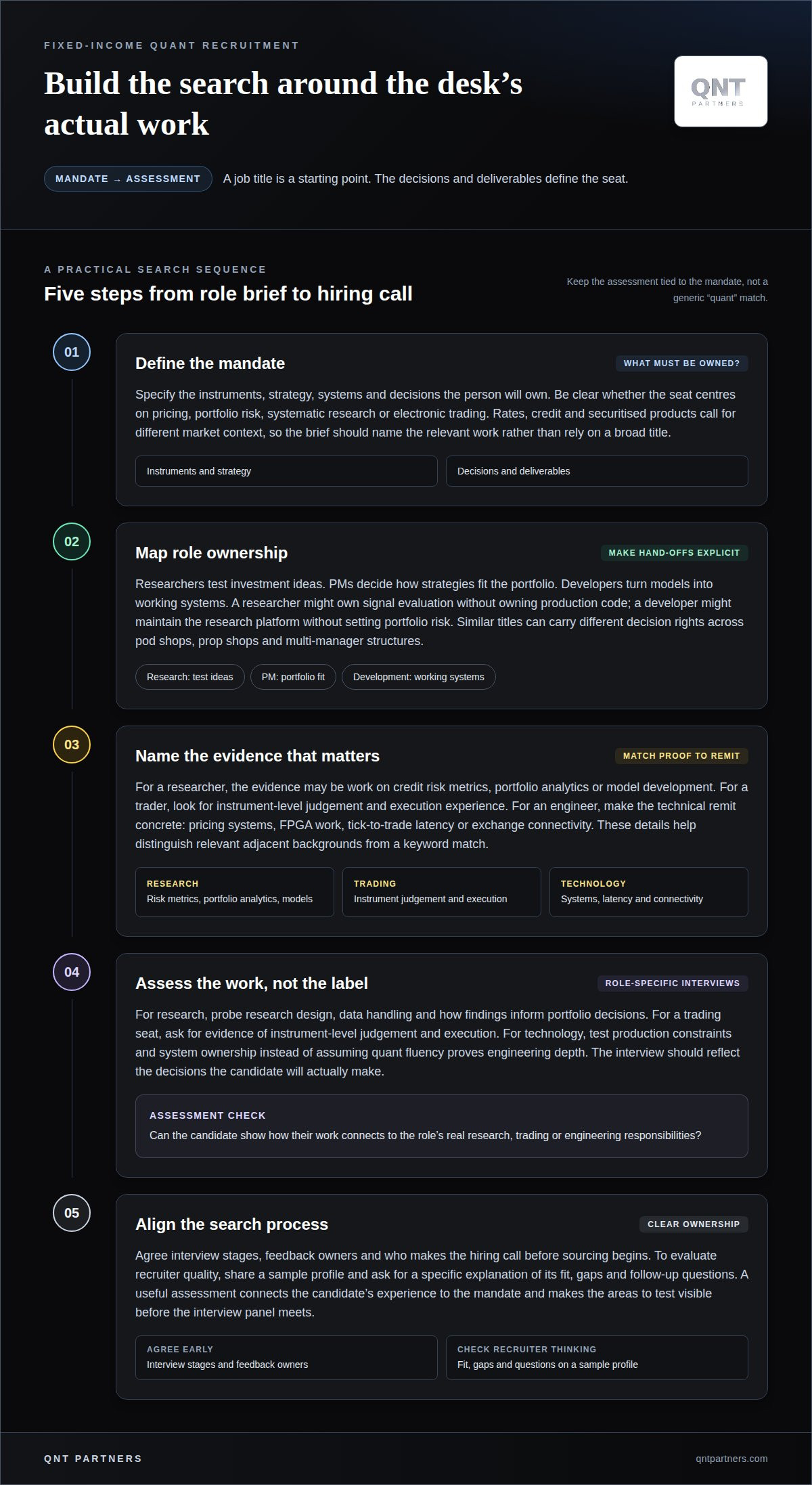
Start with a clear role brief. Specify the instruments, strategy, systems and decisions the person will own. For a quantitative researcher, that might mean credit risk metrics, portfolio analytics or model development; for an engineer, it could mean pricing systems, FPGA work or tick-to-trade latency. Those details determine which adjacent backgrounds are relevant.
Then align the assessment with the role. Assess a researcher building a model on research design, data handling and how findings inform portfolio decisions. A trader candidate should provide evidence of instrument-level judgement and execution experience. For a technology role, interviewers should probe production constraints and system ownership rather than assume quant fluency demonstrates engineering depth.
- Mandate: define instruments, strategy and ownership.
- Evidence: identify work that demonstrates the required skills.
- Assessment: use interviews that reflect the role’s actual decisions.
- Process: agree who gives feedback and makes the hiring call.
These steps also help assess recruiter quality. Share a sample profile and ask the recruiter to explain the fit, the gaps and the questions they would raise. A useful answer connects specific experience to your mandate; a generic match based on “quant” or “fixed income” tells you little.
For a new desk build-out, the search may cover both research and engineering, but keep the briefs distinct. A quant researcher may own signal evaluation, while a developer owns implementation and production reliability. Combining both into one hybrid vacancy can obscure the skills each person must bring.
Fixed-income recruitment expertise also means accounting for process constraints in candidate assessment. Garden leave or non-compete terms can affect a candidate’s start date and role options. Discuss these matters factually and in light of the candidate’s circumstances, rather than making assumptions based on their current employer or title.
If your mandate crosses research and implementation, discuss the fixed-income search with a team that can assess both disciplines.
candidate’s circumstances. The New York fixed-income quantitative researcher role required 3+ years of experience in a quantitative, analytical, or investment-related role. Use that requirement as a clear screening baseline, while still assessing whether candidates’ experience matches the specific research work and responsibilities of the seat.
Hiring for investment banks, hedge funds, market makers, and fintech
I see employer structure change what a fixed-income quant actually owns. In a hedge-fund pod, the role often sits close to a PM’s mandate; on an established bank desk, the work is more likely to feed into existing analytics and workflows. Those differences matter more than the job title.
Smaller or less familiar teams can show how much the remit varies. Annaly Capital Management listed a Residential Credit Quantitative Analyst role at VP or Director level. Voya Investment Management listed a Quantitative Research Analyst role in its I&G group. I’d clarify the product focus and actual decision rights in each case before treating either as a general fixed-income quant vacancy.
For a hedge-fund build-out, I’d pin down how research connects to the portfolio. Is the hire evaluating signals, owning a model or supporting a PM’s investment process? That distinction shapes both the experience I’d look for and how I’d assess the person’s contribution. For an SMA mandate, I’d also clarify the investment manager’s responsibilities and how the strategy is expected to operate.
A market-making search calls for a different brief. StoneX’s Fixed Income Credit Trader listing requested 5 to 15 years of fixed-income credit trading experience. I read that as a reminder to separate trading experience from quant research experience. I’d focus on the instruments traded, the candidate’s role in pricing decisions and how their work connected to execution. Tenure alone tells me little about fit.
Bank searches often involve a desk, product group and internal technology teams. I’d establish where the quant sits and who will assess the hire. At a fintech, the role may centre on a product or analytics capability instead. I’d distinguish model development from building software that puts analysis in front of users.
For a spinout or early team, I’d make decision rights explicit before outreach. A founding researcher may shape the methods and work directly with a PM, while a later hire may inherit an established research framework. The same split applies to engineers building a new execution stack versus maintaining an existing one. The titles can match, but the jobs don’t.
Across banks, funds, market makers and fintech teams, I’d tie selection to the mandate. Ask candidates to explain a relevant decision they owned and how they reached it. Then test whether that experience transfers to your instruments, team structure and operating setup. That gives the hiring panel a concrete basis for comparison, rather than relying on familiar firm names or broad job titles.
Quant fund recruiting and candidate profiles
I look past titles and employer names to what a candidate has personally built and how it changed investment decisions. Clear ownership tells me more than a polished CV.
Quant Fund Candidate Profiles
For a research role, I want to hear how a candidate took a market hypothesis and turned it into a useful portfolio input. A quantitative fixed-income researcher role at a Los Angeles investment manager, for example, puts the research remit at the centre. The key distinction is whether they formed and tested the approach or mainly maintained an existing model.
Risk-focused profiles need a different lens. A quantitative investment risk modeller role at a Newport Beach insurer points to model and risk responsibilities rather than direct strategy ownership. I ask how the candidate’s work informed portfolio decisions and how they handled model limitations. That separates strong analytics experience from research focused on generating investment signals.
For a new team or spinout, I look at how a candidate works with limited infrastructure. Someone joining an established platform may rely on existing data and production processes. A founding researcher may need to define parts of the research workflow. Both backgrounds can be valuable, but they meet different hiring needs.
Portfolio managers need a different assessment. I focus on their investment mandate, decision-making and collaboration with researchers. If the role involves managing capital through an SMA, I account for the structure and the manager’s responsibilities within it. A strong researcher is not automatically the right person to lead a portfolio.
Candidate Sourcing and Screening
When we recruit fixed-income quants, we map the strategy first, then identify relevant experience across comparable desks and research teams. I look for the product knowledge the role requires rather than relying on broad job-title matches. For a securitisation search, for instance, direct experience in that segment tells me more than a generic quant label.
In screening, I ask candidates to unpack a piece of work: their contribution, the assumptions they tested and how the result was used. I then probe the methods and code that matter for the role. That grounds the assessment in evidence rather than a list of tools copied from a CV.
I establish motivation and practical constraints early, too. Moving from an established fund into a spinout can change a candidate’s remit, resources and proximity to the PM. Garden leave or non-compete terms may affect the transition, so I address them carefully during the hiring process. Our shortlist explains each candidate’s fit and the specific points to test in an interview.
US Fixed Income Quant Analyst Recruiting Firms
In the United States, specialist recruiting is defined by the search mandate, not by a generic finance label. A firm focused on quant hiring should understand whether the seat centres on credit research, rates pricing, portfolio risk or execution. Fixed-income quant roles span distinct teams and technical requirements.
A simple list of recruiter names is less useful than assessing relevant expertise. A New York fixed-income researcher role, for example, required fixed-income experience and strong Python skills. A separate risk analyst role called for performance attribution, portfolio analytics and fixed-income risk metrics. A recruiter should distinguish these profiles before presenting candidates.
Start by asking how the search firm will map the mandate. The answer should identify the instruments, strategy and reporting line, then explain which candidate backgrounds are relevant. For a securitised-products role, structured-credit analysis may matter more than broad rates exposure. For a systematic credit seat, research ownership and coding depth may carry greater weight.
Next, examine the recruiter’s screening approach. Ask how they assess fixed-income knowledge, Python experience and the candidate’s role in prior research. A CV may mention model development, but the candidate may have maintained an existing tool rather than designed its methodology. That distinction affects fit for a research-led position.
Recruitment models also differ. An in-house team can coordinate internal stakeholders and hiring approvals. A specialist search firm can focus its market mapping on a narrower technical profile. A general staffing agency may cover broader functions. The right arrangement depends on whether your team can source and assess the specific fixed-income expertise internally.
For a new US search, define the evidence you need before outreach begins. Specify which instruments matter, what the hire will own and how interviewers will assess the work. A quantitative researcher should explain the logic behind a model and its investment use. A quant developer should demonstrate relevant implementation experience, not just familiarity with financial terminology.
Then compare each firm’s proposed process with those criteria. Look for a named search lead, a candidate assessment plan and a feedback loop with your hiring team. If a firm cannot explain how it would distinguish a credit researcher from a rates quant, its shortlist may reflect titles rather than fit. A focused mandate exposes that weakness early.
For teams defining a US fixed-income search, discuss your recruitment mandate and the specific research or trading work behind it.
QNT Partners: Quant Trading & Research Recruitment
QNT Partners supports fixed-income teams hiring for research and trading mandates where product knowledge and technical depth both matter. Its Trading & Research service covers specialist searches, while Technology & Engineering supports teams building systems for pricing, research and execution.
For roles applying machine learning to investment decisions, AI & ML Specialist Search addresses the distinct technical profile. Manager Search & SMA Sourcing is relevant when a mandate involves portfolio leadership or an SMA structure.
Bring QNT Partners in when a search needs a clear distinction between research ownership, trading responsibilities and implementation. A precise brief on the strategy, instruments and role remit gives the search a practical starting point. To discuss a fixed-income quant search, contact QNT Partners.
Set the mandate before the search begins
The next useful step is to define what the new hire must own. For fixed income quant recruitment solutions to produce a focused search, connect the mandate to a real decision, such as improving a research process, taking responsibility for a model or building a capability the team lacks.
Agree internally on who will assess each part of the role, too. A portfolio manager can judge strategy fit, while an engineering lead can assess production implementation. That clarity gives candidates a consistent view of the role and helps your team make decisions against shared criteria.
QNT Partners works with teams on quant recruitment, technology and engineering searches, and specialist AI and ML hiring. If you’re shaping a fixed-income mandate or opening a search, talk through the role with QNT Partners. A precise brief is a strong place to start.
Frequently Asked Questions
What is fixed income recruitment?
Fixed income recruitment matches people with roles focused on debt markets, from credit analysis and rates trading to portfolio risk. The hiring brief should specify the instruments and responsibilities involved. For example, a role centred on securitised products calls for different experience from one focused on rates execution. Teams also recruit for supporting technology, including developers who build systems used in pricing, analytics or trading.
What are fixed income quant recruitment solutions?
Fixed income quant recruitment solutions are specialist searches for researchers, traders and technical hires whose work connects quantitative methods with fixed-income markets. A search might focus on a credit researcher, a Python quant developer or an AI specialist supporting investment decisions. QNT Partners operates as a recruitment intermediary, and the hiring organisation alone determines candidate suitability. Candidate data is retained for up to two years from last contact, and individuals have rights under UK GDPR.
What fixed income quant roles and skills are most in demand?
Common roles include fixed-income quantitative researchers, risk analysts and engineers supporting electronic trading. Relevant skills depend on the position: research may call for Python and fixed-income experience, while risk work can require performance attribution, portfolio analytics and fixed-income risk metrics. Rates e-trading engineering calls for experience relevant to production systems. The strongest profile matches the team’s instruments, responsibilities and technical environment.