Deep Learning Engineer Search for Finance Factor Models

A strong deep learning engineer search for finance teams starts with the model’s purpose, not the frameworks on a CV. For factor-model work, assess whether candidates can distinguish classification from regression and explain how statistical factors are built, validated and used in research. Framework fluency matters, but sound validation and market-aware implementation matter more.
That distinction can get lost when a role combines machine learning and quantitative research. A candidate may know deep learning architectures but have little experience handling noisy financial data, preventing leakage or testing whether a factor carries useful information out of sample.
Define the role around the work: when classification or regression is appropriate, how statistical factor models complement deep learning, and what technical evidence to test in interviews. Assess research judgement, production constraints and the scope of the search to distinguish practical model-building ability from familiarity with tools alone.
Key Takeaways
- Define the role around the research and production work the hire will own before narrowing the technical requirements.
- Compare programming languages and deep learning frameworks by how they fit the team’s existing research and deployment stack.
- Match classification, regression and statistical factor methods to the financial question each model is intended to answer.
- Use technical interviews to test whether candidates can explain modelling choices and carry research into a practical workflow.
What programming languages and deep learning frameworks are used in finance?
Python is common in quantitative research, but it rarely represents the entire engineering environment. A deep learning engineer might prototype a return-prediction model in Python, then work with C++ components for data access or production inference. Ask where each language fits in the research-to-trading workflow.
Python supports feature research with libraries such as NumPy, pandas and scikit-learn for array operations, data inspection and model testing. PyTorch and TensorFlow add automatic differentiation and GPU-backed tensor computation. Ask candidates how they structure training pipelines, manage tensor shapes and reproduce model runs, rather than relying on a list of libraries on a CV.
For a factor model, a practical example is joining security returns with point-in-time features, then training against a defined forward target. Python can support the analysis, while SQL retrieves records from a research warehouse. The engineer should understand timestamp alignment, missing observations and how revised data could contaminate a historical test.
Choose a framework to suit the workload. PyTorch supports flexible custom model components and training loops. TensorFlow offers training and deployment workflows through its broader ecosystem. JAX provides composable transformations, including automatic differentiation and compilation. These are not interchangeable credentials: candidates should explain the task they tackled and the constraints behind their choice.
Ask candidates to walk through a technical project. Which framework handled training? How did they track inputs and outputs? What changed between experimentation and deployment? A useful answer identifies a specific design decision, such as batching irregular observations or controlling memory use, and explains its effect on the system.
Deep learning depends on the surrounding data stack. NumPy arrays, pandas DataFrames and Apache Arrow tables represent data differently, affecting copying, memory use and interoperability. Polars may suit columnar transformations, while SQL remains useful for selecting and joining warehouse data. Candidates should justify each tool for the dataset and workflow, rather than claim one library handles every stage.
Production requirements shape the language mix. A Python service may suit research or scheduled inference, while a latency-sensitive component may use C++ or Rust. Java is also used in some established data and application environments. Specify the difference between model research and performance engineering, then assess candidates against the responsibilities they will own.
For GPU work, ask whether candidates have profiled a model, not just trained it. NVIDIA CUDA enables GPU computation, while libraries such as PyTorch abstract many lower-level operations. Candidates should be able to discuss batch size, memory pressure and data transfer between CPU and GPU. These details show whether they understand why a training run slows down.
Framework fluency alone does not establish production readiness. Ask how candidates package a model, record dependencies and check that inference matches research output. ONNX can support model exchange between compatible tools, while containerisation can make software environments repeatable. Candidates should explain what they deployed and how they tested changes.
Use a small interview case based on the team’s stack. Provide a feature matrix, a target definition and a simple training objective. Ask candidates to outline data preparation, validation and model implementation in Python. Then explore the hand-off: what would change for scheduled inference, streaming data or tighter latency requirements?
Assess evidence, not framework name recognition. Look for clear reasoning about numerical stability, reproducibility, training throughput and inference requirements. If the role includes C++ integration, test that boundary directly. If it centres on research infrastructure, assess Python data handling and experiment organisation. A strong fit is an engineer whose language choices match the team’s workload.
Machine learning
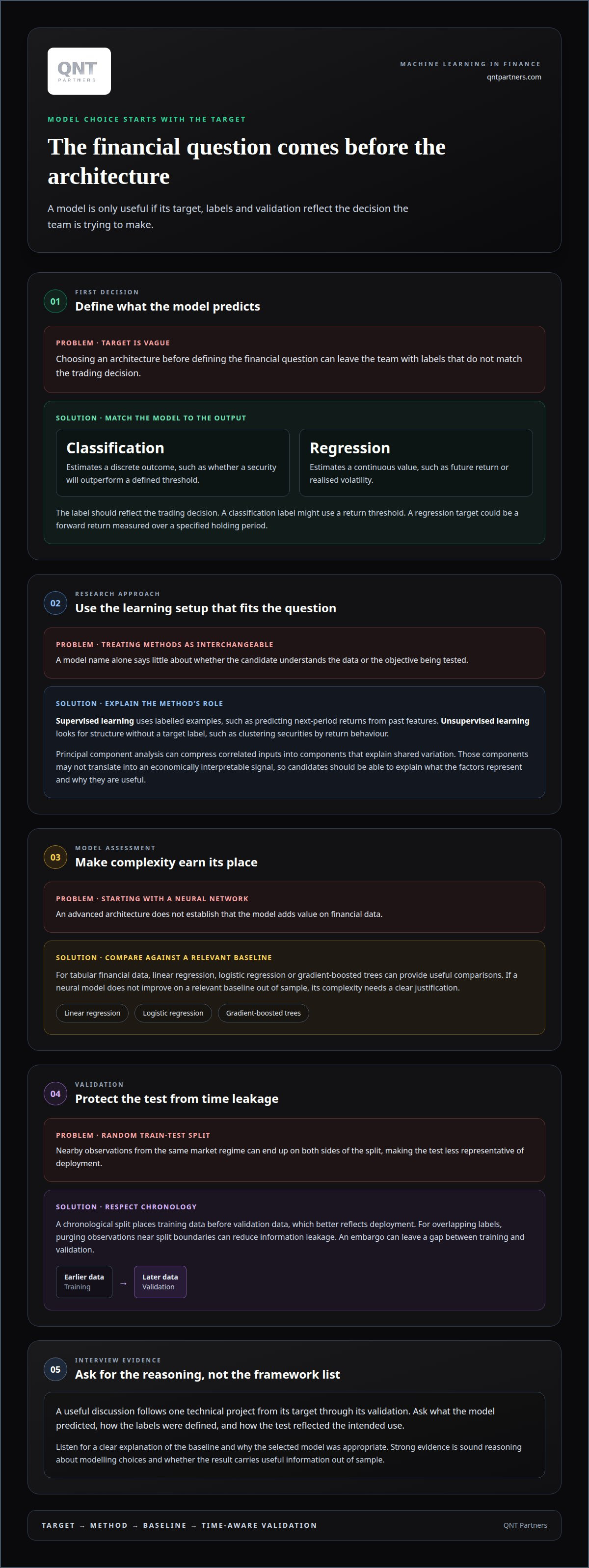
In finance, model choice starts with the target, not the architecture. A classification model estimates a discrete outcome, such as whether a security will outperform a defined threshold. A regression model estimates a continuous value, such as future return or realised volatility.
The distinction affects how a team labels data and evaluates outputs. For classification, a researcher might define positive outcomes using a return threshold. For regression, the target could be a forward return measured over a specified holding period. The label must reflect the trading decision.
Statistical factor models provide another approach. Principal component analysis can compress correlated inputs into components that explain shared variation. A deep learning engineer should understand what these components represent and why they may not translate into an economically interpretable signal.
Supervised learning uses labelled examples, while unsupervised learning looks for structure without a target label. Clustering securities by return behaviour is an unsupervised example. Predicting next-period returns from past features is a supervised task.
Ask candidates to explain the baseline before discussing neural networks. For tabular financial data, linear regression, logistic regression or gradient-boosted trees provide useful comparisons. If a neural model does not improve on a relevant baseline out of sample, its complexity needs a clear justification.
Validation is a common failure point in financial machine learning. Random train-test splits can mix nearby observations from the same market regime. A chronological split better reflects deployment, with training data preceding validation data.
For overlapping labels, purging observations near split boundaries can reduce information leakage. An embargo can leave a gap between training and validation periods. Candidates should explain when these controls matter and how they apply to the dataset, not just repeat the terminology.
Feature construction requires the same discipline. A rolling mean must use information available at the prediction timestamp. A revised fundamental value can leak future information if historical records retain only the latest version.
Test candidates on a specific failure mode. Provide a feature timestamped after the intended decision time, then ask how they would detect the issue. Strong answers trace data lineage from source records through feature generation and label creation.
Class imbalance affects classification. When positive labels are rare, accuracy can look high even as the model misses most useful events. Ask whether candidates would assess precision-recall behaviour, calibration or threshold sensitivity in relation to the strategy’s actual decision process.
Regression requires careful treatment of noisy targets. Squared-error loss penalises large residuals more heavily than absolute-error loss. Candidates should connect the chosen loss to the consequences of prediction errors, rather than select it by habit.
Factor research also requires economic interpretation. A model may rank assets effectively while relying on unstable or redundant features. Feature attribution methods, such as permutation importance, can support investigation, but they do not establish causality.
Regime shifts complicate historical validation. A model trained in one volatility environment may behave differently after market structure changes. Ask candidates how they monitor feature distributions and prediction errors after deployment, and what evidence would prompt retraining.
Deployment introduces a separate set of requirements. Batch inference may suit a portfolio rebalance process, while streaming inference serves continuously updated decisions. Candidates should identify the required data freshness and explain how production outputs are checked against research results.
Machine learning engineers also work across research and trading teams. A researcher may own target design, while an engineer builds reusable pipelines and production interfaces. Clarify decision rights during the search, particularly for model approval and maintenance. A deep learning engineer search for finance should distinguish these responsibilities before interviews begin.
Use a practical interview exercise with a small time-series dataset. Ask candidates to define a target, select a baseline and propose chronological validation. Then ask how they would prevent leakage and explain model performance to a portfolio manager.
Assess reasoning, not the number of architectures candidates can name. Someone who can defend a simple regression model may be more useful than someone who applies a transformer without a clear financial objective. In a deep learning engineer search for finance, the model must fit the decision, data and operating environment.
QNT Partners: Quant Trading & Research Recruitment
QNT Partners can help finance teams define and fill roles spanning quantitative research and machine learning. The search should reflect the work itself: model research, data engineering, production implementation or a combination. This distinction helps identify candidates who can build models and carry research into a live trading environment.
For a deep learning hire, QNT Partners’ AI & ML Specialist Search complements its Quant Trading & Research Recruitment and Technology & Engineering Recruitment. These services are relevant when launching a systematic strategy, expanding a research team or connecting model development with existing trading infrastructure.
If you’re planning a search, visit QNT Partners to start the conversation.
Set the role around the work ahead
Start by making the role’s boundaries explicit. Decide where research ends, who owns model validation and what the engineer must deliver into production. These decisions shape the interview brief and help candidates assess whether the role fits their experience.
A search for a deep learning engineer in finance works best when it reflects the team’s research and trading environment, rather than relying on a generic list of frameworks. QNT Partners offers Quant Trading & Research Recruitment, Technology & Engineering Recruitment, and AI & ML Specialist Search to support teams defining the role.
Share the mandate, the technical environment, and the capabilities the team needs to add. Contact QNT Partners about your search to discuss the role and its requirements. A precise brief gives the search a clear starting point.
Frequently Asked Questions
What does a deep learning engineer do in finance?
A deep learning engineer turns research requirements into systems that process financial data and produce usable model outputs. For example, they might build an inference pipeline that receives refreshed market features, applies a trained model and records predictions for research review. The work may also involve monitoring data quality, investigating unexpected output changes and maintaining reproducible experiments. The balance between research and production depends on how the trading team organises development.
What skills and qualifications do finance employers seek in deep learning engineers?
Finance employers look for engineers who combine machine learning knowledge with careful software practice. Relevant experience may include designing data pipelines, reviewing model behaviour and explaining technical decisions to researchers or traders. A quantitative degree can provide useful foundations, but employers should assess practical work alongside formal study. In interviews, ask candidates to explain a project’s constraints, their contribution and how they handled a result that failed to generalise.
Where can I find deep learning engineer jobs in finance?
Look at hiring firms’ own role pages and specialist recruitment channels focused on quantitative trading and technology. Candidates can use QNT Partners’ candidate channel for relevant search conversations. QNT Partners acts as a recruitment intermediary, and the hiring organisation alone determines candidate suitability. Its privacy policy states that candidate data is retained for up to two years from last contact; individuals have rights under UK GDPR.