Capital Raising for Quantitative Trading Strategies via SMAs

I’ve seen a live track record get a strategy into the conversation, but it does not, by itself, make the strategy allocatable. In my view, raising capital for a quantitative strategy through an SMA depends on how clearly an investor can assess its portfolio role, performance and operational readiness.
Returns matter, but allocators also need to understand how a strategy could diversify existing exposures and behave as markets move. I see low correlation as a point in the strategy’s favour, but it can change over time and does not replace scrutiny of drawdowns, capacity and execution.
I’ll explain how these factors shape an SMA allocation, what makes a strategy ready to trade, and why a live track record needs context. I’ll also cover how the account structure connects portfolio fit with evidence an allocator can evaluate.
Key Takeaways
- Assess a strategy’s diversification value against existing portfolio exposures; low correlation can vary across market conditions.
- Understand how an SMA’s structure shapes the allocation, reporting and investor-manager relationship.
- Evaluate AUM thresholds against the requirements of the platform and prospective investors, rather than assuming a single standard minimum.
- Compare management fees, performance fees and profit-sharing by their effect on net returns and alignment.
- For U.S. commodity-interest strategies, prospective CTA clients must receive a disclosure document when solicited to enter an agreement for trading direction or guidance.
Diversification and low correlation to traditional asset classes
Low correlation can make a quantitative strategy relevant to a portfolio, but I wouldn’t treat it as a permanent feature. Relationships can shift with market regimes, crowded positioning and liquidity. I’d examine performance across distinct periods, including drawdowns, rather than treat a historical estimate as a forecast. What matters is whether the strategy’s return drivers differ from existing equity, bond or index exposures.
Statistical arbitrage is one example. It uses mean-reversion analysis to identify pricing inefficiencies in pairs or groups of correlated securities. A manager may buy an undervalued security and short an overvalued counterpart, expecting their relationship to revert. When positions last fractions of a second, execution costs and capacity are central to the diversification case.
Other systematic approaches use different information. Event-driven models analyse historical and real-time data around earnings calls, regulatory changes, management restructuring or shareholder activity. Machine-learning strategies search large datasets for patterns that can be encoded as trading rules. In my view, portfolio behaviour depends on exposures, turnover and financing, not just the model’s label.
When raising capital for quantitative trading strategies via SMAs, I’d present diversification as a testable portfolio role, not a marketing claim. Compare the strategy’s return drivers with relevant indices and the allocator’s existing exposures. A long-short strategy may reduce broad market sensitivity while retaining basis risk between paired securities. Explain which positions and market conditions drove the observed relationship.
An SMA holds assets in an investor-specific account, unlike the pooled structure of a hedge fund. “Separately managed portfolio” often refers to an individually managed account, while managed futures describes a strategy category that can use either structure. I’d focus on the mandate and account arrangement as the key distinction.
An SMA agreement defines the investor’s restrictions and the manager’s discretion over signals. I’d make sure it explains how the mandate handles strategy deviations, so investors can distinguish an authorised adjustment from a change in the investment process.
I’ve found that a specialist can help managers identify allocators whose objectives match the strategy’s actual exposures and capacity. Qualification means testing that fit against portfolio needs, rather than treating general interest in quantitative returns as evidence of alignment.
The broker and trading workflow must support the strategy’s instruments and account-level allocations without distorting intended exposures. I’d assess capacity against market depth, order size and the effect of splitting trades across accounts. These constraints determine whether an allocation can be added while preserving the strategy’s return drivers.
For a U.S. programme, I’d clarify the mandate and assess whether the live record supports the proposed portfolio role. Then I’d match that profile with suitable investors and evaluate whether additional allocations fit the strategy’s capacity. Scale decisions should follow implementation evidence, not fundraising interest alone.
What is a separately managed account (SMA) for quantitative trading strategies?
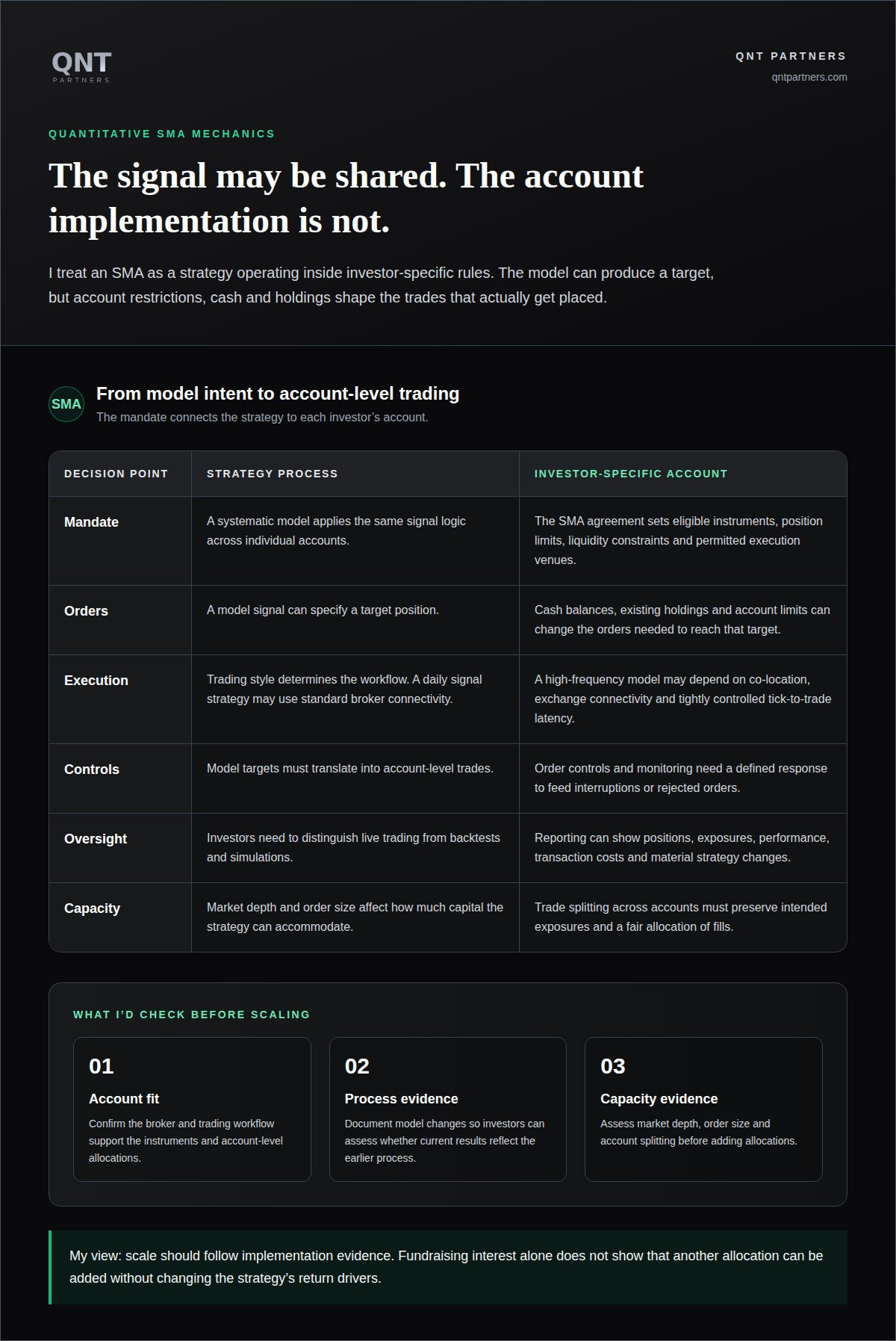
A quantitative SMA gives a manager authority to run a defined strategy in an investor-specific account. I see the key distinction in how signals and trades stay within an agreed mandate, while the account remains separate from other investors’ assets. For example, a systematic equity model can apply the same signal logic across individual accounts, subject to each account’s restrictions and available capital.
The SMA agreement translates the mandate into operating parameters. It can define eligible instruments, position limits, leverage permissions, liquidity constraints and permitted execution venues. A market-neutral model might trade paired equities but exclude certain securities for an investor. The mandate, not the model’s raw output alone, sets the limits of the manager’s discretion.
Implementation must account for differences between accounts. A signal may call for the same target position, but cash balances, existing holdings and account-specific limits can produce different orders. The portfolio management system needs to translate model targets into account-level trades, then track fills, exposures and residual positions. Reconciliation identifies differences between the manager’s records and broker statements.
Reporting connects these mechanics to investor oversight. Useful reports explain positions, exposures, realised and unrealised performance, transaction costs and material strategy changes. Quantitative managers should also distinguish live trading from backtests and simulations. Documenting model changes helps investors assess whether current results reflect the same process as earlier performance.
Technology requirements depend on the trading style. A daily signal strategy may route orders through standard broker connectivity, while a high-frequency model may rely on co-location, exchange connectivity and tightly controlled tick-to-trade latency. In either case, the manager needs order controls, monitoring and a defined response to feed interruptions or rejected orders. The account setup must support the instruments and execution workflow the model actually uses.
Investor-specific accounts also affect capacity and portfolio construction. The manager must consider whether trades can be allocated fairly across accounts without changing the intended risk profile. If an account restricts a security, for example, the system needs a documented way to handle that constraint. Consistent allocation logic matters when multiple accounts receive orders from the same signal.
Before launch, the manager and investor align on the mandate, brokerage arrangements, reporting format and operational responsibilities. They then test account permissions, data flows, order routing and reconciliation before committing the strategy to live trading. An SMA can suit an investor seeking a tailored mandate and account-level visibility, while the manager retains responsibility for systematic execution within agreed limits.
I’d put these account-level considerations in the context of the mandate mix: active fundamental strategies account for 89.4% of mandates in the eVestment universe described on the page, while active quant strategies account for 6.6%. That comparison provides context, but it does not determine whether a particular quantitative SMA fits an investor’s objectives or constraints.
I’d assess the fit by looking at how the strategy’s mandate, implementation and reporting meet the investor’s requirements. Clear allocation procedures and account-level controls make it easier to review how model decisions translate into executed trades.
What assets under management minimums do SMA platforms and investors require?
I’ve found there is no single AUM minimum across SMA platforms and investors. Each platform sets its own onboarding criteria, while each allocator decides whether a proposed allocation fits its mandate. I’d keep three figures separate: the platform’s account threshold, the investor’s allocation size and the manager’s minimum viable programme size.
They answer different questions. A platform threshold reflects its account-opening and operating requirements. An investor’s minimum may reflect portfolio construction, internal approvals or the amount needed to make an allocation material. The manager’s target needs to account for strategy-level requirements, such as technology, market access and operational support. In my experience, treating these figures as one number can create a mismatch before diligence begins.
Strategy capacity is a key constraint. A liquid futures strategy may absorb capital differently from a less liquid equity model, even when their historical returns are similar. I’d assess order size against market depth, turnover and execution style. For a strategy trading small-cap securities, an allocation that looks modest on paper may still create market impact or dilute the signal.
Account-level implementation matters too. Suppose a model generates a target position, but an investor’s mandate excludes one security. I’d check whether the remaining portfolio can still express the intended risk and whether the account remains operationally viable. Restrictions, cash balances and instrument eligibility can change how much capital the strategy can deploy effectively.
Platform readiness can shape the practical threshold as well. A platform may require evidence of a functioning investment process, reporting workflow and operational controls before accepting accounts. An investor may then assess the live track record, drawdown profile, capacity analysis and fit with existing exposures. I wouldn’t treat a strong backtest as an answer to those allocation questions.
I’d map the requirements before fundraising:
- Record platform account criteria and onboarding steps.
- Define the minimum allocation that keeps the strategy’s portfolio construction coherent.
- Model capacity across instruments, liquidity conditions and account restrictions.
- Set a programme target that supports execution and ongoing operations.
I’d present these figures separately in investor materials. For example, a platform may accept an account smaller than the manager’s preferred launch allocation. That difference is not necessarily a blocker, but I’d explain clearly how the account will be traded, monitored and reported.
At QNT Partners, we connect a strategy’s capacity and operating model with investors and platforms whose requirements fit through our Manager Search & SMA Sourcing service. I’d qualify mandate alignment before an allocation discussion turns into lengthy diligence.
Alpha Enhanced strategies typically set tracking-error budgets between 50 and 200 basis points, depending on investor risk appetite. I see this as a way for investors to express the risk they are willing to accept when assessing a strategy’s fit with their portfolio.
In statistical arbitrage, investors may take long positions in undervalued securities and pair them with short positions in overvalued securities, expecting prices to revert to the mean. I’d look closely at those intended exposures when assessing whether the strategy fits an investor’s mandate.
What are typical SMA management fees, performance fees, and profit-sharing terms?
I see an SMA fee schedule doing two jobs: paying for ongoing management and tying compensation to investment results. No single structure suits every quantitative mandate. I’d make sure the agreement defines each charge, its calculation base and timing, and shows how costs affect the investor’s net performance.
A management fee is generally linked to account assets and pays the manager for running the mandate. I’d check that the agreement specifies the valuation method, billing frequency and treatment of cash flows. Subscriptions or withdrawals during a billing period can affect the fee base, depending on the agreed calculation method.
A performance fee or incentive allocation depends on how the contract defines eligible gains. I’d check whether the calculation uses realised or total account performance, and how commissions, financing and other expenses are treated. If the incentive is based on gross profits while the investor bears trading costs, reported returns and compensation can tell different stories.
A high-water mark can stop a manager earning incentive compensation again on the same recovery in account value. The agreement defines the reference level and how losses affect future calculations. A hurdle rate works differently: it sets a return threshold before incentive compensation applies. I’d confirm whether either mechanism applies and how it works.
Crystallisation terms specify when earned incentive compensation is calculated and payable. A quarterly calculation differs from an annual one if the account rises and then falls within the year. I’d check how the agreement treats withdrawals before a calculation date, account termination and accrued but unpaid amounts.
Profit-sharing can also mean an economic split between a strategy manager and a platform or distribution partner. That’s separate from the investor’s SMA fee schedule. I’d define which revenue is shared, which costs are deducted first and whether the split applies to management fees, incentive fees or both.
For a quantitative strategy, I’d pay close attention to execution expenses. Brokerage commissions, exchange charges, borrow costs and financing can materially affect net results, especially when turnover is high. The documents should identify which expenses are charged to the account and which are borne by the manager or platform. Without that distinction, comparisons between strategies can mislead.
I’d follow the calculation from start to finish: establish the account’s opening value, apply subscriptions or withdrawals, deduct specified expenses, calculate eligible performance, then apply any hurdle or high-water mark. The manager and investor should be able to reproduce the same result from the same account statement. Precision keeps fee negotiations focused on economics rather than ambiguous definitions.
What U.S. securities laws and regulations apply to raising capital through managed accounts
An SMA account structure does not, by itself, determine which U.S. rules apply. I start with the instruments traded, the manager’s role and how prospective investors are approached. A strategy trading securities raises different questions from one directing commodity-interest trading. The mandate and solicitation materials should reflect that distinction.
For commodity-interest strategies, the Commodity Futures Trading Commission (CFTC) disclosure requirement is specific: prospective clients of a commodity trading advisor must receive a disclosure document when solicited to enter an agreement for the advisor to direct or guide commodity-interest trading. I treat the CTA relationship and solicitation process as central to launch planning.
An SMA programme should define who makes trading decisions and what authority the investor grants. I’d expect the agreement to specify permitted instruments and limits, while operating procedures record how orders follow the mandate. The documents should be consistent. A mismatch between the marketing description and trading authority creates avoidable diligence friction.
Investor communications also need careful review. I’d make sure a pitch deck describing a quantitative model distinguishes live results from simulated performance and explains the assumptions behind illustrative examples. Terms such as “market neutral” or “low correlation” need context, including the period and portfolio exposure they describe. Claims broader than the supporting evidence can complicate investor review.
I’d map the fundraising workflow before approaching allocators. Identify which entity communicates with prospects, who discusses strategy terms and when formal documents are delivered. Keep a record of the materials used and the version shared. For a U.S. programme, that creates a traceable path between investor discussions, the account mandate and the eventual trading setup.
Operational controls matter alongside legal documents. Broker permissions, investment limits and account reporting should match the agreed mandate. If a strategy trades both securities and commodity interests, distinguish the relevant activity in the mandate and investor reporting. Clear records help explain which model generated a position and under what authority it was placed.
Before launch, I’d have U.S. counsel review the strategy, account agreements, disclosure materials and solicitation process together. Counsel can assess the manager’s actual activities and instruments rather than relying on the “SMA” label alone. The review should also cover how material model changes are communicated to investors and reflected in account documentation.
For a quantitative manager, I’d define the trading activity, confirm the manager’s authority, align disclosures with the live process and ensure account operations follow the mandate. A commodity-interest CTA solicitation brings the CFTC disclosure document into focus. Treating these items as one launch workstream helps prevent gaps between what investors are told and what the SMA trades.
QNT Partners: Quant Trading & Research Recruitment
QNT Partners works with quantitative managers seeking investor access, specialist talent or both. Its Capital Raising via SMAs service supports managers preparing a strategy for allocator discussions, while Manager Search & SMA Sourcing addresses the people and mandate needs of an SMA programme.
Turn to QNT Partners when a live strategy needs a clearer route to investors or a build-out calls for quant researchers, traders or technology specialists. Quant Trading & Research Recruitment, Technology & Engineering Recruitment and AI & ML Specialist Search address key hiring needs across systematic teams.
If your next step is investor outreach or a critical hire, contact QNT Partners to discuss the mandate.
Put the next decision into motion
The next step is to make the investor proposition executable. Decide who owns investor communication, who can explain the strategy’s mechanics and who is accountable for implementation. A clear internal hand-off keeps fundraising discussions connected to what the trading operation can deliver.
Capital raising for quantitative trading strategies via SMAs works best when the commercial case and operating plan move together. Focus the next conversation on the specific gap, whether investor alignment, a launch requirement or a team capability. That gives each discussion a practical outcome instead of another round of general positioning.
I’ve seen an SMA launch lose momentum when investor communication gets ahead of the trading team’s delivery plan. Until the hand-off is clear, the mandate is still more pitch than executable business.
Frequently Asked Questions
How can a specialist help quantitative trading managers raise capital through SMAs?
A specialist can help position a strategy for relevant institutional mandates and connect managers with investors seeking SMA exposure. The work centres on investor-manager matching and the strategy’s commercial presentation. At QNT Partners, we also explain how we handle personal information: our privacy notice says candidate data is retained for up to two years after last contact, and client and commercial data for seven years. Individuals have rights under UK GDPR.