C++ Quant Developer Recruitment for Trading Firms

I see C++ hiring go wrong when teams start with the title rather than the trading system. Tick-to-trade latency and exchange connectivity demand different experience from C++ work on other systems, even when the job descriptions look similar.
That distinction matters in practice. A low-latency engineer and a quant developer building pricing infrastructure may both write C++, but they solve different problems and need to be assessed on different evidence. I’d define the role by its production environment and by how close the work sits to trading decisions before mapping candidates.
In my experience, specialist sourcing reaches beyond active applicants, while the hiring model shapes the search. Role specialisation changes the brief, too. Recruitment fees and delivery timelines depend on the scope and constraints of each search, so I look at those factors before work begins.
Key Takeaways
- The production environment and technical ownership matter more than C++ experience alone when assessing fit for a low-latency trading role.
- The hiring model shapes the mandate, whether it is a pod shop, prop shop, multi-manager structure or an SMA build-out.
- Role specialisations are best understood through the systems and trading problems people have actually owned, including exchange connectivity and tick-to-trade performance.
- Recruitment fees reflect the search structure and scope. A clear brief makes the work involved easier to establish before a search begins.
- Delivery timing turns on how tightly the role is defined and how the process handles candidate availability, garden leave and interview decisions.
C++ quant developer and low-latency recruitment
I’ve found that a C++ search works best when the brief separates ownership of trading systems from familiarity with the language. Someone maintaining exchange gateways may not have built pricing models, even if both roles require modern C++.
I map an engineer’s work to the production path first. Does the role own market-data handlers, order routing, execution logic, or research infrastructure? That boundary matters. A low-latency systems hire should not be assessed like a quant researcher.
The technical screen should reflect the system’s actual bottlenecks. For a team focused on tick-to-trade latency, I’d expect profiling, memory allocation, concurrency, and hardware interaction to matter. For exchange connectivity, protocol handling, fault recovery, and ownership of production incidents may carry more weight.
In my experience, quant developer recruiters differ mainly in their specialisation and access to the relevant talent pool. A firm focused on quant research may be a poor fit for an FPGA or exchange-connectivity search. I judge fit by whether the recruiter understands the market and the experience the mandate calls for.
In the United States, specialist quant and HFT recruiters source C++ developers for proprietary trading firms, pod shops, and multi-manager firms. The structure matters: an execution-infrastructure search is different from one for quantitative development or broader trading technology.
Recent market listings show the range of mandates: C++ low-latency roles in New York City and Chicago carried base salary ranges of 150-300K. A separate New York role focused on C++ OMS technology at VP level. Title alone tells you little about the work.
Before I approach candidates, I want the system ownership, performance constraints, team structure, and hiring manager’s evidence threshold nailed down. A Chicago prop shop building a market-data stack needs different experience from a pod hiring for an established execution platform.
I’m careful about candidate consent and disclosure. Submitting a profile without clear consent can create duplicate applications, while vague descriptions can expose confidential interest or misrepresent the role. Candidates should know the mandate, disclosure boundaries, and next step before their profile is circulated.
Garden leave and non-competes affect availability and which roles a candidate can consider. I handle them discreetly and accurately, not as routine scheduling details. For a C++ quant developer recruitment agency, trust depends on matching technical evidence to a real mandate, not circulating CVs broadly.
Quant recruiting services and hiring models
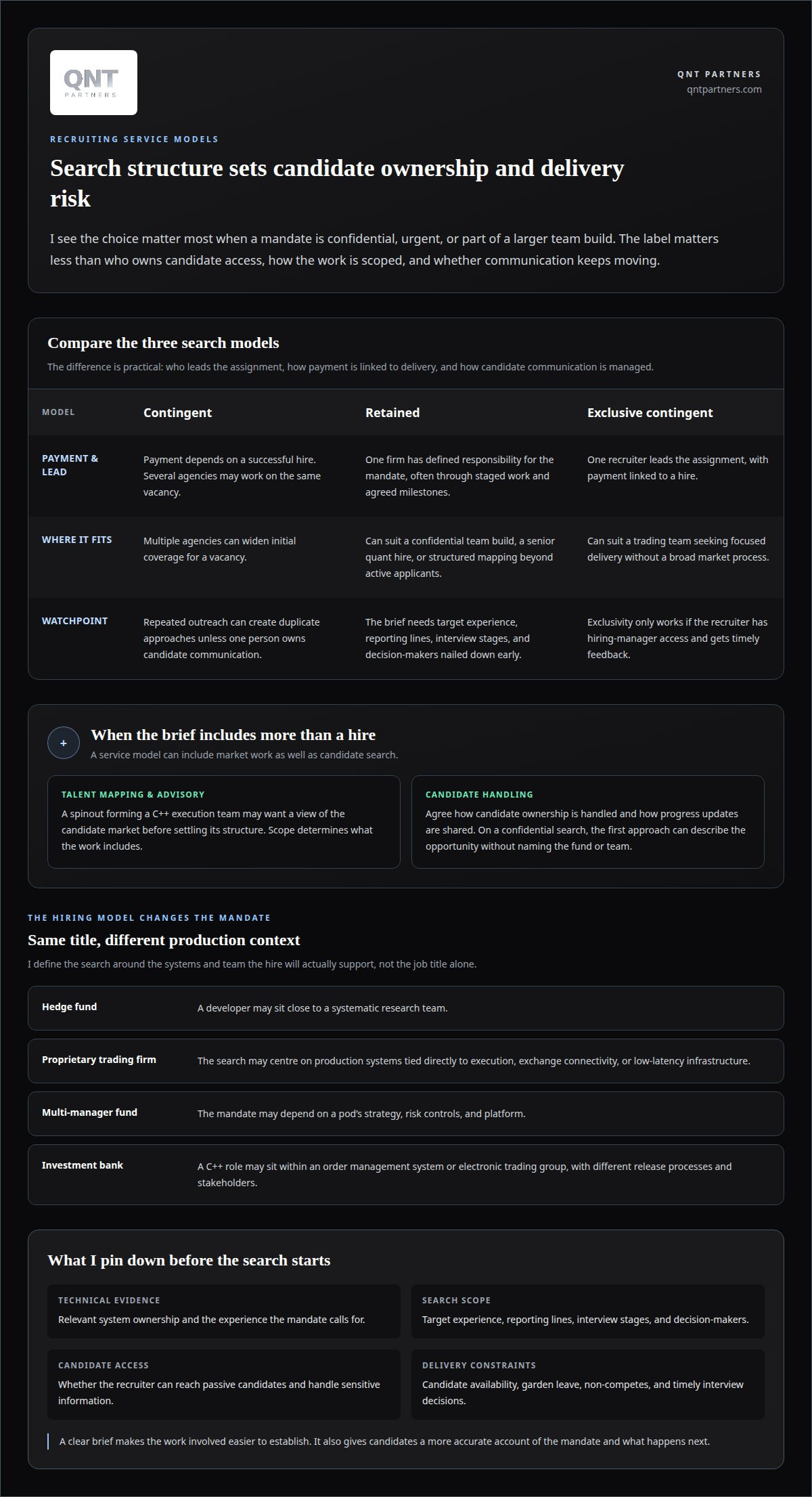
Search structure changes who controls candidate access and carries delivery risk. I see the choice matter most when a mandate is confidential, urgent, or part of a larger team build.
Recruiting Service Models
In contingent search, the recruiter’s payment depends on a successful hire. Several agencies may work on the same vacancy, widening initial coverage but also creating duplicate approaches. For a specialist C++ role, that can mean repeated outreach unless one person owns candidate communication.
Retained search gives one firm defined responsibility for the mandate, often through staged work and agreed milestones. It can fit a confidential team build, a senior quant hire, or a role requiring structured mapping beyond active applicants. The brief usually needs target experience, reporting lines, interview stages, and decision-makers nailed down early.
Exclusive contingent search combines one recruiter leading the assignment with payment linked to a hire. It can suit a trading team seeking focused delivery without a broad market process. In practice, exclusivity only works if the recruiter has access to hiring managers and gets timely feedback.
Some mandates combine recruitment with talent mapping or advisory work. A spinout forming a C++ execution team, for example, may want a view of the candidate market before settling its structure. The scope then determines what the work includes, how candidate ownership is handled, and how progress updates are shared.
The label matters less than the work. The useful distinction is whether the recruiter can source passive candidates, assess technical ownership, handle sensitive information, and keep communication moving. On a confidential search, the first approach should describe the opportunity without prematurely identifying the fund or team.
Hiring Across Financial Firms
Specialist quant recruiters work across hedge funds, proprietary trading firms, and investment banks, but the same title can point to different mandates. A hedge fund may need a developer close to a systematic research team, while a prop shop may prioritise production systems tied directly to execution.
At a multi-manager fund, the hiring model may depend on a particular pod’s strategy, risk controls, and platform. At a prop firm, the search may centre on exchange connectivity or low-latency infrastructure. An investment bank’s C++ role may sit within an order management system or electronic trading group, with different release processes and stakeholders.
Those operating differences shape how candidates are assessed. Team ownership boundaries, performance measures, and whether the hire will build new systems or maintain an existing stack all matter. A quant developer moving from a bank to a prop shop may bring relevant C++ experience and still need assessment against the new production context.
The commercial context matters too. A pod, an independent prop desk, and a bank team can differ in decision-making authority, compensation structure, and exposure to trading P&L. Those differences affect which candidates may engage, without making anyone a source of promises about future earnings.
For searches spanning these environments, the scope needs to be clear before outreach begins. Team structure and hiring priorities shape the mandate.
Quant role specialisations
A quant developer title can cover strategy implementation, research tooling, or production infrastructure. The system and its users determine which experience matters, so the title alone says little about the work.
Applied C++ skills matter more than language familiarity alone. Relevant evidence includes ownership of production code, sound memory and concurrency decisions, and the ability to explain trade-offs in a specific system. A computer science, mathematics, physics, or engineering background can support the assessment, but the role’s actual work is a stronger signal.
A strategy-facing quant developer translates research into code used by traders or systematic portfolios. A researcher, for example, may need a developer to turn a prototype into a maintainable backtesting component. Experience collaborating with researchers, handling data and numerical assumptions carefully, and building code that can be tested and extended is central to this work.
Research-platform developers solve a different problem. Their users may be researchers running experiments on historical data, so the role can centre on simulation frameworks, reusable libraries, and data workflows. Someone who has built internal research tools may be a better fit than an engineer whose work has focused exclusively on live execution.
Production systems roles call for another profile. A team operating an execution stack may value C++ proficiency alongside debugging under pressure, sound code-review judgement, and experience supporting deployed systems. For a new build, prior ownership of a component may matter more than familiarity with a particular trading strategy.
FPGA or hardware-adjacent work draws on specialist communities. Designing logic calls for different experience from integrating hardware with a software stack. That distinction shapes the work and which backgrounds are relevant.
AI and machine-learning roles sit near quant development but require their own assessment. The work may focus on putting model workflows into production or integrating inference into an existing platform. These responsibilities differ from a general C++ mandate.
Technical assessment works best when it centres on evidence people can explain. For a research platform, discuss how reproducibility and changing data inputs were handled. For a production service, examine failure analysis and the reasoning behind design choices. A code-review discussion can also reveal how someone balances maintainability with performance constraints.
A clear account of a C++ quant developer role helps engineers judge the work before interviews. The system’s purpose, the engineer’s decision-making authority, and how success will be assessed all matter. That context makes it possible to compare the mandate with relevant experience, rather than relying on the title alone.
Recruiting fees
On C++ searches, I see commercial terms vary with the work involved. A single hire and a confidential team build have different scopes, even when they start with similar job titles.
The clearest agreements define the mandate before candidate outreach begins. They specify the role, seniority, location, and whether the assignment includes market mapping. When a search expands from one platform engineer to several hires, the revised scope and its effect on the engagement are documented.
Payment terms also vary, but the agreements that avoid confusion state what triggers an invoice and when payment is due. They explain how candidate introductions are recorded, how duplicate submissions are handled, and what happens if a candidate was already in contact with the hiring firm.
I have seen this matter on searches for a Chicago prop shop seeking a C++ engineer for an execution-system build. If the mandate shifts towards maintaining an existing platform, the search criteria and recruiter’s workload may change. The agreement can set out how changes to responsibilities, seniority, or location are approved and recorded.
For multiple vacancies, terms distinguish between separate scopes and a coordinated assignment. A trading team hiring for infrastructure and research may need distinct candidate profiles and evaluation processes. The agreements that work well record which roles are included, who can approve additions, and how progress is reported for each vacancy.
Paused or withdrawn searches are another point where agreements differ. A role put on hold after candidate interviews is not the same as one stopped before outreach. The terms can specify how each situation is handled, including any agreed expenses or work already completed.
Candidate ownership provisions are often a source of disagreement. If an engineer has spoken with the hiring team before a recruiter submits their profile, a documented record can help settle the question. Agreements commonly set out how prior contact is identified and overlapping introductions resolved.
I compare proposals by scope and stated deliverables, rather than by a headline figure alone. For a low-latency search, a proposal might define candidate assessment, market coverage, and the schedule for progress reports. Those details make the recruiter’s responsibilities clear without implying every search has the same commercial structure.
In my experience, searches run more cleanly when the hiring manager and finance contact share an understanding of the written mandate. Terms covering scope changes, candidate records, invoice triggers, and cancellation give both parties a common basis for running the search.
Recruitment timelines and delivery
Searches slow down when the role changes after candidate conversations have started. In my experience, clear ownership and timely decisions matter as much as candidate availability.
Recruitment Timelines
Early calibration gives a search its shape. Reporting line, technical scope, location, and decision-makers all affect the candidate map. An execution engineer search differs from a research-platform hire, even when both require C++.
Availability can constrain timing. An engineer serving notice, on garden leave, or weighing a non-compete has different options from someone who can move immediately. Those constraints are worth understanding separately from interview feedback and offer decisions.
Interview stages work best when they reflect the job. A C++ systems candidate might meet the hiring manager, take part in a technical discussion, then speak with the team responsible for production support. Delays often follow when interviewers are unavailable or the assessment shifts after outreach begins.
Market activity gives useful context, but it does not set a search timeline. Recent listings included C++ quantitative developer roles in New York, alongside an OMS technology role. The demand differs, and so does the time each search takes to reach a decision.
Recruitment Delivery
A useful search brief separates essential requirements from preferences. From there, the candidate map should reflect the system and team, while introductions describe the role accurately and protect confidential details. That makes it easier for candidates to judge whether the opportunity fits their experience.
Candidate submissions are more useful when they show relevant evidence than when they simply stack up CVs. A profile can explain whether an engineer built an exchange gateway, maintained execution code, or supported research infrastructure. That detail lets the hiring team assess ownership boundaries against the actual work.
Feedback is most valuable when it is specific and consistent. Interview observations can reveal disagreement about a candidate’s strengths, or show that the search itself needs to change. If the team shifts from maintaining a platform to building a new one, the candidate map may need revision.
Offer discussions also depend on clear communication. A recruiter can relay role details, timing, and a candidate’s stated constraints, while the hiring team owns its terms and final decision. Garden leave or competing processes can affect acceptance timing, so delays and changing terms have real consequences.
A search for two hires may run parallel interview tracks, but each candidate still needs an individual assessment. In one quantitative developer search, two candidates were hired. I find it useful to track each person’s stage and feedback separately, rather than treating a team build as a single decision.
For a C++ mandate, progress depends on a clear cadence, a feedback owner, and a decision-maker. QNT Partners’ search delivery work reflects the value of keeping those parts coordinated.
QNT Partners: Quant Trading & Research Recruitment
In C++ hiring, the job title often tells you less than the system the person will own. A role building trading infrastructure needs a different search from one supporting research or working close to execution.
That distinction matters when a team is building its research or trading capability, or hiring across quant and engineering disciplines. The mandate may sit under Trading & Research or Technology & Engineering. AI & ML and Manager Search & SMA Sourcing cover adjacent specialist and leadership needs.
The role’s technical scope, team structure, and hiring priorities shape the search brief. Contact QNT Partners to discuss a C++ quant recruitment search.
Set the next hire against the build ahead
A C++ hire can shape more than one release cycle. Tie the search to the systems and research priorities the team expects to own next, so the role remains relevant as the platform develops.
That calls for a brief grounded in the actual mandate, not a generic title or assumed career path. A specialist search can clarify where C++ engineering ends and quantitative research begins, particularly when a new team is forming or a trading group is changing direction.
QNT Partners works across Trading & Research and Technology & Engineering, with AI & ML for adjacent technical mandates. The right focus depends on the work your team needs done and the experience required to own it.
If you’re ready to define the search around that work, start a conversation with QNT Partners. A precise brief is a useful first step towards finding the person who can build what comes next.
Frequently Asked Questions
What fees and pricing models do quant developer recruitment agencies charge employers?
Search fees and terms affect how a role gets prioritised and who carries the risk when a brief changes. I’d compare the written scope, payment trigger, candidate ownership terms, and treatment of paused or expanded mandates. A search that grows from one platform engineer to several roles needs clear scope-change terms. Get deliverables, expenses, invoice conditions, and cancellation provisions in writing before work begins.
How long does recruitment typically take for C++ quant developer roles?
C++ search timelines depend on the brief, candidate availability, interview capacity, and how quickly the hiring team makes decisions. A role combining C++ systems work with trading-domain knowledge will draw from a different pool than a broad engineering mandate. Agree the interview sequence and feedback owner early. Slow feedback can lose candidates, particularly when they are weighing a move against garden leave or a non-compete.
What should employers ask when choosing a quant developer recruitment agency?
The useful test is whether a recruiter can distinguish research development from production engineering and explain the mandate accurately. Agree confidentiality, candidate consent, duplicate submissions, and sensitive-information handling upfront. Recruiters can make introductions, but the hiring organisation decides suitability and employment terms. Data handling matters too. QNT Partners’ policy states that candidate data may be retained for up to two years, and individuals have rights under UK GDPR.
Which recruitment agencies specialize in C++ quant developer jobs in the United States?
QNT Partners specialises in quant trading and research recruitment. Specialist quant and HFT recruiters also work on C++ roles across U.S. prop shops, pod shops, and multi-manager firms. The relevant distinction is whether the recruiter understands the actual system, from exchange connectivity and co-location through to tick-to-trade latency, rather than simply matching a C++ keyword.
How can candidates find and apply for C++ quant developer jobs through recruiters?
A recruiter can help map a candidate’s production-system experience and technical ownership to a role, but the candidate should control what gets disclosed. Before a profile is circulated, agree the mandate, disclosure boundaries, and next step, then give clear consent. That keeps the conversation specific without compromising a current position or confidential work.