C++ Low Latency Developer Headhunters and How They Help

Hiring for low-latency C++ is a specialist search, not a standard software recruitment exercise. C++ low latency developer headhunters map relevant talent, assess candidates against the system’s requirements, and help employers reach engineers whose experience may be hard to identify from job titles alone.
That distinction matters when a role involves tick-to-trade latency, exchange connectivity, co-location or FPGA development. A strong C++ engineer may lack trading experience, while an engineer with the right market background may specialise in another part of the technology stack.
This article explains what specialist headhunters do, how they assess fit beyond a CV, and how their work can support teams building or expanding a low-latency engineering group. It focuses on practical search steps: translating system requirements into a clear brief, identifying relevant candidates and distinguishing hands-on experience from adjacent exposure.
Key Takeaways
- Translate the system’s latency requirements into a role brief that distinguishes core C++ work from adjacent experience.
- Assess candidates against the parts of the stack they have built, including exchange connectivity, co-location and FPGA development.
- Look beyond job titles to identify engineers whose practical experience matches the trading environment and team structure.
- Use specialist recruitment support when a build-out or spinout calls for a focused search across quant and engineering talent.
C++ low latency developer headhunters
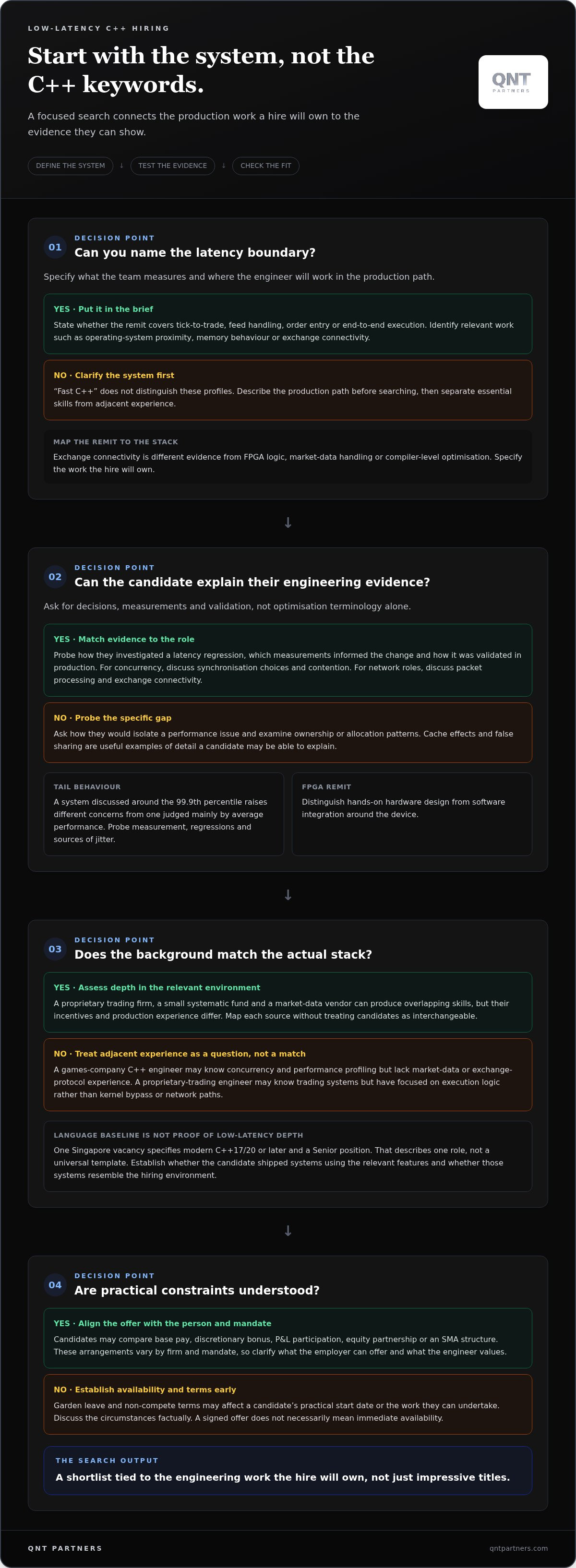
A low-latency search starts with the system, not a list of C++ keywords. Exchange connectivity calls for different evidence than FPGA logic, market-data handling or compiler-level optimisation. Specialist headhunters translate these distinctions into a candidate profile, then search for engineers whose experience matches the actual stack.
Start by separating essential skills from adjacent experience. A C++ engineer from a games company may understand concurrency and performance profiling but lack experience with market data or exchange protocols. A developer from a proprietary trading firm may know trading systems but have focused on execution logic rather than kernel bypass or network paths. The brief should specify the work the hire will own.
Clarify the latency boundary: is the team measuring tick-to-trade, feed handling, order entry or end-to-end execution? Does the engineer need to work close to the operating system, tune memory behaviour or build exchange connectivity? A brief that says “fast C++” cannot distinguish these profiles. Describing the production path can.
Latency claims also need context. A system discussed around the 99.9th percentile has different engineering concerns from one judged mainly by average performance. Headhunters can use that distinction to probe whether candidates have measured tail behaviour, tracked regressions and understood the source of jitter. The useful evidence is the candidate’s contribution, not a headline figure detached from its workload.
Assess the engineering evidence
Candidate assessment should focus on specific decisions and evidence. Ask how the engineer investigated a latency regression, which measurements informed the change and how the team validated it in production. A developer who can explain cache effects or false sharing offers stronger evidence than one who merely repeats optimisation terminology. For an FPGA role, distinguish hardware design from software integration around the device.
C++ versions help set a baseline, but they do not prove low-latency depth. A Singapore vacancy, for example, specifies modern C++17/20 or later and classifies the position as Senior. Those requirements describe one role, not a universal template. Recruiters should still establish whether the candidate has shipped systems using the relevant language features and whether those systems resemble the hiring team’s environment.
Interview design can reveal gaps before the final rounds. A short code discussion could examine ownership, allocation patterns or how the candidate would isolate a performance issue. For concurrent systems, ask about synchronisation choices and what conditions create contention. For network roles, discuss packet processing and exchange connectivity. The hiring team provides the technical depth; the recruiter keeps the evidence tied to the role.
Map the market and constraints
Market mapping is more useful when organised by source environment. A proprietary trading firm, a small systematic fund and a market-data vendor may produce engineers with overlapping skills but different incentives and production experience. Map these adjacent talent pools without treating every candidate as interchangeable. Team structure matters too: a pod-based firm may hire for a focused trading pod, while a proprietary trading firm may build shared infrastructure.
Availability requires a separate discussion. Garden leave and non-compete terms can affect a candidate’s practical start date or the work they can undertake, depending on their circumstances. Establish constraints early and discuss them factually rather than assuming a signed offer means immediate availability. For a spinout, this planning matters because engineering milestones may depend on a small number of specialist hires.
Compensation and role design also influence whether a candidate accepts. At trading firms, candidates may compare base pay, discretionary bonus, P&L participation, equity partnership or an SMA structure. These arrangements vary by firm and mandate. A recruiter’s role is to clarify what the employer can offer and what the engineer values, not to suggest that one structure suits everyone.
Use a focused process: define the system boundary, agree on the essential skills, then assess evidence against each requirement. C++ low latency developer headhunters are most useful when they can distinguish a genuine match with the stack from adjacent experience and explain the difference to both sides. The result is a shortlist based on the engineering work the hire will own, not just impressive titles.
QNT Partners: Quant Trading & Research Recruitment
QNT Partners supports trading teams hiring engineers with C++ systems expertise and an understanding of live quant environments. For a low-latency build-out, its Technology & Engineering Recruitment service focuses the search on the role’s technical remit, while Quant Trading & Research Recruitment helps align engineering hires with the team’s trading and research context.
These services are especially relevant when a new strategy, spinout or infrastructure project calls for a brief that general software recruitment may not capture. The search can also include AI & ML or Manager Search & SMA Sourcing when those needs sit alongside the engineering hire.
To discuss a search, contact QNT Partners.
Set the Search Around the System
Start by turning the engineering need into a clear hiring brief. Define what the new hire will own, which experience is essential and where adjacent backgrounds could fit. This gives interviewers a shared basis for assessing candidates and keeps the search focused as the build-out develops.
C++ low latency developer headhunters add value when they understand how an engineering remit connects to the trading and research environment. QNT Partners works across Trading & Research and Technology & Engineering recruitment, with AI & ML search for teams hiring in that area. Contact QNT Partners to discuss the role and the wider team’s needs.
If you’re shaping a search or planning an engineering hire, contact QNT Partners about hiring. A clear brief is a practical place to begin.