Algorithmic Trading Software Engineer Recruitment Agency Roles

The strongest match is rarely defined by C++ alone. An algorithmic trading software engineer recruitment agency helps trading firms assess how an engineer’s systems experience fits the work, from electronic execution to order routing. Employers often seek candidates who have developed trading algorithms or execution strategies, while engineers need a clear picture of the role’s technical demands and interview process.
That distinction matters. Low-latency engineering, production reliability and strategy-facing development can share a job title but require different evidence of competence. A strong recruitment process makes those differences clear before candidate introductions, rather than treating every systems engineer as interchangeable.
This article explains how specialist recruiters interpret a hiring brief, identify relevant experience and introduce candidates to employers. It also covers what to expect from technical assessments and interviews, and how to judge whether a role’s responsibilities align with the work you want to do. The aim is to give you a practical view of recruitment, not to suggest it bypasses technical scrutiny.
Key Takeaways
- Separate strategy-facing development from execution infrastructure before assessing whether a role fits your experience.
- Show evidence of trading algorithm or execution strategy work where the position calls for it, not only general C++ experience.
- For low-latency roles, be ready to discuss cache-friendliness, time complexity, CPU affinity and network protocols.
- Expect the interview and assessment process to vary by role, with technical evaluation focused on the systems and trading problems the team needs solved.
- Use a specialist recruiter when you need a clearer read on the mandate, employer structure or match between your skills and the team’s work.
Algorithmic trading software engineer recruitment agency
A specialist recruiter should translate a trading team’s technical brief into evidence the team can assess. “C++ engineer” is too broad for a search focused on order routing, execution workflows or low-latency systems. Start by establishing what the engineer will own: a trading application, exchange connectivity, strategy execution or production infrastructure. Each points to a different candidate profile.
Define the engineering mandate
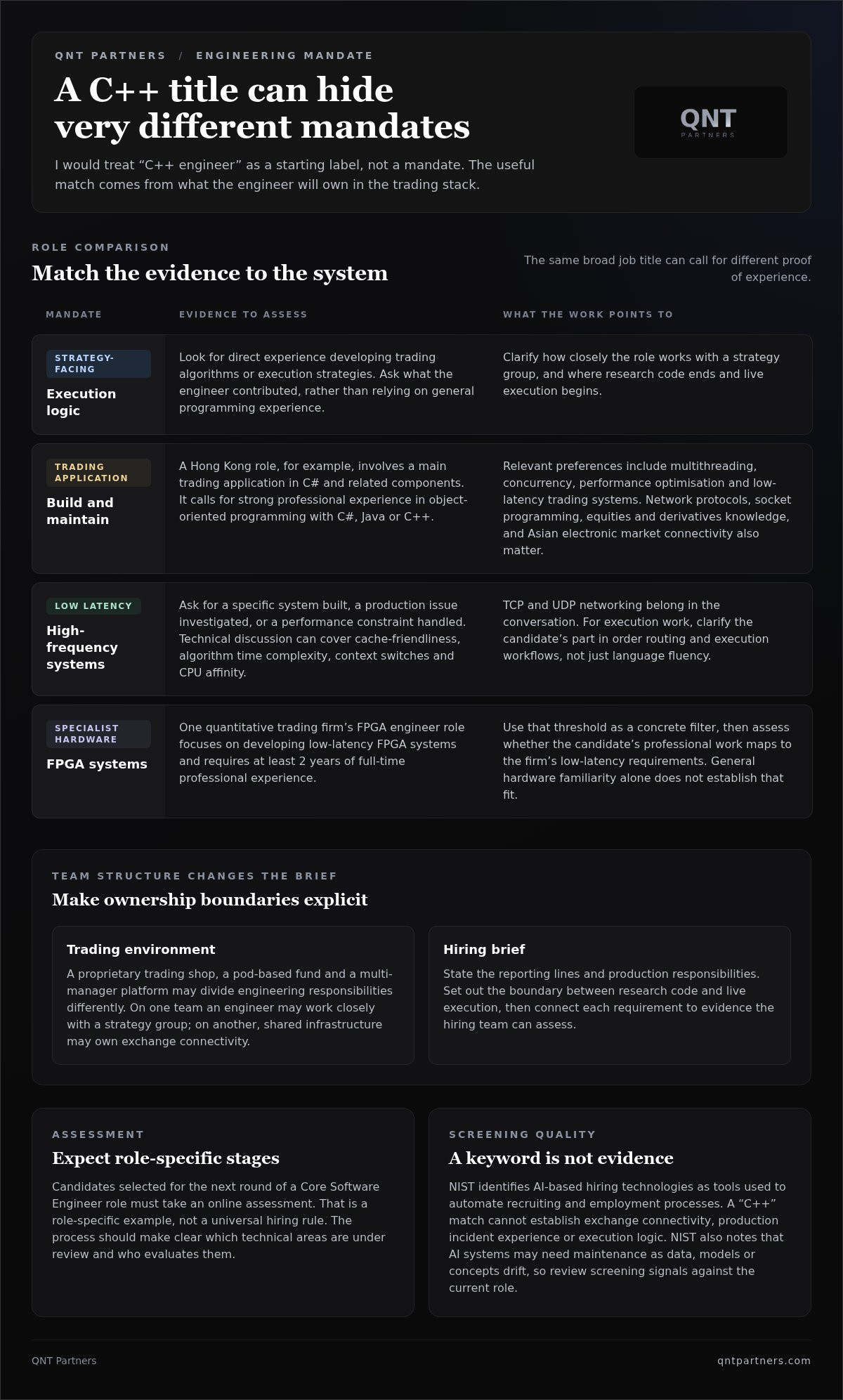
First, separate strategy-facing development from core trading infrastructure. A role building execution strategies calls for experience developing trading algorithms or execution logic. A role maintaining an electronic trading application may prioritise concurrency, reliability and production support. For example, a Hong Kong algorithmic trading developer role involves developing and maintaining a main trading application in C# and related components.
That Hong Kong role calls for strong professional experience with object-oriented programming in C#, Java or C++. It also prefers multithreading, concurrency, performance optimisation and low-latency trading systems experience. Network protocols, socket programming, knowledge of equities and derivatives, and Asian electronic market connectivity are relevant too. These criteria help distinguish direct experience from skills that are merely adjacent on a CV.
Match evidence to the system
For high-frequency trading, interview evidence needs to go beyond language fluency. Candidates should be ready to explain cache-friendliness, algorithm time complexity, context switches, CPU affinity, and TCP and UDP networking. An engineer might describe how a hot-path change affects memory access or how socket handling shapes execution behaviour. A recruiter can surface relevant examples before the hiring team spends time assessing a mismatched profile.
For FPGA work, the mandate is narrower still. A quantitative trading firm’s FPGA engineer role focuses on developing low-latency FPGA systems and requires at least 2 years of full-time professional experience. That threshold gives the search a concrete filter. Recruiters can then assess whether the candidate’s professional work maps to the firm’s low-latency requirements, rather than relying on general hardware familiarity.
System context matters as much as technology. A proprietary trading shop, a pod-based fund and a multi-manager platform may divide engineering responsibilities differently. An engineer might work closely with a strategy group on one team, while shared infrastructure owns exchange connectivity on another. The hiring brief should spell out reporting lines, production responsibilities and the boundary between research code and live execution.
Run a targeted search
Once the mandate is clear, a recruiter can compare it with candidate experience and test the match through specific examples. Useful evidence includes a system the candidate built, a production issue they investigated and a performance constraint they handled. For an execution role, ask how they contributed to order routing and execution workflows. For a strategy-facing role, clarify their part in developing algorithms or execution strategies.
The process should reflect the employer’s actual assessment. Candidates selected for the next round of a Core Software Engineer role must take an online assessment. That is a role-specific example, not a universal hiring rule. A recruiter should explain the stages, the technical areas under review and who evaluates each one, so candidates can prepare for the actual mandate.
Keep screening grounded
Automated hiring tools can influence how applications move through recruitment pipelines. The National Institute of Standards and Technology identifies AI-based hiring technologies as tools used across sectors to automate recruiting and employment processes. That makes human review important for specialist searches: a keyword match for “C++” cannot establish experience with exchange connectivity, production incidents or execution logic.
AI systems may require more frequent maintenance and corrective maintenance triggers because of data, model or concept drift, according to the National Institute of Standards and Technology (NIST). The practical hiring lesson is to keep assessment criteria tied to the current role. Recruiters and hiring teams should review whether screening signals still reflect the system, its workload and the engineering work involved.
For engineers, make the first conversation specific: clarify the system, the team’s ownership boundaries and the evidence the interview will test. For employers, a focused brief helps avoid mismatches between infrastructure specialists and strategy-facing developers. An algorithmic trading engineering search is most useful when each introduction connects demonstrated experience to a defined part of the trading stack.
QNT Partners: Quant Trading & Research Recruitment
QNT Partners works with trading firms hiring engineers for roles close to strategy, execution or core trading technology. Its Technology & Engineering Recruitment service fits searches that need to distinguish low-latency systems experience from broader software development. Quant Trading & Research Recruitment is relevant when engineering requirements intersect with research or trading workflows.
Involve QNT Partners when shaping a technical hire or considering a move into a trading environment. A focused discussion can clarify the role’s engineering scope, team structure and relevant experience. That context helps align candidate introductions with the work itself, rather than relying on a job title alone.
To discuss a search or a potential role, contact QNT Partners or visit qntpartners.com.
Make your next move deliberate
Start by defining the work you want to own. For an engineer, that means deciding whether to move towards strategy-facing development or focus more deeply on execution infrastructure. For a hiring lead, it means defining the engineering problem before opening a search. An algorithmic trading software engineer recruitment agency can help make that distinction useful in the hiring conversation.
QNT Partners’ AI & ML Specialist Search supports hiring mandates that require specialist machine-learning talent. The search starts with the work the team needs done, not a broad job title.
If you’re planning a search or considering a move into a trading team, contact QNT Partners to discuss the role or your experience. A clear brief gives the conversation somewhere practical to begin.