AI research recruitment for trading firms and the ML talent race

AI research recruitment for trading firms differs from conventional quant hiring. Strong candidates combine research depth with the engineering discipline to deploy models in production trading systems and the market understanding to identify useful problems. That combination makes role design and assessment as important as academic credentials.
Quant firms know how to assess statistical thinking, coding and evidence of alpha generation. The harder question is whether an ML researcher can work across the full path from model development to live trading, where data quality, latency and system constraints shape what can be deployed.
This article explains how the hiring bar differs, what trading firms can offer when competing with technology companies, and how to define research roles around the work a team needs done. It also examines the trade-offs between research-led and production-heavy positions, and why a generic quant brief can overlook strong AI candidates.
Key Takeaways
- Separate ML research requirements from standard quant criteria by defining how the role connects model development to production trading.
- Assess candidates on research depth, engineering execution and their ability to identify problems where machine learning can add value.
- Make infrastructure and the scope for meaningful research explicit when positioning a trading role against technology companies.
- Shape proprietary-firm roles around the actual research mandate, rather than relying on a generic AI or quant job description.
- Use specialist search support when a build-out requires candidates who can bridge machine learning and trading technology.
Competition for AI researchers between trading firms and technology companies
Trading firms compete with AI labs on more than salary. Researchers also weigh access to compute, research freedom and the problems they can work on. A finance role therefore needs a precise account of its research mandate, not a generic promise of performance-linked pay.
Finance compensation can also be substantial, but varies with seniority, strategy performance and firm economics. Market figures are not a standard range for every role.
AI research recruitment for trading firms calls for confidential executive search and careful compensation benchmarking. Separate guaranteed salary from discretionary bonus, equity or P&L participation, then compare roles with similar seniority and mandates. A researcher building execution models has a different remit from a scientist leading foundational machine-learning work. Discretion also matters when approaching employed researchers, particularly if a move could involve garden leave, non-competes or sensitive strategy information.
Technology employers can offer publication opportunities, open-source contributions and research problems beyond signal generation. Researchers also value strong infrastructure and career options across finance and technology. A hiring team should specify what the person can publish, which datasets they can use, and how research moves into production. If the role is limited to internal work, explain its intellectual scope and the team’s compute environment early. Those details help candidates compare a trading role with an AI lab’s research culture.
For US roles, visa sponsorship may be available, but it depends on the employer and candidate. Establish whether sponsorship is part of the hiring mandate before interviews begin, rather than assuming it is included.
AI research in trading carries data-integrity and market-impact risks. The U.S. Government Publishing Office notes that bad data can manipulate a learning algorithm, while algorithmic trading can have unpredictable consequences that create market volatility. Research reviews should therefore test data provenance, failure modes and controls before deployment.
For an application, prepare a concise portfolio with one or two projects. State the research question, data limits, validation method and production relevance. Include a publication or open-source contribution where available, and explain how you would adapt the method to market data. Keep proprietary results, confidential datasets and employer code out of your materials.
How is ML talent recruitment different from quant recruitment?
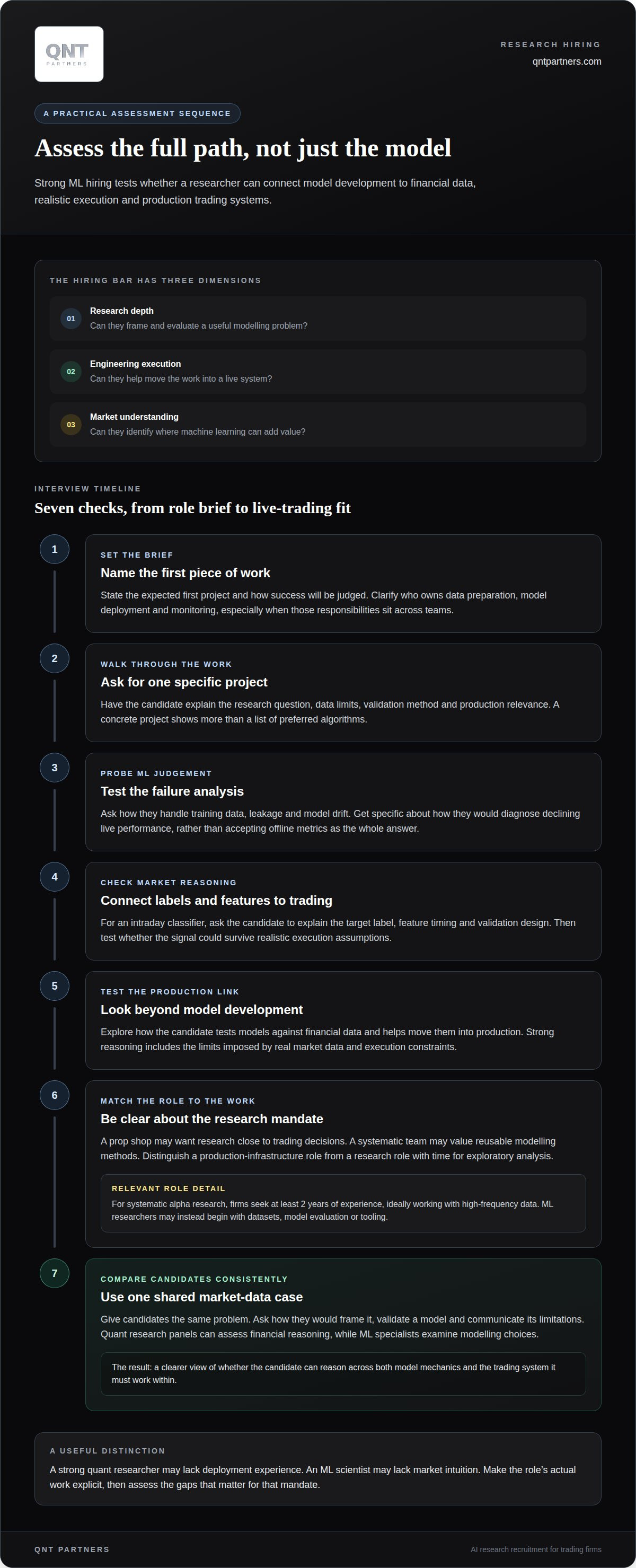
Traditional quant recruitment often starts with evidence of statistical judgment and alpha research. ML hiring adds another question: can the candidate develop a model, test it against financial data, then help move it into a production trading system? A strong quant researcher may lack deployment experience, while an ML scientist may lack market intuition.
That difference changes the interview. For quant research, discussion might focus on signal construction, sampling bias or a backtest’s assumptions. For machine-learning talent, add questions about training data, leakage, model drift and diagnosing declining live performance. Ask candidates to walk through a specific project, not simply describe their preferred algorithms.
Finance roles require theoretical research depth, engineering discipline and enough domain understanding to identify worthwhile problems. These requirements connect AI in quantitative analytics with research and trading: a model may improve analysis, but its value depends on how it performs with real market data and execution constraints. Test whether candidates can explain that link, not just report offline metrics.
Junior quant work can also differ from junior ML research. A systematic alpha research role seeks candidates with at least 2 years of experience, ideally working with high-frequency data. An ML researcher’s early work may instead centre on datasets, model evaluation or tooling. The hiring brief should make the expected first project explicit, including how success will be judged.
For example, a researcher building an intraday classifier should explain the target label, feature timing and validation design. A quant interviewer can probe whether the signal survives realistic execution assumptions. An ML interviewer can examine the training pipeline and failure analysis. Together, these checks show whether the candidate can reason across both model and market mechanics.
Role design matters as much as candidate screening. A prop shop may want research closely tied to trading decisions, while a systematic team may prioritise reusable modelling methods. State who owns data preparation, model deployment and monitoring. If responsibilities are split across teams, explain how they work together before asking candidates to assess the role.
Recruitment should distinguish research depth from inflated titles. A machine-learning engineer who builds production infrastructure may not want a scientist role dominated by exploratory analysis. Conversely, a researcher with a strong publication record may expect time to investigate methods before production handover. Match the actual work to the candidate’s experience, then assess gaps directly.
Use a structured evaluation with one shared case and role-specific follow-ups. Give candidates the same market-data problem, then ask how they would frame it, validate a model and communicate limitations. Quant research panels can assess financial reasoning; ML specialists can test modelling choices. This format makes candidates easier to compare without treating the disciplines as interchangeable.
AI researcher roles at proprietary trading firms
At a proprietary trading firm, an AI researcher’s work is usually tied to the firm’s own trading capital and systems. The mandate might involve finding features in order-book data, improving execution decisions or building models that help traders assess changing market conditions. Each role should identify its research owner and the system or decision the work is intended to affect.
Hedge funds often organise research around a strategy or portfolio, while proprietary firms can connect research more directly to internal trading desks. Market makers may focus AI work on quoting, inventory management or execution, where exchange connectivity and tick-to-trade latency shape deployment. These differences change the research question, the collaborators and the evidence needed to assess progress.
Job titles alone do not tell candidates whether a role is research-led or primarily engineering. A practical specification names the data, research workflow and production boundary. For example, does the researcher hand a validated model to a trading engineer, or own its implementation and monitoring? That distinction affects the profile required, especially if the team expects FPGA or low-latency systems knowledge.
Infrastructure can also define the role’s reach. XTX Markets listed a GPU cluster with 25,000 GPUs and 650 petabytes of usable storage. That scale illustrates why an AI researcher may need to understand compute allocation, data pipelines and experiment design, not only model architecture. Smaller proprietary teams should describe their actual environment and constraints, rather than imply they can reproduce a large technology lab.
The research mandate should explain how learning becomes a trading strategy. A candidate investigating sequential models, for instance, needs to know whether the team can test at the required market-data resolution and how results are reviewed. Separate research prototypes from live decision systems. That boundary clarifies risk ownership and prevents a promising offline result from being treated as production-ready.
Compensation and progression depend on how the role contributes to the business. A firm may link rewards to individual or team performance, while an equity partnership offers a different relationship to the business. Explain the structure alongside reporting lines and access to traders. Candidates can then assess whether becoming a research lead means managing people, setting a technical agenda or taking responsibility for deployment.
For a new build-out, define the first research problem before opening the search. A concise brief can state the market, data source, intended user and production owner. It should distinguish a scientist developing new methods from an engineer scaling existing models. That precision helps a proprietary firm reach candidates interested in the actual remit, not a generic AI title.
Recruiting talent for AI-driven financial sciences
AI hiring works best when the search starts with a research problem, not a fashionable title. A trading team should define whether the role develops prediction models, improves portfolio analysis or builds methods for market data. That decision sets the required mix of machine-learning depth, finance knowledge and production experience.
Current hiring profiles show how much the mandate can vary. A team-building opportunity in New York and Shanghai seeks at least 2 years of high-to-mid-frequency research experience, ideally on the buy side, alongside at least 2 years of machine-learning or deep-learning research or engineering experience. That combination points to a hybrid profile, not a conventional data scientist.
Senior appointments can require a different search. A quantitative research role in Abu Dhabi seeks more than 15 years of experience across quantitative research, data science and AI or machine learning, mostly in finance. For this level, assess whether the candidate has shaped research agendas and built teams, not only delivered individual models.
Start the recruitment brief by mapping the work to its owners. Identify who supplies datasets, who defines the research question and who moves a validated model towards deployment. For example, a prediction model based on order-book features needs clear ownership of timestamp alignment and evaluation. If research and engineering share those responsibilities, state where the handover happens.
Then separate essential criteria from transferable experience. One candidate may have deep-learning research experience but limited exposure to markets; another may know high-frequency data but have little experience developing modern ML methods. A structured interview can test both sides through a case study, such as designing a validation approach for an intraday prediction task.
Keep assessment tied to the role’s actual structure. Ask researchers to explain the assumptions behind their methods and how they would investigate a model that weakens out of sample. Ask engineering-led candidates how they version data and reproduce experiments. These examples reveal working habits more clearly than a list of frameworks on a CV.
Hiring across New York, Shanghai and Abu Dhabi also means aligning the search around one consistent mandate. The same title can describe a hands-on researcher, a technical lead or a senior research manager. Specify reporting lines, decision rights and the first research objective before approaching candidates. That clarity helps distinguish genuine fit from a strong CV for a different job.
For a new AI build-out, talent strategy should account for the whole research lifecycle, from data access to model review and deployment. A team seeking a senior hire may prioritise leadership and research direction; a team with an established lead may need a specialist to advance a defined method. Make that distinction early to focus the candidate pool.
What qualifications and skills do trading firms require for AI research roles?
Trading firms need AI researchers who can connect research methods to decisions made with financial data. Strong candidates show theoretical depth, engineering discipline and enough market understanding to choose worthwhile problems. A qualification matters when it demonstrates those capabilities, not simply because it appears on a CV.
Academic work can demonstrate research rigour, especially when candidates explain the question, assumptions and limits behind a result. A PhD may be relevant for a role focused on new methods, but it should not replace evidence of practical judgment. Ask candidates to walk through a project, from hypothesis and dataset construction to validation and interpretation.
For systematic alpha research, roles seek candidates with at least 2 years of experience, ideally working with high-frequency data. That background helps researchers reason about timestamp alignment, changing market conditions and the risks of leakage. A candidate without direct trading experience can still demonstrate relevant skill through careful work on sequential or event-based data.
Technical assessment should test the full research workflow. Ask how a candidate would establish a baseline, choose a validation scheme and investigate a result that weakens out of sample. For example, strong offline metrics may reflect label leakage or an unrepresentative split. The candidate should identify those failure modes and explain the next step in their analysis.
Production engineering is another essential dimension. Researchers should understand how code quality, reproducibility and data lineage affect a model’s path into a live system. For a role close to execution, probe their understanding of latency constraints and the handover between research code and production infrastructure. FPGA experience may matter for a specific low-latency mandate, but it should not be a default requirement for every AI role.
Domain understanding distinguishes useful financial research from technically sophisticated work with no clear trading application. Ask candidates why a proposed feature could contain predictive information, what market behaviour might invalidate it, and how they would monitor that change. They need not arrive with a finished strategy; they should frame testable questions grounded in the trading problem.
Structure interviews around the role’s actual balance of research and implementation. A research-led role should test experimental design and methodological judgment. An engineering-heavy role should test data pipelines, reproducibility and deployment decisions. A shared case study can show how candidates communicate assumptions and respond to critique, while role-specific follow-ups clarify their strongest contribution.
Before screening begins, define essential skills separately from preferences. This helps the team avoid rejecting a strong researcher for lacking an irrelevant tool or hiring a capable modeller who cannot meet the production mandate. Link each requirement to a task the researcher will actually own.
QNT Partners: Quant Trading & Research Recruitment
QNT Partners supports trading firms hiring AI researchers when the mandate spans machine learning, quant research and production technology. We conduct AI & ML Specialist Search alongside Quant Trading & Research Recruitment, defining the profile around the research problem and team structure.
For a build-out that also needs research leadership or specialist trading technology, Manager Search & SMA Sourcing and Technology & Engineering Recruitment address those adjacent requirements. The right search depends on whether the gap is a senior research lead, an individual contributor or someone connecting model development with trading systems.
If you’re shaping an AI research hire or planning a team build-out, contact QNT Partners to discuss the search.
Turn the research agenda into a hiring plan
The next step is to define what the hire will own, how research moves into production and where the team needs capability today. Effective AI research recruitment for trading firms starts with those operational details, not a broad job title. This gives candidates a clearer view of the work and helps the hiring team assess fit against the actual mandate.
Before opening a search, align decision-makers on the role’s research scope, reporting line and first deliverable. That clarity matters during a build-out, when the mandate can shift between research leadership and hands-on model development. A well-defined brief makes conversations more useful for everyone involved.
If you’re ready to shape the role or discuss a live search, discuss your AI research hiring with QNT Partners. A clear mandate is a strong place to start.
Frequently Asked Questions
What ML and AI roles do you place in finance?
We place ML engineers, deep-learning researchers and AI research scientists, alongside quantitative researchers, traders and portfolio managers. The right profile depends on whether the team needs someone to advance modelling methods or build technical capability for financial applications. QNT Partners operates as a recruitment intermediary; the hiring organisation alone determines candidate suitability and makes employment decisions.
What is ML and AI executive search in finance?
AI and ML executive search identifies and assesses specialists for research and leadership roles in financial firms. The search starts by clarifying the mandate, such as leading a research team or adding a senior scientist to an established group. Assessment connects a candidate’s work to the firm’s objectives, technical environment and reporting structure, rather than relying on job titles alone.
Why do hedge funds struggle to hire ML researchers?
Hedge funds can lose candidates when a role’s remit is unclear or combines incompatible expectations. A researcher approached to develop new methods may decline if the position mainly involves maintaining existing systems. Hiring teams should distinguish the research agenda from implementation duties, explain who sets priorities and identify how work is evaluated. That detail helps candidates judge whether the role matches their strengths.
What are typical salaries and bonuses for AI researchers at trading firms?
Compensation depends on seniority, location, role scope and the balance between base pay and variable rewards. Base salary and total compensation are different measures.
How can candidates find AI research openings at trading firms?
Use specialist search support to identify trading-firm roles, and establish whether visa sponsorship is part of the hiring mandate before interviews begin.