AI driven trading talent search for quantitative firms

The first decision in an AI driven trading talent search is whether the work calls for a dedicated AI engineer or stronger AI capability within an existing role. Hire for a dedicated engineering position when someone must build and own production systems. Develop skills within an existing quant or trading role when AI will extend that person’s current research or desk responsibilities. The distinction is about ownership of the build, not simply whether AI appears in the job description.
That distinction matters: a broad brief can attract technically capable candidates who do not fit the desk’s actual needs. Start with the business problem, then define the systems, data and collaboration the role will own. This article explains how to decide between hiring and upskilling, shape a research-led search, assess candidates against trading requirements and structure an offer. It also covers when specialist recruitment can help, particularly for roles spanning quantitative research, machine learning and production engineering.
Key Takeaways
- Separate roles that build and own AI systems from existing quant or trading positions where AI is an added capability.
- Define the trading problem, data access and deployment ownership before writing the role brief.
- Assess candidates on how their technical work fits the desk’s research process and production constraints, not on model knowledge alone.
- Map talent around the capabilities the build requires, then keep assessment criteria and offer discussions consistent throughout the search.
- Account for the firm’s market structure, technical environment and candidate’s current obligations when planning the search and closing process.
AI, machine learning and agentic AI talent search
For a trading desk, an effective AI search reflects the system candidates must build or operate. Separate sourcing automation from the technical judgement needed to assess research, deployment and market constraints.
Useful platforms search structured profiles and public work against role-specific criteria, while leaving room for recruiter review. For a trading firm, test whether a search can distinguish production ML engineering from generative modelling or quantitative research.
AI Sourcing Agents and Candidate Search
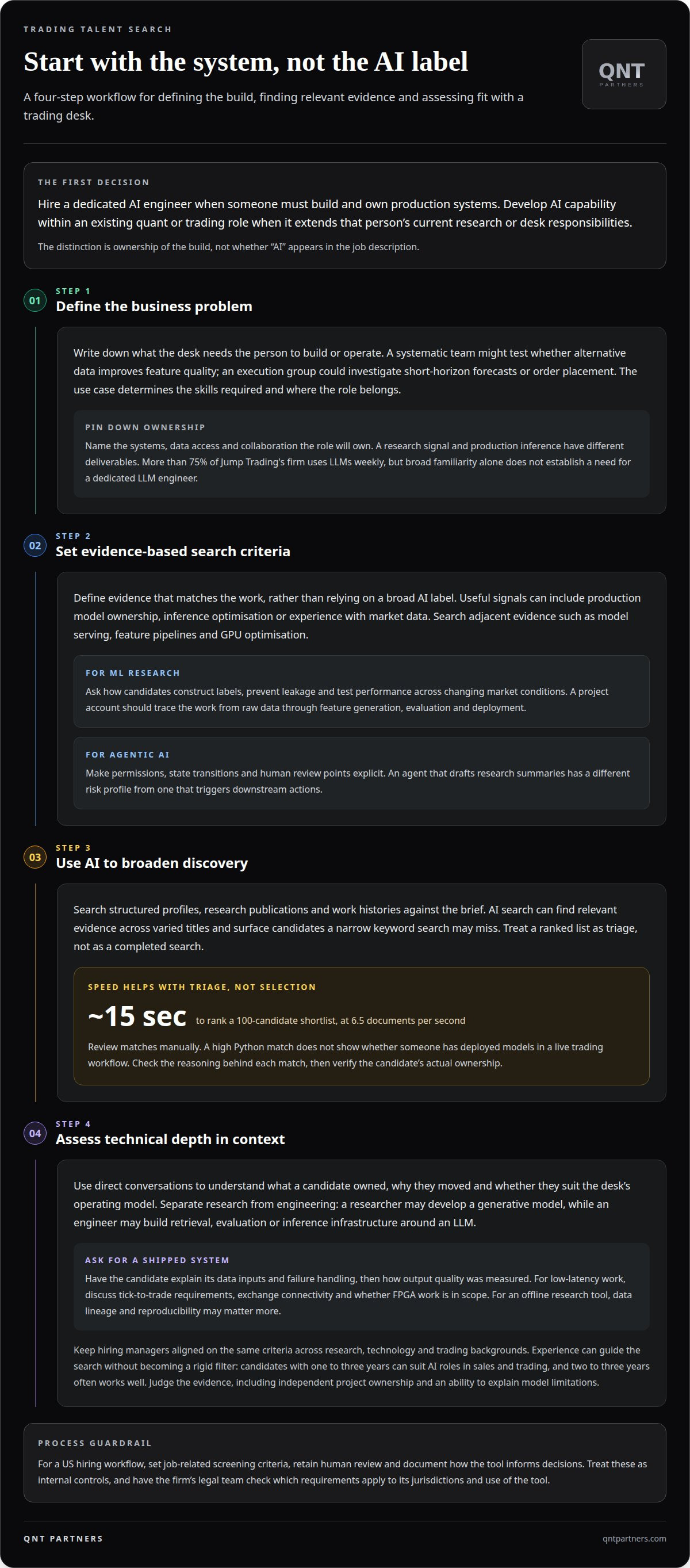
AI sourcing agents can scan profiles, research publications and work histories against a defined skills brief. Start by identifying the evidence required, such as production model ownership, inference optimisation or experience with market data. Then review matches manually. A system may rank someone highly for Python without revealing whether they have deployed models in a live trading workflow.
Some tools can process documents quickly: ranking a 100-candidate shortlist takes around 15 seconds at 6.5 documents per second. That speed helps with triage, not final selection. Use an agent to surface overlooked candidates, then check the reasoning behind each match. Search terms should include adjacent evidence, such as model serving, feature pipelines and GPU optimisation.
For LLM agents and generative modelling, distinguish research from engineering. A researcher may develop a generative model; an engineer may build retrieval, evaluation or inference infrastructure around an LLM. Ask candidates to describe a system they shipped, including its data inputs, failure handling and how they measured output quality.
Agentic AI introduces another distinction: the system can select tools and take actions across a workflow. In trading, assess whether a candidate can define permissions, state transitions and human review points. An agent that drafts research summaries has a different risk profile from one that triggers downstream actions. Make that boundary explicit in the role brief.
AI Search Compared with Traditional Recruiting
AI search can broaden the initial pool by matching skills across varied titles and profiles. Recruiters and headhunters add context: why someone moved, what they owned and whether they are open to the desk’s operating model. A stronger process combines automated discovery with direct conversations instead of treating a ranked list as a completed search.
For trading firms, compare candidates on evidence, not platform claims. Use search to identify candidates with model deployment experience, then assess their work against the desk’s data and production stack. Hiring managers can apply the same criteria in interviews, keeping technical assessments consistent across research, technology and trading backgrounds.
Experience can guide a search without becoming a rigid filter. For AI roles in sales and trading, candidates with one to three years of experience can be suitable; two to three years often works well. Judge the evidence behind that experience, including independent project ownership and the ability to explain model limitations.
For a US hiring workflow, set job-related screening criteria, retain human review and document how the tool informs decisions. Treat these as internal process controls, and have the firm’s legal team identify which requirements apply to its jurisdictions and use of the tool.
A practical workflow has four steps: define the business problem, set evidence-based search criteria, use AI to broaden discovery, then have specialists assess technical depth. For example, a firm hiring for LLM infrastructure should distinguish model research from platform ownership. This keeps the search aligned with the actual build rather than a generic AI label.
Artificial intelligence and machine-learning engineering
AI engineering hires should own a defined part of the trading system, not simply add an AI label to an existing team. The distinction matters: a researcher developing signals has different deliverables from an engineer responsible for production inference.
Trading desks use machine learning at different points in the research and execution pipeline. A systematic team might test whether alternative data improves feature quality, while an execution group could investigate short-horizon forecasts or order placement. The use case determines the skills required and where the role belongs.
More than 75% of Jump Trading's firm uses LLMs weekly. That figure points to broad familiarity, not proof that every desk needs a dedicated LLM engineer. Hiring should follow a specific build requirement, such as model serving, internal research tooling or integration with existing data platforms.
Machine-learning research for trading involves more than selecting an architecture. Candidates should explain how they construct labels, prevent leakage and test performance across changing market conditions. Ask them to trace a project from raw data through feature generation, evaluation and deployment. Their account should distinguish a research result from a contribution to a live strategy.
Engineers building trading systems need to understand the constraints of the component they own. A model deployed in a research platform may tolerate different inference times from one on an execution path. For a low-latency role, discuss tick-to-trade requirements, exchange connectivity and whether FPGA work is in scope. For an offline research tool, data lineage and reproducibility may matter more.
What skills and qualifications are most in demand for trading jobs? The answer depends on the role: quantitative research calls for statistical modelling and disciplined testing, while AI engineering requires software design, model deployment and data pipeline experience. A PhD can support research depth, but candidates still need to show how their work translates into the desk’s actual workflow.
Career fit also depends on ownership. An AI engineer joining a pod shop may work closely with a PM and a small research group; at a prop shop, the remit may span shared infrastructure. Ask candidates how they handled model monitoring, data failures and rollback decisions. Those details show whether they built a prototype or operated a system.
For a hiring brief, specify the user, input data, output and operational boundary. An internal LLM assistant that retrieves research notes, for example, needs different controls from a model that influences order decisions. Define how the role interfaces with researchers and engineers, then make system ownership explicit. Candidates can assess the opportunity accurately, and interviews can test the work they would actually do.
That precision also distinguishes AI capability from general software hiring. A team seeking model research needs evidence of experimental design; one building production infrastructure needs code quality and deployment judgement. Keep those requirements separate, or the shortlist may favour candidates whose strengths do not match the system’s critical path.
Search diagnosis, talent mapping, assessment and offer management
A search becomes manageable once the desk defines ownership, the candidate profile and the decision process. Whether hiring a PM, researcher or technology lead, diagnose the gap before mapping candidates.
Candidate Assessment and Offer Management
Assess quantitative portfolio managers and researchers by the work they owned, not their titles. For a PM, examine portfolio construction, risk decisions and the resources behind reported performance. For a researcher, trace a strategy from hypothesis through validation and implementation. Assess technology candidates separately, focusing on infrastructure ownership, reliability and collaboration with the desk.
Offer discussions should start with the candidate’s priorities and current constraints. Clarify the mandate, reporting line, decision authority and expected interaction with the PM. Then discuss compensation structure, including P&L participation, equity partnership or an SMA arrangement where relevant. Garden leave and non-competes can affect a start date, so account for them early.
Risk arises when an AI ranking system treats historical hiring patterns as a definition of merit. It may favour familiar employers, titles or career paths while overlooking relevant work under different labels. Compare recommendations with role-specific criteria, retain human review and record why candidates progress or leave the process. This creates a clearer audit trail for each decision.
AI-Powered Search Process
Build the process around a sequence: diagnose the business gap, define the role, map relevant talent, assess evidence and manage offers. A Chicago prop shop seeking a researcher may prioritise signal development, while a technology team may need production ownership. The search brief should specify the desk, system boundary, data context and interview evidence required.
Talent mapping identifies adjacent candidate pools rather than relying on job-title matches. A quantitative researcher with model deployment experience, for example, may suit an applied AI role better than someone whose profile only lists machine learning. A technology recruiting firm should manage the search using calibrated criteria, clear candidate communication and consistent interviewer feedback.
Fully managed recruiting services can coordinate the process from role diagnosis through offer discussions. The key question is ownership: who maintains the map, presents candidate evidence, gathers feedback and keeps the hiring sequence moving? Agreeing responsibilities helps prevent gaps between a PM’s assessment and technology leadership’s review.
Recruiting Costs and Effectiveness
AI tool pricing and recruiter costs in the United States depend on scope, licensing, integration needs and search complexity. The price depends on the case and is given after a quote request; cost factors include role seniority, market coverage, assessment requirements and delivery scope.
Measure effectiveness through evidence at each stage, not shortlist volume alone. Track whether mapped candidates meet the agreed criteria, reach technical assessment and remain engaged through the offer. For a researcher search, review the quality of strategy discussions; for an infrastructure hire, examine relevant system ownership. Compare the results with the original brief and adjust weak criteria.
A useful review separates sourcing performance from hiring decisions. If candidates meet the technical bar but decline, examine the mandate, interview experience and offer structure. If they do not pass assessment, refine the evidence required during mapping. This feedback loop gives the next search a clearer target.
Data-led, research-driven talent search
A useful talent map starts with the trading problem, not a list of familiar employers. Define the desk, market and work to be owned, then identify evidence of relevant capability. A systematic equity team hiring for feature research needs a different map from an execution group seeking exchange-connectivity expertise.
Build the search brief around the actual work. Specify the business problem, intended build, available data and technology, and how the firm will assess impact. For example, a market-making desk developing an ML signal should clarify whether the hire will research features, productionise models or do both. That distinction determines which candidates belong in the search.
Research the market by skills and ownership, not just title. A candidate may describe relevant work as applied research, data science or platform engineering. Map evidence such as feature pipelines, inference services, model monitoring or research tooling. Record where each candidate developed that work and how closely it matches the desk’s stack.
- Define the target. Record the desk, market, technical problem and role ownership. Separate essential requirements from skills that can be learned after joining.
- Build adjacent pools. For a model-serving role, include engineers from research platforms and production ML teams, not only candidates with “AI” in their titles.
- Assess evidence. Capture each candidate’s contribution, system context and measurable outcome. Distinguish an individual build from work delivered by a larger team.
- Refine the map. Compare interview evidence with the brief. If candidates lack deployment experience, adjust the search towards engineers who owned production systems.
Candidate data needs context. A profile showing PyTorch or distributed computing does not prove ownership of a live service. Record the project, production setting and candidate’s specific decisions. For a researcher, that could mean documenting how they validated a signal; for an engineer, tracing model deployment and incident response.
AI candidates also assess the firm’s environment. They may ask about data quality, compute access, software platforms, deployment processes, market-data access and model governance. A data-led search should capture these details accurately and present them consistently. For example, explain who owns a research platform and how a new model reaches production.
Measure search quality against the original brief, not the number of profiles found. Review whether mapped candidates pass technical assessment, whether interview feedback identifies the same strengths and where the process loses relevant people. If strong candidates repeatedly lack access to production systems, clarify infrastructure ownership or reconsider the target profile.
Research-led hiring improves when decisions are documented. Keep the criteria, candidate evidence and interview outcomes connected. When a desk changes the build, update the map rather than carrying forward stale assumptions. A search for an execution model engineer should reflect the system’s real boundary, from research hand-off through deployment and monitoring.
Technology recruiting for quantitative hedge funds and proprietary trading firms
Technology hiring at a quantitative firm depends on who owns the work and who uses it. A pod shop may place an engineer close to a portfolio manager, while a prop shop may centralise technology across trading teams. These structures change reporting lines, priorities and how candidates assess the remit. Make the operating model explicit in the recruitment process.
Consider a systematic fund building a research platform for several strategy teams. Its hire may need to translate researchers’ workflows into shared software, resolve competing requirements and maintain clear ownership boundaries. A spinout with a smaller team may instead need someone comfortable setting technical direction alongside a founding trader. Similar titles can conceal very different expectations.
Compensation and authority also affect candidate fit. A role tied to a pod’s performance may offer different incentives from a central technology position. A firm with P&L participation, an equity partnership or an SMA structure should explain how the hire’s responsibilities relate to those arrangements. Candidates need to understand what they can influence, who sets priorities and how success is judged.
Design interviews around the structure. For a shared platform role, include users from more than one research team and ask candidates to discuss conflicting requirements. For a hire embedded with a PM, assess how they handle changing priorities and communicate technical trade-offs. Focus the evaluation on decisions relevant to the mandate rather than applying a generic engineering interview.
Candidate motivation deserves equal attention. An engineer leaving a large platform team may value broader ownership at a smaller fund. Someone from a lean prop shop may prefer a defined remit and established colleagues. Discuss decision rights, team interfaces and the balance between new development and ongoing support before making an offer.
Recruitment also needs to account for movement constraints. Garden leave can affect a candidate’s availability, and non-competes may influence which roles they can consider. Treat each situation individually and align the hiring process with the candidate’s circumstances. Avoid promising a start date before understanding the relevant constraints.
For a firm hiring across research and technology, clarify who owns each decision. A PM can assess the working relationship, while a technology lead evaluates engineering judgement. Agree how their feedback will be reconciled before interviews begin. This helps prevent candidates from hearing inconsistent accounts of the role from different interviewers.
The practical takeaway is to recruit for the firm’s operating model, not a generic technology label. A platform engineer joining a multi-team buildout needs a different mandate from an early technical hire at a spinout. Set the reporting line, decision authority and incentive structure in the brief. Candidates can then judge the work and organisation they would actually join.
QNT Partners: Quant Trading & Research Recruitment
QNT Partners supports quantitative firms with searches spanning trading, research and technical ownership. Trading & Research and AI & ML searches can help define the role and identify candidates whose experience matches the desk’s requirements. For a build involving model deployment or trading infrastructure, Technology & Engineering is also relevant.
Turn to QNT Partners when the hiring brief needs sharper definition, the candidate pool crosses specialist disciplines, or interview feedback needs a consistent framework. Talent Strategy Advisory can support decisions about whether to hire externally or develop capability within existing roles. The focus is a search grounded in the firm’s mandate, systems and team structure.
Contact QNT Partners to discuss the role and search approach.
Give the role a clear mandate
The next step is to make the hiring decision practical. Decide what the new hire will own, which teams they will work with and what must change in the trading workflow. A well-scoped mandate gives candidates a concrete view of the work and interviewers a shared basis for evaluating fit.
An AI driven trading talent search is strongest when its brief reflects the mandate, not an abstract demand for AI capability. If the role is still taking shape, clarify whether the immediate need is research capacity, production engineering or a bridge between the two. That distinction can shape the search.
QNT Partners works with quantitative firms on specialist trading, technology and AI hiring. Contact QNT Partners about your search to discuss the role and the hiring approach.
A clear remit gives the search a sound starting point and candidates a reason to engage.
Frequently Asked Questions
Do finance firms need an AI engineer or AI skills within existing roles?
Hire a dedicated AI engineer when the firm needs someone to own engineering work across a system or platform. Developing skills within an existing role can suit a quant or trader who will use AI as part of established responsibilities, without owning a separate production build. A research team experimenting with internal coding assistants, for example, may need different staffing from a team building a model-serving platform.
What does AI-driven trading talent search mean?
An AI driven trading talent search uses AI-assisted discovery to find and organise candidates against a defined trading or technology brief. For example, it can surface engineers with model-serving experience even if their job titles omit “AI”. The result is a set of candidates for human review, not a verdict on suitability. The hiring team still needs to examine evidence, context and each candidate’s actual contribution.
Which AI tools help firms source and screen trading talent?
Useful tool categories include sourcing agents that search candidate profiles, systems that parse CVs and recruiting platforms that organise candidate records. Choose capabilities to match the task: finding adjacent experience, structuring application data or helping reviewers compare evidence against role criteria. For a trading technology role, a tool should help identify relevant system ownership, not just rank profiles by keywords such as “Python” or “machine learning”.
How do AI recruiting platforms assess traders and quantitative candidates?
Platforms can organise application evidence against defined criteria, but a CV alone cannot establish trading judgement. Use them to flag relevant experience, then assess candidates through structured discussions and role-specific exercises. For a researcher, examine how they formed and tested a hypothesis. For a trader, probe decision-making within the strategy’s constraints. Keep human judgement central when interpreting performance and contribution.