Trading Systems Engineer Talent Acquisition: A Practical Hiring Guide

The right trading systems engineer is defined by what they can own, not by the number of languages on a CV. Trading systems engineer talent acquisition starts with the desk’s engineering gap and the production responsibility attached to it.
A job title won’t tell candidates whether the work centres on a new build, an existing system or a specific trading team. A standard interview may not show how they reason through real engineering constraints, either.
This guide explains how to shape the mandate, assess relevant judgement and run a discreet search that fits your firm. Start by defining the ownership boundary. It gives candidates a clearer picture of the role before either side commits time to the process.
Key Takeaways
- Trading systems engineer talent acquisition should begin with the system the hire will own, then define the mandate around the firm’s structure.
- Build a scorecard that separates production engineering judgement from language familiarity and puzzle performance.
- Compare how ownership, interfaces and decision-making differ across prop shops, pod shops and multi-managers before shaping the candidate proposition.
- Agree confidentiality boundaries and a clear hiring sequence before approaching candidates or sharing firm details.
- Use internal sourcing when the mandate is clear. Consider a specialist partner when trading context or discreet access to the relevant candidate pool is harder to establish.
Define the trading systems engineer role around system ownership
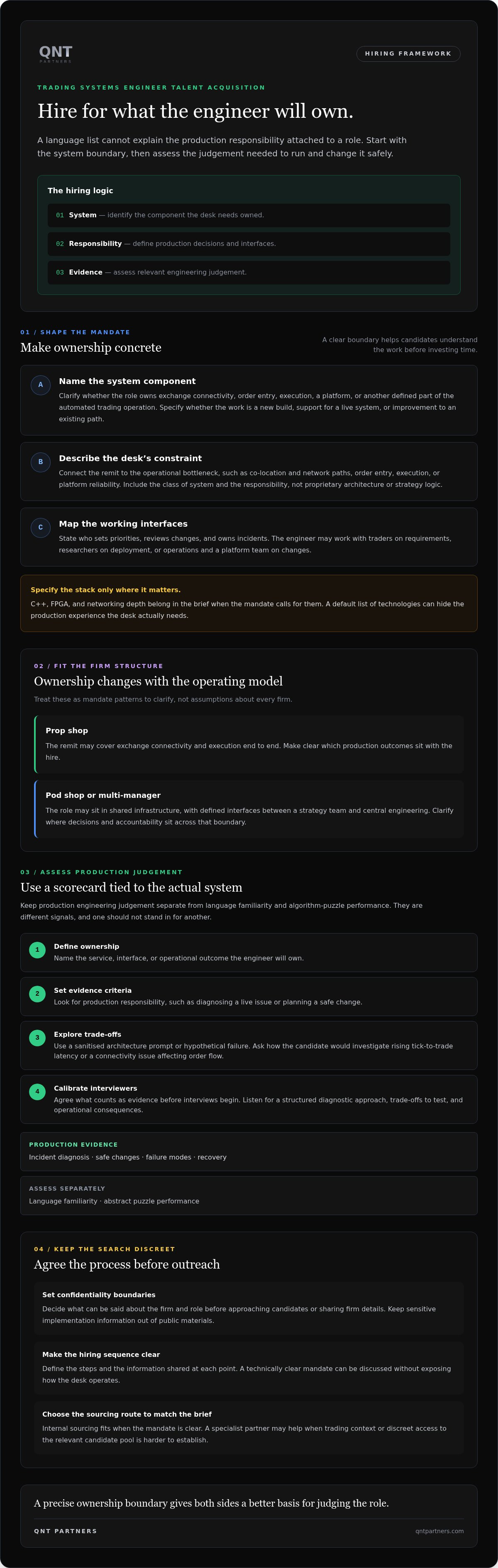
Define the role by system ownership, not by a language checklist. A prop shop may need an engineer to own exchange connectivity and execution end to end. In a pod shop or multi-manager, the remit may sit within shared infrastructure, with clear interfaces between a strategy team and central engineering. Establish the firm’s structure and the mandate first. Otherwise, the brief may list a stack without explaining what the hire is accountable for.
Map that accountability to the desk’s actual constraint: co-location and network paths, order entry, execution or platform reliability. Algorithmic trading provides broad context, but the role brief should identify which part of the automated trading operation the engineer will own. That distinction also helps position the search within HFT infrastructure recruitment, rather than treating every systems role as a general software hire.
Turn the desk’s bottleneck into a role brief
Start with the component limiting the desk and why it matters operationally. Is the hire expected to build a new execution service, support a live platform or improve an existing path without disrupting production? These are different mandates, and each calls for different evidence from candidates.
Next, define the working interfaces. A systems engineer might take requirements from traders, collaborate with researchers on deployment or coordinate changes with operations and an existing platform team. Be specific about who sets priorities, reviews changes and owns incidents. Candidates can then assess the actual remit instead of trying to infer it from a list of technologies.
Distinguish trading systems work from general software engineering
Trading systems work is shaped by production constraints. An engineer responsible for exchange connectivity may need to reason about message handling, failure modes and recovery. A role focused on co-location or execution may require experience measuring tick-to-trade latency and tracing where time is spent. A platform reliability role may place more weight on safe releases and clear operational ownership.
Specify C++, FPGA or networking depth only when the mandate calls for it. Listing all three by default can obscure the actual work and screen out engineers whose production experience better matches the system component the desk needs. Assess how candidates investigate trade-offs and manage change in a live environment, rather than whether they can recite a preferred toolset.
Keep public materials focused on the mandate and responsibilities. Describe the class of system and its interfaces, but leave proprietary architecture, strategy logic and sensitive implementation details out of the brief. Trading systems engineer talent acquisition is more precise when the role is technically clear without exposing how the desk operates.
Build a technical scorecard for trading systems engineer talent acquisition
A useful scorecard measures whether someone can own the system in production, not whether they can recite language features or solve an abstract puzzle quickly. For Trading systems engineer talent acquisition, use a consistent sequence: define the ownership boundary, specify evidence for each responsibility, assess trade-offs through relevant scenarios, then calibrate interviewers against the same criteria.
- Define ownership: State which service, interface or operational outcome sits with the hire.
- Set evidence criteria: Identify examples that demonstrate production responsibility, such as diagnosing a live issue or planning a safe change.
- Assess trade-offs: Explore how candidates reason about competing requirements, rather than whether they guess a preferred answer.
- Calibrate interviewers: Agree what counts as evidence before interviews begin.
Make sure the assessment criteria match the real constraints of the system the engineer will own.
Score production judgement separately from language familiarity and algorithm-puzzle performance. A candidate may know C++ well but have limited experience tracing a production failure. Another may show strong operational judgement while using a different toolset. Keep those signals distinct so one doesn’t stand in for the other. The U.S. Bureau of Labor Statistics overview of financial specialist occupations offers broad industry context, but it isn’t a technical assessment template for trading systems engineers.
Assess decisions without exposing sensitive systems
Use a sanitised architecture prompt or hypothetical failure scenario based on the type of responsibility, not your firm’s design. For example, ask how a candidate would investigate a rise in tick-to-trade latency or reason through a connectivity issue affecting order flow. Listen for a structured diagnostic approach, the trade-offs they would test and the operational consequences they would consider. Keep proprietary code, strategy details and firm-specific performance data out of the discussion.
Calibrate interviewers around evidence
Before interviews, agree what strong evidence looks like for each responsibility. If reliability ownership matters, define what you want to hear about diagnosis, mitigation and follow-up. Ask interviewers to record the candidate’s reasoning and supporting examples, rather than relying on broad impressions such as “good communicator” or “strong technically.” Compare candidates against the same criteria, without treating familiarity with one tool as proof of overall ability.
A scorecard only helps when interviewers use it consistently. Review the evidence together after each stage and separate observed capability from unanswered questions. That gives the hiring team a clearer basis for its next decision and helps reveal when an assessment is testing interview technique rather than the work the role requires.
Match the search strategy to the firm's trading structure
The same title can describe very different jobs across a prop shop, a pod shop and a multi-manager. Trading systems engineer talent acquisition should reflect who owns the platform, where engineering sits and how technical decisions are made. Those details shape both the role’s scope and the proposition candidates are asked to consider.
In a prop shop, engineering may support a shared trading platform or sit close to a particular desk. A pod shop may place engineers within a team whose priorities are set by its PM, while relying on central functions for parts of the infrastructure. At a multi-manager, shared technology can create more formal interfaces between the desk and platform teams. These are patterns, not rules. Confirm the actual reporting line, decision authority and production ownership with the firm.
Clarify ownership and decision speed
Ask who sets technical priorities and who is accountable when a production issue affects trading. An engineer working on central exchange connectivity may coordinate changes across several desks. Someone embedded with a team may have a narrower remit but closer contact with the PM and researchers. Neither arrangement is inherently better. The right fit depends on how the firm assigns ownership and how the candidate prefers to work.
Make team design part of the mandate rather than leaving candidates to infer it from the firm type. A build-out may need someone to establish core systems and working practices. A spinout may have a defined strategy and need an engineer to extend existing infrastructure. In both cases, state what the hire can decide and which teams they’ll depend on.
Shape a credible proposition for a build-out
For a regional prop shop building a new execution platform, explain the system mandate, the decision-making line and how engineering will work with traders. For a new systematic fund, clarify whether the role centres on building from a blank slate or integrating with existing services. Those distinctions matter more than a broad promise of technical ownership.
Discuss equity partnerships or P&L participation only when the firm has confirmed the details and approved them for disclosure. Public materials and early candidate conversations shouldn’t imply a split, partnership or reporting arrangement that hasn’t been agreed. If the structure is still being finalised, describe what is known and identify what remains open.
A credible search brief gives candidates enough to judge the work without exposing sensitive information. Explain who owns the system, who makes technical calls and how the engineer’s contribution connects to the desk. That clarity helps prevent mismatched expectations before the first interview.
Run a discreet search and remove avoidable hiring friction
A confidential search can lose credibility before the first interview if the mandate changes or the firm is identified too early. Set the sequence before sourcing begins: calibrate the role and confidentiality boundaries, approach candidates with an approved description, assess against agreed criteria, take references with the candidate’s agreement, then resolve open points before making an offer.
Decide what can be shared at each stage. An initial conversation may describe the firm as a regional prop shop or a new systematic fund, while holding back details about the team and strategy until the candidate has expressed interest and the firm is comfortable disclosing them. Agree in advance who can receive a candidate’s identity and when. Don’t promise anonymity you can’t maintain.
Make candidate conversations specific
Employed engineers need a discreet, relevant conversation, not a generic pitch. Explain the system problem, where the role sits and what authority comes with it. If the hire will own exchange connectivity or production reliability, say so. Be equally clear about what’s still undecided.
Ask about practical constraints and timing without assuming a candidate can move immediately. Garden leave and non-competes are individual matters, not universal rules. Ask what obligations the candidate believes apply and what timing they can discuss, then leave any legal interpretation to the appropriate advisers. Don’t press for confidential information about their current employer.
Keep evaluation and decisions aligned
Before the search starts, agree who owns each interview and who makes the final decision. Give interviewers the same role brief and assessment criteria, and give candidates a consistent account of the mandate. If the technical lead describes a platform build while the hiring manager describes a support role, resolve the mismatch before either side invests more time.
References should test the responsibilities that matter for this hire, not become a last-minute substitute for a clear decision. Before an offer, settle unresolved questions about reporting lines, decision authority, team interfaces and any approved compensation structure. Candidates shouldn’t have to infer the job’s real scope from changing answers at the final stage.
For a search where trading context and discretion both matter, QNT Partners can discuss a trading systems search. A controlled process gives candidates a clear basis to assess the move while keeping sensitive firm details within agreed boundaries.
Choose a specialist partner when the mandate needs trading context
Internal sourcing can be enough when the hiring manager has a clear mandate and direct access to engineers with the right production experience. A specialist search partner may help when the role spans trading technology and infrastructure, the relevant candidate pool is hard to identify or discretion matters because the hire is employed at a competing firm.
Trading systems engineer talent acquisition depends on whether a partner understands the work behind the title. They should be able to turn a requirement such as ownership of exchange connectivity or a low-latency platform into a focused brief, without reducing the search to keywords. Broader guidance on selecting a quant recruitment partner can help frame the decision, but the partner still needs to show how they’ll handle your specific mandate.
Questions to ask before commissioning a search
Ask how the partner will translate the system requirements into a candidate brief and distinguish relevant production ownership from general software experience. Check how they’ll handle candidate identities and firm information at each stage, especially before an individual has agreed to be represented. Then clarify who owns the search, how feedback will be shared and which decisions need to be made before interviews begin.
The answers should be specific to the role. If the search is for an engineer to own a new execution platform, the partner should explain what evidence they’ll look for and where the remit needs more definition. If they can only repeat the job description, the technical context hasn’t been established.
When QNT Partners may be relevant
QNT Partners recruits engineers working on low-latency trading systems and financial platforms. Founded by former industry operators, QNT Partners starts with the system mandate and its place in the desk’s operation, rather than a generic technology checklist. Read more about QNT Partners’ specialist focus to assess whether that context fits your search.
A partner should also be clear about what they can’t confirm. Candidate access, confidentiality and the precision of the brief matter more than broad claims about reach. For a wider comparison, use a quant recruitment insights resource alongside your own checks, and assess whether the proposed process fits your firm’s structure and constraints.
Before launching the search, calibrate the mandate with the people who will own the hire. Contact QNT Partners to discuss the trading systems role and define its scope, decision authority and candidate brief before outreach begins.
Set the mandate before you start the search
Trading systems engineer talent acquisition works best when the role is defined by ownership: the system the engineer will run, the decisions they can make and the desk’s actual constraint. A scorecard should test production judgement against that mandate, not reward language familiarity or puzzle performance in isolation.
Structure matters too. A prop shop, pod shop and multi-manager can offer very different reporting lines and engineering interfaces. Be clear about those details, and keep candidate conversations discreet. Discuss garden leave, non-competes or compensation arrangements only when they’re relevant and confirmed.
QNT Partners specialises in recruitment across quant trading, research and technology. Founded by former industry operators, the firm brings that context to searches involving both the engineering work and the trading environment it supports.
If you’re defining a build-out or replacing a critical owner, contact QNT Partners to discuss a trading systems engineering search. A clear mandate gives the right candidates a better basis to assess the opportunity and gives your team a stronger start to the search.
Frequently Asked Questions
What does a trading systems engineer do?
A trading systems engineer builds or maintains technology that supports trading activity. Depending on the firm and mandate, that may include exchange connectivity, execution services, co-location infrastructure or platform reliability. The role can sit close to a desk or within a shared engineering team. Its scope depends on which systems the engineer owns and how they work with traders, researchers and other engineers.
How do you hire a trading systems engineer?
Start by defining the system the engineer will own and the problem the hire is expected to solve. Trading systems engineer talent acquisition should then set evidence criteria for that mandate, use relevant technical scenarios and give interviewers consistent decision criteria. Clarify the firm’s structure, reporting line and production responsibilities in the role brief. Set the search sequence and confidentiality boundaries before approaching candidates.
What should a trading systems engineer interview assess?
Assess engineering judgement in production, including how a candidate diagnoses latency changes, considers throughput or reliability trade-offs and reasons through an exchange-connectivity failure. Use sanitised or hypothetical scenarios so candidates can explain their approach without disclosing confidential systems. Score production ownership separately from language familiarity and algorithm puzzles. Interviewers should record observed reasoning and examples, not rely on general impressions such as “strong technically”.
Should a trading systems engineer need C++ or FPGA experience?
Only if the role’s actual responsibilities require it. C++ may be central to a systems software mandate, while FPGA experience is relevant when the engineer will work directly on FPGA-based components. Neither belongs in every trading systems job description by default. Define the technical boundaries first, then distinguish essential production experience from skills a capable engineer could develop after joining.
How can a firm recruit trading engineers discreetly?
Agree what can be shared before outreach begins, including when the firm’s identity and team details may be disclosed. Use an approved role description that explains the mandate without exposing proprietary architecture, code or strategy. Keep candidate identities within the agreed process and ask about individual timing constraints directly. Garden leave and non-competes vary by candidate, so don’t assume they apply or make promises about their effect.
When should a firm use a specialist trading technology recruiter?
Internal sourcing may be sufficient when the team has a precise mandate and direct access to relevant engineers. A specialist recruiter may help when the role combines trading-system ownership with niche production experience, or when discreet candidate engagement is important. QNT Partners specialises in recruitment across quant trading, research and technology and was founded by former industry operators. Evaluate any partner on their understanding of the mandate and confidentiality needs.