The Architecture of Quant Finance: A Strategic Guide to Talent and Technology in 2026

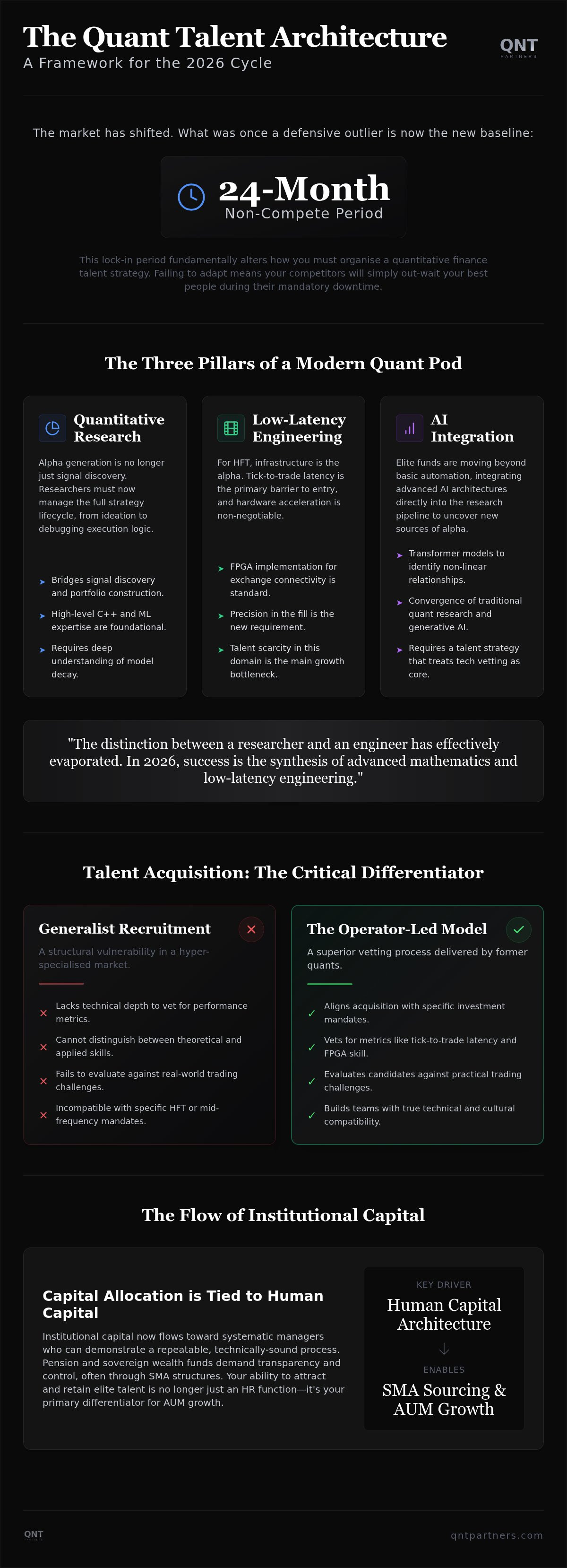
The 24-month non-compete has shifted from a defensive outlier to the baseline expectation for high-alpha pods. A high-stakes game of attrition. This lock-in period fundamentally alters how you must organise a quantitative finance talent strategy for the 2026 cycle. I've seen Sydney-based systematic funds lose entire research groups to crypto ventures because they failed to align P&L splits with the technical risk their engineers actually manage.
You already know that a researcher capable of extracting signal from messy tick data is a different breed from a generic data scientist. I've noted the friction of watching talent leakage happen while you wait out a mandatory garden leave period. It's a structural vulnerability that few firms address before it's too late.
This guide provides a strategic framework for scaling systematic teams using an operator-led search model. You will gain insight into the 2026 talent market dynamics and the mechanics of SMA structures. I also cover the equity partnerships that elite funds use to maintain their edge. I break down the core components of modern quant architecture and the strategies discreet funds use to protect alpha. Failing to adapt your human capital structure now means your competitors will simply out-wait your best people during their mandatory downtime.
Key Takeaways
- The 2026 environment demands a total convergence of traditional quantitative research and generative AI frameworks to maintain a competitive edge.
- An effective quantitative finance talent strategy requires aligning acquisition directly with specific investment mandates (such as HFT or mid-frequency) to ensure technical compatibility.
- Generalist recruitment lacks the technical depth required to vet for specific performance metrics like tick-to-trade latency or FPGA engineering.
- The operator-led model provides a superior vetting process by using former quants to evaluate candidates against real-world trading challenges.
- Institutional capital allocation is now tied to the sophistication of a fund's human capital architecture and its SMA sourcing capabilities.
The Architecture of Quant Finance: Defining the 2026 Environment
The distinction between a researcher and an engineer has effectively evaporated. In 2026, quantitative finance is the synthesis of advanced mathematics and low-latency engineering, underpinned by a deliberate human capital approach. A successful quantitative finance talent strategy now requires deep technical alignment between research and execution teams. We are witnessing a transition from siloed departments to integrated alpha generation teams. In these pods, the researcher must understand the tick-to-trade latency of their signal as clearly as the engineering team understands the model's decay.
Firms are moving beyond basic automation. We are seeing elite funds integrate transformer architectures directly into the research pipeline to identify non-linear relationships that traditional models miss. Quantitative analysis (finance) has become an exercise in managing this technological complexity at scale. Success in this environment depends on a talent strategy that treats technical vetting as a core engineering function.
Beyond Math: Technology and Execution
Execution speed is now inseparable from research. I've seen a Chicago-based prop shop move into mid-frequency spaces, using their low-latency infrastructure to gain an edge where they previously wouldn't compete. This goes beyond simple speed. Precision in the fill is the new requirement. This requires an operator mindset. Understanding exchange connectivity and co-location, alongside FPGA implementation, is as vital as the stochastic calculus used in the model. If your model is brilliant but your execution is slow, you are simply providing liquidity to a faster competitor. The 2026 environment favours those who can bridge the gap between a theoretical Sharpe and real-world P&L.
The Institutional Shift Toward Systematic Management
Institutional capital is flowing toward systematic managers who can demonstrate a repeatable process. This capital often enters via SMA structures, which provide the transparency and control that pension funds and sovereign wealth funds now demand. In this context, a quantitative finance talent strategy is the primary differentiator. The ability to build and maintain these complex systems is the current bottleneck for fund growth. The funds that win are the ones that ensure every hire adds specific technical value to the existing architecture.
The Three Pillars of Modern Quant Ecosystems: Research, Engineering, and AI
The era of the siloed genius is dead. In 2026, alpha generation is the collective output of research, engineering, and AI. A successful quantitative finance talent strategy recognises that these pillars are interdependent. I've observed that firms treating these as separate departments often suffer from model decay that they cannot diagnose or fix quickly enough to protect their P&L.
Quantitative Research and Alpha Generation
Modern researchers must bridge the gap between signal discovery and portfolio construction. Proficiency in stochastic calculus remains foundational, but it's increasingly useless without high-level C++ and ML expertise. Financial Quantitative Analysts are now expected to manage the full lifecycle of a strategy. Alpha generation is no longer just about beating a benchmark. It is the pursuit of risk-adjusted returns that exceed market benchmarks while managing the specific technical decay of the model itself. I note that the most successful pods are those where the researcher can debug their own execution logic without waiting for a developer.
Low-Latency Engineering and HFT Infrastructure
Infrastructure is the alpha for HFT firms. If you aren't using hardware acceleration like FPGAs to handle exchange connectivity, you've already lost. The scarcity of talent capable of building these platforms is the primary bottleneck for Sydney-based systematic funds and Chicago prop shops alike. Tick-to-trade latency isn't just a metric. It's the barrier to entry. High-frequency trading firms are now diversifying into longer-dated strategies, but they are doing so by bringing their low-latency engineering standards to those new markets. This creates a technical floor that slower, traditional systematic managers struggle to meet.
Pattern recognition in unstructured data is the 2026 frontier. We are seeing a massive shift toward using transformer models to ingest alternative data sets that were previously considered too noisy for production. Systematic trading mandates this level of automation because the volume of data exceeds human processing capacity. If you are looking to optimise your team's technical composition, we should discuss the specific engineering requirements of your mandate. The goal is to move from manual discovery to a factory-style pipeline where the infrastructure itself facilitates the discovery of new signals.
The Operator Model in Executive Search: Why Generalist Recruitment Fails
Generalist recruitment firms treat quantitative talent as a commodity. This is a fundamental error. I've watched systematic funds burn through six figure search fees only to hire a data scientist who couldn't identify a look-ahead bias if it hit them in the face. A quantitative finance talent strategy requires a peer-to-peer vetting process that most agencies simply cannot provide. They don't know the difference between a mid-frequency PM and a low-latency engineer because they've never sat in the seat.
The operator model changes the dynamic. It relies on search leads who have actually managed risk or written production code. We don't just source candidates. We stress-test their understanding of market plumbing. This level of vetting prevents the revolving door of junior researchers that plagues firms with weak technical leadership. Poor organisational structure and talent leakage cost millions in lost alpha. It's a quiet drain on P&L that most firms only notice when their Sharpe ratio starts to decay.
The High Stakes of Quantitative Executive Search
A single star hire can fundamentally shift a pod's performance. I've seen one PM spin out from a multi-manager shop and generate triple-digit millions in their first year at a smaller prop firm. This makes professional discretion vital. If the street knows you are building out a specific desk, your cost of acquisition spikes. Market intelligence on current P&L splits and equity partnerships is the only way to benchmark your offer against the quiet firms you've never heard of. You need to know if the 15 to 20 percent split you're offering is actually competitive for the specific risk-return profile you expect.
Navigating the 2026 Non-Compete Environment
The 12 to 24 month garden leave period is now a standard hurdle for elite talent. Managing this requires more than just a large checkbook. You need a strategy for buy-outs and a way to keep a candidate engaged during their mandatory sit-out period. We specialise in these complex transitions. Our QNT Partners firm overview outlines how our operator-led background allows us to structure these deals effectively. Strategic use of deferred compensation and SMA structures can often bridge the gap for a candidate who is hesitant to leave a large vesting pool behind. Failing to account for these mechanics during the initial search phase is a guaranteed way to lose your top choice to a more sophisticated bidder.
Building a Quantitative Talent Strategy: A Framework for Systematic Funds
A reactive hiring process is a liability. If you are only sourcing talent when a seat is empty, you've already conceded your edge to faster firms. An effective quantitative finance talent strategy treats acquisition as a continuous research function. This requires a structured framework that aligns human capital with specific investment mandates rather than broad job descriptions.
Step one is ensuring your talent pipeline matches your trading frequency. An HFT desk requires engineers who can shave nanoseconds off a tick-to-trade path, while a mid-frequency statistical arbitrage pod needs researchers with deep experience in non-linear signal decay. Step two involves implementing technical vetting that mirrors real-world production environments. Standard brain teasers are useless for identifying whether a candidate can manage a live P&L split or debug a race condition under pressure.
Compensation structures must incentivise long-term alpha generation. I've found that a 12 to 18 percent split is the current sweet spot for retaining elite PMs without eroding the fund's operational margins. Step four requires using external advisory to benchmark your organisational design against the market. Finally, step five integrates capital advisory. Sourcing SMAs allows you to scale the human capital you've already secured, turning a successful pod into a significant revenue driver.
Scaling High-Performance Systematic Teams
Moving from a three-person pod to an institutional-scale desk is where most firms fail. The technical requirements shift from individual brilliance to collective infrastructure stability. I've observed that cultural fit in these high-pressure environments is often the deciding factor in whether a team survives a 15 percent drawdown. You can find more on this transition in our guide to Organizational Design for Quantitative Trading Firms. Technical competence gets people in the door, but shared operational standards keep them there.
Manager Search and SMA Sourcing as Growth Levers
Talent strategy and capital allocation are now two sides of the same coin. Sourcing Separately Managed Accounts provides a mechanism to connect your best researchers with institutional capital without the overhead of a multi-manager fund structure. This is the primary growth lever for 2026. Our work in SMA SVA Partnerships demonstrates how linking internal talent strategy to external capital raising creates a more resilient business model. If you are ready to build a systematic team capable of institutional scale, we can assist in aligning your talent with the right capital structures.
Strategic Advisory and Executive Search: The QNT Partners Methodology
A resume is a poor proxy for production performance. We built QNT Partners because we were tired of seeing generalist recruiters misalign technical talent with investment mandates. We act as the strategic link between elite technical talent and institutional capital. Our focus remains narrow. We specialise in HFT and systematic hedge funds, focusing heavily on AI/ML specialists. This allows us to maintain a peer-to-peer dialogue with the people actually writing the code and managing the risk.
I believe that an effective quantitative finance talent strategy is an extension of the investment process itself. It's not a back-office function. We use an operator-led approach to executive search and manager vetting. This means our team includes individuals who have sat in the seats they are now filling. We understand the difference between a researcher who can find a signal in a clean dataset and one who can manage the noise of a live exchange feed. This technical vetting is what prevents the expensive mistake of a bad hire.
Global Connectivity and Technical Mastery
Our network is exclusive and highly selective. We maintain deep roots in major financial centres like London, New York, and Hong Kong. This global connectivity allows us to move talent across borders when a specific technical niche is underserved in a local market. We don't just look for candidates. We look for technical mastery in low-latency engineering and quantitative research. I've found that the best engineers are rarely looking for work. They are found through the quiet, deep-rooted relationships we've built over decades in the industry.
Connecting Talent with Capital via SMAs
The traditional recruitment model ends when a contract is signed. We take a different view. We combine executive search with capital advisory to provide a more comprehensive growth lever for our clients. By facilitating capital raising through SMA structures, we help specialised investment teams scale their operations. This connects the right talent with the right institutional capital. It creates a more stable environment for alpha generation. If you want to consult with QNT Partners on your 2026 talent strategy, we can discuss how to align your human capital with these capital structures to drive a long-term competitive advantage.
Securing the Next Cycle of Alpha
The technical floor of the industry has risen. By 2026, the firms that remain competitive will be those that treat their quantitative finance talent strategy as a core component of their investment process. Alpha is no longer found in isolated mathematics. It is extracted through the synthesis of low-latency engineering and transformer-based research pipelines. An organisational structure that eliminates friction between discovery and execution is now the baseline.
We provide the operator-led search and advisory required to build these high-performance teams. Our global reach in AI and ML specialist placement, combined with our expertise in HFT and systematic funds, ensures we vet for production-ready technical mastery. We also facilitate the strategic SMA sourcing necessary for institutional clients to scale their existing human capital. Managing 24-month garden leave cycles and complex P&L splits requires a partner who has managed these mechanics from the inside.
Success in this evolving market depends on moving faster than the decay of your models. Partner with QNT Partners for specialised quantitative search and advisory to ensure your firm is positioned for the next decade of systematic trading. I look forward to discussing how we can align your technical requirements with the world's most elite talent.
Frequently Asked Questions
What is the difference between a quantitative researcher and a quantitative developer?
A quantitative researcher focuses on signal discovery and mathematical modelling to generate alpha. A quantitative developer builds the low-latency infrastructure and exchange connectivity required to execute those models. While the roles are converging in 2026, the researcher owns the P&L of the strategy logic, whereas the developer owns the P&L of the execution speed. I've noted that the best pods now require researchers to be technically proficient enough to debug production code.
How have machine learning roles evolved in quantitative finance for 2026?
ML roles have moved from experimental research to core production engineering. Specialists now focus on integrating transformer architectures and deep learning models directly into the tick-data pipeline. It is no longer about isolated data science. It is about identifying non-linear relationships in unstructured data at scale. Firms are hiring specifically for expertise in managing the technical decay of these complex models in live environments.
Why are non-compete periods getting longer in the systematic trading space?
Non-compete periods of 12 to 24 months are now standard because they protect proprietary IP from immediate exploitation by competitors. As alpha decay accelerates, funds need longer garden leave periods to ensure a strategy is no longer viable by the time a researcher joins a rival shop. It's a defensive mechanic used by elite pods to maintain their competitive edge in a crowded market.
What skills are most valuable for a quant professional in 2026?
The most valuable skills include C++ proficiency, hardware acceleration (FPGA), and an understanding of transformer-based modelling. An effective quantitative finance talent strategy also prioritises operator knowledge of exchange connectivity and co-location. Technical mastery of market plumbing is now as vital as stochastic calculus. Candidates who can bridge the gap between theoretical research and low-latency execution are the most sought-after in the 2026 cycle.
How does an SMA sourcing strategy differ from traditional fund allocation?
Traditional fund allocation pools capital into a single vehicle managed by the firm. SMA sourcing allows institutional clients to allocate capital to specific pods or managers through Separately Managed Accounts. This structure offers superior transparency and control over risk parameters. It also allows for more flexible compensation structures and P&L splits that align the interests of the manager and the allocator more directly.
What is the operator model in quantitative recruitment?
The operator model refers to executive search led by former industry quants, traders, and engineers. We use our direct experience in systematic trading to vet candidates on a peer-to-peer level. This moves recruitment beyond simple keyword matching and into rigorous technical evaluation. It ensures that a candidate's mathematical claims hold up against the realities of production-level execution and market plumbing.
Can generalist recruitment firms effectively hire for low-latency C++ roles?
Generalist firms cannot effectively hire for low-latency C++ roles because they lack the technical depth to vet for memory management or tick-to-trade latency. They treat recruitment as a volume game. This often leads to talent leakage where firms hire engineers who look good on paper but fail in a high-pressure production environment. Specialised search requires an understanding of the specific hardware-software interactions that define modern HFT.
How does talent strategy advisory impact a hedge fund ability to raise capital?
Talent strategy advisory helps a fund organise its human capital into a structure that institutional investors find credible. By optimising P&L splits and organisational design, a fund demonstrates that it can retain the talent responsible for its alpha. This makes the fund a more attractive target for capital raising via SMAs, as allocators can see a clear link between the talent and the investment mandate.