The Evolution of Deep Learning Recruitment for Trading: 2026 Trend Analysis

The traditional quantitative researcher is no longer the sole architect of alpha. In 2026, the competitive edge has shifted decisively toward machine learning systems architects who can navigate the complex feedback loops of non-stationary markets. You likely understand the mounting frustration of vetting candidates who promise transformative results but fail to account for the inherent volatility of live trading environments. Distinguishing genuine technical mastery from well-packaged AI hype has become the primary challenge for institutional leadership.
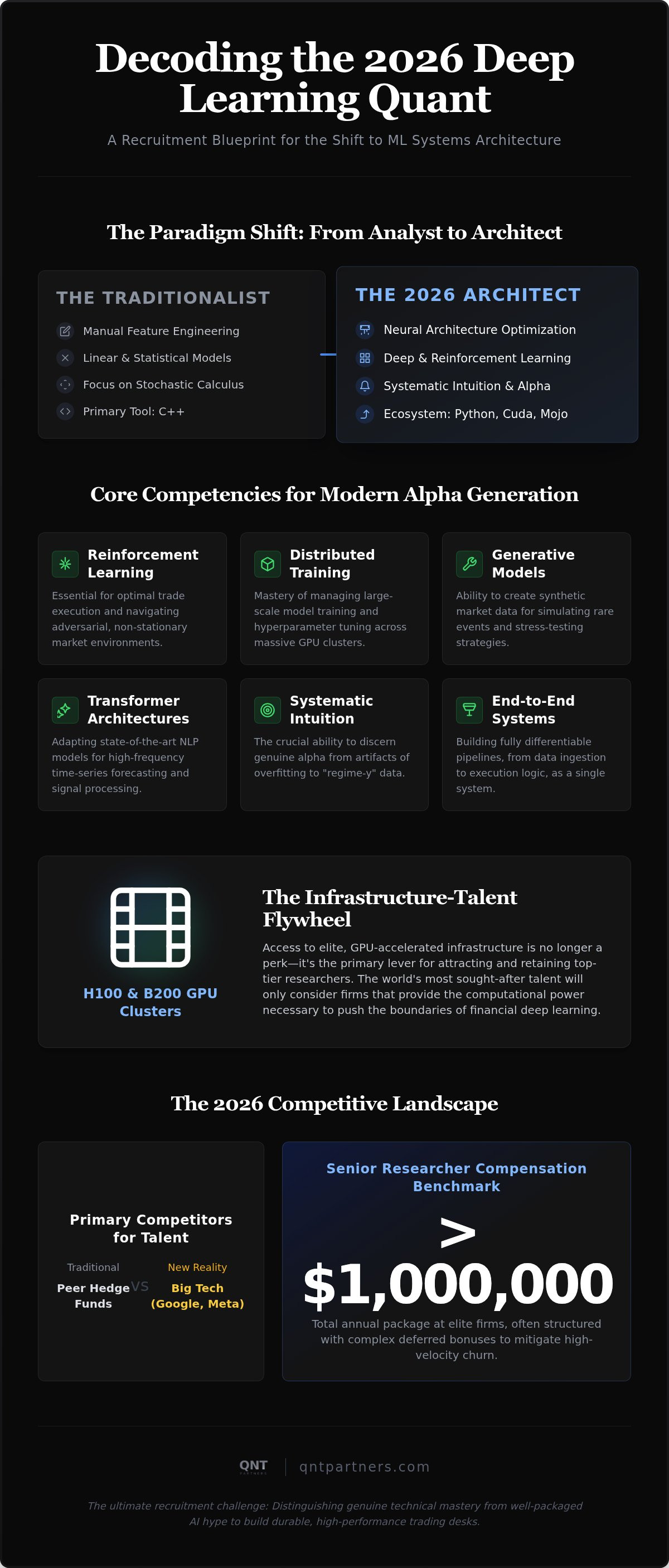
This analysis provides a comprehensive framework for deep learning recruitment for trading, offering the precision required to secure top-tier talent in an exceptionally scarce market. We examine the 2026 benchmarks for infrastructure and compensation, noting that total packages for senior researchers at elite firms now frequently surpass $1,000,000. By defining the specific architectural skills and strategic insights necessary for success, this guide serves as a roadmap for firms seeking to build durable, high-performance desks while managing the escalating expectations of the world's most sought-after researchers.
Key Takeaways
- Identify the transition from traditional feature engineering to architecture optimization and the essential role of Reinforcement Learning in modern alpha generation.
- Understand how access to GPU-accelerated infrastructure, specifically H100 and B200 clusters, has become a primary lever for attracting and retaining top-tier researchers.
- Implement a strategic framework for deep learning recruitment for trading that prioritizes peer-to-peer technical vetting to distinguish genuine capability from market hype.
- Navigate the complexities of 2026 compensation structures and deferred bonuses to secure talent in an environment of extreme scarcity and high-velocity churn.
- Analyze the shift from C++ dominance toward specialized ecosystems like Python, Cuda, and Mojo to ensure research teams remain at the frontier of technical execution.
The Convergence of Deep Learning and Quantitative Strategy
The landscape of algorithmic trading has undergone a fundamental transformation. By 2026, the industry has transitioned from manual feature engineering toward deep learning architecture optimization. Traditional linear models, once the bedrock of quantitative research, are increasingly augmented by deep neural networks capable of capturing non-linear dependencies that evade classical statistical methods. This shift has fundamentally altered the requirements for deep learning recruitment for trading, moving the focus from mathematical quants to machine learning systems architects.
Generalist AI talent often fails in this environment because they treat financial data as a static image or a fixed corpus of text. Markets are adversarial. Every successful trade changes the environment, creating a feedback loop that standard supervised learning models are ill-equipped to handle. While generalists struggle with this "market noise," Large Language Models have redefined alternative data processing. Firms now use LLMs to quantify sentiment from vast unstructured datasets with a speed that was impossible three years ago.
Beyond Signal Processing: The Neural Network Alpha
Transformer architectures, originally designed for sequence modeling in linguistics, are now being adapted for high-frequency time-series forecasting. The industry has moved toward end-to-end differentiable trading systems where the entire pipeline, from data ingestion to execution logic, is optimized through a single gradient. Financial Deep Learning is the intersection of stochastic calculus and neural architecture search. This integration allows for models that don't just predict price movement but optimize for transaction costs and liquidity constraints simultaneously.
The Recruitment Crisis: Supply vs. Demand in 2026
The demand for specialized expertise has created a severe supply imbalance. A significant gap exists between academic machine learning research and the rigors of production-grade trading. While a PhD candidate might develop a novel optimizer in a controlled setting, applying that logic to a live book requires a rare understanding of market microstructure. Competition is no longer confined to peer hedge funds. Big Tech firms like Google and Meta are the primary competitors for talent. This environment makes deep learning recruitment for trading a highly strategic endeavor. Specialized search partners who operate as technical insiders are now essential for bridging the gap between elite talent and the firms capable of providing the necessary infrastructure.
Decoding the 2026 ML Researcher Profile
The profile of the elite quantitative researcher has moved beyond the traditional boundaries of stochastic calculus. In 2026, the most effective practitioners are those who treat trading as a high-dimensional optimization problem. Reinforcement Learning (RL) has become an essential proficiency, particularly for trade execution and dynamic portfolio optimization. Unlike supervised learning, RL allows models to learn optimal policies through interaction with an adversarial market environment. This shift has fundamentally changed the requirements for deep learning recruitment for trading, as firms now prioritize candidates who can build agents capable of navigating non-stationary regimes.
The technical ecosystem has also evolved. While C++ remains vital for the final execution layer, the research phase is now dominated by Python, Cuda, and Mojo. This stack allows for the rapid prototyping of complex architectures while maintaining the performance required for massive datasets. Success in this field requires more than just coding; it demands systematic intuition. This is the ability to discern whether a model's performance is a result of genuine alpha or an artifact of overfitting to "regime-y" data. Identifying candidates with this specific discernment is difficult, which is why firms often leverage AI & ML Specialist Search experts to vet the technical depth of potential hires.
Technical Mastery: The 2026 Skill Stack
Modern researchers must demonstrate a deep understanding of distributed training and hyperparameter tuning at an institutional scale. It's no longer enough to train models on a single workstation; candidates must manage workloads across massive GPU clusters. There is also an increasing reliance on generative models for synthetic market data creation. These models allow firms to simulate rare market events and black swan scenarios that aren't present in historical datasets. This capability is critical for testing the robustness of neural networks in a low-latency environment where debugging becomes exponentially more complex as the number of layers increases.
Academic Pedigree vs. Practical Implementation
A PhD from a top-five computer science program is often the baseline for entry, but the real premium is placed on production experience. The industry has seen a rise in the value of Kaggle-style competitive backgrounds, which often prove a candidate's ability to extract signal from noisy, real-world data. The complexity of these roles has led to the adoption of advanced selection methods, including the Deep Neural Network Model for... Human-Job Matching, to ensure a precise fit between a researcher's specific architectural expertise and a firm's unique strategy. Beyond pure technical ability, the 2026 environment requires collaboration. Researchers must work seamlessly with engineers and traders to ensure that theoretical models survive the transition to live markets, making interpersonal communication a non-negotiable trait for long-term retention.
The Infrastructure-Talent Feedback Loop
The availability of massive computational resources has transitioned from an operational necessity to a primary lever in deep learning recruitment for trading. Top-tier researchers now frequently prioritize firms based on their immediate access to H100 or B200 GPU clusters, viewing compute capacity as the ultimate tool for experimentation. This "Compute as a Perk" trend reflects a shift where researchers demand the freedom to test complex architectures without being throttled by hardware limitations. For many, the choice between two competing offers often rests on the transparency of a firm's roadmap for infrastructure scaling and the dedicated compute time allocated to their specific desk.
Building these backbones requires a distinct class of professional. Sourcing the engineers who design and maintain these ML backbones is as critical as finding the researchers who use them. These ML Ops specialists ensure that distributed training remains stable and that data pipelines can handle the petabytes of unstructured information that constitute a modern firm's moat. Recruiting for specialists in unstructured data acquisition has become a priority, as the quality of the data moat directly dictates the ceiling of any neural network's predictive power. Without the right engineers to build the delivery systems, the world's best researchers cannot generate alpha.
Hardware as a Recruitment Tool
The ongoing "Compute War" has forced smaller funds to reconsider their talent acquisition strategies. Without the capital to compete for tens of thousands of high-end GPUs, these firms must find niche technical advantages or focus on highly efficient, specialized models. A direct correlation exists between high GPU-per-researcher ratios and the conversion rates of elite candidate offers. Within traditional quant desks, the rise of the ML Ops role signifies a departure from generalist IT toward a deeply integrated, research-focused engineering discipline that mirrors the complexity of the models themselves.
Software Ecosystems and Low-Latency ML
Success in the 2026 market requires mastery of the intersection between machine learning and low-level infrastructure. Firms are aggressively sourcing talent capable of writing custom Cuda kernels and designing architectures that can survive the transition from training to execution. This often involves recruiting FPGA and ASIC specialists who can implement deep learning models directly into hardware for sub-microsecond execution. While proprietary research libraries can offer a significant competitive edge, they are often a double-edged sword for recruitment. Elite researchers may hesitate to join a firm where their work is locked into a siloed ecosystem that limits their future mobility or prevents them from using the industry-standard tools they've mastered. Effective deep learning recruitment for trading must therefore balance the need for proprietary secrets with the candidate's desire for technical relevance and open-source interoperability.
Navigating the Competitive Landscape for AI Talent
The competition for machine learning expertise has reached a point of extreme scarcity. In 2026, institutional funds find themselves in a three-way tug-of-war against Big Tech and high-growth AI startups. This environment has transformed deep learning recruitment for trading into a high-stakes exercise in strategic retention. It is no longer sufficient to offer a competitive base salary. Firms must now architect "Golden Handcuffs" through sophisticated deferred bonus schemes and equity-equivalent structures that align a researcher's personal wealth with the long-term performance of their proprietary architectures. This complexity necessitates a dedicated Talent Strategy Advisory to ensure that a firm’s value proposition remains calibrated against the evolving standards of the street.
Compensation Benchmarking for 2026
Current market data reveals a significant escalation in total compensation. Senior quantitative researchers at top-tier firms now command average total packages ranging from $500,000 to over $1,000,000. Even at the entry level, base salaries have solidified between $150,000 and $200,000. Beyond these figures, the elite 1% of talent increasingly demands "Alpha-linked" bonuses. These structures provide a direct share of the PnL generated by their specific models, effectively treating the researcher as a partner rather than an employee. While remote work was once a primary bargaining chip, the 2026 trend has shifted toward "high-intensity hybrid" models, where the provision of elite on-site infrastructure is balanced with the flexibility required to source talent from global technical hubs.
The Non-Compete Minefield
Protecting intellectual property in a high-churn environment requires a sophisticated approach to legal constraints. Firms are increasingly using extended "garden leave" periods to ensure that a researcher’s knowledge of a specific neural architecture becomes stale before they can join a competitor. In 2026, the enforceability of these clauses often hinges on the specific technical domain. AI-specific non-competes must be narrow enough to be legal yet broad enough to prevent the immediate replication of a trading desk’s edge. We are also seeing a shift from individual strategic hires toward the acquisition of entire pods. Lifting a functional team of researchers and engineers is often more efficient than building from scratch, though it carries significantly higher legal and financial risks. Navigating these transitions requires the discretion and calm authority of an experienced search partner who understands the movement of talent at the highest levels of the industry.
Strategic Execution in Deep Learning Search
Execution in this rarified market requires more than a broad network; it demands a peer-to-peer technical assessment that only an operator can provide. At QNT Partners, we approach deep learning recruitment for trading with the discretion that high-stakes institutional environments demand. This "Quiet Power" allows us to navigate elite circles where the most valuable talent rarely engages with traditional job boards. Our global connectivity extends beyond the usual financial centers, tapping into non-traditional technical hubs in Eastern Europe and Southeast Asia. These regions have become fertile ground for researchers who possess the mathematical rigor and low-level engineering skills required for modern neural architecture search.
CTOs initiating a search for a Deep Learning Lead must move beyond surface-level credentials. A framework for this process begins with defining the specific market non-stationarity the desk aims to exploit, followed by an honest assessment of the firm's compute runway. Only then can a search partner identify an individual capable of translating theoretical breakthroughs into production-grade alpha. This methodical pace ensures that the movement of talent is strategic, not reactive, mirroring the logical thinking of the firms we represent.
The Vetting Process: Beyond the GitHub
Standard technical screens often fail to account for the adversarial nature of the markets. Our vetting process focuses on a researcher’s ability to handle "Fat Tails" and extreme market volatility. We look for adversarial thinking. This is the capacity to anticipate how a model might fail when liquidity vanishes or when market regimes shift abruptly. We identify "operators" who don't just understand the math but have a proven track record of PnL impact. This distinction is critical for firms that can't afford the latency of an academic's learning curve. We assess how a candidate manages distributed training at scale and their intuition for debugging complex networks in live environments.
Building the Future: Organizational Advisory
Success isn't just about the first hire; it's about the organizational structure that supports them. We provide Talent Strategy Advisory to help firms design team structures that eliminate silos between machine learning researchers and execution traders. Scaling a high-performance desk requires a methodical approach to talent density, ensuring that each subsequent hire complements the existing stack. Whether you're making your first foundational hire or expanding a full research desk, the strategy must be as precise as the models you intend to deploy. If you're ready to secure the architects of your next-generation alpha, consult with QNT Partners on your AI talent strategy.
Securing the Architects of Next-Generation Alpha
The 2026 trading environment demands a fundamental shift in how institutional firms identify and retain talent. As neural architectures become the primary drivers of predictive modeling, the reliance on high-performance GPU clusters has created a feedback loop where infrastructure and human capital are inseparable. Success in this landscape requires more than just capital; it necessitates a deep technical understanding of how these models interact with market non-stationarity. Effective deep learning recruitment for trading is no longer a volume-based process but a strategic search for researchers who can navigate adversarial environments.
To maintain a competitive edge, firms must move beyond traditional credentials and partner with advisors who operate at the same technical level as the candidates they source. It's essential to work with a partner who understands the nuances of neural architectures in finance. Partner with QNT for Specialized AI & ML Executive Search to leverage our elite network of ML researchers and HFT operators. We provide the discreet, strategic talent advisory global funds need to build high-performance desks. We look forward to helping you lead the next evolution of quantitative strategy.
Frequently Asked Questions
What is the primary difference between a quant researcher and an ML researcher in 2026?
The distinction lies in the methodology of alpha generation. Traditional quants focus on manual feature engineering and stochastic calculus to model market behavior. In contrast, ML researchers specialize in neural architecture search and end-to-end differentiable systems. By 2026, the ML researcher is expected to optimize the learning process itself rather than just the signals. This shift has fundamentally redefined the requirements for deep learning recruitment for trading across the industry.
How much compute power is required to attract top-tier deep learning talent?
Attracting elite talent requires significant investment in GPU-accelerated infrastructure. Top researchers expect immediate access to H100 or B200 clusters with high GPU-per-researcher ratios. Providing "Compute as a Perk" means researchers have the freedom to experiment without hardware-imposed latencies. Funds that don't offer dedicated compute time often struggle to compete with institutional giants that have established petabyte-scale data pipelines and massive distributed training capabilities.
Are PhDs still mandatory for deep learning roles in quantitative trading?
While a PhD from a top-tier institution remains the baseline for many elite desks, it's no longer the sole requirement. Production experience and a proven track record in competitive ML environments, such as Kaggle, are now highly valued. Firms prioritize candidates who can demonstrate the transition of theoretical models into live, profitable trading strategies. The ability to manage distributed training at scale often outweighs purely academic credentials in the 2026 market.
How are LLMs being used in quantitative recruitment and research?
LLMs have revolutionized both the sourcing of talent and the processing of alternative data. In recruitment, they are used to quantify candidate fit by analyzing technical output and project history. In research, LLMs process vast unstructured datasets to extract sentiment and identify regime-shifting signals at speeds previously unattainable. This automation allows researchers to focus on higher-level architecture optimization while the LLM handles the initial quantification of complex, non-linear market data.
What are the current compensation benchmarks for ML researchers in HFT?
Compensation for ML specialists has escalated due to extreme scarcity. Entry-level researchers typically command base salaries between $150,000 and $200,000. For senior-level talent, total compensation packages frequently range from $500,000 to over $1,000,000. The most sought-after researchers often demand "Alpha-linked" bonuses, where their pay is directly tied to the PnL generated by their models. These benchmarks reflect the strategic importance of deep learning recruitment for trading in 2026.
How do you vet an ML researcher for financial market experience if they come from Big Tech?
Vetting talent from Big Tech requires assessing their understanding of market non-stationarity. Unlike the static datasets common in general AI, financial markets are adversarial and constantly shifting. We evaluate a candidate's adversarial thinking, which is their ability to anticipate how a model might fail during a regime shift or liquidity crisis. A successful transition depends on the researcher's capacity to move beyond supervised learning toward models that account for the feedback loops of live trading.
What is the role of reinforcement learning in modern trading strategies?
Reinforcement Learning (RL) is now central to trade execution and dynamic portfolio optimization. Unlike traditional models that predict price direction, RL agents learn optimal policies by interacting with the market environment. This allows for the simultaneous optimization of transaction costs, liquidity constraints, and alpha generation. In 2026, proficiency in RL is a non-negotiable skill for researchers building autonomous trading systems that must adapt to high-frequency changes in market microstructure.
How can boutique hedge funds compete with Jane Street or Citadel for AI talent?
Boutique funds compete by offering specialized technical environments and greater individual impact. While they may not match the sheer scale of institutional giants, boutiques can provide researchers with more autonomy and a direct share of the PnL. Strategic use of "Compute as a Perk" and a focus on niche architectures allow smaller firms to attract elite talent. Partnering with a specialized advisory firm ensures these boutiques can identify and secure researchers who value agility over institutional scale.