Talent Strategy for Hedge Funds: Engineering the Human Capital Stack in 2026

Your lead quantitative researcher is likely planning a spinout because your current capital allocation model fails to account for their personal P&L trajectory. I've watched funds lose their most profitable pods not to higher base salaries, but to more sophisticated equity structures and superior technical environments. Developing an effective talent strategy for hedge funds in 2026 requires moving beyond simple headcount targets (it demands a fundamental redesign of the human capital stack). The traditional recruitment model is broken. It treats researchers as replaceable components rather than the primary architects of alpha.
I understand the frustration of seeing a high-performance team stall due to rising non-compete costs or inefficient P&L split structures. I'll explain why the standard approach fails elite funds and how to architect a strategy that prevents alpha leakage. We will look at specific methods to reduce garden leave friction and ensure your team remains stable under the pressure of multi-manager competition.
We'll examine the shift toward pass-through fee models and the necessity of aligning your talent with SMA structures. This isn't about general HR principles. It's about the technical and financial engineering required to maintain a 12 to 20 percent P&L split while protecting your proprietary signals.
Key Takeaways
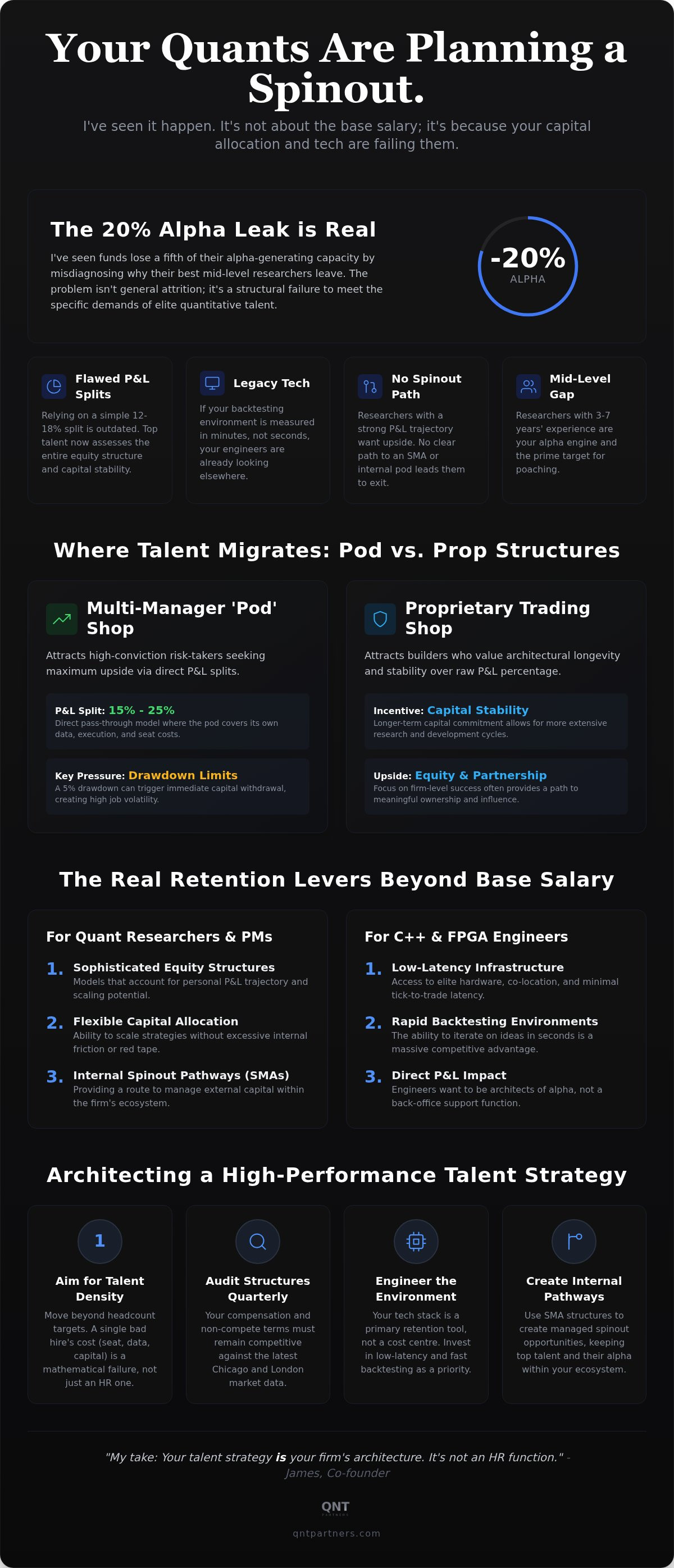
- I have seen funds lose 20 per cent of their alpha by treating quants like generalists and ignoring the specific needs of mid-level researchers.
- Assess how the 12 to 20 per cent P&L splits at multi-manager platforms compare to the stability of proprietary shops when designing incentives.
- Integrate SMA sourcing into your talent strategy for hedge funds to provide a pathway for spinouts while keeping talent within your ecosystem.
- Acknowledge that elite C++ and FPGA engineers prioritise low-latency infrastructure and fast backtesting environments over simple base salary increases.
- Maintain a high-performance framework by conducting quarterly audits of your compensation structures against the latest Chicago and London market data.
The Failure of the Generalist Talent Strategy
The standard recruitment model treats quants like general finance hires, which is a fundamental error in fund management. I have seen funds lose 20 per cent of their alpha-generating researchers because they ignored the mid-level talent gap, focusing instead on junior intakes or expensive PM hires. A talent strategy for hedge funds is the architecture of your firm. It is not a series of job postings. If your strategy relies on an agency that also recruits for retail banking or general accounting, you are already behind the market.
A 12 to 18 per cent P&L split is no longer the only lever for retention. While compensation remains a factor, elite researchers look for specific technical environments and capital allocation models that allow them to scale their strategies without excessive friction. They want to know that the infrastructure supports their Sharpe ratio rather than dragging it down.
Defining Human Capital Architecture for 2026
We are moving away from the traditional recruitment environment toward a structured advisory approach. I prioritise talent density over head count in systematic desks because the P&L drag of a single bad hire in a pod shop structure can be catastrophic. When a researcher fails to produce, the cost includes the seat fee and the data costs. You also face the opportunity cost of the capital they occupied. It is a mathematical failure, not just a hiring one.
This architecture requires a deep understanding of how your researchers interact with your data pipeline and execution systems. If the latency in your backtesting environment is measured in minutes instead of seconds, your talent will migrate to a firm that has already optimised its stack. The mid-level gap is particularly dangerous. These are the researchers with 3 to 7 years of experience who have developed the intuition for market regimes but aren't yet managing their own pods. They are the prime targets for aggressive multi-manager platforms offering 20 to 25 per cent splits, often found in London or Chicago hubs.
Identifying the Alpha Leakage Problem
Elite researchers leave for stealth mode startups or crypto ventures because they feel their current firm is a legacy environment. They are often willing to trade a stable salary for the upside of a spinout or a more aggressive P&L split. Garden leave and non-competes are becoming more expensive to enforce, especially as the UK government considers a three-month cap on restrictive covenants. QNT Partners specialises in identifying these flight risks early by maintaining deep relationships with researchers who are quiet about their intentions. A proper talent strategy for hedge funds must account for these external pressures before they manifest as resignations.
Failing to address these leaks leads to a hollowed-out middle layer. You end up with expensive PMs and inexperienced juniors. There is no one left to execute the core research that drives long-term returns. I recommend a quarterly audit of your P&L split against the Chicago and London markets to ensure your architecture remains competitive.
Pod Shop vs Prop Shop: Comparing Talent Incentive Structures
The spread between a 15 per cent and 25 per cent P&L split is often the least interesting part of a Portfolio Manager’s term sheet. I find that researchers now value capital stability as much as the raw percentage. The choice of structure dictates the type of talent you will attract. Pod shops draw in high-conviction risk-takers. Prop shops attract builders who prefer architectural longevity. A sophisticated talent strategy for hedge funds must acknowledge that these groups are not interchangeable.
The Mechanics of the Pod Shop Model
In a multi-manager environment, 15 to 25 per cent splits function as a direct performance incentive. This is almost always a pass-through model where the pod covers its own costs, including data and execution fees. While the upside is significant, the psychological pressure of drawdown limits is a constant friction point for researcher retention. If a pod hits a 5 per cent drawdown, the risk of capital withdrawal or termination is immediate. This volatility in job security often triggers alpha leakage as researchers look for more stable environments during periods of flat performance. They don't want to worry that a single bad month will lead to a hard stop on their career. You can read more about the organizational design for quantitative trading firms to understand how these structures impact long-term scalability.
Prop Shop Stability and Long-Term Equity
Proprietary trading shops provide a different value proposition. They offer stable internal capital and a "no-silo" environment that encourages collaborative alpha generation. To secure the top 1 per cent of researchers, these firms frequently use equity partnerships rather than just high cash splits. I favour a hybrid approach for mid-sized systematic funds. This involves offering a baseline P&L split of 12 to 15 per cent, supplemented by equity in the management company or a specific strategy carve-out. This structure aligns the researcher with the firm's growth while mitigating the "mercenary" mindset common in pod shops.
Builders often prefer the prop shop model because it allows them to focus on the technical stack, such as FPGA optimisations or exchange connectivity, without the threat of a sudden liquidation. They are looking for a firm where they can contribute to a collective Sharpe ratio. If you are struggling to balance these incentives against the aggressive offers from larger platforms, we can help you audit your current compensation framework. The consequence of getting this wrong is a revolving door of talent that never stays long enough to reach peak productivity.
SMA Sourcing and the Strategy of Capital-Linked Talent
The most effective way to retain a mid-level researcher with PM ambitions is to stop treating them like an employee and start treating them like a capital mandate. Separately Managed Accounts (SMAs) have transitioned from being a niche institutional preference to a primary tool for talent acquisition. I use SMAs to help managers spin out from larger platforms while keeping institutional backing. This structure provides a level of transparency that attracts sophisticated quants who want to see the specific source and duration of the capital they are trading.
A modern talent strategy for hedge funds must integrate capital sourcing with recruitment. Approximately 50 per cent of hedge funds offered SMAs in 2026. This trend is driven by investors who want more control. It is also driven by quants who want to avoid the "black box" of internal capital allocation often found in multi-manager firms. QNT Partners advises on SMA sourcing and capital raising as a core component of firm architecture.
Linking Capital Allocation to Talent Retention
Direct capital mandates prevent high-performance talent from jumping to larger platforms by giving them autonomy over their own P&L. When a researcher manages an SMA, they are no longer subject to the arbitrary drawdown limits of a broader pod. They answer to the investor and their own risk parameters. The role of SMA SVA partnerships is critical here. It allows for a structured relationship between the talent and the capital provider. Institutional investors favour funds with a clear talent-to-capital link. They want to know exactly who is responsible for the Sharpe ratio and that the individual is properly incentivised to stay.
The Operational Due Diligence of Talent
Vetting the team behind the SMA is more important than the algorithm itself. I evaluate the stability of a systematic trading desk by looking at the technical debt and the "key man" risk within the code base. If a strategy relies on a single engineer who hasn't documented their FPGA optimisations, the SMA is fragile. Key man clauses are a standard part of these mandates. They ensure that if the primary researcher leaves, the capital is protected. I focus on the human capital stack because the algorithm is a lagging indicator of the team's ability to innovate. A stable desk requires a mix of researchers and developers who can maintain exchange connectivity without relying on a single point of failure.
Managing Technical Infrastructure as a Recruitment Tool
Elite C++ developers and FPGA engineers do not work for funds with high technical debt. I have seen researchers reject offers because the backtesting environment was too slow to support their iteration cycle. Tick-to-trade latency is now a recruitment metric as much as a trading metric. If your system operates in the 2 to 10 microsecond range while competitors are sub-1 microsecond, you will struggle to hire the architects of the next generation. Technical talent prioritises the quality of the stack because it directly impacts their ability to generate P&L.
Co-location and exchange connectivity are the actual benefits package of the HFT world. A 10 Gbps CME GLink connection for co-location carries a monthly charge of $12,000, while a 10 Gbps connection to the CME EConnect gateway at data centres like Equinix NY4 costs $6,000 per month. Providing this level of access is the baseline for a modern talent strategy for hedge funds. Without it, you are asking elite talent to compete with a handicap. Researchers want to know that their execution logic is as close to the matching engine as possible.
The Low-Latency Talent War
Hiring for hft infrastructure recruitment requires operator-level knowledge of the stack. We are seeing a decisive shift from Python-heavy research to C++ and FPGA implementation. To pitch your stack to a developer with five competing offers, you must demonstrate a commitment to hardware acceleration. They want to work on systems where the logic executes on FPGAs in under 1 microsecond. AI models typically run on CPUs or GPUs to identify market regimes, feeding parameters into these deterministic FPGA execution paths.
AI and ML: The New Infrastructure Requirement
Providing the compute power necessary for deep learning research is a non-negotiable requirement. The role of GPU clusters in attracting top-tier ML specialists cannot be overstated. I believe the AI build-out is the most significant talent trend of 2026. Researchers need to know they can test parameters on massive datasets without waiting days for a result. The current pattern involves AI providing strategic input while the FPGA handles high-speed execution. If you need to upgrade your technical team to support these requirements, you can contact us for a technical search audit. This ensures your infrastructure acts as a magnet rather than a deterrent.
Implementing the High-Performance Alpha Framework
The firms that retain their best researchers aren't the ones with the highest base salaries. They're the ones that have built a continuous feedback loop between the trading desk and the search process. Most funds treat recruitment as a reactive event. A PM resigns, a search begins. That model is structurally incapable of protecting alpha because the damage is already done before anyone picks up the phone.
A genuinely effective talent strategy for hedge funds runs on a quarterly rhythm. I recommend auditing your P&L split against current Chicago and London market rates every three months, not annually. The spread between what a London-based systematic fund offers and what a Chicago prop shop is paying mid-level researchers can shift materially within a single quarter, particularly when a new multi-manager platform enters a geography aggressively. If you're only checking once a year, you're already behind.
Anonymising your search is equally non-negotiable. When a fund signals it's looking for a specific type of C++ developer or a researcher with a particular signal construction background, competitors can infer strategic intent. We run searches with full confidentiality protocols, targeting specific pods and proprietary shops without revealing the client until the final stages. This protects your alpha while still giving you access to researchers who aren't on the open market.
Architecting the Spinout-Proof Team
The spinout threat is almost always a symptom of a compensation structure that doesn't scale with the researcher's contribution. Internal "mini-pods" with equity upside in a specific strategy carve-out address this directly. A researcher managing a $50M sleeve with a 15 per cent P&L split and a 5 per cent equity stake in the strategy vehicle has a fundamentally different relationship with the firm than one on a flat salary. The former is building something. The latter is waiting for a better offer.
Succession planning for senior PM exits is where most funds fail. The knowledge is usually concentrated in one person's head and in undocumented code. I assess this risk by mapping the technical dependency graph of a desk before any senior departure becomes a crisis. A well-structured quantitative finance talent strategy accounts for this explicitly, building redundancy into both the team and the codebase so that an exit doesn't hollow out the desk's productive capacity.
The QNT Partners Approach
We integrate talent strategy advisory directly with executive search because the two are inseparable at the senior level. I work peer-to-peer with Heads of Trading, not through an HR intermediary. That relationship matters because the most important conversations, the ones about a desk's actual risk tolerance, its technical debt, and which researchers are genuinely flight risks, don't happen in formal briefings.
Every senior placement I make, I vet personally for both cultural and technical fit. A researcher who is technically exceptional but misaligned with a fund's risk culture will underperform within eighteen months. The cost of that misalignment, in lost P&L, in disruption to the desk, and in the search that follows, is far higher than the fee for getting it right the first time.
The goal is a firm that quants actively want to join because of its reputation for technical excellence, fair capital allocation, and genuine career architecture. That reputation is built placement by placement, audit by audit. It doesn't happen by accident.
Redesigning Your Human Capital Stack
Alpha is a function of the environment you build, not just the individuals you hire. If you continue to treat recruitment as a reactive headcount exercise, you will remain vulnerable to the aggressive 20 to 25 per cent splits offered by elite multi-manager platforms. A successful talent strategy for hedge funds requires a technical infrastructure that supports sub-1 microsecond execution and a capital allocation model that offers genuine equity upside. I have seen that linking researchers to SMA structures prevents the "mercenary" drift common in Chicago and London systematic funds.
QNT Partners operates as an operator-led boutique search firm with specific expertise in high-frequency trading and AI. We provide specialised SMA sourcing advisory to ensure your fund architecture is as competitive as your algorithms. It's about moving from a series of job postings to a structured advisory approach that protects your proprietary signals. Contact James at QNT Partners to organise your talent strategy and secure your 2026 build-out. The most profitable desks of the next decade are being engineered right now. I look forward to helping you architect yours.
Frequently Asked Questions
Is a 20 per cent P&L split standard for quant researchers in 2026?
A 20 per cent P&L split is common for Portfolio Managers at top-tier multi-manager platforms, but it is not the standard for individual researchers. Researchers typically receive a discretionary bonus tied to the pod’s performance or a smaller percentage of the net P&L. Top-tier PMs can negotiate up to 25 per cent. For a mid-level researcher, total compensation usually ranges from $550,000 to $950,000 including base and bonus.
Can SMA structures help hedge funds retain their best talent?
Separately Managed Accounts (SMAs) are a primary tool for talent retention because they provide transparency and autonomy. I use SMAs to help researchers transition into PM roles while keeping institutional backing. This capital-linked talent strategy for hedge funds prevents quants from jumping to larger platforms by giving them direct control over their P&L. It replaces the "black box" of internal capital with a clear, mandate-driven relationship between the researcher and the investor.
How much does garden leave typically cost a mid-sized fund?
The cost of garden leave includes the full salary and benefits paid during the non-compete period, which often ranges from 6 to 12 months. For an elite researcher with a $200,000 base salary, the direct cost is high, but the actual loss is the opportunity cost of their alpha production. You also face the risk of a "key man" exit that triggers investor withdrawals. These costs highlight why a proactive strategy is more efficient than reactive litigation.
What happens if a senior PM spins out with their entire team?
A full team spinout often leads to immediate alpha leakage and technical debt as proprietary code and logic leave the firm. If the team managed a significant SMA, the capital usually follows the talent, resulting in a direct hit to the firm's AUM. I recommend building internal redundancy and using equity upside in specific strategy vehicles to mitigate this. Without these protections, a single exit can hollow out a systematic desk's productive capacity.
Is FPGA expertise more valuable than Python for HFT roles?
FPGA expertise is significantly more valuable for low-latency execution roles where tick-to-trade latency must be sub-1 microsecond. While Python is essential for research and backtesting, the actual implementation of competitive HFT strategies in 2026 relies on C++ and hardware acceleration. Elite developers prioritise firms that have moved past Python-heavy execution to deterministic FPGA paths. Providing these technical environments is a critical recruitment tool for attracting top-tier engineering talent.
Can I hire elite quants without offering equity partnerships?
You can hire elite quants without equity, but you'll struggle to retain them against aggressive offers from proprietary shops or multi-manager platforms. Top-tier quants view equity as the only way to align their interests with firm growth. If you don't offer equity, your talent strategy for hedge funds must compensate with higher P&L splits, often in the 15 to 25 per cent range, or superior technical infrastructure to remain a competitive destination.