Talent Retention for HFT Firms: The Build vs Join Calculation in 2026

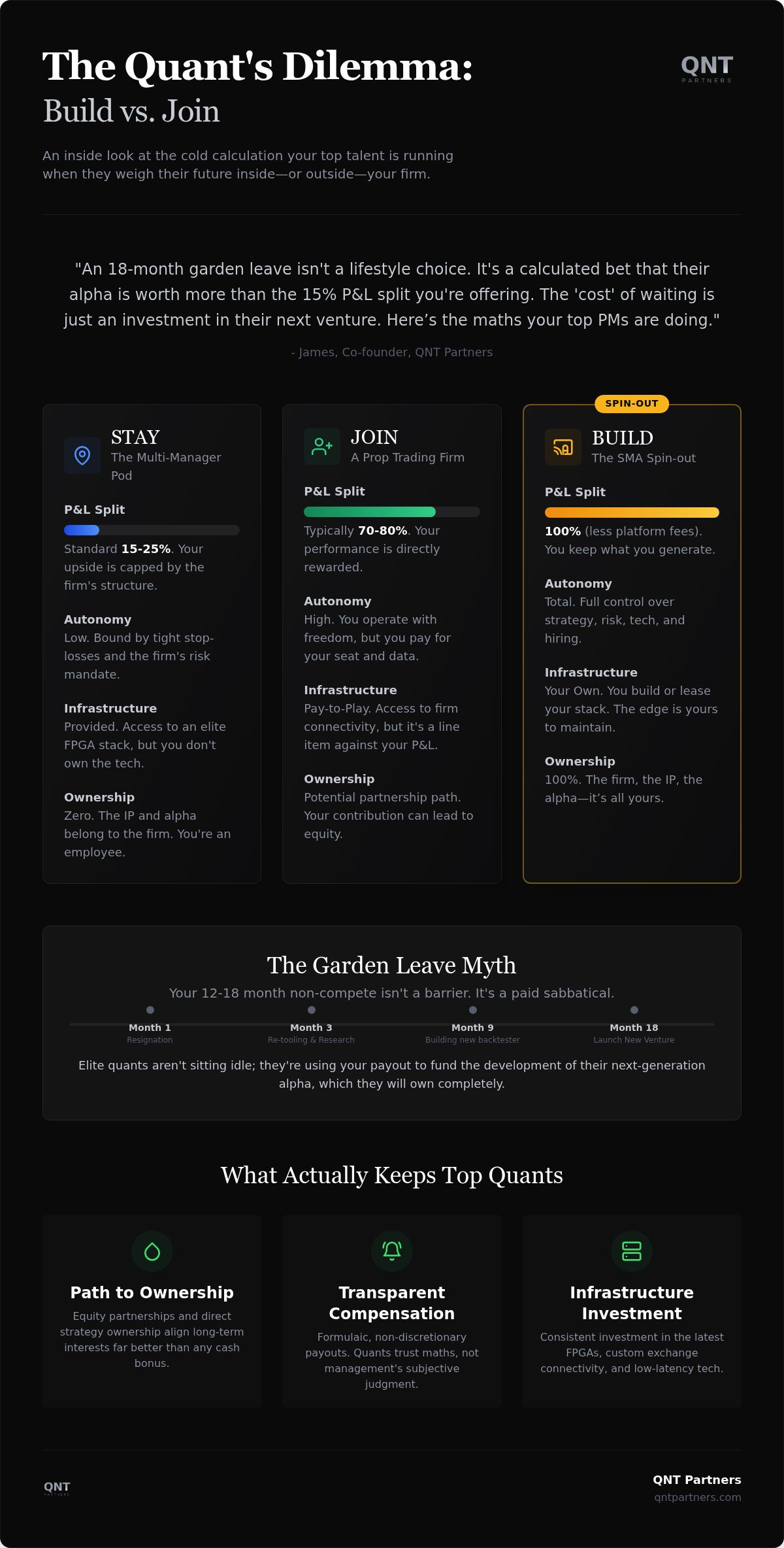
An elite quant researcher deciding to sit out for an 18 month garden leave period isn't making a lifestyle choice. They're making a cold calculation that their current P&L split, perhaps stuck at 15 percent, no longer compensates for the alpha they generate using your FPGA stack. Effective talent retention for HFT firms in 2026 requires moving past the idea that a high base salary or a nice office culture can offset the lure of a 70 percent split at a proprietary trading firm or the autonomy of an SMA structure.
I've seen dozens of senior PMs at Sydney-based systematic funds and Chicago prop shops walk away from eight-figure deferred bonuses because infrastructure parity has reached a point where they can replicate their edge elsewhere. You likely feel the pressure of escalating P&L demands and the constant threat of talent leakage to crypto firms that offer immediate liquidity and higher upside. The cost of replacing a lead developer who understands your exchange connectivity and tick-to-trade latency is often higher than the split increase they originally requested.
I will break down the Build vs Join calculation that your top traders are running. You'll see how to organise your firm's structure to lower turnover costs and maintain a competitive edge in talent strategy. This analysis covers the specific mechanics of equity partnerships and capital lock-ups that actually keep alpha-generating teams stable.
Key Takeaways
- The 12 to 18 month garden leave period is no longer a sufficient deterrent for elite quants who view this time as an opportunity to re-tool for crypto or private ventures.
- You need to understand the structural shift in P&L splits, where the 15 to 25 percent range is now the baseline for preventing talent leakage to multi-manager pods.
- Infrastructure parity is a primary driver of talent retention for HFT firms, as low-latency engineers will prioritise shops that consistently invest in the latest FPGA hardware and custom exchange connectivity.
- Retention is an infrastructure and capital allocation problem, where the quality of the team on the next desk over defines the culture more than any traditional HR initiative.
- Quantify the true cost of alpha loss by benchmarking your internal structures against the spin-out threats and SMA sourcing models currently dominating the market.
Beyond the Non-Compete: Why HFT Retention is a Structural Problem
The standard 12 to 18 month garden leave is no longer the ironclad deterrent it was a decade ago. Senior researchers in High-Frequency Trading (HFT) often treat this period as a paid sabbatical to re-tool. I've seen PMs use that time to build their own backtesting engines or pivot into the crypto space. If you're relying on a legal contract to keep your talent, you've already lost the battle. Effective talent retention for HFT firms has to happen while the researcher is still active and engaged. Once they've handed in their resignation, they've already done the math on their next three years.
The "build vs. join" calculation is the primary driver for senior departures. It's a technical and financial assessment of where their alpha is most valuable. This calculation isn't just about the immediate payout. It's about the long-term ownership of the strategy and the infrastructure used to execute it. When a researcher feels they can replicate their edge with a lean team and a few million in seed capital, your retention strategy needs to offer more than just a higher base salary.
The Economic Logic of the Spin-out
The math for a senior PM is simple. If they're at a Sydney-based systematic fund taking a 15 to 20 percent P&L split, the ceiling is visible. The rise of SMA structures means they can keep 100 percent of their alpha while paying a platform fee. Capital advisory firms now specialise in making this transition easier by providing the regulatory umbrella and seed capital. For a PM with a Sharpe ratio above 3.0, the risk of building often looks lower than the risk of joining another firm where they'll be just another pod in a multi-manager machine. We've noticed that firms offering equity partnerships or direct strategy ownership are the ones successfully countering these spin-out threats.
The Failure of Generalist HR Policies
Researchers making seven figures don't care about standard corporate benefits. Free lunches and wellness days are noise. The real friction usually comes from discretionary bonuses. In a field where everything is quantified, a subjective payout feels like an insult. Elite quants favour transparent, formulaic payout structures. They want to know exactly how their bonus is calculated relative to their net P&L and the firm's overheads. If the math isn't clear, they'll start running the numbers on a move to a firm with a more rigid, performance-linked contract. A 12 month non-compete is a minor hurdle when compared to the frustration of an opaque compensation model.
P&L Splits and the Psychology of the Pod Shop
A senior PM at a multi-manager pod shop and a lead trader at a Chicago prop shop are playing entirely different games. At a pod shop, the 15 to 25 percent P&L split is the industry standard for established desks. You get the capital, the brand, and the pass-through expense model, but you're also subject to tight stop-losses that can end a career in a single bad quarter. In contrast, traders at competitive prop shops often receive a 70 to 80 percent split of their profits. They pay for their own infrastructure and seats, which creates a fundamentally different retention profile. Understanding these nuances is critical for targeted retention strategies that actually stick.
Clawback provisions are the quickest way to erode long-term loyalty. When a firm forces a trader to pay back previous bonuses due to a subsequent drawdown, it shifts the risk-taking incentive in a way that feels punitive. I've noticed that elite quants will often favour a slightly lower split if it means they don't have a sword hanging over their previous year's earnings. Structuring equity partnerships can align firm health with individual performance without the toxicity of aggressive clawbacks. It's about moving from a transactional relationship to one of shared ownership.
Formulaic vs. Discretionary Compensation
The transparency of a formulaic payout, often called "the grid," is a powerful tool for talent retention for HFT firms. When the math is fixed, there's no room for the perceived unfairness that comes with discretionary pools. The grid is a mathematical certainty in compensation. If you hit your numbers, the payout is automated. Discretionary models often lead to sudden exits because a PM feels their contribution was undervalued by a committee that doesn't understand their specific alpha decay or market microstructure edge.
Equity and Deferred Payouts
Vesting cycles of three to five years are standard for stabilising core teams. However, there's a risk of "golden handcuffs" leading to a culture of quiet quitting on the desk. A researcher who is only staying to collect a deferred payout isn't innovating. They're just maintaining the status quo until the day they can walk. Balancing immediate cash splits with long-term firm equity is the only way to ensure the team remains hungry. If you're struggling to find that balance, we can help you benchmark your current splits against the broader market.
Infrastructure Parity: Keeping Low Latency Engineers Engaged
Low-latency engineers are often more loyal to the hardware stack than they are to the management team. If you're running a software-based execution system in the 2 to 10 microsecond range while competitors are hitting sub-1 microsecond latencies using FPGA, your best developers already have one foot out the door. Talent retention for HFT firms is as much about the capital expenditure on hardware as it is about the base salary. Elite engineers want to work on the hardest problems with the fastest tools. If you stop investing in the latest cards or exchange connectivity, you're effectively telling your team that you've given up on the arms race.
I've noticed that engineers at Sydney-based systematic funds stay longer when they're treated as architects of the alpha, not just support staff for the traders. Technical debt is a primary driver of burnout. When a lead developer spends 70 percent of their week patching legacy codebases or managing brittle data pipelines, they start looking for a greenfield project elsewhere. Maintaining an engineering-first culture means ensuring that the people building your custom network stacks and microwave links have as much influence on firm strategy as the heads of trading. They want the technical prestige of being the fastest on the wire.
The Hardware Arms Race as a Retention Tool
Investing in co-location and microwave links is a prerequisite for keeping a high-tier engineering team sharp. When you secure the closest possible rack to the exchange matching engine, you're giving your engineers the best possible canvas for their work. Working on bleeding-edge tech reduces the desire to move to Big Tech because the feedback loop in HFT is almost instantaneous. You ship code and see the impact on tick-to-trade latency immediately. You don't get that at a social media giant or a generic cloud provider. The thrill of the chase is what keeps them at the desk.
Research Environment and Tooling
Providing the compute power necessary for high-dimensional ML research is another critical hook. Data researchers lose momentum when a backtest takes three days to complete due to infrastructure bottlenecks. They want a research environment that is as fast as the execution layer. Firms that prioritise HFT Infrastructure Recruitment understand that the quality of the tooling prevents a senior engineer from jumping to an AI lab where the hardware budgets are effectively infinite. Retention in this niche is built on technical respect and the refusal to let legacy systems rot. If the tools are broken, the talent will leave to find someone who can fix them.
Garden Leave Strategy and the Cost of Talent Leakage
Losing a lead researcher during a critical strategy build-out is a direct hit to the P&L that goes well beyond the cost of a recruiter's fee. If a researcher taking a 15 to 25 percent split moves to a direct competitor, the alpha they carry with them often represents a value five to ten times their total annual compensation. You aren't just losing a person; you're potentially subsidising a rival's next three years of performance. Strategic talent retention for HFT firms relies on knowing exactly when a non-compete is worth the cost of the garden leave and when it's simply an expensive formality. The hidden cost of hiring a replacement includes the six to nine months of lost momentum and the non-trivial risk of a new PM failing to integrate with your existing exchange connectivity.
The use of 12 month non-competes is standard for protecting proprietary signals, but I've seen a shift toward "no-compete" models for lower-level execution or data engineering roles. This reduces the friction of hiring and improves the firm's standing in the talent market. You have to decide if the signal decay of a junior researcher actually warrants the 12 month salary outlay. In many cases, paying for garden leave for a non-alpha generator is just a waste of capital that could be better spent on hardware upgrades or P&L split adjustments for your core performers.
Managing the Exit Process Professionally
Aggressive litigation against departing employees usually backfires in the tight-knit quant community. The reputation of a firm is its most valuable asset when competing for elite quants who have multiple offers on the table. If you're known for suing everyone who tries to move to a Chicago prop shop, you'll eventually find your candidate pipeline drying up. We've seen more success with firms that maintain a professional "boomerang" policy. Allowing high performers to leave on good terms and return later with new skills from the crypto or tech sectors is a far more effective long-term strategy. It signals confidence in your firm's infrastructure and culture while keeping the door open for proven alpha generators.
Benchmarking the Market
You need to know when your pods are being headhunted before the resignation letters land on your desk. This requires active Human Capital Benchmarking to understand how your compensation and non-compete terms stack up against the current market. The cost of a 12 to 18 month garden leave is significant, but it's often cheaper than the 12 months of lost alpha while a new hire gets up to speed on your tick-to-trade latency and FPGA stack. If you need to benchmark your current team's risk or restructure your exit protocols, contact us for a strategic talent audit.
Strategic Talent Advisory: Re-engineering Firm Culture for Alpha Longevity
Culture on an HFT trading floor is an emergent property of technical excellence, not a set of HR initiatives. If your lead researchers feel they are the smartest people in the room by a wide margin, they will eventually leave to find a more challenging environment. Talent retention for HFT firms depends on maintaining a density of elite talent that justifies the commute and the non-compete. I've observed that the most stable firms are those where traders and researchers feel they are learning from their peers every day.
Internal HR teams often lack the market connectivity to understand why a senior quant might be tempted by a boutique spin-out or an SMA structure. They are focused on generalist metrics while we provide the external benchmarking necessary to see where your firm sits in the global hierarchy of talent. Our role at QNT Partners involves more than just search; we specialise in the strategic advisory that underpins talent retention for HFT firms. Salary is only one component. You must also know if your P&L splits, which often range from 15 to 25 percent in pod structures, are actually competitive in the 2026 market.
Building for Resilience
Moving away from "key man" dependencies is the only way to protect your long-term alpha. If your entire equities desk relies on a single researcher's proprietary library, you are one resignation away from a multi-year rebuild. We advise firms on how to organise their teams into pods that share enough infrastructure to be efficient without compromising the security of individual strategies. This modular approach ensures that the firm's intellectual property isn't walking out the door with a single PM. It creates a structure where knowledge is shared among peers without exposing the entire firm to a catastrophic talent leak.
The Future of HFT Talent
The migration from Tradfi to Crypto has taught us that the next generation of quants prioritises autonomy over firm brand. They want to own their code and see a direct link between their performance and their payout. A prestige name on a CV is no longer enough to keep a researcher who feels micromanaged or under-compensated. They are looking for the freedom to test hypotheses without navigating internal bureaucracies.
Firms that survive the next decade will be those that treat their researchers as partners in a joint venture. You need to structure your firm to reward innovation while providing the scale that a solo trader cannot replicate. A firm is only as stable as its most frustrated researcher.
Re-engineering the Alpha Lifecycle
Retention in this industry isn't about legal barriers or office perks. It's a cold calculation of where a researcher's alpha is most protected and rewarded. I've observed that the most resilient firms treat their infrastructure as a primary retention tool and their P&L splits as a transparent, formulaic grid. You must move past the idea that a 12 month garden leave is a safety net. It is often just a paid sabbatical for your best talent to build something better elsewhere.
Effective talent retention for HFT firms requires a proactive shift toward organisational designs that reward autonomy and technical mastery. We specialise in search for low-latency and AI/ML talent, and we provide the strategic advisory needed to benchmark your organisational structure against the market. If you are ready to audit your current framework, you should consult with me on your firm’s talent strategy. Protecting your edge is possible when you align the firm's growth with the individual's ambition.
Frequently Asked Questions
What is the average garden leave for a senior quant trader in 2026?
The standard range for senior alpha generators is currently 12 to 18 months. Chicago prop shops and Sydney systematic funds use these periods to ensure signal decay before a trader can join a competitor. It's an expensive tool for talent retention for HFT firms because you're paying a senior PM to sit out while the market moves. I've noticed some firms trying to push to 24 months, but 12 months remains the baseline.
How do HFT firms calculate P&L splits for research teams?
We see two distinct models in the current market. Pod shops typically offer a 15 to 25 percent split of net P&L with a pass-through expense structure. Traditional prop shops often reach 70 to 80 percent, but the trader covers their own infrastructure and exchange connectivity costs. These payouts are usually formulaic, using a fixed grid to ensure transparency and prevent the friction caused by discretionary bonus pools.
Why are quants leaving proprietary trading firms for crypto funds?
The move is driven by the allure of keeping a higher percentage of the alpha and the lack of legacy technical debt. Crypto funds often provide immediate liquidity and a level of autonomy that is hard to find in a mature Chicago prop shop. Researchers also favour the 24/7 market feedback loop and the opportunity to build custom execution stacks without navigating decades of brittle, inherited code.
Is a 24 month non-compete enforceable in the UK or US?
A 24 month non-compete is rarely enforceable in either the UK or the US. UK courts generally view 12 months as the upper limit for reasonableness. In the US, while the federal ban was vacated in 2024, state laws in Virginia and Washington have severely restricted these agreements. Most firms now stick to a 12 month garden leave to ensure the contract actually holds up under legal scrutiny.
What are the most effective non-monetary retention tools for HFT engineers?
Low-latency engineers stay for the hardware. If you provide a greenfield environment with the latest FPGA cards and microwave links, you'll keep them engaged. They want an engineering-first culture where they aren't just support staff for the traders. Reducing technical debt and allowing them to architect custom exchange connectivity is often more effective than a marginal increase in base salary or standard corporate office perks.
How does a pod shop structure differ from a traditional prop shop for retention?
Retention in a pod shop is tied to the firm's capital and brand. You get a 15 to 25 percent split but face tight stop-losses that can end a career quickly. Prop shops offer more stability and higher splits, often 70 to 80 percent, but require the trader to be an operator who manages their own costs. Pod shops struggle with retention when a PM feels they've outgrown the firm's risk limits.
What is the cost of replacing a high-frequency trading researcher?
The direct recruitment fee is the smallest part of the bill. You have to factor in the six to nine months of lost momentum and the potential alpha leakage to a competitor. If a lead researcher taking a 20 percent split leaves, the total cost often reaches five to ten times their annual compensation. Talent retention for HFT firms is essentially a risk management exercise to avoid these catastrophic build-out delays.
How can SMA structures be used as a retention tool for PMs?
Separately Managed Accounts allow a PM to own their track record while using the firm's infrastructure. It acts as a retention tool by offering a middle ground between being an employee and spinning out entirely. PMs gain more autonomy and can often negotiate better long-term equity or profit-sharing terms. We specialise in SMA sourcing to help firms create these internal spin-out pathways for their top performers.