Talent Mapping for Trading Firms: A Market-Led Approach to Hiring

A “quant trader” title tells you little about how someone will fit a desk. A pod at a multi-manager, a prop shop and an SMA build-out can use the same title for people working with different strategies, risk frameworks and execution stacks. Talent mapping for trading firms should start with the work the desk needs done, not a list of job titles.
I’ve seen searches become urgent only after a team has lost time defining the role. By then, a relevant researcher, trader or low-latency engineer may be committed elsewhere, on garden leave or constrained by a non-compete. A market map isn’t a list of active candidates. It’s a discreet, current view of where relevant experience sits and what may affect a future search.
Here’s how I’d map talent pools around strategy, systems and team structure, then use that view to sharpen a hiring decision. The aim is a focused search when a build-out, spinout or critical hire moves from possibility to priority, without mistaking market intelligence for a shortlist.
Key Takeaways
- Start talent mapping for trading firms with the desk’s actual requirements, not broad job titles.
- Group experience by the work people do, such as signal research or low-latency systems engineering, and the trading context behind it.
- Compare talent pools by role fit and systems experience, not employer reputation alone.
- Refresh the map when desk plans or technical requirements change, so it remains useful for decisions.
- Use mapping to inform a focused, discreet search. Don’t assume that everyone identified is ready to move.
Why talent mapping for trading firms starts with the desk
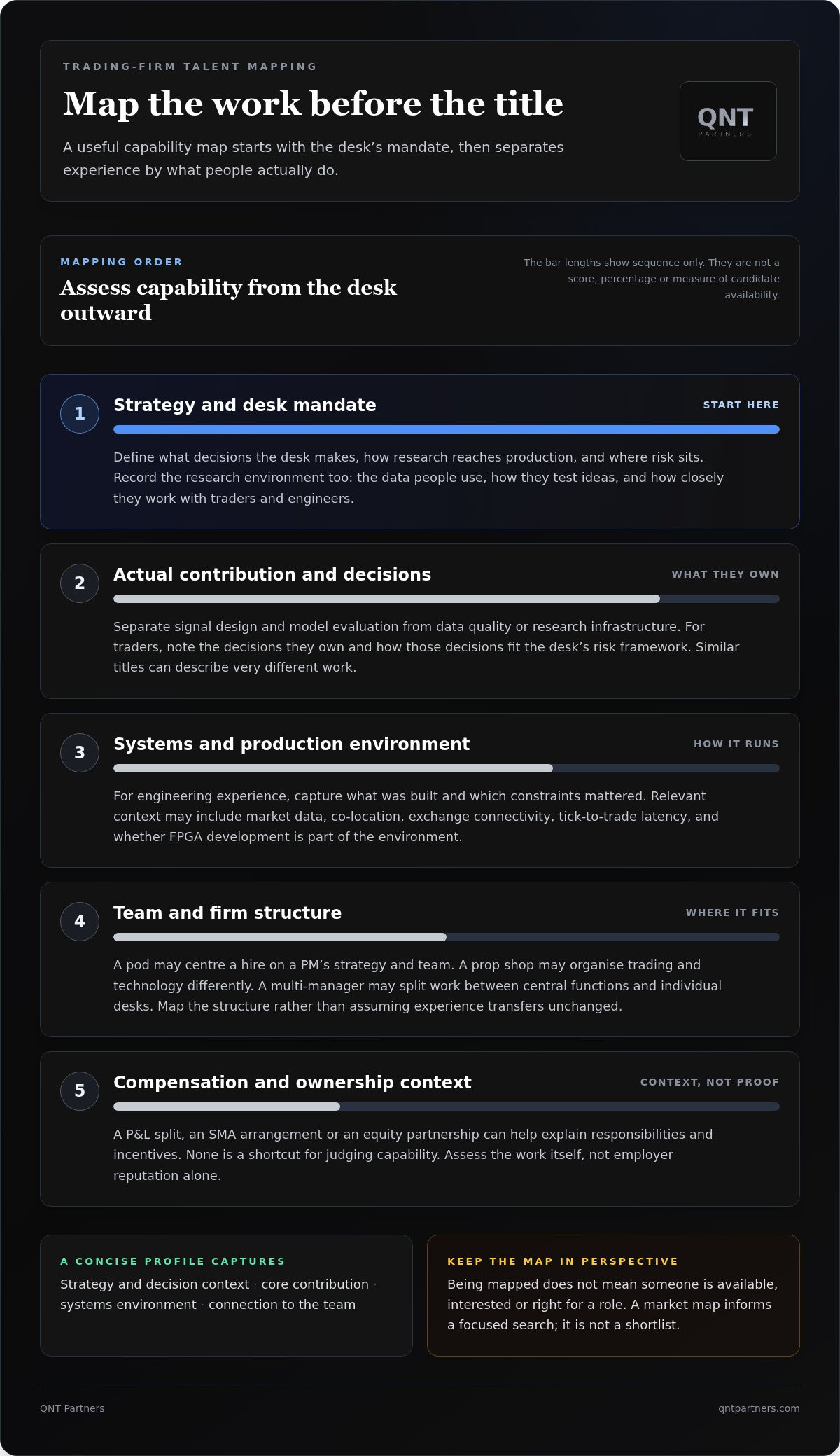
A job title is a poor unit of analysis for a trading hire. Start with the desk’s mandate: what decisions it makes, how research reaches production and where risk sits. A useful map records the capabilities that mandate calls for, the talent pools where they may be found and market changes that could affect a search.
That’s different from a database that pairs names with labels such as “quant researcher” or “C++ developer”. Those labels don’t tell you whether a researcher owns signal design or maintains an existing model, or whether an engineer works on exchange connectivity, market data or another part of the stack. Talent mapping for trading firms is useful when it captures those distinctions without treating a mapped person as an active candidate.
The desk provides the context for interpreting experience. Consider the research environment: what data people use, how they test ideas and how closely they work with traders and engineers. The same title can describe different responsibilities at a pod shop, a prop shop or a team managing an SMA. A map should make those differences visible before a role opens.
What makes a trading-firm talent map different?
It connects role requirements to how the desk makes decisions and organises work. A systematic build-out might need researchers who can develop signals within a particular investment process, with engineers supporting the route from research code to live execution. A new prop desk may put more weight on trading judgement and the systems used to execute its strategy. Research, trading and engineering overlap, but they aren’t interchangeable categories.
Broader Talent Management Principles provide a foundation, but a trading map has to translate workforce planning into desk-level capability. Employer names alone won’t do that. Record fit against the actual work and team structure, then use the map to sharpen the questions behind a future search.
When does mapping become useful?
Start when there’s a decision on the horizon, not only after a vacancy appears. A planned desk expansion, possible spinout or capability gap in research or execution can justify an early market view. That view helps test whether the proposed structure matches the experience the firm may need to reach, before the search brief hardens.
Mapping informs decisions; it isn’t a hiring forecast. Someone’s circumstances can change, and appearing in a map doesn’t mean they’re available, interested or right for the role. Keep the work discreet and tied to the capability question. If the desk’s plans change, revisit the assumptions before turning the map into a search brief.
Map capability clusters across trading, research and technology
A useful capability map describes what someone contributes to a trading system, not every tool they’ve touched. Group experience by the work and where it has an impact: forming and testing signals, making trading decisions, or building systems that support execution. These groups can overlap, but they shouldn’t be collapsed into one broad “quant” category.
A trading-firm capability map connects a person’s decisions and technical work to a specific strategy, desk structure and production environment. That’s the test I use to decide whether two similar CVs represent the same talent pool or different kinds of experience.
Separate similar titles by actual work
For researchers, record the strategy context, modelling responsibilities and proximity to traders. One researcher may develop signals and own model evaluation; another may focus on data quality or research infrastructure. Both can be called quant researchers, but their day-to-day work may be relevant to different roles.
Apply the same discipline to trading roles. Map the decisions a trader owns, how they fit the desk’s risk framework and whether the role sits in a pod, a centralised team or a prop operation. “Trader” and “PM” don’t, by themselves, show decision scope or how performance is assessed.
For engineering, distinguish general software development from low-latency systems work. Relevant context may include co-location, exchange connectivity, tick-to-trade latency and whether FPGA development is part of the environment. A technology inventory tells you less than a clear account of what the engineer built, which constraints mattered and how the system connected with trading and research.
Account for firm and team structure
Structure shapes the role, not the quality of the person. A pod shop may define a hire around a PM’s strategy and team; a prop shop may organise trading and technology differently; a multi-manager firm may divide responsibilities between central functions and individual desks. Capture those differences rather than assuming experience transfers unchanged between models.
Compensation and ownership context can also help explain a role. A P&L split, an SMA arrangement or an equity partnership may shape someone’s responsibilities and incentives, but none is a shortcut for judging capability. Note the structure as context, then assess the work itself. Broader Talent Management in Financial Services discussion can frame industry-level considerations, while a trading-firm map needs to stay specific to the desk.
Keep each profile concise: the strategy and decision context, the person’s core contribution, the systems environment and how the role connects with the team. That gives a hiring manager a practical basis for comparing talent pools without turning the map into a credential checklist. For a specialised search, QNT Partners can help define the desk’s capability requirements.
Compare talent pools by fit, not by employer name
A recognisable firm name can make a profile look relevant before you’ve established what the person did. Treat employer history as a lead, not a verdict. Two researchers at the same organisation may have worked on different strategies, data or stages of the research process. Someone at a lesser-known firm may have experience that maps more directly to the desk you’re building.
Use a compact comparison matrix to keep the assessment consistent across talent pools:
- Capability: What work did the person own, and where did their contribution sit in the trading process?
- Strategy context: What market, instrument or research problem shaped that work?
- Systems environment: Which infrastructure or technical constraints were central to the role?
- Likely role fit: Which parts of the target role appear to align, and what needs further assessment?
Capability fit tells you more than employer-name matching because it connects a person’s actual work to the desk’s operating requirements. A researcher from a small systematic fund, for example, may suit a new build-out if their research process and strategy context align. A researcher at a larger firm may have a different remit. Neither the name nor the size of the firm answers the fit question on its own.
Build a useful view of adjacent talent pools
Include adjacent talent only when there’s a credible link between someone’s experience and the role. A researcher from another strategy may bring transferable modelling or data skills, but the market structure and decision process still matter. For an execution-focused role, experience in another electronic market may be relevant if the systems constraints resemble those of the target desk. Similar vocabulary isn’t enough.
Apply the same discipline to crypto-to-tradfi moves. Digital-asset experience may be relevant when the work and technical environment connect to the role, but it isn’t a universal source of trading talent. I’ve written about the tradfi-to-crypto transition as a pathway whose relevance depends on the individual’s experience and the destination team.
Keep the map discreet and defensible
In public-facing examples, describe firms by type or location unless their identity is public. Internally, distinguish observed market information from assumptions about a named person. A team change may be visible; an individual’s interest in moving usually isn’t. Don’t turn one into a claim about the other.
A map should guide a focused search, not become unsolicited outreach by another name. Record the basis for a fit assessment, keep sensitive detail limited to what the decision requires and revisit assumptions before acting on them. Comparisons between talent pools should help define the search without implying that anyone mapped has agreed to be part of it.
Keep a talent map current without turning it into a static list
A talent map loses value when it looks current but rests on old assumptions. With talent mapping for trading firms, the point of a refresh isn’t to update every profile on a calendar. It’s to check whether the market view still helps answer the hiring decision in front of you.
Use a simple cycle:
- Define the decision. Clarify which role, desk plan or capability gap the map needs to inform.
- Map relevant capabilities. Focus on skills and operating context connected directly to that decision.
- Validate the picture. Separate confirmed information from interpretation, and record when the map was reviewed.
- Refresh when conditions change. Revisit the map when the decision, market signals or assumptions shift.
There’s no useful universal refresh interval. A map for a live build-out may need attention as plans develop; one supporting a longer-term capability discussion may stay relevant until something material changes. Set review timing according to the decision and relevant market movement, not an arbitrary monthly or annual schedule.
Validate the map against the hiring decision
Before relying on a map, check that each capability still relates to the role and strategy under consideration. If a desk shifts from planning research capacity to building an execution function, the relevant talent pool may change. The same applies when the mandate or infrastructure requirements change, such as when a team revises its approach to exchange connectivity or co-location.
Label the basis for each useful observation. A confirmed role change is different from an interpretation of what it might mean for someone’s next move. Record the review date and mark uncertainty plainly. That helps the next person using the map distinguish evidence from a working hypothesis.
Use mapping before a search opens
A market view is preparation, not candidate assessment. It can sharpen a search brief by clarifying which capabilities are essential, which adjacent backgrounds may transfer and where the role’s requirements need further definition. Once the firm is ready to hire, the brief can inform a focused search. People identified during mapping still need to be approached appropriately and assessed against the role.
Mapping describes a market and informs a decision; it doesn’t establish someone’s interest, suitability or availability, and it doesn’t promise a placement. Quant trading recruitment should carry market context into the search without treating preliminary intelligence as a shortlist.
For a specialised search, QNT Partners can help define the capability and timing considerations.
How QNT Partners uses trading-market context in talent advisory
Hiring plans often expose an organisational question before they expose a vacancy. I’m James, co-founder of QNT Partners. In advisory work, I start by asking where a capability should sit, who it needs to work with and what decisions it should own. Our experience in quant trading, research and technology helps keep those questions grounded in how the teams operate.
For a new build-out, sequencing may be the key issue. A firm might need research leadership before adding individual contributors, or need to clarify ownership between a central engineering group and a trading desk. Those choices affect reporting lines, interfaces and later role briefs. Our work on quantitative trading team design considers how organisational decisions shape the capabilities a firm needs.
From market view to a focused search
Once the organisational question is clear, we can connect it to the right area of search. A mandate centred on model development calls for a different conversation from one focused on low-latency infrastructure or engineering leadership. We specialise in quantitative trading, research and technology recruitment, including AI and machine-learning search, and use that context to help firms define a role’s scope and seniority.
Talent strategy advisory sits alongside executive search at QNT Partners. We can work through the design question as well as the hiring requirement, rather than treating an unclear structure as a wording problem in a job description.
When to bring in a specialist partner
A discreet build-out, a spinout or a technical mandate spanning research and engineering can benefit from an outside perspective before the structure is fixed. A specialist can test the assumptions behind proposed roles and identify where the brief needs sharper boundaries. That’s useful when the investment goal is clear but the division of responsibilities isn’t.
For help working through those decisions, QNT Partners provides talent advisory and specialist search.
Make the next hiring decision more deliberate
Connect the market view to a decision your desk needs to make. Before a planning meeting, write down the capability that could constrain the build-out, what evidence would change your view of the gap and who needs to weigh in. That gives the discussion a practical focus, whether the decision concerns a researcher, a trading mandate or a technical hire.
This preparation also helps separate a defined need from the assumption that the team simply needs more people. Talent mapping for trading firms is valuable when it improves the choices in front of you, not when it grows into an ever-expanding list.
If you’re planning a build-out or defining a specialised mandate, talk to QNT Partners about your team’s hiring priorities.
Frequently Asked Questions
What is talent mapping for trading firms?
It’s a way to test a proposed team design against the experience available in the market. For example, a firm considering one role that combines research and production coding can compare that profile with a design that separates the responsibilities. The map can show where a role may be too broad or where the division of work needs another look.
How is talent mapping different from recruitment?
Recruitment is the active work of filling an approved role, including approaching people, holding conversations and progressing suitable candidates through selection. Mapping informs decisions that come before that work, such as whether the role should be senior or its remit narrowed. The distinction is useful when a firm is exploring options but hasn’t authorised a search.
How often should a trading firm update its talent map?
There’s no fixed interval that suits every map. Assign someone to own it and make the review date visible, so decision-makers know how recently its assumptions were checked. A change log can show what was revised and why. Retire details that no longer support a decision instead of carrying them forward as if they were current.
Can talent mapping identify candidates for a confidential build-out?
Yes. A confidential project can be assessed through role scenarios before the firm identifies itself or approaches individuals. One practical approach is to share an anonymised capability brief with a small, authorised group, then compare possible team configurations without circulating named profiles widely. This keeps early planning focused on the mandate and limits unnecessary disclosure while the structure is being considered.
What should a quant trading talent map include?
Include the factors that affect whether someone’s experience can transfer: decision rights, reporting lines, expected collaboration with research or engineering, and stated mobility constraints such as garden leave. Keep constraints separate from conclusions about availability. During a live search, timing and contractual circumstances need proper attention, but a preliminary map shouldn’t imply that someone can move on a particular date.
Should a talent map include competitor firms?
It can, but separate firms being considered as talent sources from firms used as organisational comparators. The first group can help show where relevant experience sits; the second can help examine how other teams divide responsibilities. Keeping those categories distinct prevents an organisational benchmark from being mistaken for a likely source of hires. In public-facing examples, don’t name firms unless their identity is public.