Systematic Investment Manager Vetting: Auditing the Machine, Not Just the Model

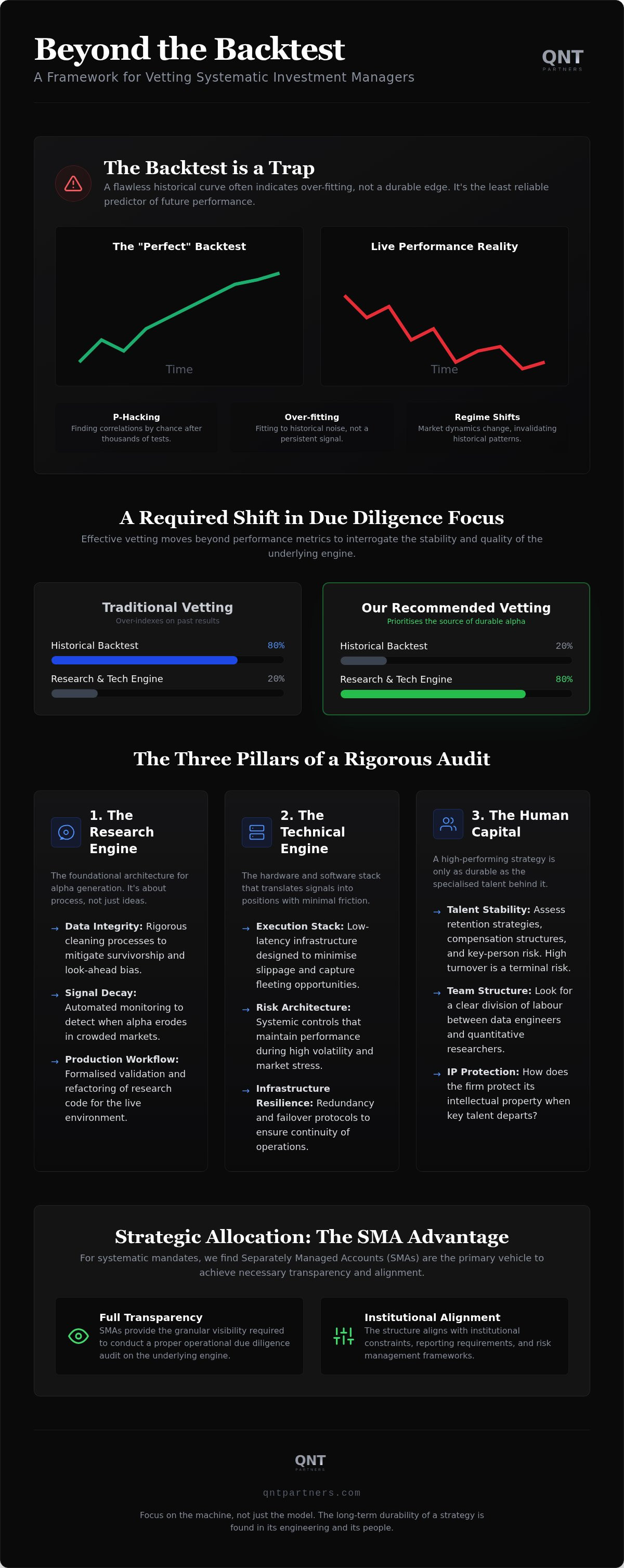
A flawless backtest is often the least reliable indicator of a quantitative strategy's future performance. While many allocators focus their due diligence on historical sharpe ratios, the true source of systemic risk resides within the research engine and the stability of the engineering team. Rigorous systematic investment manager vetting demands a shift in perspective, prioritising a comprehensive evaluation of the machine over a narrow audit of the model.
Selecting a manager involves an intimate understanding of how technical infrastructure handles market stress and how talent retention strategies protect intellectual property. You likely recognise that a high-performing strategy is only as durable as the code and the specialised talent behind it. This article provides a repeatable framework for institutional selection, offering clarity on the technical requirements of elite quant firms and the human capital markers that signal long-term continuity. We will examine the dual-track audit process, covering data integrity, infrastructure resilience, and the operational risks inherent in SMA allocations.
Key Takeaways
- Shift focus from historical backtests to the underlying research engine to avoid the common pitfalls of over-fitting and regime shifts.
- Evaluate data sourcing and signal generation processes to ensure the manager can effectively identify and adjust for alpha decay in crowded markets.
- Assess execution management systems and risk architecture to confirm the technical infrastructure maintains performance during periods of high market volatility.
- Conduct a rigorous human capital audit as part of your systematic investment manager vetting to mitigate the terminal risks associated with talent turnover.
- Consider Separately Managed Accounts as the primary vehicle for systematic mandates to achieve the necessary transparency and alignment with institutional constraints.
Beyond the Backtest: The Imperative for Rigorous Systematic Vetting
Systematic investment management has evolved from simple trend-following rules into a complex synthesis of high-frequency execution and machine learning architectures. In the current environment, distinguishing between genuine alpha and automated beta requires a more granular approach than traditional Investment Management Overview frameworks suggest. Effective systematic investment manager vetting moves beyond the surface level of historical performance to interrogate the stability of the underlying research engine. This process requires a dual-track audit focusing on both the technical infrastructure and the human capital that sustains it.
The backtest paradox remains a primary hurdle for institutional allocators. Stellar historical returns are frequently the weakest indicator of future performance because they often reflect a model's ability to fit historical noise rather than capture enduring market inefficiencies. While passive factor-beta strategies offer transparent exposure to known risk premiums, active systematic strategies seek to exploit transient opportunities through superior data processing and execution speed. A rigorous audit must therefore prioritise three core pillars:
- Research Methodology: The process of signal discovery, data validation, and the prevention of selection bias.
- Execution Infrastructure: The hardware and software stack that translates signals into market positions with minimal slippage.
- Human Capital: The stability and technical mastery of the engineering and research teams responsible for model evolution.
The Limitations of Traditional Performance Analysis
Traditional metrics like the Sharpe ratio can be deceptive in quantitative contexts. High ratios often mask significant tail risk or are the result of p-hacking, where researchers test thousands of variables until a statistically significant pattern emerges by chance. Backtest over-fitting is the primary risk in contemporary manager selection, representing a failure to distinguish between signal and coincidental historical correlations. Allocators must look for evidence of out-of-sample testing and walk-forward analysis to verify that a strategy possesses genuine predictive power.
Systematic vs Discretionary: The Evolving Spectrum
The rise of quantamental approaches has blurred the lines between automated and human-led decision making. While human intervention is often necessary for high-level risk management or responding to exogenous shocks, a truly systematic mandate must possess a repeatable, code-governed process for signal generation and trade execution. Establishing a baseline requirement is essential; the strategy's core logic should remain programmatic and independent of daily discretionary bias to ensure scalability and consistency in complex SMA mandates.
Auditing the Research Engine: Data Integrity and Signal Generation
The research engine serves as the foundational architecture for alpha generation. Effective systematic investment manager vetting requires a granular assessment of the data universe, extending beyond simple price-volume feeds into proprietary or alternative datasets. Managers must demonstrate a rigorous approach to data cleanliness, specifically addressing how they mitigate survivorship and look-ahead bias. High-tier firms often maintain a distinct separation between data engineers, who focus on the integrity of the pipeline, and quantitative researchers, who develop the signals. This division of labour ensures that the raw material is verified before it enters the modelling stage.
Understanding signal decay is equally critical. In crowded markets, alpha tends to erode as strategies become commoditised. A sophisticated manager implements automated monitors to identify when a signal's performance deviates from its expected decay profile. The transition from research to production is another area of risk. Institutional allocators should look for a formalised workflow where code developed in research environments is independently validated and refactored for the live market. This ensures that the machine remains consistent with the model under real-world conditions. Aligning these technical requirements with institutional standards is a core component of SEC Guidance on Due Diligence, which emphasises the need for independent verification of a manager's claims.
Data Governance and Alternative Data Sets
Proprietary data acquisition is a significant differentiator. Vetting should include an analysis of the firm's data spend and the uniqueness of their sources. If a manager relies solely on publicly available data, their signals are likely to be highly correlated with the broader market. Integrity checks must be programmatic. Manual cleaning processes introduce human error and lack the scalability required for modern systematic mandates. Evaluating these technical nuances requires a partner with deep operator experience. If you are refining your selection criteria, consult with our advisory team to discuss bespoke vetting frameworks.
Machine Learning and Model Complexity
The trade-off between model interpretability and raw performance is a central theme in AI-driven strategies. While deep learning can capture non-linear relationships, it often creates black box risks that are difficult to monitor. Allocators must demand a level of transparency that explains the economic logic behind the model's decisions without requiring the disclosure of sensitive IP. Stress-testing these models against historical regimes, such as the 2010 Flash Crash or the 2020 volatility spikes, provides insight into how the machine behaves when data distributions shift unexpectedly. This level of scrutiny is essential to ensure that the strategy can adapt to novel market conditions without catastrophic failure.
Operational Due Diligence (ODD): Stress-Testing the Technical Engine
The transition from a theoretical signal to a live market position is where most systematic strategies face their greatest operational friction. Rigorous systematic investment manager vetting must move beyond the research notebook to evaluate the hardware and software that execute the trade. This process involves a granular audit of the Execution Management System (EMS) to determine how the manager measures and mitigates slippage. In high-turnover strategies, even minor latencies can erode the alpha generated by the model, making the technical engine a primary driver of net performance.
Cybersecurity protocols must now align with heightened regulatory standards, including the June 2026 compliance deadline for SEC Regulation S-P amendments. These rules require a written incident response program for data breaches, a critical requirement for any manager handling institutional capital. Vetting should confirm that the firm's disaster recovery plans include redundant connectivity and hot-failover capabilities, ensuring that low-latency operations remain stable during unexpected infrastructure outages. Protecting the algorithmic code is as vital as protecting the capital itself.
Infrastructure Calibre: Low-Latency and Cloud Integration
The technical stack defines a firm's execution capability. In high-frequency mandates, the use of specialised hardware like Field Programmable Gate Arrays (FPGAs) or Graphics Processing Units (GPUs) provides a necessary edge in processing speed. You should assess the manager's connectivity strategy, weighing the speed of physical co-location against the scalability of cloud integration to ensure it suits the strategy's turnover profile.
The Risk Management Framework
A sophisticated risk architecture prioritises real-time monitoring over post-trade analysis. Systematic investment manager vetting should include an audit of automated risk limits and hard kill switches designed to prevent algorithmic runaway. While external tools offer a baseline, elite quant shops often develop internal, low-latency risk engines that operate independently of the trading loop to provide an objective layer of safety.
The Human Capital Audit: Talent Stability and Organisational Alpha
Systematic investment manager vetting remains incomplete without a rigorous evaluation of the human capital that builds and maintains the technical stack. While the models are automated, the alpha generation process is inherently human. Allocators must distinguish between academic pedigree and genuine industry operator experience. A team of elite researchers with a history of managing volatile market regimes provides a form of organisational alpha that a purely theoretical team cannot replicate. This audit must also account for evolving regulatory standards, such as the FCA Non-Financial Misconduct Rule effective September 2026, which incorporates culture and conduct into fitness and propriety assessments.
Vetting the Quantitative Research Team
Productivity metrics should focus on the diversity of thought and the rate of signal evolution rather than just the volume of research output. The "Star Manager Risk" is particularly acute in smaller quant shops where a single individual may hold the keys to the core codebase. Assessing the stability of the collective team is essential. Top-tier quant researchers in high-frequency trading firms typically maintain an average tenure of three to five years, with transitions often governed by stringent multi-year garden leave and non-compete clauses.
Organisational Structure and IP Retention
Intellectual property retention is the primary defensive moat for a systematic firm. Vetting should include an audit of how the firm documents its research and protects its codebase during talent transitions. Knowledge must be institutionalised rather than remaining as tribal knowledge held by a few key employees. Effective Organizational Design for Quantitative Trading Firms: A 2026 Strategic Framework ensures that the departure of a CTO or Head of Research does not result in a catastrophic loss of strategy continuity.
Compensation structures must align with the long-term objectives of institutional allocators. Researchers should be incentivised for consistent alpha generation and capital preservation rather than short-term volatility or simple AUM growth. High talent leakage often indicates a misalignment in incentives or a toxic internal culture, both of which are terminal risks for systematic funds. If you require assistance in benchmarking a manager's talent stability, contact our talent strategy advisors to discuss our proprietary search and vetting methodologies.
Strategic Allocation: Navigating SMA Sourcing and Mandate Selection
Institutional allocators are increasingly moving away from commingled fund structures in favour of Separately Managed Accounts (SMAs). This shift is driven by a requirement for greater transparency and direct asset ownership, which are often obscured in traditional pool vehicles. In the context of systematic investment manager vetting, an SMA allows the allocator to audit trade execution in real-time, ensuring that the manager’s live activity remains consistent with the documented model. This structural choice provides a defensive layer against style drift and operational opacity.
Customisation is a primary advantage of the SMA framework. Systematic strategies can be tailored to meet specific institutional constraints without compromising the core alpha engine. Whether an allocator requires stringent ESG overlays, specific liquidity profiles, or caps on portfolio leverage, the programmatic nature of these strategies allows for precise adjustments. Fee structures are also evolving to reflect this alignment. The industry is transitioning from the traditional "2 and 20" model toward performance-aligned SMA pricing, where management fees are compressed and incentives are directly linked to risk-adjusted net returns.
The Benefits of SMA Sourcing for Systematic Strategies
SMAs provide a level of oversight that commingled funds cannot replicate. By maintaining assets in their own custody, institutions eliminate the counterparty and operational risks inherent in shared vehicles. This structure also facilitates SMA SVA Partnerships, where technical expertise and institutional capital are aligned through a high-governance framework. Real-time oversight of algorithmic execution allows allocators to verify that the manager is adhering to execution quality standards and risk limits as markets evolve.
The Final Selection Checklist
Before an investment committee presentation, the vetting process should culminate in a final verification of the technical and organisational machine. Key points include:
- Verification of data provenance and cleaning protocols.
- Evidence of out-of-sample signal stability and walk-forward analysis.
- Audit of hardware latency and execution slippage metrics.
- Independent validation of automated risk "kill switches".
- Assessment of research-to-production code deployment workflows.
- Review of researcher tenure and historical talent turnover.
- Evaluation of internal knowledge management and IP retention.
- Alignment of performance-based fee structures with institutional goals.
- Confirmation of Regulation S-P and conduct rule compliance.
- Verification of disaster recovery and infrastructure failover systems.
Red flags that should immediately terminate the vetting process include unexplained model drift, a lack of formalised incident response plans, or significant talent leakage in the core engineering team. For institutional allocators seeking to lower operational risk in their quantitative allocations, partner with QNT Partners for specialised SMA sourcing and manager vetting advisory.
Evolving the Standard for Systematic Due Diligence
Rigorous systematic investment manager vetting requires a transition from verifying backtests to auditing the technical and human architectures that sustain them. Institutional allocators must prioritise technical resilience and human capital stability to mitigate the risks of black box failure or sudden alpha decay. By focusing on the research engine and the engineering team, you ensure that your allocations are built on durable operational foundations rather than transient historical noise.
The move toward Separately Managed Accounts provides the transparency required to monitor these complex architectures in real-time. QNT Partners is specialised in sourcing elite quant and AI/ML talent and facilitating complex institutional SMA mandates through deep industry operator expertise in systematic trading. Maintaining this level of technical precision and professional discretion remains the only viable path to consistent performance in an increasingly automated sector. Contact QNT Partners for Strategic SMA Sourcing & Talent Advisory to refine your manager selection framework. We look forward to supporting your strategic objectives.
Frequently Asked Questions
What is the difference between operational due diligence and investment due diligence in systematic vetting?
Investment due diligence focuses on the strategy's alpha potential and signal logic, while operational due diligence audits the technical and organisational infrastructure supporting it. In systematic investment manager vetting, the operational audit examines the execution engine, risk controls, and cybersecurity protocols. While investment diligence ensures the model can generate returns, operational diligence confirms the machine can deliver them without failure. Both are essential to mitigate the risk of black box strategies failing in live markets.
How can an allocator detect backtest over-fitting in a quant manager’s pitch?
Allocators should look for excessive complexity in the model's parameters and a lack of out-of-sample or walk-forward testing. If a manager’s pitch focuses exclusively on historical Sharpe ratios without explaining the economic logic of the signals, over-fitting is likely. Ask for performance data from regimes different to the one where the signal was discovered. Genuine alpha should persist across varying market conditions rather than relying on a narrow historical window to show results.
What role does AI and Machine Learning play in modern systematic manager vetting?
AI and machine learning allow allocators to automate the analysis of massive datasets to identify hidden correlations and style drift in a manager's portfolio. Modern vetting uses machine learning to stress-test models against synthetic market scenarios, simulating flash crashes or liquidity crises. This technical approach helps verify a firm’s claim of using deep learning or neural networks, ensuring the complexity of the strategy is justified by its predictive performance and operational logic.
Why is talent turnover such a high-risk factor for quantitative hedge funds?
Talent turnover is a terminal risk because quantitative strategies are deeply tied to the specific researchers and engineers who built them. When key personnel depart, the firm loses the institutional knowledge required to evolve the model as market regimes shift. High turnover often signals cultural issues or misaligned incentives, which can lead to intellectual property leakage. Stability in the technical team is a primary indicator of long-term strategy continuity and organisational alpha.
What are the specific advantages of using an SMA for systematic investment mandates?
Separately Managed Accounts offer institutional allocators full transparency, direct asset ownership, and real-time oversight of execution. Unlike commingled funds, an SMA allows for the customisation of risk limits and ESG constraints to meet specific mandate requirements. This structure eliminates counterparty risk and provides a clearer view of the manager’s algorithmic activity. It is the preferred vehicle for those demanding the highest level of professional discretion and operational control over their capital.
How should an allocator evaluate a black box strategy without seeing the source code?
Vetting a black box strategy requires an audit of the inputs, outputs, and the research-to-production workflow rather than a line-by-line code review. Allocators should examine the data cleaning protocols, the logic behind signal generation, and the automated risk management framework. By interviewing the researchers and testing the model’s response to non-linear market events, you can gain confidence in the strategy's integrity without compromising the manager’s proprietary intellectual property or technical secrets.
What are the key technical infrastructure requirements for a high-frequency systematic manager?
High-frequency managers require low-latency execution engines, often utilising specialised hardware like FPGAs and GPUs for rapid signal processing. Technical pipelines with redundant connectivity to major exchanges are essential to minimise slippage and ensure execution quality. Vetting should also confirm the presence of real-time risk monitors and automated kill switches that operate independently of the trading loop. These requirements ensure the firm can execute high-turnover strategies with precision and resilience during periods of market stress.
How often should a systematic manager be re-vetted after the initial allocation?
Ongoing monitoring should occur at least quarterly, with a comprehensive re-vetting conducted annually or following significant internal changes. These events include major technical infrastructure upgrades, shifts in market regimes, or departures of key personnel like the CTO or Head of Research. Regular audits ensure the strategy remains aligned with its original mandate and that the firm’s operational standards haven't eroded over time. Consistent oversight is critical to managing the evolving risks in systematic trading.