Statistical Arbitrage Recruitment: Hiring for the Full Strategy in 2026

Good statistical arbitrage recruitment starts with the strategy’s research-to-execution loop, not a generic quant job description. A researcher who can explain signal decay may still be the wrong hire if the role centres on portfolio construction or live execution.
I’ve seen role briefs blur ownership across research, trading and engineering, then rely on broad quant questions that reveal little about how someone will work in the seat. For a stat arb team, the useful evidence is specific: how a candidate formed a hypothesis, tested it against market data and handled the gap between a backtest and production.
This article shows how to define a hire around your operating model and assess contribution rather than relying on titles or credentials. I’ll cover how to map the role to the strategy’s workflow, build a focused search and account for candidate moves, garden leave or non-competes discreetly. The aim is a brief that reflects the mandate and an interview process that tests judgement relevant to it.
Key Takeaways
- Define the mandate from the strategy’s operating model. Identical quant titles can conceal very different responsibilities.
- Map where research ends and implementation begins to clarify the contribution expected from the hire.
- Use statistical arbitrage recruitment to test mandate-specific evidence, not broad quant credentials alone.
- Agree ownership and assessment criteria before approaching candidates to keep a confidential search focused.
- Operator-informed role calibration can make candidate conversations more precise without exposing protected strategy details.
Statistical arbitrage recruitment starts with the strategy’s operating model
“Quant researcher” can describe two jobs with little day-to-day overlap. One person may own signal research and validation. Another may spend most of the week working out how signals behave once they meet costs, portfolio constraints and live execution. Statistical arbitrage recruitment works when the brief makes that distinction clear instead of treating a familiar title as a complete description of the mandate.
The strategy sets the requirements. Instruments shape the market data and domain knowledge a hire needs. Holding period affects how research connects to execution and which decisions need to happen close to the market. A strategy built around slower-moving relationships won’t have exactly the same workflow as one whose edge is sensitive to rapid changes in liquidity. The role brief should explain which of these differences matter to the seat.
For background on the term and its development from pairs trading, see What is statistical arbitrage? For hiring, a general description of the strategy is only a starting point. The useful question is which parts of its research and implementation the new person will own.
What the strategy requires from its team
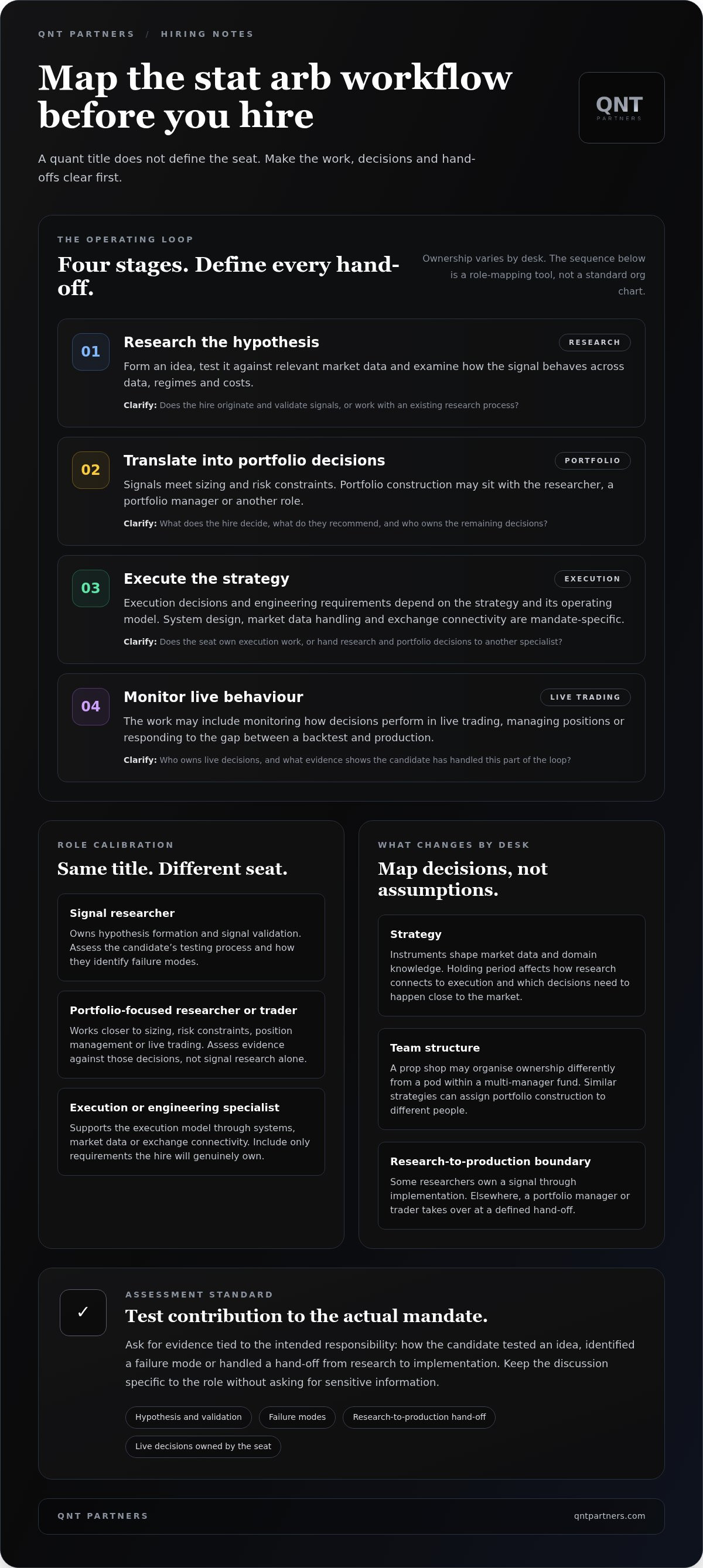
A candidate may begin with a market hypothesis, turn it into a testable signal and examine how it behaves across data, regimes and costs. The next stage may involve translating research into portfolio decisions and monitoring how those decisions perform in live trading. That chain doesn’t always sit with one person. In one team, researchers may own a signal through implementation. In another, a portfolio manager or trader takes over at a defined hand-off.
Execution and live trading bring different responsibilities from research. The role might include position management or execution decisions, while engineering may focus on the systems that support the strategy. The split depends on the firm’s structure and the strategy’s demands. Name the actual hand-offs in the brief rather than implying there is one standard desk model.
Why generic quant job descriptions underperform
Broad requirements such as “strong modelling skills” or “experience with systematic strategies” can attract capable people while leaving the job unclear. Candidates can’t tell whether they’ll develop hypotheses, improve an existing research process or take signals into production. The hiring team may then assess different candidates against different assumptions about the seat.
Unclear ownership also weakens interviews. A discussion of modelling technique may be relevant, but it won’t establish whether someone can do the work this mandate needs. Ask for evidence tied to the intended responsibility: how the candidate tested an idea, identified a failure mode or handled a hand-off from research to implementation. Keep the discussion specific to the role without asking for sensitive information.
Strategy-led hiring defines a role by the decisions and work a person will own across the strategy’s research and implementation process. That is more useful than a checklist of credentials because it gives the hiring team a consistent basis for assessing fit.
There is no universally ideal quant profile for every stat arb desk. A strong researcher may be a poor match for a seat centred on live portfolio decisions, while a trader may not be expected to originate signals. Get ownership clear first. Then map responsibilities across research, trading and engineering and use that map to guide the search.
Map research, trading and engineering to the statistical arbitrage workflow
A statistical arbitrage strategy runs through a chain of decisions, but the people responsible for each stage vary by desk. A signal moves from research into portfolio construction, where it meets sizing and risk constraints, then into execution. Recruitment gets more precise when the role brief identifies who owns each hand-off and what the next person in the chain needs from them.
That map also shows where a delay or mismatch can affect the work. If a researcher hands a signal to a portfolio manager, define what research delivers and which portfolio decisions sit elsewhere. If the researcher owns the signal through implementation, assess their ability to work across that boundary. These are different seats, even if both carry the same title.
Quantitative researchers and traders
Researchers may form hypotheses, test them against relevant data and evaluate whether a model’s behaviour supports further development. The role might also include examining sensitivity to costs or changes in the instruments being traded. The brief should distinguish those research tasks from live decisions about risk, position sizing and trading.
Those responsibilities don’t divide uniformly. A prop shop may organise ownership differently from a pod within a multi-manager fund, and two teams with similar strategies may place portfolio construction with different people. Specify what the hire decides, what they recommend and where another role takes over. This lets you assess a candidate’s evidence against the actual seat rather than an assumed desk structure.
Technology and execution specialists
Engineering requirements should follow the execution model. A role may focus on system design, market data handling or exchange connectivity. Co-location may matter when the strategy’s infrastructure depends on proximity to an exchange. Include these requirements in the brief only when they describe work the hire will genuinely own.
Tick-to-trade latency and FPGA experience are equally specific to the mandate. If execution speed is central to the strategy, define the engineering problem and assess experience against it. If the strategy doesn’t depend on that work, adding FPGA or ultra-low-latency credentials narrows the search without improving fit. Technical keywords aren’t a substitute for a clear account of the systems the team runs.
Research develops the signal, trading connects it to portfolio decisions, and engineering supports the execution path the strategy requires. That’s one operating loop, even when the functions sit in separate teams.
For statistical arbitrage recruitment, I’d turn that loop into a short ownership map before screening candidates: what enters each stage, who makes the decision and what evidence shows they can do the work. We use this kind of role calibration in our quant and technology searches, grounded in how the desk is organised. A precise map gives interviewers a shared test of fit and candidates a clear view of what they would own.
Why a generic quant brief misses statistical arbitrage talent
A strong generalist quant can bring valuable modelling skill, but that alone doesn’t show they can contribute to a particular stat arb mandate. The relevant evidence depends on the seat. A researcher expected to challenge a signal should explain how they framed and tested it. Someone responsible for implementation should show how their work moved from analysis into a live process. Statistical arbitrage recruitment should test that connection, not treat general quant ability as a proxy for role fit.
A compact comparison helps turn broad requirements into interview evidence:
Research judgement: Generic signal, “strong statistical background.” Mandate-specific evidence, how the candidate formed a research question, selected a test and interpreted an ambiguous result.
Work ownership: Generic signal, “experience building models.” Mandate-specific evidence, what the candidate personally owned and where responsibility passed to a portfolio manager, trader or engineer.
Implementation: Generic signal, “production experience.” Mandate-specific evidence, how research was monitored, revised or connected to trading decisions in the candidate’s actual role.
Outcomes: Generic signal, an impressive team result. Mandate-specific evidence, the candidate’s contribution and the decisions they influenced.
Evidence that reflects the mandate
Listen for the candidate’s reasoning, not only the result. How did they decide a relationship warranted testing? What assumptions did they examine, and what would have changed their conclusion? A thoughtful answer can reveal research judgement even when commercial details must remain private.
Then tie the discussion to the brief. If the hire will contribute to monitoring or trading decisions, ask for an example of how their analysis informed that work. If implementation sits elsewhere, assess the quality of their hand-off instead. The standard is evidence against the stated responsibilities, not breadth for its own sake.
Structure the interview around actual work
Use a technical discussion that reflects the strategy’s instruments and research process without disclosing protected signals or portfolio details. A hypothetical problem can test how someone approaches data quality, a changing relationship or an inconclusive result. Keep the scenario close enough to the role to reveal judgement, but separate it from proprietary models and live trading data.
Probe individual contribution carefully. “The team deployed a model” says little about who framed the hypothesis, made the implementation decision or monitored the result. Ask candidates to describe their own decisions and the constraints they worked within. Don’t request source code, confidential models or trading records as proof.
Titles and credentials can help describe a background, but they’re weak substitutes for role evidence. A single interview result is also a narrow sample, especially if it tests only mathematical fluency. Assess research judgement, ownership and implementation contribution against consistent criteria, then compare the evidence across candidates. This gives a generalist a fair route to demonstrate fit and stops a polished CV from standing in for the work the seat requires.
Build a focused statistical arbitrage search without exposing the mandate
A discreet search still needs enough detail for candidates to decide whether a conversation is relevant. Separate information that helps assess the opportunity from information that could reveal the strategy. Agree that boundary before the first approach, and apply the same standard across everyone involved in the search.
Use a defined sequence:
- Define ownership. Record the decisions, deliverables and interfaces attached to the hire, including what sits outside the role.
- Calibrate evidence. Agree which experience is essential, which capability can be developed, and what interviewers need to hear to assess fit.
- Map candidates. Identify relevant backgrounds and potential conflicts before outreach, rather than circulating a broad, speculative list.
- Assess fit. Compare candidates against the agreed criteria, while tracking their individual availability and process preferences.
This sequence keeps the search centred on the mandate without putting confidential mechanics into general circulation.
Calibrate the brief before approaching candidates
Separate requirements that must be present on day one from skills the team can build after the hire starts. Be precise about the level of independence expected, the people the role will work with and the decisions it can influence. That detail helps interviewers describe the opportunity consistently and stops a single preferred CV from quietly becoming the job specification.
For a build-out or spinout, anonymise the firm and remove details that could identify its strategy or backing. The initial description can still outline the team’s stage, broad mandate and reporting structure. Decide in advance what further information can be shared, with whom and at what point. Our specialist quant and technology search work is grounded in this kind of role calibration.
Run a discreet, evidence-led process
Sequence conversations so candidates first understand the role’s scope, seniority and working context. If there is mutual interest, share additional detail selectively and only when it helps the candidate assess the opportunity. Keep written materials consistent with the conversation, and avoid circulating strategy-sensitive documents more widely than necessary. A controlled process protects the mandate while giving candidates a meaningful basis for deciding whether to proceed.
Give timing the same individual attention. Ask each candidate about their likely availability and any garden leave or non-compete constraints that may affect a move. Don’t assume those conditions are uniform or treat one person’s situation as a market rule. Record the candidate’s own account, revisit timing as the process advances and avoid promising a start date before the relevant details are clear.
A focused search is easier to manage when the hiring team agrees on disclosure boundaries, interview responsibilities and how timing will be discussed. The result is fewer mixed messages and a clearer basis for deciding which conversations should move forward.
How QNT Partners approaches specialist statistical arbitrage recruitment
A useful search starts with the team’s operating constraints, not a standard list of quant credentials. QNT Partners is a boutique recruitment and advisory firm focused on quantitative trading, research and technology. As a co-founder, I find former operator experience most useful when a broad hiring need has to become a clear, assessable role.
We work with clients to establish what has changed in the team and why the hire is needed. Is this a new seat, a replacement or part of a build-out? Which work is accumulating, and where does the team need more capacity or ownership? Those answers help distinguish a genuine requirement from a wishlist assembled from neighbouring roles.
Search built around the team’s actual requirements
We calibrate the brief against the firm’s structure, the seniority of the hire and the work already covered by the desk. That means clarifying what the person is expected to contribute, what they will learn from colleagues and how success will be assessed during the hiring process. We also help clients separate essential experience from preferences that might rule out relevant candidates unnecessarily.
That discussion informs candidate mapping and how we present the opportunity. A research hire needs a different conversation from an engineering specialist, even if both roles support the same strategy. The brief should make the level of ownership clear without exposing protected details. Our quant and technology searches cover the functions involved in technically demanding mandates.
Infrastructure belongs in the search only when it is part of the role. Where the team needs low-latency systems, we focus the engineering search on relevant technology and infrastructure experience. Where the mandate centres on research or trading, the assessment should reflect those responsibilities instead. Keep the profile anchored to what the team needs this person to do, not a collection of fashionable keywords.
Start a confidential discussion
Our search work covers quantitative research, trading, technology and engineering. We also provide talent strategy advisory to help teams clarify hiring priorities as their structure develops. The discussion can begin with the role’s scope, seniority and the capabilities the team needs to add. From there, we shape a focused search and communicate the opportunity with appropriate discretion.
A well-calibrated mandate gives everyone involved a more useful reference point. Hiring leaders can assess candidates against the work, while candidates can decide whether the responsibility fits the next step they want to take. It won’t remove the judgement required in a specialist hire, but it makes that judgement more grounded and consistent.
Set the mandate before the next hire
A hiring brief is part of the strategy’s operating design, not a document to file away once the search begins. As the desk changes, ownership can shift too. A new instrument, a different execution requirement or a change in how research reaches the portfolio may alter the profile the team needs.
I’d revisit the mandate whenever the work itself changes. Check that the person you’re hiring will still own the decisions and hand-offs described in the brief, and that the interview process tests those responsibilities. That keeps statistical arbitrage recruitment tied to the desk’s current needs rather than yesterday’s organisation chart.
At QNT Partners, we work across quantitative trading, research and technology talent. If you’re shaping a hire or refining a search, start a conversation about your mandate. A clear account of the work gives the team a practical place to begin and gives the right candidate a reason to engage.
Frequently Asked Questions
What roles are typically involved in a statistical arbitrage team?
Beyond researchers, traders and engineers, some teams need people who maintain research data, portfolio analytics or operational controls. These functions may sit inside the strategy group or elsewhere, depending on the firm. When scoping a hire, list recurring tasks that currently lack an owner, including data validation or model monitoring. This can expose a support gap that a generic “quant” headcount would leave unresolved.
How do firms assess statistical arbitrage candidates?
Use an interview plan that tests different dimensions rather than asking every candidate the same broad technical questions. A discussion of a past project can test how someone handles uncertainty; a separate, role-relevant exercise can show how they communicate decisions. Agree in advance how interviewers will record observations, then compare candidates against the same criteria. This reduces the risk that confidence or conversational style dominates the debrief.
Should a statistical arbitrage researcher also be a trader?
Only if the role has enough scope and support for both functions. Combining them can suit a team that expects the researcher to stay close to portfolio decisions, but it can also create competing priorities between developing new work and managing existing positions. Before combining responsibilities, define how the person’s time will be allocated and who covers decisions when research demands take priority.
How can a firm recruit discreetly for a statistical arbitrage strategy?
Use a staged approach to sharing information. An initial candidate discussion can describe the team’s mandate and level of responsibility without naming the firm or revealing strategy-specific details. Share further context only with candidates who have a clear reason to continue, and keep internal notes factual and appropriately restricted. This gives candidates enough information to assess relevance while limiting unnecessary circulation of sensitive material.
Can low-latency engineering experience matter in statistical arbitrage recruitment?
It can, but the useful question is which system the engineer will work on. A candidate experienced in exchange connectivity may fit a different problem from one focused on research infrastructure or data pipelines. Describe the engineering remit in terms of the systems owned and the interfaces involved. That makes it easier to distinguish relevant experience from a low-latency label that may not match the actual work.
How should garden leave or a non-compete affect a quant search?
Build timing into the search plan around each candidate’s stated circumstances, rather than assuming a standard availability date. Decide which start windows are workable before interviews progress, then revisit timing if the candidate’s situation changes. Keep discussions discreet and don’t ask candidates to share documents or sensitive details that aren’t needed to plan the process. Treat each case on its own facts.
When should a statistical trading firm use a specialist recruiter?
A specialist recruiter can add value when a search depends on understanding how experience transfers between desk structures, or when the relevant talent pool is difficult to identify by title alone. This can matter for a new team whose roles are still taking shape. A clear internal brief remains essential: it lets the recruiter focus outreach on people whose backgrounds connect to the mandate rather than simply producing a larger list.