SMA Sourcing for Hedge Funds: Finding the Right Institutional Mandate

SMA sourcing for hedge funds works when mandate fit comes before meeting volume. A long list of allocator introductions means little if the strategy, risk parameters and operating model do not suit the investor’s requirements.
An SMA can give an investor more control and transparency than pooled fund capital. The trade-off is a more involved operating relationship, so the structure needs to work for both sides. Fundraising loses focus when managers start conversations before they can explain why their strategy belongs in a particular mandate.
This article sets out how specialist sourcing connects hedge fund managers with relevant institutional investors, and what to assess before committing time to the process. It covers strategy fit, operating capacity and the differences between an SMA and a pooled fund. At QNT Partners, we bring quant and hedge fund market knowledge to manager-investor matching, helping frame a mandate for focused discussions rather than a broad fundraising push.
Key Takeaways
- SMA sourcing for hedge funds is most effective when the manager’s strategy and operating model match an investor’s mandate.
- Assess mandate objectives, strategy capacity and operational requirements before treating headline performance as evidence of suitability.
- Compare an SMA with pooled fund capital by considering governance, operational demands and the level of investor-manager engagement each structure involves.
- A focused sourcing process helps prioritise relevant discussions and communicate the manager’s strategy accurately and discreetly.
- Specialist knowledge of quantitative trading, research, technology and hedge funds can help frame a mandate for more relevant institutional conversations.
SMA Sourcing for Hedge Funds Starts with Mandate Fit
An SMA opportunity makes sense only when the investor’s mandate fits the manager’s strategy and operating model. A credible track record may earn a conversation, but it does not establish that the investor can accommodate the strategy, its capacity needs or the way it runs.
For a hedge fund manager considering institutional capital through a separately managed account, SMA sourcing for hedge funds means identifying suitable investors and creating relevant conversations between them and managers. It is targeted matching, not high-volume outreach. The aim is to understand where a strategy may fit before either side spends time on a process with little chance of alignment.
What SMA sourcing means for a hedge fund manager
Sourcing starts with the mandate, not a generic investor list. Consider the investor’s objectives and constraints alongside the manager’s strategy, capacity and operating requirements. A market-neutral equity strategy and a high-turnover futures programme, for example, may call for very different mandate discussions, even if both managers have compelling performance histories.
The advisory work is to identify plausible points of fit and explain the manager’s approach clearly. That means describing how the strategy trades and where capacity or operational needs matter, without stretching the story to suit an investor. Sourcing can create a path to a relevant conversation. It cannot guarantee an allocation or investment outcome.
How an SMA differs from pooled fund capital
A Separately Managed Account (SMA) is generally arranged for a particular investor, while pooled fund capital is invested alongside capital from other investors in a shared fund structure. That distinction is a starting point, not a complete description of any specific mandate. Terms vary, and the documentation determines the actual arrangement.
For both parties, the practical questions are how the mandate will be run, what reporting is expected and how investor and manager responsibilities are organised. Those details determine whether the structure works in practice. Do not assume the SMA label alone defines control or operating arrangements.
For further context on how these structures can shape investment relationships, see our insight on SMA and SVA partnerships. Before sourcing starts, define the strategy and operating conditions an institutional mandate would need to accommodate. That gives discussions a precise basis and keeps attention on investors whose requirements may genuinely align.
How an SMA Mandate Connects Investor Objectives with Strategy
A mandate needs more than a strategy with a persuasive track record. Its objectives must be compatible with how the manager invests, the capacity available and the operating arrangements the investor expects. Performance can support a case for further discussion, but it cannot establish suitability on its own.
Mandate fit is alignment across investor objectives, investment strategy and the operating requirements needed to run that strategy. That is the test I would use before treating an institutional introduction as a serious opportunity.
What managers should clarify before a sourcing process
Be precise about the strategy’s scope and capacity, including the type of capital sought and the operating conditions that matter. For a systematic trading strategy, this could mean explaining how market access, execution or technology affects its operation. If co-location, exchange connectivity or tick-to-trade latency is material, explain why and how it relates to the strategy. Technical detail should clarify the mandate, not distract from it.
Prepare a consistent account of the team’s experience, investment process and operating model, supported by information that can be shared in an investor discussion. Separate established facts from projections and assumptions. Present terms that remain open to negotiation as open, not as settled parts of the mandate.
What institutional investors may assess
An investor may examine whether the strategy addresses the mandate’s objectives, whether the manager’s experience is relevant, and what diligence is needed to understand the strategy’s risks and operations. The emphasis depends on the mandate. A technology-intensive trading approach may prompt different questions from a less execution-sensitive strategy, but no single diligence checklist applies across all investors.
Clear, consistent information helps both sides identify gaps early. If a manager describes capacity differently across conversations or leaves the operating model vague, an investor has less basis to assess fit. A relevant introduction can then turn into a broad diligence exercise without a clear mandate rationale.
In SMA sourcing for hedge funds, sector knowledge helps frame these details in terms an institutional investor can assess. At QNT Partners, we work on manager search and SMA sourcing, shaping relevant discussions around the strategy and the investor’s stated objectives. Organise the manager’s core materials around mandate fit so the initial conversation can focus on substance rather than basic context.
SMA Versus Pooled Fund Capital: Assess the Practical Trade-Offs
An SMA can give an investor a mandate shaped around its requirements, but those requirements may create work the manager’s existing strategy or infrastructure is not set up to support. Pooled capital may fit better when the manager’s strategy is designed to run consistently across investors. Neither structure is automatically preferable. The question is whether the investment and operating arrangements suit both sides.
| Consideration | SMA | Pooled fund |
|---|---|---|
| Mandate fit | Can be framed around a specific investor’s objectives, subject to the agreed mandate. | Investors participate in a shared fund strategy, which may be more consistent with the manager’s existing structure. |
| Operating implications | Mandate-specific requirements may affect how the manager runs and reports the strategy. | Operations are organised around the fund’s existing structure and processes. |
| Investor-manager engagement | The relationship may involve direct discussion of the mandate and its requirements. | Engagement takes place within the fund’s established terms and investor arrangements. |
When an SMA may suit a manager’s objectives
An SMA merits consideration when an investor has a defined objective and the manager can run the strategy within the mandate without compromising its investment process. Capacity matters, as does operational readiness. A bespoke request may change how a strategy is implemented or reported. Suitability depends on what the investor needs and what both parties agree to support.
When pooled capital may be the more suitable route
Start with the manager’s current fund structure and capital plans. If the strategy is built to operate for pooled investors, mandate-specific requirements could add complexity or create constraints that do not fit the approach. That does not rule out an SMA, but it calls for a clear assessment of what would change and whether those changes make sense for the business.
For more on how investment partnerships can be structured, see our insight on SMA and SVA partnerships. This comparison helps managers decide which capital conversations are worth pursuing before they commit resources to a mandate process.
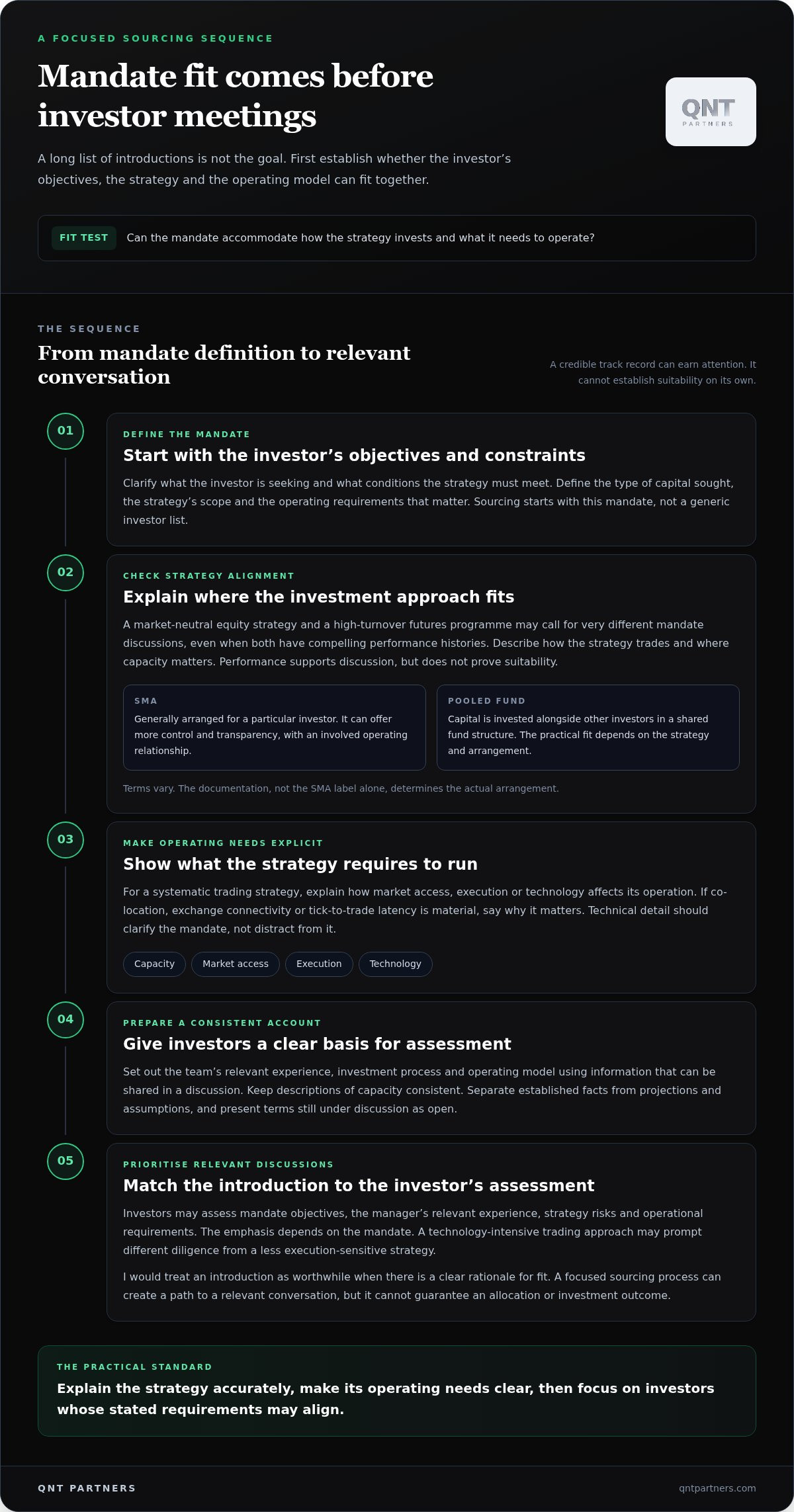
A Disciplined SMA Sourcing Process Reduces Mismatched Conversations
A good introduction starts an assessment. It is not evidence that capital will follow. A sourcing process should narrow the field before investor conversations begin, using a clear view of the mandate and the manager’s actual strategy and capacity.
A practical sequence is:
- Define mandate fit. Set out the investor objectives and operating requirements the strategy could meet.
- Prepare manager context. Present the strategy, team and operating model using substantiated information.
- Identify relevant discussions. Prioritise investors whose stated objectives appear compatible with the mandate sought.
- Assess alignment. Use follow-up to clarify fit, diligence requirements and possible next steps.
A qualified mandate conversation shows that there may be strategic alignment. It is not a capital commitment. Keeping that distinction clear helps managers plan sensibly and communicate without implying an outcome that has not been agreed.
Prepare a clear manager and strategy profile
Make the profile specific enough for an investor to understand how the strategy operates and what it needs. Include the team’s relevant experience, strategy scope and substantiated operating capabilities. For a quant manager, explain the role of execution or technology in the process when it is relevant to the mandate. Keep the materials consistent with the capacity available and the capital sought.
Separate established facts from assumptions, projections and terms that remain open to discussion. Do not imply a track record, investor commitment or agreed mandate where none exists. Accurate framing protects credibility and gives an investor a sound basis for deciding whether to proceed.
Qualify and progress relevant discussions
Before arranging an introduction, compare the manager’s profile with the investor’s objectives. If there is a plausible fit, use the initial conversation to test it. Follow-up should clarify what aligns, what needs further diligence and whether there is a concrete next step. Share information deliberately and represent the strategy consistently.
That discipline is central to SMA sourcing for hedge funds. We focus on relevant manager-investor discussions, rather than treating the number of introductions as a measure of progress. To see more about our work with institutional clients, visit QNT Partners’ client work.
How QNT Partners Approaches SMA Sourcing for Hedge Funds
At QNT Partners, we treat manager search and SMA sourcing as a mandate-fit exercise. We connect institutional investors with managers whose strategy and operating model align with the opportunity under discussion. Our role includes capital-raising advisory through SMAs, not a promise of an allocation or investment result.
A useful introduction starts with a clear view of what the investor is seeking and what the manager can deliver. That gives both sides a basis to assess fit before committing to a longer process.
Specialist context for quantitative and systematic managers
Our focus spans quantitative trading, research, technology and hedge funds. That sector context helps us frame a manager’s strategy in practical terms, including team experience and relevant operating requirements. For a systematic strategy, those requirements might include execution or exchange connectivity when they are material to how the strategy runs.
QNT Partners was founded by former industry operators. We bring that experience to manager and investor discussions, keeping the conversation grounded in how the business and strategy work rather than relying on a headline performance narrative alone. For further context on SMA-related investment structures, see our insight on SMA and SVA partnerships.
Discuss a potential mandate with QNT Partners
Managers considering institutional capital can outline the strategy, capacity and operating requirements they want a mandate to accommodate. Institutional clients can set out their investment objectives and relevant constraints. That gives us a practical starting point for assessing where a discussion may be relevant.
SMA sourcing for hedge funds should lead to focused conversations, not a volume target. If you are considering a mandate or sourcing requirement, discuss SMA sourcing with QNT Partners.
Make the Next Mandate Conversation Count
The right structure depends on the fit between investor objectives and the manager’s strategy, capacity and operating model. An SMA can suit a defined mandate, but its specific requirements need to work for the manager too. Pooled fund capital may make more sense where the existing strategy and operations are built around a shared structure.
Good SMA sourcing for hedge funds is selective. Clear, substantiated information helps identify relevant investor discussions, while an introduction remains the start of assessment, not a commitment of capital.
At QNT Partners, we specialise in quantitative trading, research and technology markets. We provide manager search and SMA sourcing for institutional clients, drawing on the perspective of a firm founded by former industry operators. I believe a precise mandate brief is the best place to start.
If you are considering an SMA mandate or sourcing requirement, discuss SMA sourcing with QNT Partners. A focused conversation can clarify the next step.
Frequently Asked Questions
What is SMA sourcing for hedge funds?
SMA sourcing for hedge funds is the process of identifying suitable institutional investors and managers, then developing relevant conversations around a potential separately managed account mandate. The work starts with fit: an investor’s objectives and requirements need to align with the manager’s strategy, capacity and operating model. An adviser can help frame the opportunity and connect the parties, but sourcing does not guarantee an allocation or investment outcome.
How does an SMA differ from investing in a hedge fund?
An SMA is arranged around an individual investor’s mandate, while a pooled hedge fund combines capital from multiple investors within a shared fund structure. That broad distinction does not determine every practical detail. Control, reporting and operating arrangements depend on the mandate documentation. Managers and investors should assess what the structure requires in practice, rather than assuming every SMA or pooled fund follows identical terms.
Why might a hedge fund manager seek an institutional SMA mandate?
A manager may explore an institutional SMA when an investor’s defined objectives appear to suit the strategy and the manager can support the mandate operationally. It can provide a route to an investment partnership structured around a particular investor’s requirements. The decision should also account for capacity and the manager’s existing capital plans. An institutional introduction is a chance to assess fit, not evidence that capital is committed.
What do investors assess when considering an SMA manager?
Investors assess whether the manager’s strategy addresses their mandate objectives and whether the team has relevant experience. They may also examine strategy capacity, operating arrangements and the information available to support diligence. The focus varies with the investor and mandate, so managers should not assume a universal checklist or standard threshold. Clear, consistent explanations of the strategy help investors identify what aligns and what needs further review.
Can an SMA suit every hedge fund strategy?
No. An SMA’s mandate-specific requirements may not suit a strategy’s design, capacity or operating model. A manager should consider whether bespoke requirements affect how the strategy is implemented or supported. That does not make pooled capital automatically preferable. The right structure depends on the investor’s objectives and the arrangements both parties can support without compromising the strategy or creating unnecessary operating strain.
How does an SMA sourcing adviser support a hedge fund manager?
An SMA sourcing adviser helps identify potentially relevant institutional investors, frame the manager’s strategy for those discussions and assess alignment as conversations progress. At QNT Partners, we specialise in quantitative trading, research and technology markets, and provide manager search and SMA sourcing for institutional clients. We facilitate relevant connections and advise on capital raising through SMAs, without promising an allocation or investment result.