SMA Capital Allocation Advisory: Aligning Mandates, Managers and Capital

An SMA allocation can be technically viable and still be a poor fit. In my view, SMA capital allocation advisory earns its place by testing whether a manager’s actual strategy and operating model fit the mandate, not by producing a longer list of names.
Allocators know that constraints matter. Capacity, liquidity terms, transparency and portfolio guidelines can shape an opportunity as much as the investment thesis. The harder question is whether a manager can meet those requirements without compromising how the strategy generates returns. Sourcing alone won’t answer that.
I’ll set out a practical way to assess mandate and manager fit, and where an adviser can contribute alongside an allocator’s existing investment process. For systematic and quantitative managers, that means testing the strategy against the mandate’s requirements and separating genuine alignment from a plausible pitch. For allocators considering an SMA, or managers seeking capital through one, that distinction helps establish whether discussions can lead to an investable structure.
Key Takeaways
- Start with the mandate’s actual constraints so manager selection reflects what the allocator needs, not a generic strategy description.
- SMA capital allocation advisory can organise sourcing and assessment around mandate fit, with the process shaped by the client’s requirements.
- Assess evidence against each mandate requirement, and distinguish operational or structural fit from performance history.
- Agree role clarity, reporting expectations and review points as part of the allocation discussion.
- QNT Partners provides manager search, SMA sourcing and capital-raising advisory to institutional clients focused on quantitative investment strategies.
Why SMA Capital Allocation Advisory Starts with the Mandate
A manager can run a credible systematic strategy and still be wrong for an allocator’s mandate. I start with the requirements, not the manager list. If the strategy relies on instruments the account excludes, or execution conditions it can’t support, more meetings won’t resolve the mismatch.
SMA capital allocation advisory translates an allocator’s requirements into a mandate, then sources and assesses managers against it. The work should sharpen the selection process, not promise performance or take the investment decision away from the allocator.
An SMA gives an investor a separately managed portfolio rather than an interest in a pooled vehicle. The Separately Managed Account overview provides a neutral introduction to the structure. For an allocation, I focus on how the account’s terms interact with the manager’s strategy and operating model.
What an SMA mandate needs to make explicit
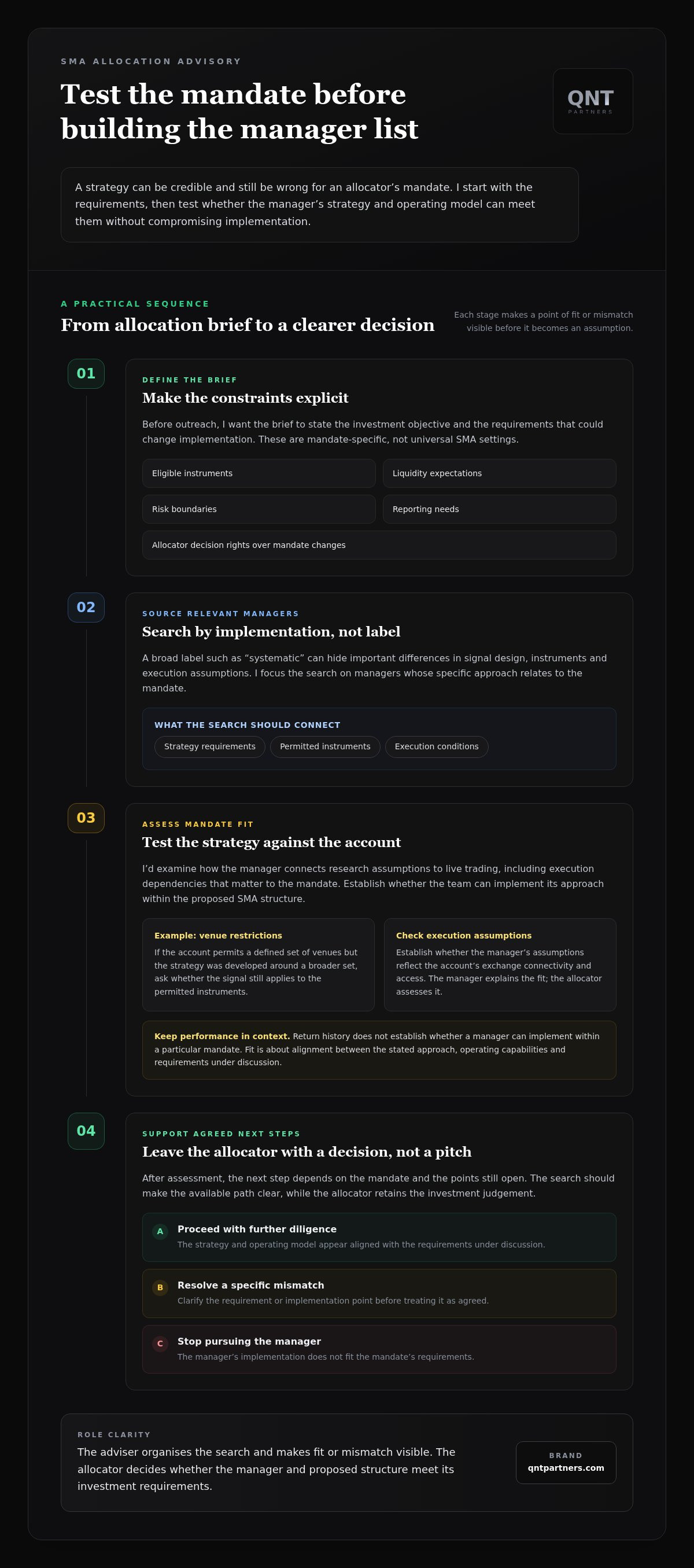
Before outreach, I want the brief to state the investment objective and the constraints that could change implementation. Depending on the allocation, those might include eligible instruments, liquidity expectations, risk boundaries, reporting needs or the allocator’s decision rights over mandate changes. These are requirements to agree, not universal SMA settings.
A precise brief narrows the relevant manager universe. If a quantitative strategy depends on particular instruments or execution conditions, an account with incompatible restrictions may not suit it. I’d rather identify that early than ask a manager to reshape the strategy around assumptions the allocator never intended.
Where an adviser contributes to allocation
An adviser sources and assesses relevant managers against the allocator’s stated mandate, then supports the agreed next steps.
That means testing the strategy’s operating requirements, not relying on broad labels such as “systematic” or “market neutral”. I look for a clear account of eligible markets, implementation and constraints, then compare it with the brief. If a requirement is unclear, resolve it before it becomes an assumption in manager discussions.
The adviser organises the search and makes points of fit or mismatch visible. The allocator decides whether the manager and proposed structure meet its investment requirements. Sourcing creates relevant options. Allocation remains the allocator’s investment judgement.
How SMA Capital Allocation Connects Investors and Managers
A useful manager search tests the mandate against how a strategy actually trades. The sequence is simple: define the brief, source relevant managers, assess fit, then support agreed next steps. The scope and order depend on the allocation. A fixed diligence process can’t replace an understanding of the strategy.
From allocation brief to relevant manager universe
Search parameters should follow the requirements that affect implementation. In quantitative strategies, labels can hide important differences in signal design, instruments and execution assumptions. The search should identify managers whose specific approach relates to the mandate, not simply those who describe themselves as systematic.
Consider a hypothetical mandate that restricts trading to a defined set of venues, while a manager’s strategy was developed around a broader venue set. That difference raises practical questions: does the signal still apply to the permitted instruments, and do the manager’s execution assumptions reflect the account’s exchange connectivity and access? The manager should explain the fit. The allocator can then assess whether the restriction changes implementation or leaves a workable mandate.
Specialisation matters here. A search focused on the mechanics of the mandate can distinguish managers with relevant experience from those whose strategies only appear similar at a high level.
What manager assessment should establish
Assessment should establish whether the strategy fits the brief and whether the team can implement it within the proposed SMA structure. I’d examine how the manager connects research assumptions to live trading, including any execution dependencies material to the mandate. The investment manager selection framework offers a reference for combining qualitative and quantitative analysis. Each line of enquiry should inform an actual allocation decision.
A credible fit isn’t a forecast of returns. It means the manager’s stated approach and operating capabilities align with the requirements under discussion. Sourcing can’t guarantee investor interest, an allocation or investment performance.
After assessment, next steps may include further discussion of the SMA structure or alignment between the parties, depending on the client’s mandate. Our SMA and SVA partnership analysis explores related considerations. The search should leave the allocator with a clearer decision: proceed with further diligence, resolve a specific mismatch, or stop pursuing a manager whose implementation doesn’t fit.
Assessing SMA Manager Fit Without Confusing It with Performance
A return history can draw attention, but it doesn’t show whether a manager can implement a strategy within a particular SMA mandate. I’d assess the strategy’s mechanics against the account’s constraints, then treat performance as context rather than a proxy for fit.
Mandate fit versus headline performance
A quantitative strategy may depend on queue position, short holding periods or a specific execution set-up. If an SMA mandate limits instruments or changes the available execution arrangements, those assumptions may no longer hold in the same way. The manager should explain what the strategy requires and where the proposed account differs.
Past performance alone cannot establish mandate fit because it doesn’t show whether the strategy’s research and execution assumptions work within the allocator’s constraints.
Performance still matters, but assess it in context: which strategy produced it, how it was implemented, and whether the proposed SMA would operate under comparable conditions. A fit assessment can expose relevant differences. It can’t remove investment risk or establish future returns.
Questions an allocation process should resolve
Separate essential requirements from those the allocator could negotiate. Then test the manager’s stated capabilities against each one. If a diligence step won’t change the shortlist, clarify a constraint or inform a decision, it may add process without practical value.
| Mandate requirement | Evidence to assess | Allocation implication |
|---|---|---|
| Eligible instruments or markets | Research scope, traded instruments and the strategy’s stated dependencies | Whether the manager can apply the strategy within the permitted universe |
| Execution constraints | Order handling assumptions, holding period and reliance on execution conditions | Whether the account’s operating set-up is consistent with the strategy |
| Team capability | Who owns research, implementation and ongoing strategy decisions | Whether responsibilities and expertise match the proposed SMA approach |
For a systematic manager, I’d look for a clear link between research assumptions and live implementation, rather than rely on a strategy label. That’s where SMA capital allocation advisory should sharpen judgement, not add ceremony.
The assessment should leave the allocator with a decision they can act on: continue diligence, resolve a specific mismatch, or stop the search. None of those outcomes is a view on future performance.
Structuring SMA Advisory Around Governance and Ongoing Review
An allocation can fit on paper but become harder to assess if responsibilities, reporting expectations and review points are vague. Governance belongs in the SMA discussion from the outset. It determines how the allocator and manager will recognise, communicate and respond to changing circumstances.
Set expectations before an allocation proceeds
Role clarity matters. The allocator sets the mandate and retains investment decision-making authority. The manager manages the strategy within the agreed scope. The adviser supports the search and selection process, helping both sides identify where expectations need to be explicit.
Documentation and reporting should reflect the mandate, not a generic template. Agree what information the allocator needs to assess the account against its objectives, who will provide it and how issues will be raised. The detail varies by client and structure. Set expectations before an allocation proceeds, rather than discovering later that each party understood the arrangement differently.
I’d also agree review points in terms of the original mandate. A useful review asks whether the strategy and account remain aligned with the stated objectives and constraints. It shouldn’t become a routine exercise that creates activity without informing a decision.
Review fit as requirements change
Mandates can change as an allocator’s priorities or constraints evolve. A manager’s capacity or operating approach may shift too. Either development can affect the original fit, even if the strategy label stays the same.
Review triggers should connect to the assumptions behind the allocation. If a mandate depends on access to a defined universe of instruments, a change to that universe warrants a fresh fit assessment. If the allocator revises reporting expectations, the parties should consider whether the existing arrangement can still meet them. These are prompts to reassess alignment, not automatic reasons to change managers.
SMA capital allocation advisory can keep those questions tied to the mandate and support a considered discussion between allocator and manager. It doesn’t replace the allocator’s ongoing oversight or remove investment risk. Its value is making responsibilities and review points clear enough to support a decision when circumstances change.
The QNT Partners contact page is the place to start a discussion about a specific allocation or capital-raising requirement.
QNT Partners’ SMA Capital Allocation Advisory in Practice
A defined mandate gives a manager search something concrete to test. Without it, conversations can drift towards broad strategy claims instead of whether a manager’s approach suits the allocator’s requirements.
At QNT Partners, we work with institutional clients on manager search, SMA sourcing and capital-raising advisory. Our focus is quantitative investment managers and the requirements of systematic strategies. We connect mandates with relevant managers and support a considered selection process. We advise on sourcing and capital raising via SMAs, rather than investing capital directly.
That specialist focus matters when a manager’s description leaves out details that determine fit. A strategy may be systematic, for example, but differ in research approach, instruments or implementation assumptions. Those distinctions help shape a relevant search and a useful discussion between allocator and manager. They don’t guarantee an allocation or investment outcome.
When specialist SMA advisory is relevant
I see the advisory work as most useful when an institutional client has a defined allocation requirement, or a manager-search need that calls for a clear link between mandate and capability. That might mean assessing which managers appear suited to the brief, or helping a quantitative manager frame a capital-raising discussion around an SMA. The scope follows the client’s decision, not a preset process.
Our institutional client work is grounded in the quantitative trading, research and technology markets. As a boutique firm founded by former industry operators, we bring that market understanding to mandate and manager discussions without claiming a particular result in advance.
Starting a focused allocation discussion
A useful first conversation starts with the mandate objectives and the decision in front of you. For an allocator, that could be the investment requirements shaping a search. For a manager, it could be the SMA capital-raising need and the type of institutional mandate that may fit the strategy.
Bring the requirements you’re working through, and the discussion can focus on the allocation or manager-search question at hand. Discuss your SMA allocation requirements to establish the mandate and the next decision to resolve.
Put the Mandate to Work
An SMA allocation is stronger when the mandate, the manager’s capabilities and the allocator’s requirements line up before capital is committed. Clear constraints focus the search, while structured assessment separates genuine fit from a persuasive performance record. Governance and review expectations then give both sides a reference point if requirements or capacity change.
SMA capital allocation advisory should sharpen those decisions, not promise returns or add process without purpose. At QNT Partners, we specialise in quantitative investment markets and provide manager search, SMA sourcing and capital-raising advisory for institutional clients. Founded by former industry operators, we focus on connecting specific mandates with relevant investment managers.
If you’re working through an allocation or capital-raising requirement, share the mandate and the decision you need to make. Discuss your SMA allocation requirements with QNT Partners. A clear brief is a practical starting point for a focused conversation.
Frequently Asked Questions
What does SMA capital allocation advisory involve?
SMA capital allocation advisory helps an allocator turn investment requirements into a focused manager search and assess potential fit. The work can include clarifying the mandate, sourcing relevant investment managers, assessing their strategies and operating capabilities, and supporting agreed next steps. The scope follows the allocator’s requirements. It informs the selection process, but the allocator retains the investment decision, and no advisory process can promise a particular return.
How does an SMA differ from investing in a pooled hedge fund?
In an SMA, the investor owns the account and appoints a manager to manage it under the agreed mandate. In a pooled hedge fund, investors generally hold an interest in a fund that pools their capital. An SMA can give the investor more direct control over account terms and visibility into the portfolio, while the details depend on the structure. The distinction matters when assessing mandate constraints and reporting needs.
How can an institutional investor assess manager fit for an SMA?
Assess whether the manager’s strategy can operate within the mandate, then examine the team’s relevant capabilities and proposed account implementation. For a quantitative strategy, look beyond the label and establish how its research approach, eligible instruments and execution assumptions relate to the allocator’s requirements. Treat performance history as context, not proof of fit. The assessment should clarify conditions or mismatches that could affect the allocation decision.
Can SMA advisory help a quantitative manager raise institutional capital?
Yes. SMA advisory can support a quantitative manager’s institutional capital-raising effort by connecting its strategy and capabilities with relevant allocation requirements. QNT Partners provides manager search, SMA sourcing and capital-raising advisory for institutional clients in quantitative investment markets. The work can help structure a focused discussion around a manager’s SMA opportunity, but it doesn’t guarantee investor interest, an allocation or investment performance.
What information should an investor define before sourcing SMA managers?
Define the investment objective and the constraints that could materially affect how a strategy operates in the account. Clarify which requirements are essential and which may be negotiable, along with expectations for decision rights and reporting. The more precisely the brief captures the investor’s needs, the more effectively a search can distinguish relevant managers from those whose approach would require a material change.
Does SMA sourcing guarantee an allocation or investment performance?
No. Sourcing identifies and assesses managers against an allocator’s stated requirements; it cannot ensure the allocator proceeds or that a manager delivers a particular result. The allocator makes the investment decision, and investment risk remains. A disciplined process can make fit and outstanding questions clearer, helping the parties decide whether to continue discussions, resolve a mismatch or end the search.