Quantitative Trading Platform Headhunters: A Buyer’s Guide

The best Quantitative trading platform headhunters aren’t necessarily the ones with the longest database. They understand why a low-latency C++ hire for a prop shop may be a poor fit for a platform role supporting autonomous pods at a multi-manager fund.
A broad shortlist can create more work without improving your options. If a recruiter can’t explain where the role sits in your architecture or what the hire needs to own, more candidate profiles won’t fix the brief. Clear role calibration is what separates a relevant search from a stream of CVs that miss the mark.
This guide explains how to assess a search partner before sharing a mandate. It covers questions that test their understanding of quant-platform roles, how to judge whether their market access fits your hiring priorities, and what a discreet, technically credible process should look like. The aim is a tighter brief and a shortlist built around the system you’re actually building.
Key Takeaways
- Separate platform engineering mandates from quant research, trading and broader technology roles before briefing a search partner.
- Ask Quantitative trading platform headhunters to restate the technical scope and intended outcomes in their own words.
- A larger database does not guarantee a stronger shortlist. Assess the relevance of the recruiter’s market access and candidate calibration.
- Build the brief around platform scope, role outcomes and reporting lines, and include architecture or performance details only when your team can verify them.
- Consider QNT Partners for searches involving quantitative trading, research, low-latency engineering or financial platforms.
What quantitative trading platform headhunters should understand
Mandate fluency matters more than a large, undifferentiated candidate database. Quantitative trading platform headhunters need to establish whether a firm is hiring someone to build the trading stack, operate its infrastructure or develop the strategy that runs on it. Those are different searches, even when the job titles look similar.
Here, a platform search means finding talent to build or operate the technology and systems that support quantitative trading. It sits within the broader practice of Executive search, but the recruiter needs enough technical and firm-structure context to define the mandate accurately. A software engineer working on execution is not interchangeable with a quant researcher, a trader or an engineer supporting general business technology.
Which roles sit inside a trading-platform search?
Platform engineering mandates can cover low-latency systems, exchange connectivity, market data and co-location infrastructure. The recruiter should clarify what the hire will own. A role focused on exchange gateways and tick-to-trade latency has a different brief from one maintaining internal research tools or core compute infrastructure.
Job titles alone won’t settle that distinction. “Quant developer” might mean implementing strategies alongside researchers, or production engineering for an execution platform. Before mapping candidates, a search partner should clarify the system boundary, the team the hire will join and how the team will judge success.
A search may also include quant researchers or traders when the mandate combines platform development with strategy ownership. For example, a new team might need researchers to develop signals and engineers to productionise execution. If those responsibilities sit in separate teams, treat them as separate mandates rather than blending them into one vague “quant platform” role.
Why firm structure changes the mandate
A prop shop, a pod shop and a multi-manager firm shouldn’t be treated as interchangeable hiring environments. A prop shop may have central ownership of trading infrastructure, while a pod-based business may give an individual team more influence over its tools and hiring priorities. The arrangement varies by firm, so the label should prompt questions, not replace the answers.
In a multi-manager structure, establish who owns the role’s budget and who the hire reports to. A central platform engineer may support several teams, while an engineer hired by a specific pod may report into that group and work against its trading priorities. The role’s position can affect how its contribution is assessed and how costs are allocated against a pod’s P&L.
Before the search begins, pin down ownership, reporting lines and whether the hire serves one strategy or a shared platform. That gives the recruiter a usable mandate and candidates a clearer picture of the work.
How to assess a quantitative trading platform headhunter
Quantitative trading platform headhunters should be able to explain the mandate before they start searching. Assess that capability in a structured discussion, not by the size of a candidate database or the number of familiar firm names a recruiter can mention.
- 1. Test role calibration. Ask the recruiter to describe the role’s technical scope without using its title. Can they distinguish tick-to-trade latency from broader system performance and explain which parts of the stack the hire will own?
- 2. Probe technical fluency. Where relevant, discuss FPGA work, exchange connectivity and dependencies between platform components. The recruiter doesn’t need to design your system, but should ask informed questions rather than treating each term as a CV keyword.
- 3. Define candidate relevance. Ask how they’ll assess evidence of delivery in a comparable environment, not just previous employers or matching phrases. Agree which experience is essential and which skills could be developed after the hire joins.
- 4. Set process expectations. Clarify how sensitive information will be handled, how often you’ll review progress, and who owns candidate feedback and changes to the mandate. Agree how you’ll recalibrate if the initial profile misses the mark.
Test role calibration before the search begins
Use a concrete system example from your own environment. If the role touches FPGA execution, ask the recruiter to distinguish that work from exchange connectivity and adjacent platform dependencies. A technically credible partner should be able to reflect the role’s boundaries, then separate must-have experience from skills your team can teach. If the discussion stays at title level, pause before signing.
Academic backgrounds can provide context, but they aren’t a substitute for evidence of relevant work. For example, Cornell's Financial Engineering Program outlines a financial engineering curriculum. Treat an academic profile as one reference point, then assess candidates against the mandate’s actual engineering or research requirements.
Check access and search discipline
Ask how the firm will map relevant teams and approach candidates without disclosing a confidential build-out. Look for a clear explanation of how outreach will be controlled and candidate fit assessed, rather than a promised shortlist count. Agree on a feedback cadence and when both sides will review the brief against candidates’ responses.
The process should allow for adjustments if market feedback exposes a mismatch between the specification and available experience. If you’re comparing specialist partners, you can also review QNT Partners’ client work in quant, trading and technology recruitment.
Specialist headhunter versus general recruiter: what changes?
A larger database does not automatically produce a better shortlist. For a platform role, a specialist’s value lies in interpreting the mandate, reaching relevant people and assessing whether their experience maps to the systems and team you’re hiring for.
A general recruiter may be well suited to a clearly defined, repeatable technology hire. The difference tends to show up when a title hides important distinctions. A C++ engineer who has built exchange connectivity has a different background from one focused on internal tools, even if both CVs contain the same language and employer keywords.
Where specialist search can add value
Quantitative trading platform headhunters should share enough vocabulary with your team to hold a useful first conversation. They should understand how a prop shop’s central technology group can differ from an engineer embedded in a pod, and how a platform mandate relates to the trading or research teams it supports.
That context changes how candidates are qualified. Rather than matching a candidate to a list of terms, a specialist can probe what the person actually built, which teams used it and how their responsibilities fit the new role. It also helps make outreach relevant. Candidates can hear a credible account of the system and reporting context before deciding whether to engage.
Specialisation isn’t a placement guarantee. The test is whether it leads to better-calibrated conversations and clearer evidence of fit, not whether a recruiter claims unique access or promises a particular result.
When a broader recruitment route may fit
A broader route can make sense for a role with a stable specification, a well-understood candidate profile and a hiring process designed to handle open applications. If the work is clearly scoped and the team can assess applicants directly, a specialist search process may add little.
Confidential build-outs call for a different approach. Open applications can reveal the role and its timing. Discreet outreach gives the hiring team more control over what is shared and with whom. That distinction matters for a senior hire, a spinout or a search tied to an unannounced platform change.
Choose based on the mandate, not a blanket preference for specialist or generalist recruiters. Role seniority, technical ambiguity and the need for discretion should determine the route. A repeatable infrastructure hire and a confidential search for the person shaping a new trading platform don’t need the same process.
Build a search brief around the platform, not the job title
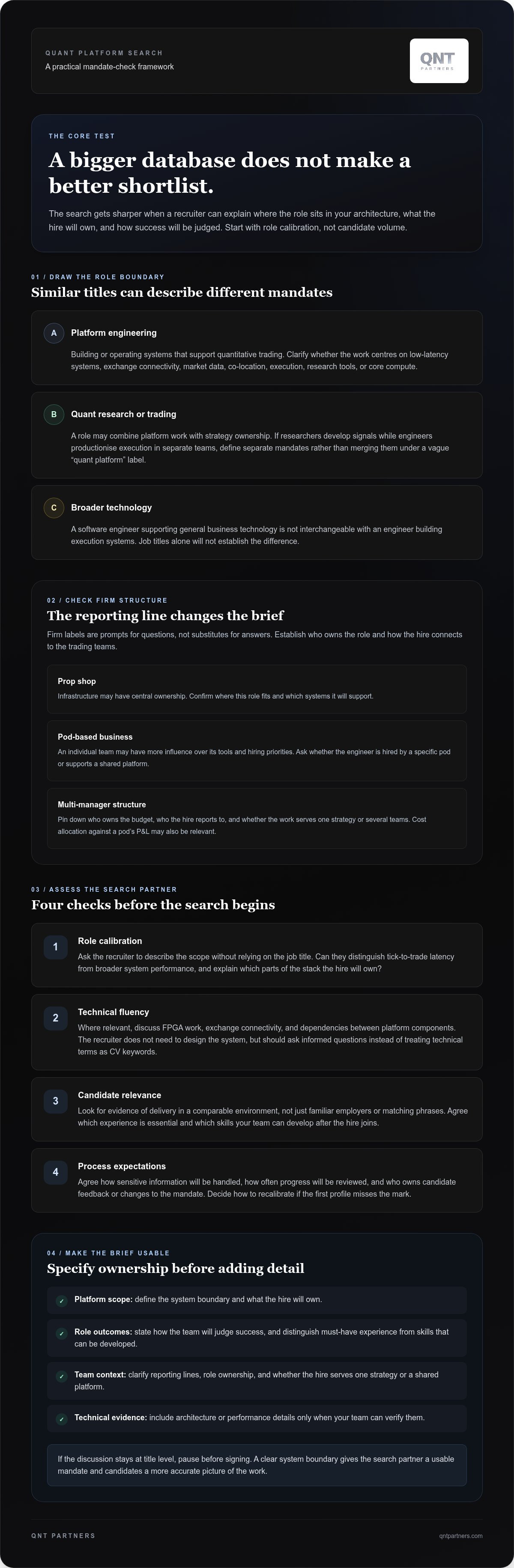
A title is a poor search brief. Before engaging Quantitative trading platform headhunters, describe the system the hire will work on, the decisions they’ll own and where the role sits in the organisation. Include architecture and performance details only when your team can substantiate them. A vague claim about “ultra-low latency” won’t help calibrate candidates if the hiring team can’t explain which part of the system it refers to.
Use this checklist to make the mandate concrete:
- Platform scope: Identify whether the role covers execution, exchange connectivity, co-location infrastructure, research tooling or another defined area.
- Role outcomes: State what the person is expected to build, operate or improve, and how the team will assess their contribution.
- Reporting and ownership: Name the manager, team and key internal stakeholders. Clarify whether the hire supports one strategy or a shared platform.
- Firm context: Explain whether the mandate sits in a prop shop, pod shop or multi-manager structure, but only where that changes ownership, priorities or decision-making.
Translate system requirements into candidate criteria
Turn each platform requirement into evidence you can assess. If the remit is execution, define the relevant ownership and performance context. If it involves infrastructure, specify the systems in scope. Include FPGA experience only if the platform requires it. Then separate essential experience from adjacent skills that could transfer. This keeps the search focused without screening out candidates for requirements the role doesn’t need.
For a mandate centred on trading infrastructure, focus the brief on the systems the hire will work on and the interfaces they’ll own. That makes it easier to distinguish platform engineering experience from general technology work.
Account for candidate mobility and incentives
Describe the role’s incentive structure only when it’s relevant and confirmed. A PM hire may need a clear account of P&L participation; an engineering role may not. If an equity partnership or SMA structure affects the mandate, explain how it relates to the position. QNT Partners has also discussed SMA and SVA partnerships in more detail.
Ask candidates about garden leave or non-competes early enough to understand possible timing constraints. Don’t assume the terms, duration or effect. Confirm the facts with the candidate and leave legal interpretation to the appropriate advisers. A precise brief gives your search partner a sound basis for assessing fit and discussing the role discreetly. Discuss your platform search.
When QNT Partners may fit a platform search
QNT Partners may fit when a hire sits close to quantitative trading, research or the technology that supports a financial platform. The boutique firm, founded by former industry operators, focuses on recruitment across those areas, including engineers working on low-latency trading systems and financial platforms.
Mandates aligned with QNT Partners’ work
Relevant mandates can include searches for quantitative researchers, traders and engineers responsible for platform or infrastructure work. The deciding factor is the role’s actual remit. A search for an engineer supporting exchange connectivity calls for a different candidate profile from a search for a researcher developing strategies, even if both roles sit within the same trading group.
QNT Partners also searches for AI and machine learning specialists working on financial applications. The brief should make clear how the hire’s work connects to the firm’s models or trading activity, rather than relying on a broad AI title.
When comparing specialist recruitment firms, look for evidence that a firm understands both quant hiring and the technical context of the mandate. A general overview can help frame the choice, but the specific brief still needs to establish which teams, skills and market relationships matter for your search.
Start with a confidential mandate discussion
Start with a direct conversation about the platform, the role’s scope and the timing. Outline what the hire will own, who they’ll work with and which details need to remain confidential. That gives QNT Partners a basis to assess whether the mandate fits its quant, trading and technology recruitment work, and to clarify the search parameters before proceeding.
You don’t need to share sensitive architecture details before establishing what’s relevant. A clear remit and the right level of context are enough to start a useful discussion. Discuss a quant-platform search.
Make the next search more precise
A strong platform search starts with a brief that describes the system, the role’s ownership and the team it supports. Then assess whether the recruiter can translate that brief into relevant candidate conversations, rather than relying on job titles or database matches. For sensitive build-outs, agree how information will be shared and how the search will be reviewed.
Quantitative trading platform headhunters should understand the distinction between quant, trading and technology mandates. QNT Partners specialises in quantitative trading, research and technology recruitment, including searches for engineers working on low-latency trading systems and financial platforms. Founded by former industry operators, the firm brings that background to role definition and candidate calibration.
If you’re shaping a search, bring the platform scope, hiring priorities and any confidentiality constraints to the first discussion. Discuss a confidential search with QNT Partners. A clear brief gives relevant candidates a better picture of the work and gives your team a sound basis for deciding who moves forward.
Frequently Asked Questions
How do I choose a headhunter for a quantitative trading platform?
Choose a headhunter who can explain the role’s technical scope without leaning on its title. Quantitative trading platform headhunters should understand what the hire will own, how the platform supports trading or research, and which experience is essential. Ask how they’ll assess candidates beyond keyword matches and familiar employers. Agree how discreet outreach will work, how you’ll give feedback and when you’ll review the brief.
What should a quant trading platform search brief include?
Describe the platform area, the role’s expected outcomes and its reporting line. Make clear whether the remit covers execution, infrastructure, research tooling or another function. Include architecture and performance details only if your team can substantiate them. Note the firm structure if it affects ownership or decision-making, such as a shared platform supporting multiple teams versus an engineer embedded within one trading group.
Can a generalist recruiter hire low-latency trading engineers?
Yes, particularly when the role is clearly scoped and the recruiter has access to suitable candidates. The challenge is calibration. A low-latency engineer working on exchange connectivity may have a different background from one focused on internal systems, even if both profiles share languages or employer names. Ask how the recruiter will distinguish relevant experience and assess the candidate’s actual ownership of production systems.
How do headhunters assess candidates for HFT technology roles?
They should compare a candidate’s demonstrated work with the role’s actual requirements, not simply count matching terms on a CV. For an HFT technology mandate, clarify whether relevant experience includes low-latency systems, exchange connectivity or a specific part of the platform. The recruiter can then probe what the candidate built or operated, the teams they supported and how closely that experience maps to your environment.
When should a trading firm use a specialist headhunter?
Use a specialist when the mandate is senior, technically ambiguous, confidential or tied to a build-out where the candidate pool needs careful calibration. A clearly defined, repeatable hire may suit a broader recruitment route or open applications. The decision depends on the role and hiring context. If a job title hides distinct requirements, specialist search can help sharpen the brief and focus candidate conversations.
How should firms handle confidential searches and candidate outreach?
Decide what information can be shared, with whom and at what stage. Give the search partner enough context to describe the opportunity accurately, while identifying details that could expose a build-out or team change. Agree how candidate interest and feedback will be handled before outreach begins. For candidates with garden leave or non-compete terms, establish the relevant facts and seek appropriate advice where needed.
Does QNT Partners recruit quantitative trading technology talent?
Yes. QNT Partners recruits across quantitative trading, research and technology, including engineers working on low-latency trading systems and financial platforms. The firm also searches for AI and machine learning specialists for financial applications. Founded by former industry operators, QNT Partners serves HFT firms and hedge funds worldwide. The fit depends on the role’s scope, required experience and hiring priorities. Contact QNT Partners to discuss a search.