Quantitative Trading Desk Recruitment: A Reference for Desk Heads and Founders

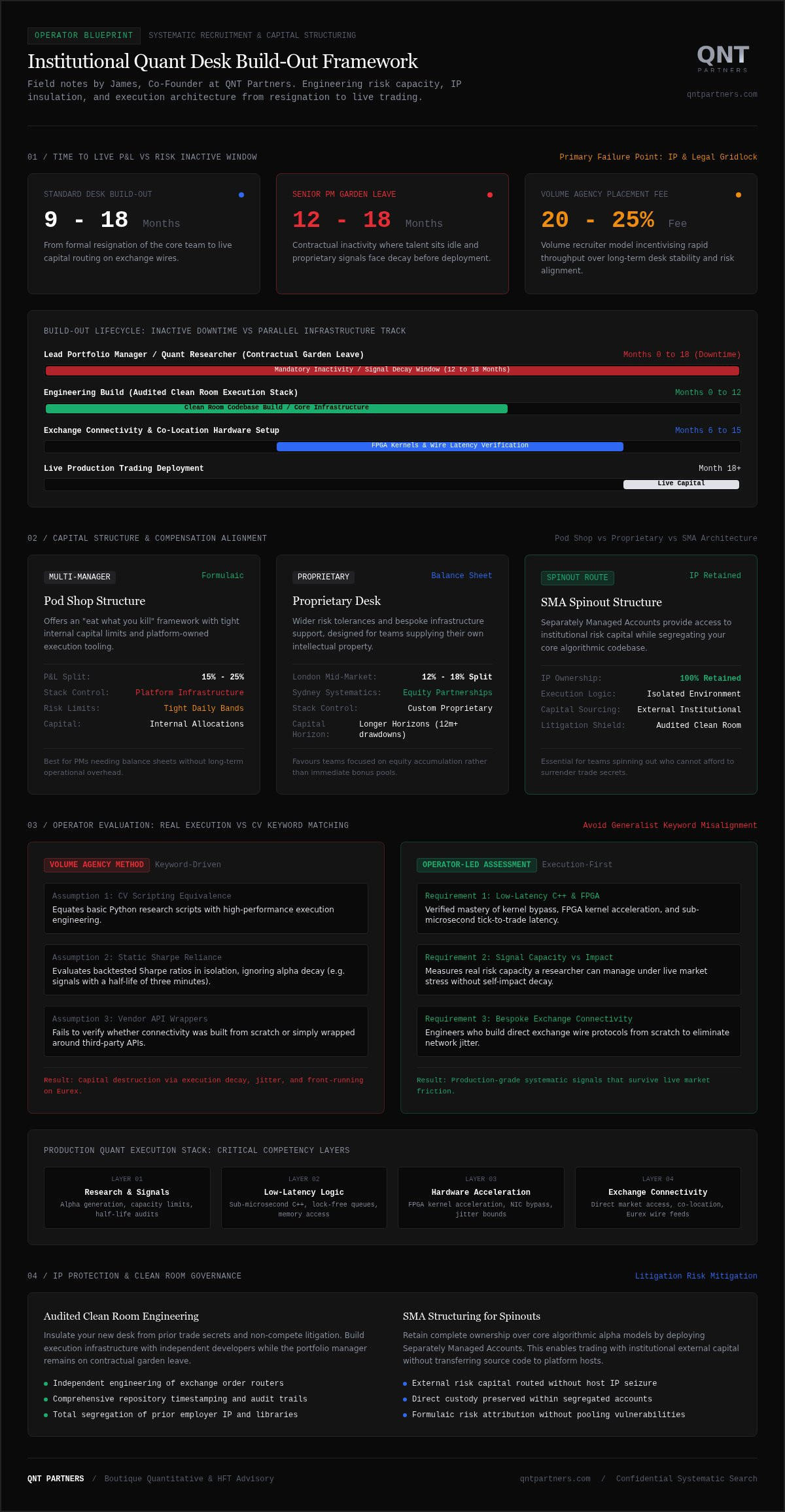
A standard institutional quant desk build-out now takes between 9 and 18 months from resignation to live trading. Most of that time is wasted in legal gridlock or waiting for garden leave to expire.
I have seen countless founders approach quantitative trading desk recruitment as a standard hiring exercise, only to watch their alpha decay while their lead researcher sits on a beach for a year. This is a migration of risk capacity and intellectual property rather than a simple headcount filler. You likely know that generalist recruiters fail because they don't understand the difference between sub-microsecond execution logic and standard back-end plumbing.
At QNT Partners, we focus on the engineering required to support high-capacity signals. I am providing a technical framework for engineering these build-outs and migrating elite talent without the usual operational friction. I will cover the mechanics of P&L splits and the nuances of SMA structures for spinouts. I will also address how to audit clean room engineering to prevent IP litigation.
Key Takeaways
- Avoid generalist headhunters who mistake standard Python scripting for high-performance C++ engineering. Specialist quantitative trading desk recruitment requires an operator-led approach to identify talent capable of building sub-microsecond execution logic.
- Select your desk structure based on capital requirements and risk appetite. Multi-manager pod shops offer formulaic P&L splits between 15 and 25 percent, while proprietary desks provide wider risk bands and higher payouts for those supplying their own IP.
- Evaluate candidates on technical execution rather than backtested Sharpe ratios. Focus on engineers with proven experience in FPGA kernel acceleration and exchange connectivity to ensure signals aren't lost to execution decay.
- Factor in 12 to 18 months of downtime for senior portfolio managers due to contractual garden leave. Use audited clean room engineering during the build-out phase to insulate your new desk from prior trade secrets and litigation risks.
- Retain ownership of algorithmic alpha models by using Separately Managed Account (SMA) structures. This allows spinouts to trade on external capital while maintaining full control over their core codebase and intellectual property.
Why Generalist Headhunting Fails Systematic Desks
I have seen generalist firms treat a quant researcher like a standard investment banker. It is a fundamental misunderstanding of the asset class. In quantitative trading desk recruitment, a bad hire costs more than a lost placement fee. It destroys capital through poorly engineered execution logic or signals that decay before they hit the wire.
Most recruiters rely on keyword matching. They see "Python" on a CV and assume the candidate can build a production-grade systematic strategy. I know that the gap between a Python scripter and a low-latency C++ engineer is massive. One builds prototypes; the other ensures you don't get front-run on the Eurex. Generalists can't have a peer-level conversation about tick-to-trade latency or signal decay because they've never sat in the chair. They might look at a traditional Sharpe ratio and think they've found a star, ignoring the fact that the alpha has a half-life of three minutes. Recruiters often miss that a researcher's value isn't just the Sharpe, but the capacity they can manage without market impact. This lack of technical depth leads to "CV spamming" where the desk head ends up doing the recruiter's job of basic filtering.
The Problem with Volume Recruitment
Volume agencies prioritise the 20 to 25 percent placement fee over the long-term stability required in quantitative trading desk recruitment. Their business model requires high throughput, which is the opposite of what a discreet build-out needs. They often ignore the cultural nuances between a Chicago prop shop and a London hedge fund. A trader who thrives in a high-pressure prop environment might fail in a multi-manager pod where risk limits are tight and capital is internal. C-level talent and desk heads require a level of discretion that a volume shop simply cannot provide. Sending a PM's track record to ten different firms without a non-disclosure agreement is a recipe for IP leakage and legal friction.
Operator Knowledge as a Filter
I use my background as an operator to vet candidates before they ever reach your desk. We filter for engineers who have actually built exchange connectivity from scratch rather than just using a vendor's API. True vetting requires understanding the difference between a pretty backtest and live execution under market stress. I look for those who understand kernel bypass and FPGA constraints because these are the people who actually move the P&L. When we speak to a candidate, we are discussing the mechanics of their execution stack and how they handle jitter. This ensures that the candidates you interview are actually qualified for the role, saving you weeks of technical screening time.
Structuring the Build-out: Pod Shops vs Proprietary Desks
Choosing between a multi-manager pod and a proprietary structure dictates your entire hiring strategy. If you are a founder planning a build-out, the capital structure you choose will determine the calibre of talent you attract. It also dictates the overhead you must carry. Quantitative trading desk recruitment varies wildly depending on whether you are offering a formulaic payout or a discretionary bonus pool.
Multi-manager pods typically offer higher P&L splits, often sitting between 15 and 25 percent of net trading profit. These structures appeal to PMs who want a clear "eat what you kill" model. However, you are often trading on a platform's infrastructure. This means you have less control over the underlying stack. Proprietary desks usually provide lower direct payouts but offer better infrastructure support and longer capital horizons. I advise founders to consider their capital requirements before choosing a recruitment path. If you lack the balance sheet to sustain a 12-month drawdown, a pod structure might be the only viable route.
Payout Mechanics and Equity
Equity partnerships are becoming more common in Sydney-based systematic funds. They prioritise long-term retention over immediate cash payouts. In contrast, a 12 to 18 percent split is the standard for mid-market desks in London. When we negotiate these deals, deferred compensation and clawbacks must be addressed in the initial search. It is pointless to hire a top-tier researcher if their payout structure encourages short-term risk-taking that triggers a stop-loss. We often help clients design these incentive structures to align with the desk's long-term alpha decay profile.
Infrastructure Requirements
Proprietary desks need a heavier focus on low-latency engineering talent. If you are building a prop shop, you are likely hiring for speed as much as alpha. This requires engineers who can handle FPGA kernel acceleration. They must also manage sub-microsecond exchange connectivity. Multi-manager pods often rely on the central platform for execution tech. This allows your hiring to focus purely on alpha generation. Regardless of the structure, you must comply with FINRA regulatory guidance on algorithmic trading supervision to ensure your controls are production-ready. Identify early if you are hiring for alpha or hiring for speed. Mixing the two without a clear infrastructure plan leads to technical debt that kills a desk within its first year.
Technical Benchmarks Beyond the Sharpe Ratio
A high Sharpe ratio in a backtest is a poor predictor of live performance. I find that many candidates can produce a clean equity curve in a simulated environment, yet they crumble when faced with actual exchange connectivity jitter. In quantitative trading desk recruitment, I prioritise technical execution over theoretical returns. A backtest doesn't account for the reality of being front-run by a faster participant.
For HFT roles, I look for engineers who understand FPGA and kernel bypass. Vetting for C++ expertise must go beyond syntax. It needs to include deep knowledge of memory management and lock-free programming. Without these, your execution stack will never achieve the sub-microsecond tick-to-trade latency required to compete. The ability to work with raw tick data is a non-negotiable for research roles. If a researcher cannot handle the noise of a binary feed, they won't survive a live production environment. High-calibre quantitative trading desk recruitment requires a filter that generalist firms simply lack.
Hardware and Low-Latency Standards
Placing a developer in a Chicago prop shop requires knowledge of Solarflare or Mellanox hardware. I favour candidates who have experience with microwave or laser transmission for long-haul routes between New York and Chicago. You should ask about their specific experience with exchange protocols like FIX or binary feeds. It is the difference between being a user of technology and a builder of it. I prioritise those who can optimize the network stack at the driver level.
Evaluating Research IP
Does the researcher understand the impact of market microstructure on their signals? I check for experience in handling data bias and over-fitting in ML models. The best researchers can explain their alpha without revealing protected IP. When moving senior talent, we often reference the FTC Noncompete Rule provisions to understand how restrictive covenants apply to those with access to sensitive trade secrets. This ensures the migration process doesn't trigger a clean-room rewrite or a legal block. I always look for researchers who can demonstrate how their signals behave during market stress regimes rather than just cherry-picking high-volatility events. A strategy that only works in a bull market is a liability, not an asset.
Managing the Migration: Garden Leave and IP Risks
Garden leave is the primary friction point in quantitative trading desk recruitment. Senior portfolio managers and lead researchers should expect 12 to 18 months of downtime before they can touch a production environment at a new firm. I have seen desks fail because they did not budget for the carry cost of sitting out. It is a massive capital drain that many founders underestimate, especially when you factor in the decay of the candidate's market knowledge during the wait. Managing the transition requires a clear plan for IP protection and legal compliance to ensure the new entity isn't born into a lawsuit.
Negotiating Non-compete Clauses
Non-competes in New York are handled differently than those in London or Paris. While UK courts test for reasonableness and legitimate business interests, US firms often use these clauses as a blunt instrument to prevent talent migration. I help firms structure buy-outs or early releases where possible. Sometimes, a "bad leaver" clause can be mitigated by offering a higher deferred equity stake in the new venture. The cost of the non-compete is often as high as the sign-on bonus. It is a critical line item in your desk build-out budget. We specialise in identifying the specific levers that can shorten these periods, such as negotiating carve-outs for non-competing asset classes or specific geographical restrictions that don't overlap with the new desk's focus.
Protecting the Firm and the Individual
Avoid any discussion of specific code or algorithms during the interview process. This is the fastest way to trigger a "theft of trade secrets" claim under the Defend Trade Secrets Act. I ensure the candidate understands their fiduciary duties to their current employer throughout the search. They shouldn't be logging into their current firm's VPN while talking to us. Proper documentation and "clean room" engineering plans prevent future litigation from former employers. If a researcher brings a signal they developed at a Sydney-based systematic fund, they must be able to prove they can recreate the alpha from first principles without using proprietary libraries or datasets. We can help you manage these high-stakes migrations with the discretion required to protect your reputation and your capital. Failure to document this process properly often leads to an injunction that can freeze a desk for two years.
A Framework for Desk Recruitment
A successful desk build-out requires a blueprint that starts with technical constraints. You must define your strategy capacity and the required execution speed before you even look at a CV. Quantitative trading desk recruitment fails when the search parameters are vague. If you are building a high-frequency strategy, your first hire shouldn't be a generalist researcher; it should be the architect who understands your exchange connectivity requirements.
I recommend using a boutique search firm that understands your technical stack. You need a partner who can distinguish between C++ developers who write standard applications and those who specialise in lock-free programming and memory management. We focus on the specific mechanics of the trade, ensuring that every candidate has the technical mastery to support your P&L goals. Anonymising the initial outreach is equally vital. It protects your firm’s market positioning and prevents competitors from front-running your strategy entry.
Strategic Talent Advisory
Decisions regarding team structure are paramount. I advise on whether to hire a full team or build around a single PM. Lift-outs provide immediate alpha but come with significant legal baggage and "key man" risk. Building around a PM allows for more controlled scaling and better cultural alignment within a proprietary structure. You can see our vetting process for individual contributors and lead researchers. For those seeking market benchmarking on current payout structures and garden leave durations, I suggest reviewing our Insights page.
The Operator-Led Advantage
I speak to candidates as a peer, not a salesperson. This increases the hit rate for elite talent because I understand the difference between a mid-tier researcher and a high-frequency specialist. We focus on the build-outs that others haven’t heard of yet, often working with firms that operate in stealth mode. Concrete results come from understanding the mechanics of the trade, from co-location costs to tick-to-trade latency. When you speak the same language as a PM, you can cut through the standard recruitment fluff and get to the core of their alpha generation process.
Close the deal with a clear contractual split and a detailed infrastructure roadmap. If a researcher knows exactly when their FPGA-accelerated execution will be live, they are far more likely to commit. Successful quantitative trading desk recruitment is about removing technical and financial uncertainty. Providing a candidate with a 12 to 18 percent split and a guaranteed hardware budget is the most effective way to secure a signature from a top-tier performer.
Executing a Production-Ready Desk Migration
The success of a systematic desk depends on the integrity of its initial technical stack and the discretion of its migration plan. I have observed that the most effective build-outs occur when founders stop treating talent as a commodity and start treating it as a transfer of risk-adjusted alpha. You must account for the 12 to 18 months of garden leave downtime while ensuring your execution logic remains sub-microsecond.
We specialise in HFT and systematic fund recruitment, using our operator-led search experience to filter for engineers who actually understand FPGA and kernel bypass. Our discreet global network allows us to move elite talent without triggering the legal friction that often kills a spinout before it reaches live trading. Effective quantitative trading desk recruitment is about precision and technical mastery rather than volume.
If you are ready to move beyond generalist headhunting, you should contact James to discuss your next desk build-out. We can help you structure the 12 to 18 percent P&L splits and infrastructure roadmaps required to secure a lead PM. I look forward to helping you build a desk that actually scales.
Frequently Asked Questions
How long is the standard garden leave for a quant trader in 2026?
Contractual garden leave and post-employment non-compete periods average 6 to 12 months for standard desk contributors. If you are a founding partner or a senior desk head, expect these restrictions to reach 18 to 24 months. These durations are designed to protect intellectual property and ensure that alpha decay has significantly progressed before you can deploy similar strategies at a competitor.
What are typical P&L split ranges for a new pod in a multi-manager fund?
Formulaic portfolio manager payout splits at multi-manager pod shops generally sit between 15 and 25 percent of net trading P&L. These payouts are calculated net of internal financing, exchange fees, and desk personnel overhead. In contrast, proprietary trading operations often provide higher splits, ranging from 20 to 50 percent, particularly when the desk supplies its own intellectual property and covers dedicated infrastructure costs.
How do you vet low-latency C++ developers for an HFT desk build-out?
Vetting for quantitative trading desk recruitment requires testing for deep knowledge of memory management and lock-free programming. I look for engineers who have actually built exchange connectivity stacks rather than those who simply use vendor APIs. You should evaluate their ability to optimize the network stack at the driver level and their experience with kernel bypass techniques such as Solarflare OpenOnload or Mellanox VMA.
Is the migration from crypto trading back to TradFi still happening?
Talent rotation is cyclical and depends heavily on volatility regimes. I am seeing a steady flow of researchers returning to systematic funds when crypto market volatility compresses and institutional infrastructure becomes more attractive. Traders often favour the stability and capital depth of a Chicago prop shop or a London hedge fund after experiencing the operational risks and liquidation events common in the offshore crypto space.
What is the difference between a prop shop and a pod shop for a researcher?
Proprietary desks offer longer capital horizons and wider risk bands, allowing for strategies with slower decay rates. Payouts can scale past 40 percent if the desk owns the IP. Multi-manager pod shops run much tighter stop-loss drawdowns, often triggering automatic risk cuts at 3 to 5 percent. While pods offer less capital flexibility, they provide a plug-and-play infrastructure that allows researchers to focus purely on alpha generation.
How do non-compete laws in London affect quant recruitment compared to Chicago?
London remains governed by common law reasonableness, as the proposed three-month statutory cap was never enacted. Restrictions must protect a legitimate business interest to be enforceable. In Chicago and across the US, the Federal Trade Commission's nationwide ban was vacated in 2024, meaning enforceability is strictly determined by individual state law. This makes the legal cost of quantitative trading desk recruitment highly dependent on the specific jurisdiction of the employment contract.
What technical skills are most in demand for systematic trading infrastructure?
FPGA kernel acceleration and sub-microsecond execution logic remain the highest priorities for HFT build-outs. I prioritises candidates who can manage exchange-specific binary feeds and those with experience in microwave or laser transmission for long-haul routes. Beyond execution, there is a growing demand for AI and ML specialists who can handle massive tick-data sets without falling into the trap of over-fitting or data bias.
How does SMA sourcing assist in a quant desk spinout?
SMA sourcing allows a desk to trade on external institutional capital while retaining direct ownership of their algorithmic alpha models and core codebase. This structure is ideal for spinouts that want to avoid the "platform tax" of a multi-manager fund. We facilitate these investment partnerships through our capital advisory services, connecting vetted managers with allocators who favour the transparency and IP security provided by a Separately Managed Account.