Quantitative Researcher Headhunters: What Technical Fluency Looks Like

A researcher who has shipped signals into a live book is not automatically right for a team still building its data and execution stack. That distinction is where quantitative researcher headhunters earn credibility: by understanding the mandate before mapping candidates to it.
Most hiring leads know the problem. A broad brief can collapse research, trading and low-latency engineering into one generic quant profile. An approach without credible technical context gives a strong candidate little reason to engage. I’ve found that searches work better when they start with the strategy, the team’s shape and the environment the researcher will actually work in.
This article looks at what technical fluency means in practice and how it changes the search conversation. We’ll distinguish research profiles from adjacent quant roles, then consider how a pod shop, prop shop or systematic fund’s structure affects the brief. The aim is a precise, discreet search for relevant people, with fewer mismatches that slow a build-out or weaken confidence on either side.
Key Takeaways
- Define the research mandate by the strategy, team structure and expected contribution, not by the job title alone.
- Technical fluency in quantitative researcher headhunters means calibrating the role accurately, not replacing the firm’s technical interview.
- Distinguish familiarity with quant terminology from an understanding of the mandate and where specialist search adds value.
- Use a clear sequence: define the mandate, calibrate the profile, then approach relevant candidates with credible context.
- QNT Partners’ former-operator roots inform our focused approach to quant, research and technology search.
Why quantitative researcher headhunters need a precise mandate
A research title alone tells you little about the hiring mandate. The same title might describe someone developing signals, building research infrastructure or working closely with a trader on a live book. Quantitative researcher headhunters need to establish what the hire will own and how that work connects to the strategy.
I start with the investment process and the gap the team is trying to fill. A researcher expected to improve signal quality has a different remit from one expected to productionise datasets and experiments. Neither profile is inherently better. The right fit depends on what the team can already do, where its bottleneck sits and what contribution it expects from the new hire.
A research title can hide different mandates
Strategy research and research engineering can overlap, but they aren’t interchangeable. A strategy researcher may spend more time testing hypotheses, controlling for data artefacts and assessing whether a signal survives realistic execution assumptions. A research engineer may focus on making that work repeatable through data pipelines, experiment tooling or production integration, where the mandate calls for it. Be clear about which problem the hire needs to solve.
Asset class and trading horizon sharpen the distinction. A researcher working on short-horizon futures signals may need experience reasoning about order-book dynamics and execution effects. Someone working on a slower equity strategy may spend more time on cross-sectional features, corporate actions or portfolio construction. These are examples, not templates. Match evidence of relevant work to the actual strategy instead of treating every systematic background as equivalent.
The same calibration separates adjacent roles. A trader may own intraday decisions and risk within a defined mandate. A quant developer may turn research logic into production code. An infrastructure engineer may work on exchange connectivity or latency. In some teams those boundaries overlap. The brief should spell out where, rather than assume a title settles it. A general overview of the quantitative analyst role can provide context, but it won’t specify the work your team needs done.
Team structure changes the profile
Structure changes how a researcher contributes. In a pod shop, the role may sit close to a PM’s existing book, with research priorities shaped by that team’s portfolio and risk process. At a prop shop, the brief may centre on a strategy built within the firm’s trading model. A multi-manager platform can have different expectations, depending on how research resources and decision-making sit across teams. These labels are useful context, not substitutes for operating detail.
Spell out who sets research priorities, who owns implementation and how the work reaches a live strategy. If the hire is expected to partner with a trader, define what each person owns. If an existing platform handles data or execution, explain where the researcher’s remit begins and ends. That context stops researchers, traders, quant developers and infrastructure engineers being treated as interchangeable candidates.
At QNT Partners, we bring that mandate-level discussion into quant and HFT recruitment. Founded by former industry operators, we use the role, strategy and team context to shape the search. Across a quant or HFT hiring mandate, a clear brief gives candidates a credible account of the work and gives the hiring team a relevant basis for assessment.
What technical fluency looks like in quantitative researcher search
Technical fluency in a search conversation isn’t a recruiter trying to conduct the firm’s research interview. It means translating the mandate into an accurate candidate profile, then describing the work in terms a credible researcher recognises. For quantitative researcher headhunters, that means understanding the role’s boundaries, not claiming to validate a strategy’s alpha.
Mandate-specific calibration means matching a candidate’s evidence of work to the research ownership, implementation responsibilities and trading interaction the role actually requires. That’s the standard I use. The hiring team remains responsible for assessing technical depth, research quality and performance claims through its own interview process.
Questions that clarify the research mandate
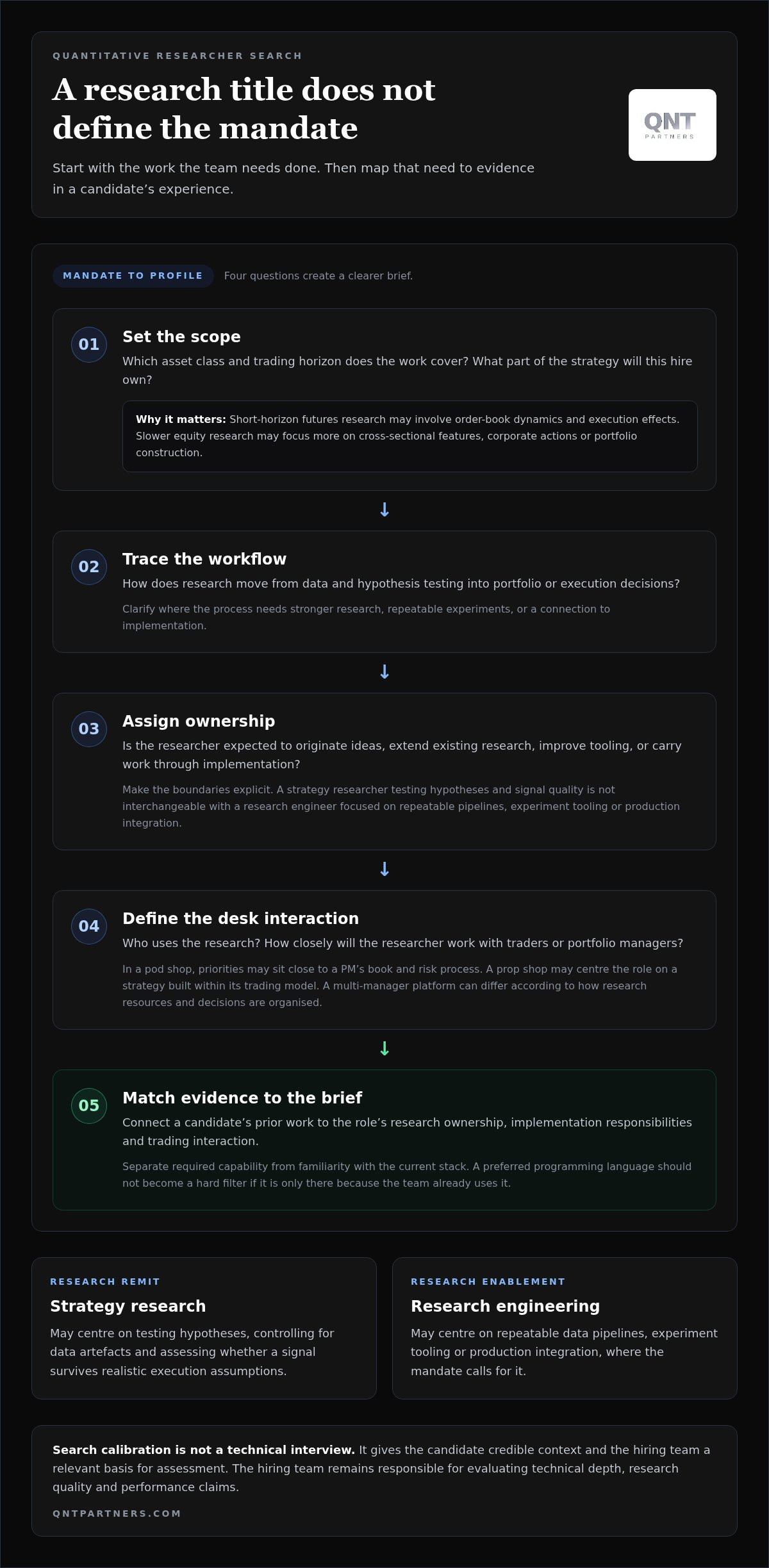
A useful search discussion gets beyond the strategy label. The detail that matters is how research is done and where the new hire is expected to take ownership. I’d clarify:
- Scope: Which asset class and trading horizon does the work cover, and what part of the strategy is in scope for this hire?
- Workflow: How does research move from data and hypothesis testing into portfolio or execution decisions?
- Ownership: Is the researcher expected to originate ideas, extend existing research, improve tooling or carry work through implementation?
- Desk interaction: Who uses the research, and how closely does the researcher work with traders or portfolio managers?
Those answers separate requirements from preferences. If the role needs someone who can work directly with production code, that belongs in the core profile. If a particular language is preferred only because it appears in the current stack, making it a hard filter may exclude candidates who can do the work. The brief should distinguish capability from familiarity with one team’s tools.
Signals that a candidate profile is properly calibrated
A calibrated profile connects prior work to the responsibilities on offer. A candidate who developed signals but handed implementation to another team may fit a research-led mandate, but not one where the researcher must own production integration. Someone who has worked closely with a trading desk may bring relevant experience when research decisions depend on execution feedback. Establish what the candidate personally owned rather than inferring it from a title or employer.
Technical requirements should follow the same logic. C++ may matter where research code must meet production or latency constraints. FPGA experience, co-location or exchange connectivity belongs in the brief only when the role touches those systems. Otherwise, these terms add noise and risk drawing profiles for adjacent engineering work instead of the research remit.
Sharpe ratios and other performance claims are context for the firm’s assessment, not proof a search partner can certify. I can clarify what a candidate says they researched and how that work relates to the mandate. The hiring team must test the research, attribution and implementation details. That boundary keeps the search credible with both sides. Our quant hiring discussions start with it, so candidate conversations reflect the work rather than a list of fashionable technical terms.
Can a quantitative researcher headhunter understand the work?
Recognising terms such as stat arb, market microstructure or feature engineering doesn’t prove someone understands your mandate. I’d judge a search partner by whether they can describe what the hire will do, how the role fits the team and which parts of a candidate’s experience are relevant. That’s a more useful test of quantitative researcher headhunters than a fluent conversation full of technical vocabulary.
Search expertise and technical assessment are different jobs. A headhunter should make the role and candidate fit legible; the investment team decides whether the research stands up. A recruiter can clarify the brief and test whether a candidate’s account of their work is relevant. They shouldn’t claim to validate alpha, reproduce analysis or judge whether performance will persist.
What specialist search can clarify
A focused search translates the hiring team’s priorities into a profile candidates can recognise. Describe the mandate in terms of ownership and working relationships, rather than copying a list of tools into an advert. A researcher may have built signals, maintained research tooling or partnered closely with traders. Those backgrounds can be relevant in different ways, but they aren’t interchangeable.
Adjacent experience needs a precise explanation. Someone from a slower systematic strategy may have transferable skills for a different horizon, but the connection should be explicit. Perhaps the role needs strength in experimental design while another part of the team covers execution. That’s a reason to explore a candidate’s experience, not to assume one strategy background proves competence in another.
Discreet outreach also depends on accuracy. Candidates should hear a credible account of the team, the research remit and what the role does not own. If the position is still being shaped, describe that plainly rather than overstating the mandate. That protects the firm’s reputation and lets candidates decide whether a serious conversation makes sense.
What remains with the investment team
The firm owns strategy validation and investment decisions. Its researchers and PMs are best placed to examine a candidate’s methods, assumptions, data choices and treatment of costs or execution constraints. A headhunter can surface relevant experience and organise a useful conversation, but the technical interview is the firm’s assessment.
Performance claims need the same boundary. A candidate’s reported Sharpe or P&L contribution can help the team frame follow-up questions, but it doesn’t establish attribution or prove the result will repeat. The investment team must assess the evidence in context, including what the candidate personally owned and how the work was deployed.
I think credible search is visible in the hand-off. The hiring team should receive a candidate profile tied to the mandate, with a clear account of relevant experience and any meaningful gap. The candidate should understand the role without being promised a particular outcome. That division keeps the search useful and the final judgement with the people responsible for the strategy.
How a focused search moves from mandate to candidate conversation
A search loses time when outreach starts before the hiring team has agreed what the person will own. I keep the sequence simple: define the mandate, calibrate the profile, then engage relevant candidates. Each step should reduce ambiguity, not add another layer of keywords to a job description.
- Define the mandate. Set out the strategy context, why the hire is needed and how the work sits within the team. A pod building around an existing book may need a different contribution from a prop shop forming a new research group.
- Calibrate the profile. Convert that context into responsibilities, seniority, essential experience and technical requirements that follow from the work. Keep research ownership distinct from engineering scope.
- Engage relevant candidates. Explain the opportunity in terms of its actual remit and operating structure, sharing sensitive detail progressively and discreetly.
Calibrate the role before outreach
The brief needs to identify who sets priorities, where implementation sits and how the researcher interacts with traders or PMs. A candidate expected to develop research and take it into production has a different remit from one working alongside a dedicated engineering team. If the work crosses into low-latency engineering, specify the systems responsibility rather than treating every researcher as an infrastructure hire. For searches that include those engineering requirements, we draw on our quant and technology recruitment work.
Seniority should describe scope, not just years in the industry. Is the hire expected to execute a defined research programme, shape its direction or establish a capability within a new team? The answer affects the candidate profile and the level of autonomy to communicate.
Confidentiality matters early. A spinout or team build-out may involve details that shouldn’t appear in a first approach. I share enough to establish the strategy type, remit and broad structure, then bring in further context as the conversation warrants. That lets a candidate assess relevance without exposing information prematurely.
Make candidate conversations specific
Strong outreach gives a candidate something concrete to evaluate: the research problem, the team’s operating model and how the role connects to trading and implementation. If compensation includes a P&L split, an SMA structure or an equity partnership, describe the relevant model accurately and only when the firm is ready to discuss it. Avoid generic claims that a package is “competitive” or that an outcome is assured.
Timing also belongs in the mandate. Garden leave or a non-compete may affect when a candidate can move, but those details are context for planning a search, not a basis for legal advice. I don’t assume a standard duration or make promises about a start date. Clarifying timing constraints with the candidate and hiring team helps set realistic expectations before interviews progress.
For a search brief grounded in the role, strategy and team structure, discuss your quant hiring mandate with us. A precise first conversation gives outreach a credible starting point and reduces the risk of approaching researchers for work they would never own.
QNT Partners’ approach to quantitative researcher search
A quantitative research search is strongest when the hiring team can describe the work behind the title. I’m James, co-founder of QNT Partners. We’re a boutique search and advisory firm focused on quantitative trading, research and technology, working with HFT firms and hedge funds on specialist hiring mandates.
We begin with the search brief, not a fixed template. A researcher joining an established team may have a defined remit, while a hire for a new build-out may need to help shape how research fits with the wider operation. That difference changes how we frame the opportunity and which experience is relevant.
A specialist remit across quant and HFT
Our search work covers quantitative researchers, traders and technical talent. These roles can sit close together, particularly in smaller teams, but the hiring need still has to be defined precisely. A researcher developing signals for a PM has a different remit from a trader responsible for day-to-day strategy decisions. A technical hire working on execution systems has a different assessment path again.
We use the team context to explain the position accurately, rather than relying on a broad quant title. Our quant and technology search work centres on the mandate and the responsibilities the new hire will take on.
Build-outs and spinouts can involve shifting boundaries between research, trading and engineering. We shape the search discussion around the capability the team needs to add and how that work will sit alongside existing responsibilities.
Start with the search mandate
A useful first discussion can be direct. Outline the role, the strategy it supports and how the team is organised. Explain what the hire should own and where the role connects with trading or engineering.
From there, we shape the search around the profile the team needs and represent the opportunity accurately to relevant candidates. The goal is a focused, discreet conversation based on the actual remit.
If you’re building a team or replacing a key research capability, discuss a quantitative research search with us. Bring the mandate and team context, and we can start with the role you need to fill.
Set the mandate before the search starts
Before opening a search, write one sentence describing the decision this hire should help the team make or the research bottleneck they should address. Use it as a practical test for every part of the brief: does this requirement help identify someone who can do that work, or is it simply familiar from another role?
That sentence can keep the search aligned as the team learns from candidate conversations. If the remit shifts, update the profile before widening the field. A clear mandate gives researchers a credible reason to engage and gives interviewers a consistent basis for assessing fit.
For quantitative researcher headhunters, technical fluency shows up in the quality of that alignment, from the first brief through to the candidate conversation. I’m James, co-founder of QNT Partners. I’d be glad to discuss the shape of a specific search with you.
Discuss your quantitative research search with QNT Partners. Bring the mandate and team context, and we’ll focus the search on the work the hire needs to own.
Frequently Asked Questions
What does a quantitative researcher headhunter do?
A quantitative researcher headhunter manages the search’s market-facing work and keeps candidate discussions aligned with the hiring team’s process. After early interviews, for example, they can organise feedback around recurring gaps in experience or mismatches in role expectations. That gives the team a clearer basis for refining its candidate criteria, rather than restarting the search whenever one interview produces a different impression.
How can I tell whether a quant recruiter understands the role?
Look at the quality of the market feedback they bring back. Useful feedback identifies patterns, such as candidates consistently interpreting the role as more execution-focused than the hiring team intended. It should give you something specific to act on, not merely report that candidates are interested or unavailable. A recruiter who can explain those patterns helps the team see where its description or expectations need clarifying.
Can a quantitative researcher headhunter recruit for HFT firms?
Yes. An HFT firm can use specialist search for hires across an expanding desk or a new strategy build-out. If a team is hiring both a researcher and a systems engineer, each search should have its own candidate profile and interview path, even if both hires support the same trading effort. That keeps the roles distinct while allowing the firm to coordinate hiring around one team need.
How is a quantitative researcher different from a quant developer?
The distinction depends on the work the team needs done, so interview design should reflect it. A research candidate might present how they framed and tested a hypothesis; a developer candidate might reason through a software design problem. Those exercises provide different evidence. Agreeing on what each interview should test helps the panel compare candidates against the right criteria instead of relying on a shared title.
When should a hedge fund use a specialist quant headhunter?
A specialist can be useful when a fund’s internal team lacks the time or reach to build a focused candidate map alongside its day-to-day work. This is especially relevant when a search spans a narrow research area and adjacent backgrounds need careful consideration. Agreeing on what makes a candidate worth an initial conversation helps the fund use its interview time on profiles with a clear reason to be in scope.
Can a headhunter help with a discreet search?
Yes. Before outreach begins, the hiring team can agree what information may be shared at each stage and who is authorised to receive candidate details. A practical safeguard is to obtain a candidate’s permission before circulating an identifiable profile internally. These steps limit unnecessary disclosure while allowing a serious conversation to progress, particularly if the role or team change isn’t yet public.
How does QNT Partners approach quantitative researcher recruitment?
QNT Partners treats the search as a working discussion with the hiring team, including how interview feedback will refine the profile. We help keep that feedback specific to the agreed criteria, so adjustments reflect evidence from the process rather than shifting preferences. Hiring leaders can make the process more useful by deciding in advance who will assess each part of a candidate’s experience and how the panel will share its findings.