Quantitative Research Talent Acquisition: Hiring for the Research Lifecycle

A strong backtest doesn’t make someone a fit for every live desk. Quantitative research talent acquisition works best when the search starts with the research mandate, not a generic list of modelling credentials.
A researcher may be expected to originate signals, build production-ready code, work alongside traders or own parts of the research stack. Those responsibilities vary by strategy and structure, whether the seat is in a pod shop, a prop shop or a systematic fund. Academic depth matters, but so does evidence that a candidate’s work can hold up against live data, execution constraints and the desk’s decision process.
I’m James, co-founder of QNT Partners. I’ll set out how to define the mandate, assess research quality and production relevance, and run a discreet search around the desk’s structure. I’ll also cover how to distinguish research, trading and engineering expectations, and account for practical constraints such as confidentiality, garden leave and competing offers. The goal is a hire whose capabilities match the work the desk needs done.
Key Takeaways
- Set the research mandate against the strategy, instruments and horizon before writing the role specification.
- Define how the researcher will work with traders and engineers, accounting for differences between prop shops, pod shops and multi-manager teams.
- Assess research quality through the candidate’s problem formulation, data choices and validation discipline, not credentials or headline backtest results alone.
- Make quantitative research talent acquisition more precise by calibrating the mandate before mapping and approaching relevant profiles.
- Protect confidentiality from the first conversation, particularly during a build-out, spinout or unannounced strategy expansion.
Start quantitative research hiring with the desk’s mandate
Research hiring misses the mark when the mandate is reduced to a generic job description. “Build models and identify trading opportunities” says little about what the new hire will own, how their work should affect decisions or what must happen before an idea reaches the desk.
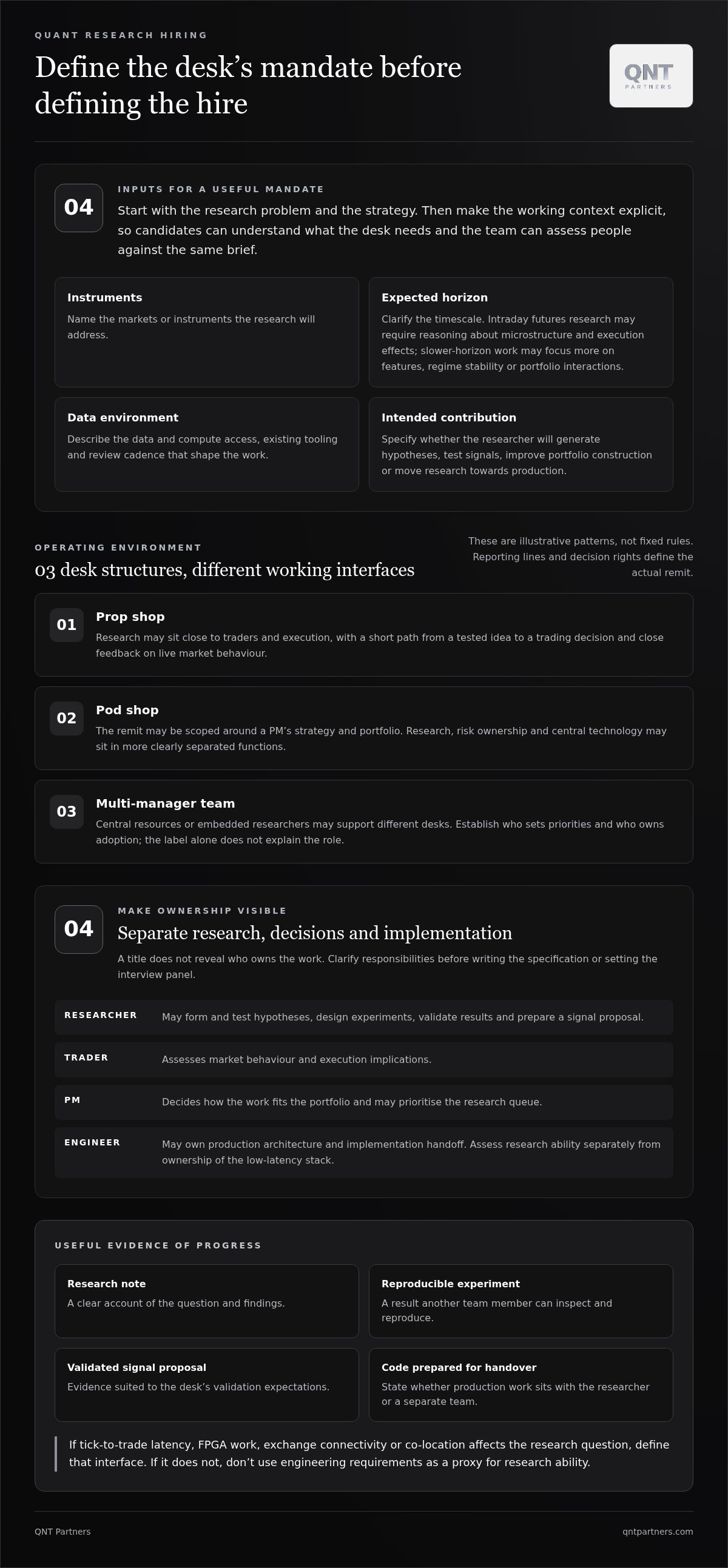
Start with the strategy and the research problem. Specify the instruments, expected horizon, data environment and intended contribution: generating hypotheses, testing signals, improving portfolio construction or taking a research process towards production. Those details make quantitative research talent acquisition more precise. Candidates get a concrete picture of the work, and the hiring team gets a consistent basis for assessing fit.
Write a mandate around the research problem
Describe the question the researcher will investigate and how it connects to the firm’s systematic approach. The mandate might centre on testing whether a signal survives changes in market regime, or improving an existing model for a particular set of instruments. Distinguish exploratory research, where a well-supported negative result can be useful, from work expected to pass validation and enter production.
Set expectations for outputs and collaboration
Define useful progress: a research note, reproducible experiment, validated signal proposal or code prepared for handover. Be clear about decision ownership. Researchers may form and test hypotheses, traders assess market behaviour and execution implications, PMs decide how the work fits the portfolio, and engineers handle production architecture. The boundaries vary, but leaving them implicit invites mismatched expectations.
Include working constraints in the initial brief. Note data and compute access, review cadence, existing tooling, and dependencies on engineering or trading capacity. If the researcher is expected to move from Python research into production code, say so. If deployment sits with a separate team, describe the handoff. Candidates can then judge the role against the actual work, rather than infer its scope from a title. For an overview of the field’s methods and applications, see Understanding Quantitative Research.
Set the role inside the desk’s structure
A Chicago prop shop may expect research to sit close to traders and execution, with a short path from a tested idea to a trading decision. In a pod shop, research may be scoped around a PM’s strategy and portfolio, with clearer separation between research, risk ownership and central technology. Neither structure is inherently better. The important question is where this role has influence and where it hands work on.
Reporting lines and decision rights determine the real remit. Establish who prioritises the research queue, who signs off on a signal’s use and who resolves conflicts between research quality and near-term desk needs. A candidate reporting to a PM may have different priorities from someone in a central research group, even if both job descriptions use the same title. Let that distinction shape the search brief and interview panel. A useful hiring framework connects role scope to the desk’s trading model, rather than treating recruitment as vacancy discovery.
Shape the quantitative researcher role around its operating environment
A researcher’s title tells you little about the work. The same signal-research remit could mean testing slower-moving futures strategies in a central team, or investigating short-horizon behaviour alongside traders in a prop shop. For quantitative research talent acquisition, define the operating environment before deciding which skills are essential.
Strategy horizon and instruments set the technical context. A researcher working on intraday futures may need to reason about market microstructure and execution effects. A slower-horizon role may place more weight on feature design, regime stability or portfolio interactions. Include production constraints when they change the research itself. Tick-to-trade latency matters to a microstructure hypothesis; it may be peripheral to a signal measured in days.
Compare the role across desk structures
These are illustrative patterns, not fixed rules. A Chicago prop shop may place research close to trading decisions, with rapid feedback on live market behaviour. A pod shop may scope research around a PM’s strategy, with a defined portfolio and separate risk or technology functions. A multi-manager platform can include either model, so reporting lines and decision rights matter more than the label.
- Prop shop: Research may sit near trading decisions, with close feedback on how a signal behaves in execution.
- Pod shop: The remit may be tied to a PM’s book, with priorities shaped by that strategy’s portfolio needs.
- Multi-manager team: Central resources or embedded researchers may support different desks, so clarify who sets priorities and owns adoption.
Separate research ownership from implementation
State whether the hire owns hypothesis formation, experimental design, validation or a handoff into production. A researcher should be able to work with software engineers on reproducibility, data contracts and implementation implications without being assessed as though they own the low-latency stack. If FPGA work, exchange connectivity or co-location constraints affect the research question, include that interface. If they do not, don’t use engineering requirements as a proxy for research ability.
Research outputs need context. A credible result may be a carefully rejected hypothesis, not a production signal. The National Academies Press discusses the challenge of evaluating research beyond simple metrics in Assessing Research Program Quality. Apply the same discipline to hiring: assess the reasoning and evidence behind the work, not only its final performance statistic.
Account for incentives and team design
P&L splits or an equity partnership can affect how a firm expects researchers to contribute and how it recognises outcomes. There is no standard model across firms, and a researcher’s remit should not be inferred from a PM’s economics. Set out the reporting line, review process and route from research result to portfolio decision. A clear quantitative trading team design framework can help connect those choices to the desk’s structure.
For a narrow mandate or discreet team build-out, a specialist search partner can translate the operating model into a technically specific candidate brief.
Assess research quality beyond credentials and backtests
A strong academic record can show technical depth, and a polished backtest can show an interesting result. Neither tells you on its own whether a researcher made sound choices about the question, data or validation. In quantitative research talent acquisition, assess the reasoning behind the result, not just the result presented.
Research quality is the disciplined use of sound methods, relevant evidence and clear judgement to test a hypothesis and understand its limits.
Test how candidates reason about research
Ask candidates to explain a research decision without requesting code, datasets or documents from a previous employer. They can use a public example, a hypothetical problem or a sanitised description of their process. Keep the discussion anchored to choices they personally made, rather than letting a polished project summary stand in for technical depth.
Probe how they selected the data and checked for leakage, survivorship bias or timestamp errors. Ask why they chose a particular validation design, then explore how they would respond if results weakened across regimes or instruments. A useful question is, “What evidence would make you reject this hypothesis?” Strong reasoning includes a credible path to being wrong, not just a persuasive account of why a signal worked.
Listen for precision. Can the candidate explain which assumptions mattered, what changed during testing and where interpretation begins? They should separate a finding from a conjecture and identify what the available evidence cannot establish. I put more weight on that clarity than on a candidate’s ability to defend every result as a success.
Connect research evidence to live constraints
A backtest only means something in relation to how it was constructed. Ask about the universe, sample period, transaction-cost assumptions, rebalance logic and out-of-sample design. A high Sharpe ratio without those details is context-free evidence. The goal isn’t to impose one testing recipe across every strategy, but to see whether the candidate can explain why the method fits the question and where it may fail.
Bring in production constraints when they affect the mandate. For a short-horizon strategy, discuss capacity, execution assumptions and whether tick-to-trade latency could change the result. For a slower signal, those details may have little bearing on research quality. FPGA design or exchange connectivity belongs in the assessment only if the researcher will work directly on problems shaped by those systems.
Use the same assessment dimensions for each candidate while allowing for different research styles. Record the evidence behind each judgement: how the candidate framed the problem, defended data choices, tested failure modes and explained the result. That makes comparisons more useful than relying on prestige, confidence or a headline metric. A backtest can start the discussion; the candidate’s reasoning should determine where it goes.
Run a discreet search without losing technical precision
Confidentiality and technical precision belong in the same search process. In quantitative research talent acquisition, vague outreach can expose a build-out while attracting candidates who match a title but not the mandate. Agree what the team can disclose before the first conversation.
Calibrate the search before approaching candidates
Align the hiring team on the evidence that matters. Separate essential experience from adjacent profiles worth considering, then decide who owns technical assessment and who makes the final decision. If a researcher, PM and engineering lead expect different things from the hire, resolve that before the role reaches the market.
Set disclosure boundaries by stage. Early outreach might describe the strategy type, instruments and broad remit without naming the firm or revealing a signal, launch plan or client relationship. Share more detail only when the candidate’s fit and interest justify it. For a spinout or unannounced expansion, keep identifying information out of role summaries and interview materials that could circulate beyond the intended group.
Keep assessment and communication disciplined
A focused search can follow five steps:
- Calibrate: Agree the mandate, essential evidence and decision ownership.
- Map: Identify researchers whose methods and experience connect to the mandate, including relevant adjacent profiles.
- Engage: Approach candidates discreetly, sharing information in stages.
- Assess: Apply consistent technical criteria while allowing for different career paths and research styles.
- Align: Bring the hiring team together on evidence, expectations and next steps.
Consistency doesn’t mean asking every candidate to present the same career history. One researcher may have taken a signal from initial hypothesis through validation; another may have contributed a specific modelling method within a larger team. Assess each against the same core criteria, then record what they personally owned and how clearly they explain their decisions.
Keep feedback moving between researchers, PMs and hiring decision-makers. After each technical discussion, capture the evidence observed, open questions and who will resolve them. This avoids making candidates repeat the same assessment for different interviewers and gives the team a shared basis for comparison.
Discuss timing early, but treat it as individual. Garden leave, notice periods and non-competes can affect availability or the sequence of a move. Terms and circumstances vary, so don’t turn a general assumption into a legal conclusion. Where interpretation matters, the candidate and employer should rely on appropriate legal advice.
We run specialist searches with this balance in mind: technical calibration, controlled disclosure and clear feedback at each stage. If you’re planning a build-out or filling a defined research seat, discuss a research search with us before the mandate is circulated.
Make specialist search part of a durable research capability
A specialist search adds value when the role sits outside the reach of a desk’s immediate network, or when the mandate is too specific for broad sourcing to interpret accurately. That often applies during a discreet build-out, spinout or unannounced strategy expansion. The aim is to reach relevant researchers without diluting the technical brief or exposing sensitive plans.
Choose the right moment for specialist support
Internal referrals can work well when the team knows the profile it needs and can reach people with relevant experience. Generalist sourcing is less effective when the distinction between adjacent profiles matters, such as a researcher who has tested signals for a particular horizon versus a quant developer whose strength is implementation. The titles may look similar. The evidence of fit is different.
Specialist market knowledge helps sharpen that distinction before candidate conversations begin. It gives the hiring team a clearer view of which experience is directly relevant, where adjacent backgrounds could transfer and which questions will test the mandate. At QNT Partners, we focus on quantitative trading, research and technology hiring across HFT and hedge fund environments. That technical focus informs how we frame research roles and speak with candidates, while keeping confidential searches appropriately discreet.
Search support is most useful when it improves the brief and the relevance of conversations, not when it simply increases the volume of profiles. A narrow mandate may produce a small pool of plausible candidates. The response should be careful calibration, not lowering the bar or widening the brief until it no longer reflects the desk’s needs.
Turn the hire into a team-level decision
Before opening the search, revisit where the researcher will sit and how their work will connect with the rest of the team. Confirm who sets research priorities, who reviews findings and where responsibility passes to trading, portfolio management or engineering. These decisions shape the day-to-day remit and reduce the risk of hiring someone to solve a problem the team hasn’t agreed how to own.
Think about the capability the team needs beyond the immediate vacancy. A new researcher might extend a strategy into another instrument set, add capacity for validation or complement the group’s methods. That doesn’t mean hiring for an abstract future state. Check that the role strengthens the research process the firm intends to build, rather than creating an isolated seat with unclear interfaces.
I’d make the next step concrete: write down the research mandate, expected contribution and team decision structure before opening the search. That gives candidates a credible account of the work and the hiring group a shared basis for assessing fit. If you’re defining a specialist research role, discuss your research hiring mandate with us.
Set the mandate before the next hire
The next research hire can shape how a strategy develops, how evidence moves into production and where the desk builds capability. Treat quantitative research talent acquisition as a decision about the team’s operating model, not simply a vacancy to fill.
I’ve found the most useful starting point is a written mandate the hiring team can stand behind: the problem the researcher will own, the decisions they can influence and the interfaces they’ll need to work through. That clarity gives candidates a straight account of the role and helps the team assess fit against the work ahead.
At QNT Partners, we bring an operator’s perspective to specialist searches across quantitative trading, research and technology. The firm was founded by former industry operators, which informs how we engage with technically specific roles and the desks hiring for them.
If you’re preparing a research build-out or refining a role before it goes to market, discuss your quantitative research hiring mandate with us. Put the mandate in writing before the search opens, so every candidate conversation tests the same role.
Frequently Asked Questions
How long does a quantitative research search usually take?
There’s no dependable fixed duration. Timing depends on how clearly the role is defined, candidate availability and how quickly the hiring team makes decisions. In quantitative research talent acquisition, delays often arise when interviewers disagree about the remit or feedback sits with several stakeholders. Before outreach, agree the interview stages, decision owners and feedback cadence. Factor in notice periods or garden leave once relevant candidates’ circumstances are known.
Can a quantitative researcher move from academia into a trading firm?
Yes. Academic researchers can bring strong foundations in mathematical modelling, experimental design and statistical inference. The transition depends on how well they apply those skills to the firm’s research problems and work within its constraints. A practical assessment can use a fresh hypothetical problem rather than confidential prior work. Look for clear reasoning, sensible assumptions and an ability to explain how they would test an idea with imperfect data.
How should a firm protect confidentiality during a quant search?
Limit sensitive information to people who need it, and control what appears in search documents and communications. Use neutral calendar titles, restrict access to candidate notes and avoid putting a strategy name or client detail in email subject lines. Agree internally who can brief candidates and when. Keep confidential information from previous employers out of the process too. These operational choices reduce accidental disclosure without making candidate conversations needlessly opaque.
What should candidates be told about a role before the first interview?
Give candidates enough detail to decide whether a conversation is worthwhile: the team’s broad strategy, instruments, research remit, reporting line and interview format. Be clear about which skills are essential and what the role won’t own. If the position involves a case discussion or technical exercise, explain its format and expected preparation. Candidates should be able to assess the opportunity without being asked to share proprietary research from their current or former firm.
Can a quant research search include candidates outside hedge funds?
Yes. Relevant candidates may come from academia, proprietary trading, market data or technology teams, depending on the mandate. A researcher from a non-fund setting may have developed useful expertise in modelling or large-scale data analysis without working directly on a trading desk. Assess the transfer carefully: ask how their methods might apply to the instruments, data and decision process in this role, rather than treating sector history as a substitute for evidence.
How do garden leave and non-competes affect a potential move?
They can affect a candidate’s start date or the work they can take on, but the impact depends on the individual’s agreement and circumstances. Treat timing as something to clarify with the candidate, not as a legal conclusion based on a job title or location. Don’t ask for confidential documents or interpret contractual terms during recruitment. If a restriction may affect the move, the candidate and employer should seek qualified legal advice.